
Stories
The Wallet, the Notice, and the Secret at Fort Aldridge
A young girl returns a general’s wallet and an eviction notice to Fort Aldridge, triggering a buried investigation into missing military family funds, her father’s disappearance, and a trust that may have unlawfully charged her family for years. As the truth unfolds, a hidden letter points to a mysterious Box 17 and a possible clue that Ruby’s father may still be alive.

Part 2
The command struck the lobby like thunder.
For one breath, nobody moved. The receptionist’s hand hovered above the phone. The two military police officers stopped mid-step. Even the clicking sound of shoes across the polished floor disappeared, swallowed by the sudden silence.
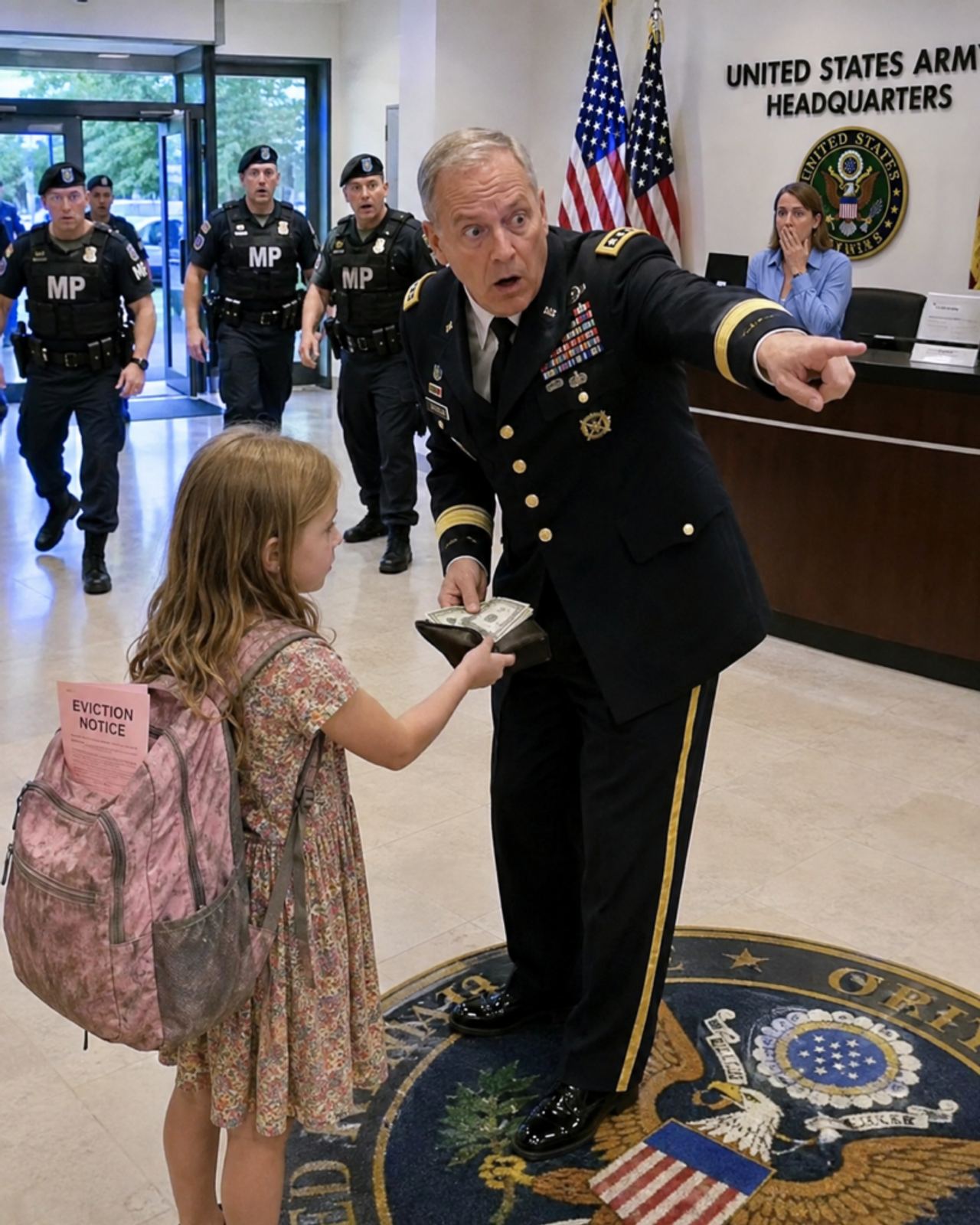
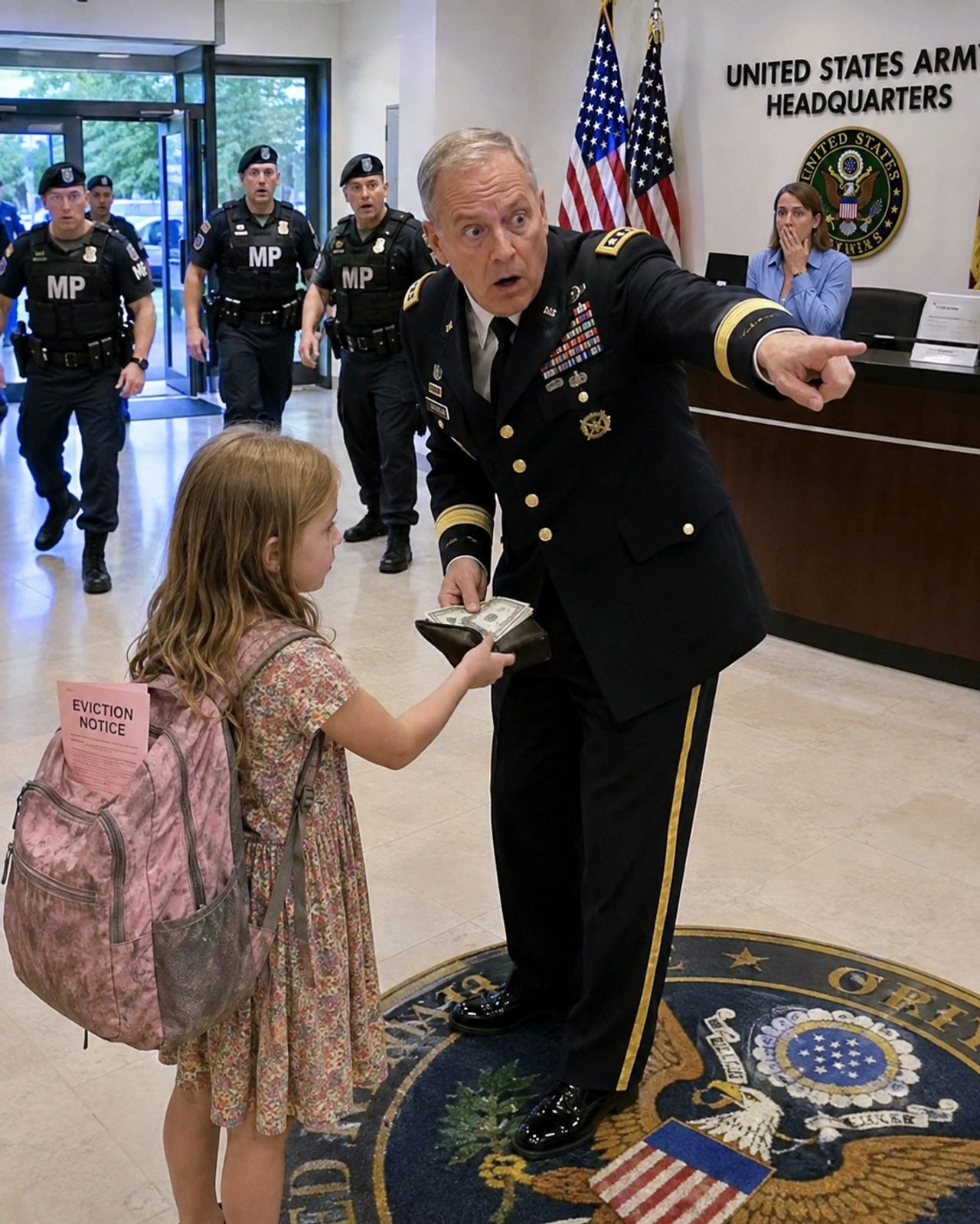
I stood in the center of it all, small and dusty and hungry, with General Nathaniel Graves’s wallet pressed against my chest.
I thought I had done something wrong.
I thought maybe returning a wallet to a place like that was somehow against the rules. Maybe I had touched something I wasn’t supposed to touch. Maybe the money inside was part of something important, and now I had made a terrible mistake.
The General’s eyes were still fixed on the pink paper sticking out of my backpack.
“Sir?” one of the officers asked carefully.
General Graves did not answer him at first. His face had turned pale in a way that made him look older than he had a moment before. Not weak, exactly. Just shaken. Like he had opened a door in his mind and found something waiting there that should have been long gone.
Then he looked at me.
“What is your name?” he asked.
His voice was softer now, but that only frightened me more.
“Ruby,” I whispered.
“Ruby what?”
I swallowed. “Ruby Hart.”
The silence changed.
I did not know silence could do that, but it did. It became heavier, deeper. The receptionist looked from me to the General. One of the officers shifted his weight. Somewhere behind me, a printer hummed and stopped.
General Graves took one careful step closer.
“Who is your mother, Ruby?”
“Mara Hart,” I said. “She works at the laundry on Finch Street. And sometimes at the diner.”
His expression tightened at her name.
He held out his hand, not toward the wallet, but toward the notice. “May I see that paper?”
I hesitated. My mother had folded the eviction notice twice before slipping it into my backpack that morning because she did not want me to lose it. She had said she needed to take it to the community office after work, to ask if anyone knew about emergency housing.
It was our proof that everything was falling apart.
The General noticed my hesitation and lowered his hand.
“You are not in trouble,” he said.
I wanted to believe him. But doors were being locked behind me, and soldiers were standing as if they had been carved from stone.
“I promise,” he added.
So I set the wallet carefully on the front desk, unzipped my backpack, and pulled out the pink paper.
It was wrinkled from being carried all day. One corner had torn where my math workbook had pressed against it. Across the top, in big letters, it said FINAL NOTICE.
General Graves took it like it was made of glass.
His eyes moved over the page. The address. The landlord’s name. The case number printed along the side. Then his gaze stopped at a line near the bottom, where someone had stamped a small square seal in purple ink.
He touched that seal with one finger.
“Where is your mother right now?”
“At work,” I said. “She doesn’t know I came here.”
The receptionist made a small sound, as if she disapproved of that, but the General did not look away from me.
“You came alone?”
I nodded.
“With my wallet.”
“Yes, sir.”
“And all the money was still inside?”
I looked down. “Yes, sir.”
His eyes softened, but only for a second. Then the worry returned.
“Captain Vale,” he said.
A woman in a dark blue uniform stepped forward from near the corridor. She had kind eyes and a notebook tucked beneath one arm.
“Yes, General.”
“Find Major Ellison. Tell him I need the sealed archive from the Mercer file. Right now. And contact Legal Assistance. Quietly.”
The captain’s eyebrows lifted. “Sir, the Mercer file?”
“Yes.”
She glanced at me, then back at him. “Understood.”
She turned and left quickly.
The name meant nothing to me. Mercer. It sounded like a street, or a doctor, or someone grown-ups mentioned when children were not supposed to listen.
General Graves folded the notice once and handed it back to me.
“Ruby,” he said, “I need you to come with me for a few minutes.”
My stomach twisted.
“Do I have to?”
“No,” he said at once. “You do not have to do anything you do not want to do. But there are things about this notice that may help your mother. I would like to understand them before you leave.”
Help my mother.
Those three words reached deeper than fear.
So I followed him.
He did not take me through the grand hallway where portraits of officers hung in gold frames. Instead, he led me into a smaller conference room with a round table, a window overlooking the base garden, and a pitcher of water sitting beside clean glasses.
The room smelled like lemon polish and paper.
General Graves did not sit at the head of the table. He pulled out a chair for me and sat across from me like he was visiting a neighbor, not commanding a building full of soldiers.
“Are you hungry?” he asked.
I shook my head too fast.
He looked at me for a long moment.
Then he pressed a button on the wall phone. “Please bring a sandwich, fruit, and milk to Conference Room B. Also call Ms. Mara Hart at Finch Street Laundry. Tell her her daughter is safe at Fort Aldridge and ask her to come here as soon as possible.”
My heart jumped. “She’s going to be mad.”
“She may be scared first,” he said gently.
That made my throat sting, because he was right.
A few minutes later, a young soldier brought in a tray with a turkey sandwich cut in half, an apple, and a carton of milk. I tried to eat slowly, but my hands betrayed me. I took big bites and hoped nobody noticed.
General Graves noticed. He pretended not to.
He placed his wallet on the table between us.
“You did something honorable today,” he said. “Most adults would have struggled with that decision.”
I looked at the wallet. “We needed the money.”
“I know.”
The way he said it made me look up.
He did know. Not in the polite way grown-ups said things when they were trying to comfort a child. He looked like he understood what it meant to count coins for bus fare, to pretend a growling stomach was not loud, to watch your mother become smaller under the weight of bills.
“I almost kept it,” I admitted.
“But you didn’t.”
“My mom says doing right matters most when nobody’s watching.”
“She sounds wise.”
“She cries in the bathroom,” I said before I could stop myself.
The General looked down at his hands.
For a moment, he seemed unable to speak.
Then Captain Vale returned, carrying a thin gray folder and followed by an older man with silver hair and reading glasses hanging around his neck.
“General,” she said, placing the folder on the table.
The older man looked at me with surprise, then kindness. “I’m Major Ellison,” he said. “I help people with legal trouble sometimes.”
“Are we in legal trouble?” I asked.
“No,” he answered. “But someone may have made legal trouble for your family.”
General Graves opened the folder.
Inside were old documents, yellowed at the edges. There were photographs, typed reports, and a copy of a newspaper article with a headline I could not read from my side of the table.
The General lifted one photograph and stared at it.
His jaw tightened.
Then he turned it around.
“Do you know this man?”
The photograph showed a young soldier with dark curly hair and a crooked smile. He was standing beneath a tree, holding a baby wrapped in a yellow blanket. Beside him stood a woman I recognized immediately, though she looked younger and less tired.
My mother.
I nearly knocked over the milk.
“That’s Mom,” I whispered.
“And the man?”
I stared at his face.
I had seen that face before, but not in a photograph. I had seen pieces of it in my own mirror. The curve of the eyebrows. The shape of the mouth. The same dimple that appeared in my left cheek when I smiled.
“My dad?” I asked.
General Graves closed his eyes briefly.
“Yes,” he said. “Sergeant Daniel Hart.”
The name made the room tilt.
My mother had told me my father was gone. Not much else. When I asked too many questions, she would say, “He loved us, Ruby. That part is true.” Then she would become quiet for the rest of the evening.
“Is he dead?” I asked.
Major Ellison took off his glasses.
General Graves looked at him, then back at me.
“He was reported missing twelve years ago,” the General said.
I frowned. “But I’m eight.”
“I know.”
That answer made no sense, and somehow it made too much sense.
Captain Vale pulled a chair closer but did not sit. Her face had changed since the lobby. She looked less like an officer following orders and more like a person hearing a story she wished were not true.
“Twelve years ago,” General Graves said, “your father was assigned to a unit connected to Fort Aldridge. He discovered something troubling. Money meant to support military families after emergencies had been moved through false accounts.”
“Stolen?” I asked.
The adults exchanged glances.
“Yes,” Major Ellison said. “Stolen.”
I thought of the nine hundred dollars in the wallet and felt my face burn, even though I had returned it.
“My dad stole it?”
“No,” General Graves said sharply, then gentler, “No, Ruby. He tried to stop it.”
The knot in my chest loosened only a little.
“He brought documents to someone he trusted,” the General continued. “A civilian records clerk named Evelyn Mercer. She was going to help him file a protected report. But before that could happen, the records disappeared. Your father disappeared. And Evelyn Mercer left her job without notice.”
“People said she ran,” Major Ellison added quietly. “Some said Daniel Hart ran with her. The case was never properly resolved.”
“My mom doesn’t talk about him,” I said.
“She may not have known what to believe,” General Graves said. “A lot of people were told a lot of things.”
I looked at the photo again.
My father’s smile seemed too alive to belong to someone buried in old paper.
“What does that have to do with our eviction notice?”
General Graves picked up the pink paper again and pointed to the purple seal.
“This stamp belongs to an old property trust that used to manage emergency housing connected to Fort Aldridge. It should have been dissolved years ago.”
Major Ellison leaned forward. “Your apartment building is owned by a company that should not exist anymore.”
That seemed impossible. Buildings were not ghosts. Rent notices were not secrets. They were painfully real. They came in envelopes and made my mother sit at the kitchen table with her hands over her face.
“The name printed here,” the Major continued, tapping the bottom of the page, “is Aldridge Family Housing Trust. That trust was part of the missing file from twelve years ago.”
Captain Vale drew in a slow breath. “And Ruby’s address is listed in the Mercer file.”
The General looked at her.
She opened the folder to a page covered in typed lines and old signatures. “Apartment 3B, Aldridge Arms. Reserved dependent placement. Daniel Hart, Mara Hart, infant daughter.”
Infant daughter.
I looked at them, confused. “But we pay rent.”
Major Ellison’s face grew troubled. “You should not have been paying rent there at all.”
I did not understand at first.
Then, slowly, the words settled.
Not paying rent.
Years of my mother working until her fingers cracked. Years of overdue notices. Years of choosing between groceries and electricity. Years of whispered phone calls and apologies to landlords who spoke to her like she was always one mistake away from vanishing.
“She didn’t know,” I said.
“No,” General Graves replied. “I don’t think she did.”
I pushed the sandwich away.
Suddenly I was not hungry.
“Why would someone do that?”
Nobody answered right away.
Outside the window, a flag moved in the wind. The garden looked peaceful, full of sunlight and trimmed hedges, like nothing ugly could survive there.
But ugly things did survive. They hid in files. They hid in stamps. They hid behind doors people forgot to open.
The conference room phone rang.
Captain Vale answered it, listened, then covered the receiver.
“Ms. Hart is here.”
My heart began to pound again.
General Graves stood. “Bring her in.”
When my mother entered the room, she was still wearing her blue laundry smock. Her hair had escaped its bun, and there was a pale streak of detergent powder across one sleeve. Her eyes found me instantly.
“Ruby.”
I jumped from the chair and ran into her arms.
She held me so tightly I could barely breathe. “What were you thinking? Coming across town alone? Do you know what could have happened?”
“I’m sorry,” I said into her smock.
Her hands moved over my shoulders, my face, my hair, checking that I was real and whole.
Then she noticed the General.
Her body went still.
“Mara,” he said.
My mother’s face changed in a way I had never seen before. Fear passed across it, followed by anger, followed by something almost like grief.
“General Graves.”
“You remember me.”
“How could I forget?” she said.
The room became sharp around the edges.
I stepped back, looking from one to the other. “Mom?”
She kept one hand on my shoulder. “Ruby, we’re going home.”
“Ms. Hart,” Major Ellison said gently, “please wait.”
My mother looked at him. “No.”
General Graves did not move. “I found the Mercer file.”
That stopped her.
Her fingers tightened on my shoulder.
“What did you say?”
“The file was archived under a restricted administrative hold. I should have found it years ago.”
My mother’s eyes filled, but she blinked the tears back fiercely. “You should have believed him years ago.”
The words landed like a slap, though she did not raise her voice.
General Graves accepted them without defense.
“Yes,” he said. “I should have.”
I had never seen an adult look guilty in such a quiet way.
My mother’s breath trembled. “Daniel came to you first.”
“I know.”
“He trusted you.”
“I know.”
“He said you were the one person who would not look away.”
General Graves lowered his head.
For the first time, he did not look like a famous commander from television. He looked like a man who had carried one mistake for a very long time and had just been handed proof it was heavier than he remembered.
“I was told the documents were false,” he said. “I was told Daniel had financial problems and was trying to shift blame. I was preparing to question him formally when he disappeared. By then, the people responsible had already buried the evidence.”
“And you let the story bury him too,” my mother whispered.
“I did.”
No one spoke.
My mother looked at the photograph on the table. Her face crumpled for one second before she gathered herself back together.
“Where did you get that?”
“It was in the Mercer file,” Captain Vale said.
My mother touched the edge of the photo as if touching it too hard might erase him.
“That was taken the week before everything changed,” she said. “Ruby was three months old.”
Three months old.
I stared at her. “Mom, why didn’t you tell me?”
Her eyes softened when she looked at me. “Because I didn’t know how to explain a wound that never closed.”
“I thought maybe he left us.”
“No.” She crouched before me, taking both my hands. “No, Ruby. Your father loved you. He loved us. Whatever else anyone told me, I never doubted that.”
General Graves slid the eviction notice across the table. “Mara, have you been paying rent to Aldridge Family Housing Trust?”
My mother stared at the paper. “For years. The building changed managers twice, but the payment address stayed the same. Why?”
Major Ellison explained carefully.
With every sentence, my mother’s face grew paler. When he said the apartment had likely been assigned as protected family housing after my father vanished, she sank into a chair.
“So all this time,” she said, “someone has been collecting money from us on a home we were already entitled to live in.”
“It appears so,” Major Ellison said. “We need records to confirm, but this notice should not have been issued.”
My mother laughed once, but there was no humor in it. “They were going to put us out on Friday.”
“Not anymore,” General Graves said.
She looked at him sharply. “You don’t get to make promises to us.”
“No,” he said. “But I can make calls. I can reopen what should never have been closed. And I can start by making sure no one removes you from that apartment while this is investigated.”
My mother looked away.
I could see the battle inside her. Pride against exhaustion. Anger against fear. Hope against the memory of being disappointed too many times.
Major Ellison folded his hands. “Ms. Hart, you don’t have to trust anyone blindly. I can give you documents. Names. Case numbers. You may contact a civilian attorney as well. But please let us stop the eviction first.”
My mother pressed her lips together.
Then she nodded once.
“Stop the eviction,” she said. “Nothing more until I understand everything.”
General Graves looked relieved, but only slightly. “Of course.”
For the next hour, grown-ups made phone calls.
I sat beside my mother while Captain Vale brought her coffee and a plate of crackers she barely touched. Major Ellison spoke to someone from the county housing office. General Graves paced near the window, his voice low and controlled as he asked for archived signatures, property records, and names connected to the old trust.
I understood only pieces.
Court stay.
Fraud review.
Dependent housing designation.
Suspended eviction.
But each piece seemed to remove one brick from the wall pressing against my mother’s chest.
At last, Major Ellison hung up and smiled for the first time.
“The eviction is paused,” he said. “A written notice will be delivered tomorrow morning. No lockout. No removal. No penalties while the title and trust records are reviewed.”
My mother covered her mouth.
She did not cry. Not exactly.
But her shoulders shook once.
I leaned against her, and she wrapped an arm around me.
General Graves watched us with an expression I could not name.
Then Captain Vale came in carrying a second folder.
“Sir,” she said, “archives found one more item attached to the Mercer file. It was misfiled under personal effects.”
General Graves took it.
The folder was thin. Inside was a sealed envelope, brittle with age. Across the front, written in dark blue ink, were three words.
For Mara only.
My mother stood so quickly her chair scraped the floor.
“That’s Daniel’s handwriting.”
General Graves handed it to her without opening it.
Her fingers trembled as she broke the seal.
Inside was a single folded letter and a small brass key taped to the page.
My mother stared at the key first.
Then she unfolded the letter.
Her eyes moved across the words. Once. Twice. Her breath caught, and she sat down slowly.
“Mom?” I whispered.
She did not answer.
Instead, she held the letter out to General Graves.
He read silently. The room seemed to hold its breath around him.
When he finished, he looked at Major Ellison.
“What is Box 17?”
The Major frowned. “What box?”
My mother looked at me, her eyes wide with confusion and something fragile that might have been hope.
“Daniel wrote that if anything happened to him, Evelyn Mercer would hide the real records in Box 17 at the old Aldridge railway station.”
Captain Vale shook her head. “That station was closed years ago.”
“No,” General Graves said slowly. “Part of it was converted into storage for county archives.”
My mother looked down at the brass key in her palm.
For the first time all day, nobody seemed to know what to say.
Then Captain Vale turned the envelope over.
Her face changed.
“There’s something written on the back.”
My mother took it and read aloud, her voice barely above a whisper.
“If Ruby ever comes to Fort Aldridge, tell Graves the clock did not stop.”
The room went cold.
I looked at the adults, waiting for one of them to explain.
But General Graves was staring at the sentence as if it had been written that morning.
Because beneath those words, in the same blue ink, was a date from three weeks ago.
Part 3
For a long moment, no one in the conference room spoke.
The envelope lay on the table between them, thin and yellowed, as ordinary as any piece of old paper. But the date written on the back did not belong to the past.
Three weeks ago.
Ruby stared at the ink until the numbers blurred. She knew dates because her teacher made the class write them at the top of every worksheet. She knew what three weeks meant. Three weeks ago, she and her mother had eaten noodles three nights in a row because the rent was due. Three weeks ago, Ruby had lost a library book and cried until her mother found it under the bed. Three weeks ago was not history.
Three weeks ago was now.
Mara Hart sat very still, the brass key clenched in her hand. Her face had gone quiet in the way it did when she was trying not to fall apart in front of her daughter.
General Graves looked at Captain Vale. “Who accessed this file?”
Captain Vale stepped closer, eyes already scanning the archive label. “The exterior log says it was transferred from deep storage this morning, but that would only cover today’s handling. The envelope was inside the Mercer file before it reached us.”
“Then someone touched it before today,” Major Ellison said.
Mara’s voice came out dry. “Daniel wrote that?”
General Graves picked up the envelope carefully and examined the handwriting again. “It appears to match the letter.”
“Appears?” Mara repeated.
“I don’t want to tell you anything as fact until we confirm it.”
Mara gave a faint, painful smile. “That may be the first careful thing anyone has said to me about Daniel in twelve years.”
The words were soft, but Ruby felt them. She watched the General lower his gaze, not angry, not defensive, just accepting the weight of what her mother had said.
Ruby slipped her hand into Mara’s.
“Mom,” she whispered, “does this mean Dad is alive?”
Every adult in the room seemed to take the same breath and hold it.
Mara turned toward her daughter. For a moment, Ruby saw something bright and terrified flash behind her mother’s eyes. Hope. But hope, Ruby realized, could be as frightening as bad news when someone had learned not to trust it.
“I don’t know, sweetheart,” Mara said. She brushed Ruby’s hair away from her forehead. “I don’t know what it means yet.”
“But it’s his writing.”
“It might be.”
“And it said if I ever came here.” Ruby looked at the envelope again. “How would he know I would come here?”
No one answered.
The question seemed to fill every corner of the room.
General Graves stood. “We need Box 17.”
Mara straightened at once. “I’m going with you.”
“That may not be wise.”
“I wasn’t asking for permission.”
Captain Vale looked between them, and for a second Ruby thought she might smile. She didn’t, but something in her expression softened.
Major Ellison removed his glasses and rubbed the bridge of his nose. “The old Aldridge railway station is county property now. If Box 17 is inside their archive storage, we can request access through the proper office.”
“How long?” Mara asked.
“Normally? Days.”
General Graves folded the letter and placed it back beside the envelope. “We don’t have days.”
Mara looked at him. “Why?”
He did not answer quickly. Ruby noticed that adults often delayed the truth by rearranging their faces first.
“Because if someone added that date three weeks ago,” he said at last, “then someone else may still be watching this file. Watching you. Waiting to see whether we notice.”
Ruby moved closer to her mother.
Captain Vale turned to the General. “I can call the county archive supervisor. There’s an emergency access protocol for records connected to active housing disputes.”
Major Ellison nodded. “And we do have an active housing dispute now.”
“Make the call,” General Graves said.
Mara looked down at the key again. “What if this is nothing? What if we open the box and it’s empty?”
“Then we know that too,” Major Ellison said kindly.
Ruby touched the key with one finger. It was colder than she expected. “What if it isn’t empty?”
Mara closed her hand around it.
“Then,” she said, “we finally stop being afraid of questions.”
The sun had begun to lean west by the time they left Fort Aldridge in a dark government sedan driven by Captain Vale. Ruby sat in the back seat between her mother and Major Ellison. General Graves rode in front, his shoulders broad and silent beneath the crisp lines of his uniform.
Outside the window, the city changed block by block. The clean lawns and stone buildings of the base gave way to grocery stores, cracked sidewalks, bus stops, laundromats, and apartment windows glowing with late afternoon light. Ruby recognized streets from bus rides with her mother, but everything looked different from inside the quiet car.
Mara kept one hand wrapped around Ruby’s and the other around the brass key.
Ruby kept glancing …
Read more stories
- HE FIRST STOOD ON THE GRAND OLE OPRY STAGE IN 1967. IT TOOK ANOTHER 26 YEARS BEFORE CHARLEY PRIDE WAS FINALLY ASKED TO JOIN.
- FOUR YEARS AFTER I DISAPPEARED, MY HUSBAND MET THE SONS HE NEVER KNEW
- Three young children stand on a stage in front of a crowd, clapping joyfully and sharing a playful performance moment together.
- The Wedding Ended Before Anyone Reached the Altar