
Stories
She Left Christmas Unnoticed—Ten Years Later, They Begged for Her House
Clara Quinn leaves her wealthy but emotionally neglectful family behind after a humiliating Christmas dinner, builds a successful life of her own, and later refuses to let her parents move into her home when they come asking for help. The story becomes a reflection on neglect, self-worth, and the power of choosing distance over continued erasure.

On Christmas night, Clara Quinn left her parents’ house so quietly that no one noticed she was gone.
Ten years later, the same parents stood in the foyer of her home asking if they could move in.
By then, Clara had learned something that changed everything: neglect does not always arrive as shouting or violence.
Sometimes it arrives draped in linen, smiling over candlelight, speaking in polished voices that leave no bruise anyone else can see.
The Quinn family understood appearances better than almost anyone.
Their estate sat on a long private drive lined with bare winter trees and trimmed hedges that looked elegant even under snow.
At Christmas, the house seemed less like a home than a staged portrait of old money and inherited certainty.
The silver was always polished.
The roses were always fresh.
The air always smelled faintly of cedar, wine, and whatever was roasting in the kitchen.
And at the center of it all stood Richard Quinn, Clara’s father, a man who had spent his life behaving as if every room adjusted itself to his presence.
Clara had been raised in those rooms, but she had never truly belonged to them.
By the time she was a child, she had already understood the unspoken rules.
Samantha, two years younger, was sunshine when sunshine was needed.
Samantha laughed at the right moments, dressed the right way, charmed the right guests.
She was pretty in the way their mother liked, confident in the way their father admired, and instinctively skilled at giving people the reflection of themselves they wanted to see.
Clara was quieter.
Observant.
She remembered small details others missed.
She noticed how afternoon light changed a room, how certain fabrics made people softer, how old furniture carried stories in its scratches and worn edges.
As a girl, she rearranged her bedroom over and over, creating little worlds out of color and shape and borrowed beauty.
Once, when she was eleven, a teacher praised one of her sketches and told her she had a gift for visualizing spaces.
Clara had come home glowing, only to hear her father say, “That’s nice, sweetheart.
But gifts are hobbies.
Real life is work.”
She never forgot the difference in his tone when Samantha won things he considered important.
Still, Clara kept trying.
Children do that.
They keep offering themselves in smaller, tidier forms, hoping one of those versions will finally be enough.
By her twenties, she had become a master of graceful disappointment.
She smiled at the right times.
She accepted being interrupted.
She made herself agreeable at charity dinners and birthdays and holidays where her father praised Samantha’s accomplishments as if Clara’s life existed somewhere off to the side, half-finished and slightly embarrassing.
That Christmas, Clara was twenty-eight and newly hopeful in a way she had not allowed herself to be for years.
She had completed her first real interior design project for a client who owned a narrow brick townhouse downtown.
It had been a difficult job with a tiny budget, damaged floors, and impossible deadlines.
Clara had worked nights, bartered with craftsmen, refinished old wood with her own hands, and transformed the dim little place into something warm, airy, and quietly beautiful.
For weeks she had imagined, not applause exactly, but maybe respect.
Maybe one sentence from.
her father that did not reduce what she loved into something decorative and foolish.
The Christmas table that year shimmered under candlelight.
Guests from their social circle filled the room with smooth voices and practiced laughter.
White roses floated in crystal bowls.
Outside, snow collected on the dark windows in delicate lace-like patterns.
Richard stood and lifted his glass.
“To Samantha,” he announced, beaming.
“The pride of the Quinn family.”
The room responded with applause.
Clara clapped too, because what else was she supposed to do?
A woman seated across from her turned and asked, kindly enough, “And what about you, Clara? What are you doing these days?”
Clara straightened a little.
“I’m an interior designer,” she said.
“I just completed my first major project last month.”
She barely got the sentence out before Richard chuckled.
“Interior design,” he repeated.
“That sounds like expensive decorating.
Maybe one day she’ll find something real to do.”
Laughter moved around the table.
Soft.
Controlled.
Civilized.
Her mother touched his sleeve.
“Don’t tease her,” she murmured.
But she was smiling when she said it.
Samantha leaned toward Clara and whispered, “Don’t be sensitive.
Dad just worries about your future.”
And in that moment something inside Clara settled into place with startling clarity.
It was not rage.
Rage would have been hotter.
It was recognition.
She saw, all at once, that she had spent years trying to earn tenderness from people who enjoyed her gratitude more than they valued her.
They liked her best when she absorbed the insult, translated it into something smaller, and remained at the table anyway.
Dessert was served, but Clara could not taste it.
She stood and excused herself.
No one stopped the conversation.
Her heels clicked across the marble hall and up the staircase.
In her room, everything looked preserved and untouched, as if her real life elsewhere had never happened.
She opened the closet and pulled out the small overnight bag she had packed two nights earlier after a private, embarrassed voice inside her had whispered that Christmas would go badly again.
She packed with mechanical calm.
Three sweaters.
A pair of jeans.
Her sketchbook.
The cash she had hidden from freelance work.
At the front door, she paused and looked through the glass toward the dining room.
The family glowed in gold light, leaning toward one another, complete and comfortable.
Her chair sat empty at the table.
No one came looking.
No one called her name.
She stepped out into the snow and walked down the long drive with her bag in one hand and the cold burning tears from her face before they could fall.
The next morning she woke in a tiny rented room above a barbershop, listening to a radiator clatter in protest against winter.
It smelled faintly of dust and old soap.
She had exactly enough money to pay one month’s rent and buy groceries if she was careful.
Clara found part-time work at a diner on Birch Street.
It was not glamorous.
She poured coffee, wiped tables, memorized regulars, and came home each night with aching feet and the smell of bacon trapped in her hair.
But for the first time in her life, nobody in that place looked at her and saw the less impressive Quinn daughter.
They just saw Clara.
At night she drew.
She sketched mugs, staircases, alley windows, peeling doorframes, the line of light under old apartment doors.
She drew rooms the way some people write prayers.
One wet afternoon, an older woman came into the diner and noticed the drawings Clara had tucked near the register.
Her name was Eleanor Whitmore.
She had silver hair, direct eyes, and the quiet confidence of someone who had long ago stopped performing for approval.
“Did you make these?” Eleanor asked.
Clara braced herself for amusement.
“Yes.”
Instead Eleanor studied them carefully.
“You understand rooms,” she said.
A week later, Clara stood in front of Prospect Hill, Eleanor’s aging mansion on the edge of town.
It was beautiful in the tired way old houses sometimes are—cracked columns, warped shutters, neglected gardens, ceilings stained by years of small failures.
Most people saw expense and trouble.
Clara saw proportion, memory, and a structure still trying to hold itself upright.
Eleanor hired her to help oversee a restoration.
Clara threw herself into the work.
She learned from carpenters and glaziers, preservationists and painters.
She studied old floor plans and wood species and the difference between restoring a room and merely making it expensive.
She walked the halls at dawn and dusk, learning where the light gathered and where it retreated.
She brought patience where others brought vanity.
Prospect Hill changed slowly.
So did Clara.
By the time the project was finished, the house had become known in local circles as one of the most tasteful restorations in the region.
That led to another commission, and another.
Clara developed a reputation for bringing old homes back without stripping them of their soul.
She did not chase trends.
She listened to spaces.
Clients trusted her because she made beauty feel honest rather than showy.
Years passed.
Her portfolio grew.
So did her confidence.
Eventually Clara bought a historic home of her own and restored it with the same care she had once begged others to show her.
The house stood on a quiet street beneath old trees, with tall windows, polished oak floors, and a foyer that opened into rooms full of steady light.
Nothing in it shouted.
Everything belonged.
She belonged too.
She had friends now who knew her laughter before they knew her résumé.
She had work that challenged her and paid her well.
She had a name people respected because she had built it herself.
Then Richard Quinn’s life began to unravel.
The family business, which had once seemed invincible, suffered losses after a series of arrogant decisions and bad investments.
The market changed.
Credit tightened.
Properties that once symbolized status became liabilities.
The estate consumed money faster than it could impress anyone.
Friends who had long benefited from Richard’s confidence became harder to reach.
Clara heard pieces of it through distant channels.
She did not ask questions.
One gray afternoon in late autumn, ten years after that Christmas, someone rang her front bell.
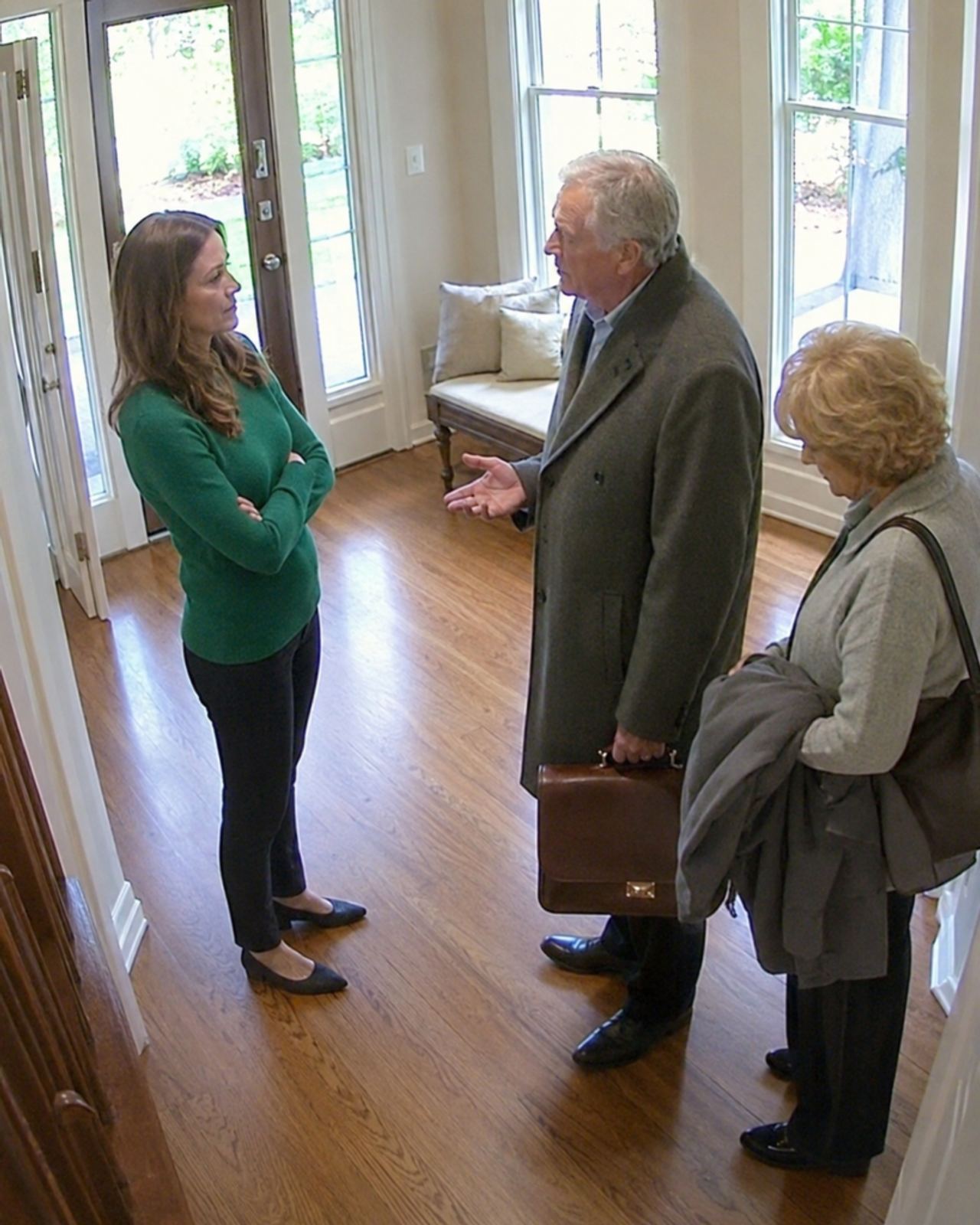
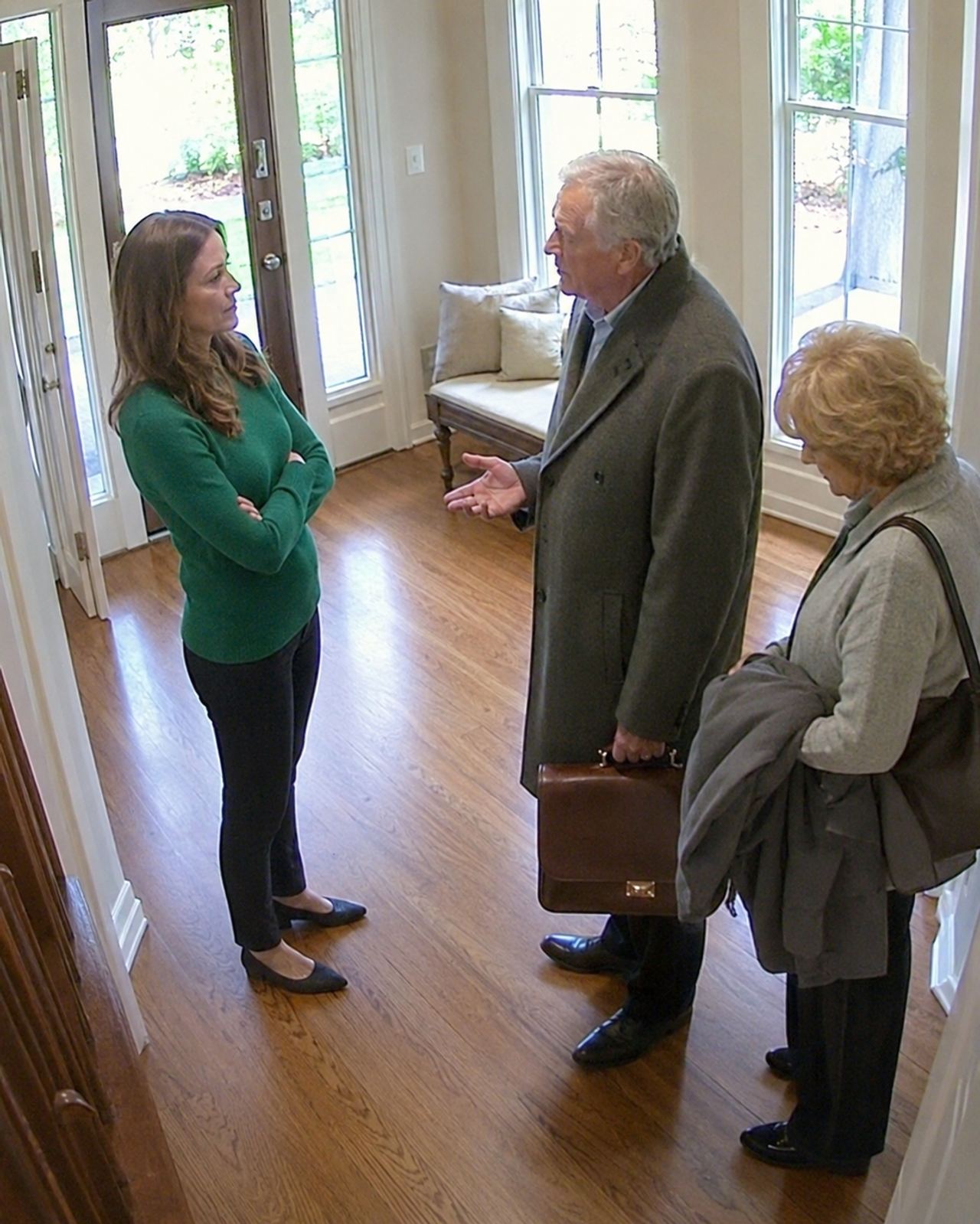
When she opened the door, she found her mother and father standing there.
For one disorienting second, Clara saw both versions of them at once: the polished figures framed by candlelight in the dining room of her memory, and the older, more fragile people now standing uncertainly on her front step.
Her mother entered first, eyes immediately moving through
the foyer, taking inventory.
The restored staircase.
The antique mirror.
The clean lines.
The stillness.
Richard came in more slowly.
Age had thinned him.
Pride still held his shoulders up, but strain had settled visibly into his face.
They did not ask how she was.
Richard cleared his throat.
“We need somewhere to stay for a while,” he said.
“Until certain matters are resolved.”
Clara said nothing.
Her mother stepped in with her usual gentleness, the same gentleness that had always softened cruelty without preventing it.
“This is family, Clara,” she said.
“You’ve done very well for yourself.
Surely we can count on your kindness.”
Richard looked around again, as though the house itself offended him by proving what she had become without him.
“There’s plenty of room here,” he added.
“Don’t make this difficult.”
That sentence did it.
Not because it was the harshest thing he had ever said, but because even now, standing in the evidence of her life, he still spoke as though she existed to smooth inconvenience for him.
Clara looked at them for a long time.
She remembered the Christmas toast.
The soft laughter.
The chair no one noticed was empty.
She remembered working double shifts and drawing by lamplight.
She remembered the first time Eleanor had looked at her as if she possessed something worth seeing.
Then Clara said, with perfect calm, “I don’t open rooms for people who never saved me a chair.”
The silence that followed was unlike anything she had ever experienced with her father.
Richard Quinn, a man who had built his whole identity on having the next word, simply stood there with his mouth slightly open.
Her mother blinked, stunned, as if she had expected resistance but not memory.
Not precision.
Then her mother recovered first.
“Clara,” she said, quietly incredulous, “you cannot mean to punish us forever over one dinner.”
Clara almost laughed, but there was no humor in it.
“One dinner?” she repeated.
“You think that was one dinner?”
Neither answered.
She stepped toward the door and opened it wider.
Not as an invitation.
As clarity.
“I am not punishing you,” she said.
“I am refusing to disappear for your comfort again.”
Richard’s expression darkened with something like shame, though it arrived dressed as anger.
“After everything we gave you—”
Clara cut him off.
“You gave me a room in a house where I was never truly welcome,” she said.
“Everything I have now, I built after leaving it.”
Her mother’s eyes filled, but Clara had learned that tears were not always evidence of innocence.
Sometimes they were grief at losing access.
Richard looked as though he wanted to argue, to command, to reduce her once more into the child at the end of the table.
But there was no table here.
No audience.
No power he could summon from the walls.
At last he lowered his eyes.
They walked out without another word.
Clara closed the door gently behind them.
Then she stood alone in her foyer, listening to the quiet she had once feared.
Only now it did not sound like abandonment.
It sounded like peace.
A week later, Samantha called.
Clara let it go to voicemail.
In the message, her sister cried, then accused, then cried again.
She said their parents were struggling.
She said Clara was being cruel.
She said family should mean something.
Clara deleted the message without replying.
That winter, she hosted Christmas in her own home for a handful of friends, former clients who had become chosen family, and Eleanor, who brought a pie and a bottle of wine and looked around the table with a private smile.
The meal was simple and warm.
Candles glowed in the windows.
Laughter rose naturally, without calculation.
At one point Clara stepped away to the kitchen and came back carrying an extra chair from the corner.
“Why the extra seat?” one of her friends asked.
Clara set it down beside the table and smiled.
“Because everyone here gets one,” she said.
Later that night, after the dishes were done and the last guest had left, Clara stood in the doorway and watched snow fall across her garden.
For a moment she thought about the younger version of herself walking down a long drive with a small bag and no witness to her leaving.
That woman had believed she was being erased.
She had not known she was making space.
And if there was any aftershock left in Clara, it came not from regret but from the question that still lingered in quiet moments: when a family only values you after you become useful to them, is forgiveness noble, or is distance the first honest thing you have ever given yourself?