
Human Stories
She Called Me Dumb Until Campus Security Opened The Dorm Door
A young woman raised in severe family abuse is labeled the “dumb one” by her mother until she reaches college, where a violent intervention exposes years of control, medical abuse, and manipulation. With the help of campus security, medical staff, and legal advocates, she and her siblings finally escape and begin rebuilding their lives.

For eighteen years, my mother called me the dumb one.
She did not say it like an insult at first.
She said it like a diagnosis.
Natalie was the smart one because she had been quiet as a newborn.
Eden was the pretty one because nurses said she had delicate features.
Miles was the strong one because he came out large and loud.
I was the dumb one because I was born small, blue, and fighting for breath.
Mom believed first impressions were destiny.
She wrote our roles into baby books, school forms, medical histories, and eventually into our bodies.
Natalie was rewarded for answers, then punished for wanting to paint.
Eden was praised for beauty, then starved when her body tried to become strong.
Miles was told pain was weakness until broken bones became chores.
I was removed from school after third grade because I read too well.
Mom told everyone I had a severe learning disability.
The truth was that I was getting harder to control.
She gave me pills that made my thoughts float away from me.
She told me they helped my condition.
They helped hers.
They made me slower, quieter, easier to point toward the corner where the dumb one belonged.
My siblings protected me in the only ways they could.
Natalie taught me from textbooks after midnight, whispering definitions while the floorboards creaked.
Eden stole my pills and replaced them with vitamins whenever Mom looked away.
Miles pretended to scare me from the barn, then taught me how to stretch the curve Mom had forced into my back.
We built a secret language because children trapped in a house learn to become weather.
One tap meant wait.
Two taps meant run.
A turned spoon meant meet me later.
A porch light flicker meant Mom was listening.
When I was fifteen, we tried to leave.
Miles had saved money from odd jobs, and Natalie had planned the route to the station.
Mom found us through the trackers she had placed in our phones.
She punished each of us according to our roles.
Miles carried feed bags until his back gave out.
Natalie solved equations until her hands cramped.
Eden stood in front of mirrors and listed flaws until her voice went flat.
I wrote I am too stupid to think for myself until the words stopped looking like words.
After that, Mom moved us to the isolated farmhouse and told people we needed peace.
Peace meant no teachers.
Peace meant no neighbors.
Peace meant no one asking why four children flinched when their mother opened a drawer.
At eighteen, I found online classes through the public library computer.
I studied in stolen minutes while Mom believed I was looking at picture books.
Natalie invented emergencies that needed her brilliant mind.
Eden cried over imaginary skin disasters that held Mom for hours.
Miles staged injuries so Mom would drag him inside and leave me alone in the barn.
I passed my GED with shaking hands.
Then I applied to State University.
When the acceptance letter arrived at the P.O. box, Miles brought it to the barn under his jacket.
None of us spoke for a full minute.
Then Eden covered her mouth and sobbed.
Natalie pressed the paper to her chest like a prayer.
Miles said, “You got out.”
I should have known Mom would hear freedom breathing.
My first week on campus felt like living inside someone else’s life.
I picked my own clothes.
I ate when I wanted.
I sat in a classroom and answered a question without lowering my head.
My roommate asked whether I wanted the top shelf in the closet, and I almost cried because nobody had ever asked me where I wanted anything.
Then Mom called.
She sounded calm.
That was always worse.
“The school called about your records,” she said.
My stomach dropped before she finished.
“I withdrew you. Miles is bringing you home.”
I turned and saw my brother in the doorway.
He looked sick.
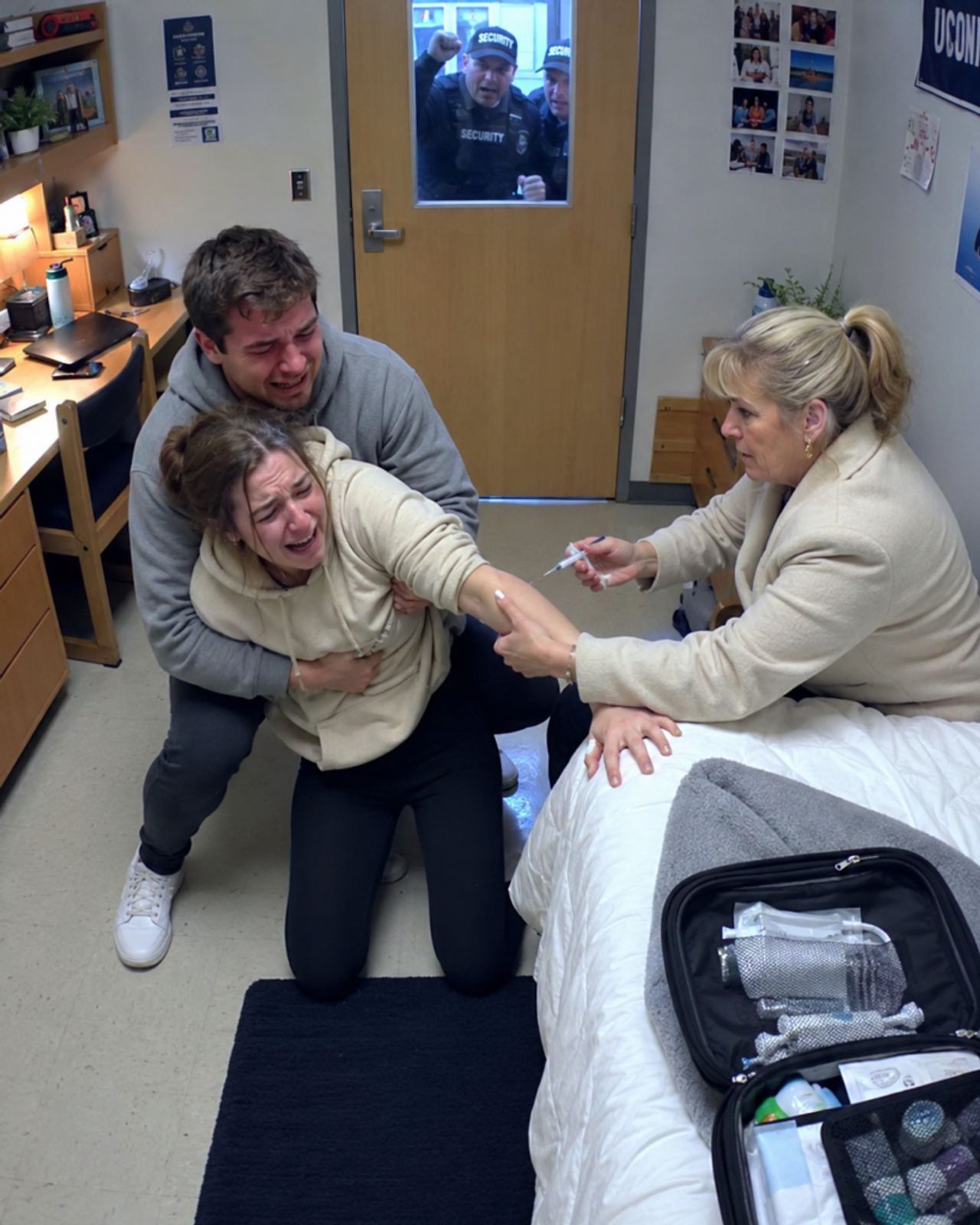
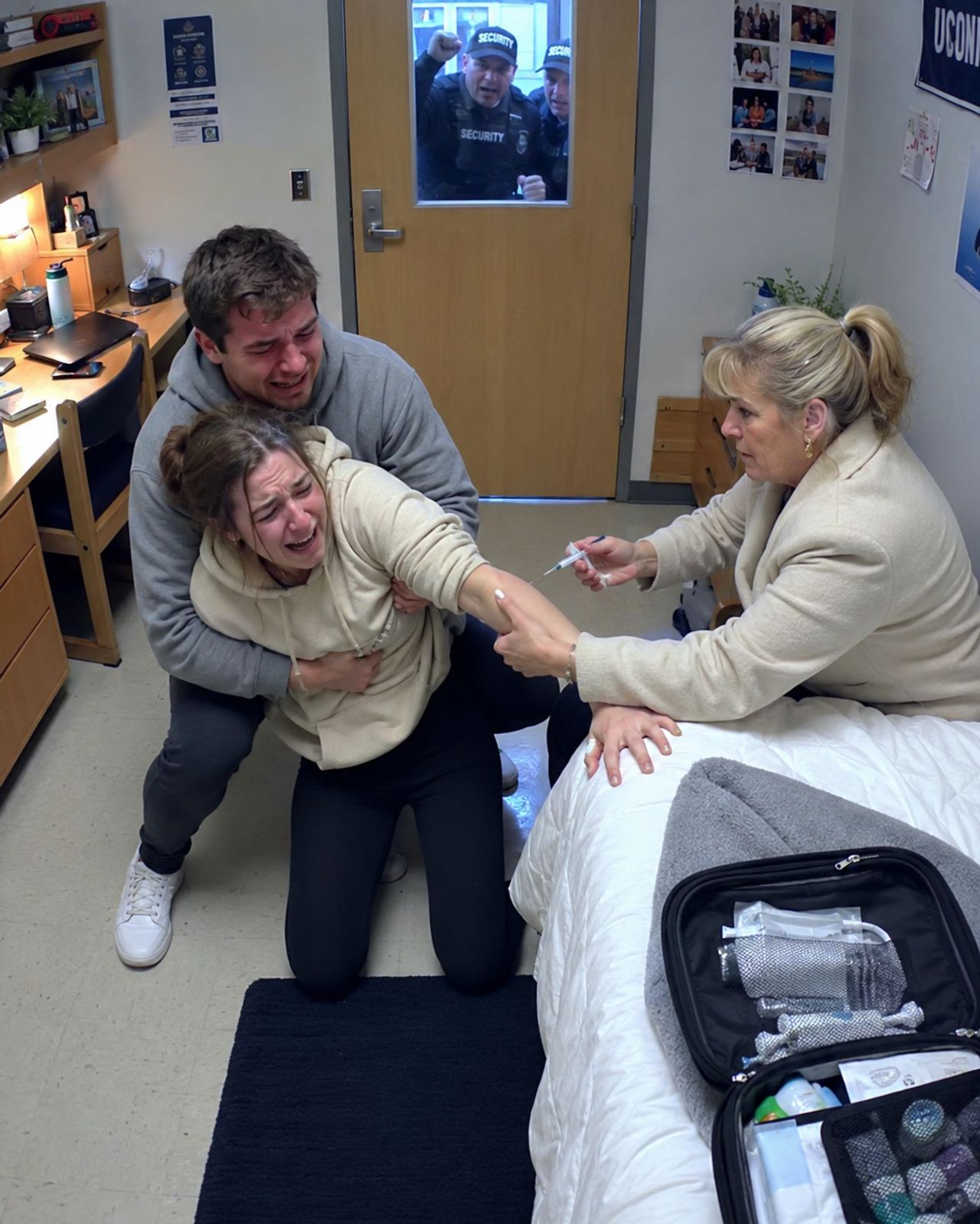
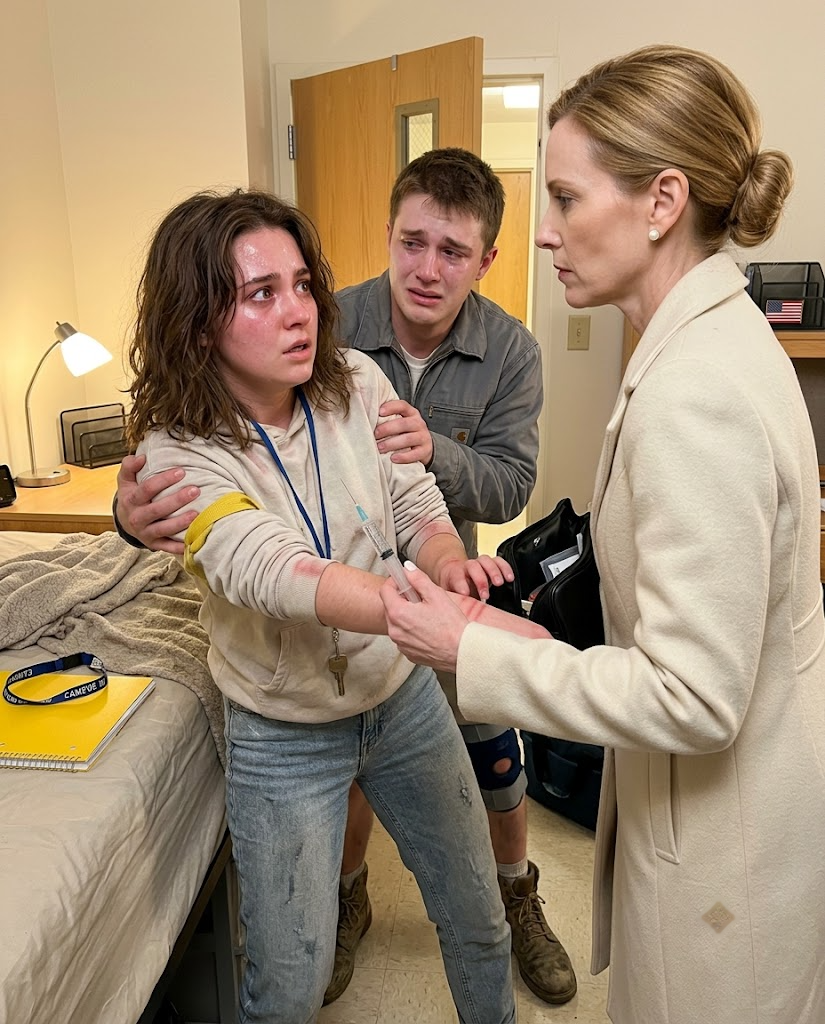
Behind him stood Mom with the medical bag she kept locked under her bed.
Miles whispered that she had threatened Natalie and Eden.
Then he caught my arms.
Mom came inside and closed the door.
She told me I had upset the family ecosystem.
She told me Dr. Benson could quiet the parts of my brain that kept reaching above my place.
She opened the bag.
I saw gloves, vials, wipes, and a syringe already filled.
“By morning,” she said, “you won’t remember wanting a brain.”
I was terrified, but terror had lived with me for so long that it had become a room I knew how to stand in.
I looked at her and said the sentence that split my life in two.
“I am not your dumb one.”
She raised the needle.
Miles cried but did not let go.
Then campus security pounded on the door.
Officer Calliope Nash came in with her radio already lifted.
She saw my arms pinned behind me.
She saw the syringe disappearing into the bag.
She saw my mother’s perfect face trying to rearrange itself into concern.
Mom said I was unstable.
Mom said I made up stories.
Mom said she was only trying to get her disabled daughter home safely.
Officer Nash asked why a safe daughter had red marks on her arms.
Mom did not answer fast enough.
That pause saved me.
Backup came.
An ambulance came.
At the hospital, Dr. Leora Kimura photographed the needle mark and the grip bruises.
She took blood, urine, mouth swabs, and hair samples.
She listened when I described the pills.
She did not smile politely and look toward my mother for the real version.
She believed me enough to write everything down.
The university sent a case manager named Leandra Maguire.
Leandra blocked Mom from my school records and helped me file safety papers.
An attorney named Linnea Phelps came from legal aid with a yellow pad and a voice like locked steel.
She said we would fight any attempt Mom made to declare me incompetent.
Mom made that attempt before the week was over.
She filed for emergency guardianship and told the court I had the mind of a small child.
She sent emails about how the dumb one had to accept her place or the family balance would collapse.
Linnea told me not to answer.
Evidence sounds different when you stop defending yourself and start saving it.
Detective Lucinda Bridges asked whether we had proof this went back to birth.
I thought of Mom’s baby books, her charts, her punishment logs, and all the things children remember but cannot carry into court.
Then Miles found the birth certificates.
He stuffed a thumb drive into my mailbox with one word on a sticky note.
Evidence.
On Natalie’s certificate, Mom had written smart one, exceptional cognitive function.
On Eden’s, she had written pretty one, aesthetic priority.
On Miles’s, she had written strong one, physical dominance required.
On mine, in her neat cursive, she had written dumb one, severely limited capacity.
Linnea stared at the scans until her face went pale.
She said it was premeditated abuse in handwriting.
The medical results came next.
Dr. Kimura found sedatives in my system.
The hair analysis showed a pattern stretching back years.
The drugs were not treatment.
They were control.
A judge denied Mom’s guardianship petition after an independent evaluator tested me for three hours and wrote that I was competent, articulate, and academically capable.
Mom wore a navy suit to court and tried to look wounded.
The judge read her emails about the ecosystem.
His expression hardened with every page.
He granted a temporary restraining order.
Mom violated its spirit within hours.
Cousins called me selfish.
Family friends said I was breaking her heart.
Someone posted my dorm address online and claimed I was dangerous and mentally impaired.
Campus security started walking me to class.
I found a GPS tracker sewn into my backpack lining.
Officer Nash held it in an evidence bag and looked angrier than I had ever seen her.
Fear is loudest after rescue because your body finally has time to shake.
I slept with a chair under my doorknob even though campus security was downstairs.
I checked every hallway.
I jumped when my roommate opened a soda.
Freedom was beautiful, but it was not gentle.
Eden escaped next.
Mom found her hidden phone and smashed it, and Eden ran while Mom was still screaming about betrayal.
A shelter took her in and helped her eat without permission.
Miles went to a clinic and learned his knees, shoulders, and spine were damaged from years of forced training.
The X-rays made him angry in a way Mom had never allowed.
Natalie sent a written statement with photos of the paintings Mom had burned.
She said losing art had hurt worse than bruises because it proved Mom wanted every extra part of us dead.
Detective Bridges got a search warrant for the farmhouse after a neighbor came forward.
The neighbor said she had heard screaming for years and seen medical supply trucks delivering boxes to a house that claimed to be ordinary.
Police found notebooks in Mom’s bedroom.
They found charts tracking whether each of us stayed in role.
They found bottles of sedatives with no patient names.
They found tracking devices, syringes, and printed emails between Mom and Dr. Benson discussing private procedures for problem children.
Dr. Benson’s license was suspended after other families came forward.
Mom was arrested for assault, stalking, and endangerment.
In her mug shot, she still tried to hold her chin like she was the only sane person in the room.
She pleaded guilty after the prosecutor offered a deal that guaranteed a ten-year no-contact order for all four of us.
Miles wanted it over.
Eden wanted safety.
Natalie still hoped therapy might make Mom understand.
I did not need Mom to understand.
I needed her to stop reaching for us.
The judge accepted the plea and warned her that one more message through anyone would mean jail.
For the first time in my life, an adult with power said no to my mother and meant it.
The final twist came from a bank envelope, not a courtroom.
Our grandmother had died when I was little, and Mom always said she left nothing worth mentioning.
After the search, Linnea found an old trust notice tucked in the farmhouse files, unopened because Mom had hidden it before any of us could read.
Grandma had left money for all four of us to use only after we turned eighteen and only for housing, school, medical care, or escape from our mother’s control.
The letter inside was addressed to us by name.
Not the smart one.
Not the pretty one.
Not the strong one.
Not the dumb one.
Natalie.
Eden.
Miles.
Layla.
Grandma had written that children are not ecosystems, trophies, tools, or mirrors.
They are doors.
Aphorisms used to sound fake to me, but that one stayed.
A child is not a role to maintain.
A child is a door you either open or spend your life trying to lock.
We read the letter together in Linnea’s office with a box of tissues between us.
Natalie kept tracing her own name with one finger.
Eden asked whether she was allowed to keep the original, then laughed because none of us had to ask Mom for allowed anymore.
Miles folded his copy so carefully that the creases looked measured.
I read my name again and again until it stopped feeling like a mistake someone might take back.
That was the strange part of surviving her.
Danger ended faster than training did.
Mom could be kept away by judges, locks, campus alerts, and probation officers.
Her voice still lived in our bodies like a bad old alarm.
Eden still apologized before ordering food.
Natalie still hid her sketches under a notebook when anyone walked past.
Miles still tried to carry every heavy thing in the room even with a brace on his knee.
I still heard dumb one in the pause before every answer.
Healing was not a door that swung open once.
It was a door we learned to push every morning.
Eden used part of her share for an apartment near campus and eating disorder treatment.
Natalie got a job in an art store and painted in the back room during breaks.
Miles started physical therapy and a support group for abused men, where he said the word victim without choking on it.
I registered for a full course load after financial aid approved my dependency override.
The first morning of English class, I sat in the front row.
The professor asked a question about the reading.
My hand went up before fear could drag it down.
I gave my answer.
The room did not explode.
No one grabbed my arm.
No pill appeared in a paper cup.
The professor smiled and said I had made an excellent point.
After class, I walked to the library without hunching.
The sun was warm on my face, and students moved around me like I belonged among them.
For years, Mom had tried to make dumb a cage small enough to hold me.
But cages are not identities.
They are evidence.
And once the door opened, I did not crawl out as the dumb one.
I walked out as Layla.
Read more stories
- Oven Roasted Smoked Sausage and Potatoes
- He Took His Father’s Bedroom After Surgery. Then Dad Took Back the House
- My parents had already finished their anniversary meal when I arrived, Mom smiled, “Oh, you’re late, cover the bill, will you?” My sister laughed, “Still as clueless as ever,” until I realized I had been invited exactly when their meal ended, called the manager, and suddenly their faces turned pale.
- Southern Cornbread Dressing