
Human Stories
On My Own Yacht, My Son-in-Law Smirked In Front Of Everyone And Said, “Plumbers Have No Place Here” — He Thought I’d Swallow The Humiliation Like A Quiet Old Man, Until One Sentence Turned His Perfect Life Into A Room Full Of Witnesses
A hardworking Detroit mechanic buys and restores a yacht with his wife, only to be mocked by his son-in-law in front of guests. As the mechanic quietly investigates deeper, he uncovers signs of financial misconduct that could destroy Preston Caldwell’s polished life.

“Plumbers don’t belong on yachts.”
That was what my son-in-law told me in front of twelve people on the deck of a vessel I had paid for in full with money I made with my own two hands.
I did not correct him right away.
That was my first mistake.
Or maybe it was the greatest gift I ever gave myself, because the patience I showed in that moment, that slow and deliberate silence everybody in earshot mistook for shame, became the beginning of the end for Preston Caldwell.
My name is Steven Wallace. I am fifty-seven years old. I have been a licensed diesel mechanic for twelve years, and before that I spent the better part of two decades doing whatever trade work Detroit would give a man willing to work hard and keep his word.
Plumbing. Electrical. HVAC. Roofing. Small repairs in bitter January weather. Emergency calls in July heat. Basements with standing water. Furnaces that quit before Christmas. Engines that sounded like they were coughing up gravel.
You name it, I fixed it.
I have never been ashamed of a single callus on these hands. Every one of them put food on the table. Every one of them helped buy my daughter Elena her first bicycle, pay for her college education, and eventually, yes, purchase a forty-two-foot motor yacht docked on the Detroit River.
But I am getting ahead of myself.
Let me tell you about Preston.
Preston Caldwell came into my daughter’s life about four years before any of this happened. She met him at a corporate networking event downtown, the kind where everyone wears name tags, shakes hands too firmly, and pretends the wine is better than it is.
He was a junior partner at a commercial real estate firm. Tailored suit. Expensive watch. Firm handshake. The kind of smile that had been practiced so often in a mirror that the man wearing it had forgotten it was not natural.
Diana, my wife of thirty-one years, liked him at first.
I did not.
I could not explain it then. Diana would ask what my problem was, and I would shrug and say, “I don’t know. Something about him.”
She would call me a protective old bear, and I would let it go because Elena was glowing. A man who loves his daughter learns quickly that her happiness is not the place to plant suspicion unless he has evidence.
Evidence matters.
You do not take an engine apart because you have a bad feeling. You wait for the diagnostic to confirm it.
So I shook Preston’s hand. Firm, I will give him that. The handshake was firm.
I came to dinners. I tolerated the way he looked at my truck in the driveway like it was something that had accidentally wandered onto a golf course. I smiled when he talked about investment philosophy, long-term positioning, and whatever else came out of his mouth during those early dinner conversations.
None of it ever included one real question about what I did or what I had built.
Not once, in four years of family dinners, holiday gatherings, birthday celebrations, and Sunday afternoons at our house, did Preston Caldwell ask me a meaningful question about my work or my life.
He learned what I did within the first five minutes of meeting me. Then he filed it away in whatever mental cabinet he kept for things that did not interest him, and he moved on.
Diana noticed.
One night, after a dinner where Preston had talked for most of the meal, she stood beside me at the sink and said, “He doesn’t ask you much, does he?”
“He asks how I’m doing,” I said.
“He asks the table how everyone is doing,” she said. “That is not the same thing.”
I told myself he was young. I told myself young men with new success often mistake noise for substance. With time, I figured he would settle down. He would realize the world was bigger than his own ambition. He would start to see the people around him.
He did not grow.
He hardened.
By the time Elena and Preston got married, at a wedding I paid for entirely, every centerpiece, every dinner plate, every open-bar tab, because Preston’s parents were retired and had limited means and I did not want my daughter’s wedding to be smaller than she deserved, he had settled into a very specific shape.
Preston was the kind of man who sorted people the moment he met them.
People useful to his career.
People decorative enough for his social life.
And people beneath his notice.
He placed me firmly in the third category.
I noticed.
I always notice.
I just did not say anything yet.
The yacht came about three years into their marriage. I know how that sounds. A mechanic buying a forty-two-foot motor yacht sounds like the setup to a joke. Most people expect the punch line to be lottery money, a mysterious inheritance, or some wild investment that turned a working man into a rich one overnight.
The truth was less dramatic and more satisfying.
Diana and I had been quietly, steadily, almost boringly accumulating money for decades.
No flashy investments. No gambling on markets I did not understand. No get-rich-quick nonsense. What I had was a skill people always needed, a reputation built one completed job at a time, and a business that had grown slowly from a one-man operation into a small, profitable fleet of service contracts.
Diana handled our household budget with the same discipline she brought to everything else. For years, she kept a physical ledger in a drawer in the kitchen. Every month, she sat down with it and reconciled every dollar.
She grew up poor on the east side of Detroit, and people who have watched a family struggle because the numbers do not add up develop a special relationship with clarity.
Between the two of us, we built something real.
Nobody gave it to us.
Nobody invested in us.
Nobody opened a door.
We built it with the discipline of people who understand that no one is coming to save you, so you had better learn to save yourself.
The yacht was our one great extravagance.
Diana had always loved the water, and I had grown up watching the Detroit River from a distance. That wide, moving body separating Michigan from Ontario always felt to me like proof that borders are human inventions and the world underneath them does not care.
There was something about being on that river that felt like freedom.
We found Diana’s dream through a broker who specialized in pre-owned vessels. Forty-two feet. Twin diesel engines. Tired cosmetics. Good bones.
I inspected the engines myself before we signed anything. I was not about to let someone sell me a bad engine. Not with my background.
She needed work, but the important parts were sound. I could see exactly what she could become.
For six months, I restored her during my off hours. I scraped away neglect. I retrofitted the galley. I replaced upholstery, updated the navigation systems, redid paint, repaired fittings, and rebuilt one engine component myself because the quote I received for replacement was insulting.
When I finished, she was not just a boat.
She was ours.
Diana cried when she saw the name lettered on the transom.
Diana’s Dream.
I am not too proud to admit I had something in my eye that day, too.
We docked her at a private marina on the Detroit River. We took her out on weekends. Sometimes it was just Diana and me, and those were my favorite days, slow and quiet, with the water ahead of us and nowhere particular to be.
Sometimes we brought friends. Maria and Everett came often. Reed and Jocelyn, neighbors we had known for years, became regulars. Jocelyn always brought a cooler large enough to feed twice the number of people invited. Reed had helped me source parts during the first overhaul. Everett had been one of my closest friends for more than twenty years, the kind of man you want in your corner because he is slow to speak and usually right when he does.
It was the best thing I had ever bought.
I felt no guilt about it.
Elena and Preston came aboard for the first time that summer.
Elena was delighted. She had always loved the water. As a little girl, she had been comfortable on boats in a way some people are born with and others never learn. She walked around barefoot with her arms slightly spread, like she was greeting something she had missed.
Preston stood on the deck in new boat shoes. I noticed that immediately. He had purchased specific shoes for the occasion, which told me he had thought carefully about the image.
He looked around with an expression I could not read at first.
Not impressed.
Not unimpressed.
More like assessment.
The way an appraiser looks at a property before deciding what number to put on it.
“Nice boat, Steven,” he said.
Just like that.
Nice boat.
The way a man compliments a neighbor’s new grill.
“She’s a yacht,” I said, keeping my voice easy.
He waved a hand. “Right, right.”
I filed that away.
Small drawer.
I would come back to it.
The trouble truly started when Preston’s firm began doing well. Not just well, according to him. Spectacularly well. He was making more money than he had ever made, and the effect it had on him was not pretty.
Success reveals character the way pressure reveals cracks in metal. It does not create anything new. It only exposes what was always there under the surface.
What was always there in Preston was contempt.
It came out slowly at first, the way bad habits do, as though increasing comfort had made him careless about hiding it.
He started talking over Diana at family dinners. Small things at first. Finishing her sentences with different endings. Steering conversations away from whatever she had raised. Diana is not a woman who makes a scene, so she let it pass, but I watched her jaw tighten sometimes.
Diana keeps count the way she keeps ledgers.
Then he started referring to Elena’s career as “her little job.”
Elena was a pediatric nurse. A good one. Skilled, steady, genuinely committed. The kind of nurse parents remember by name because she knows how to speak when they are frightened and how to stay calm when a room needs calm.
Preston called that “her little job.”
He said it with affection, which made it worse. He smiled as though her real vocation was an adorable hobby she was allowed to keep alongside the main project of being his wife.
Elena did not fight about it in public.
She went still.
Very still.
Then she changed the subject.
I saw that stillness enough times to understand it was not a one-time accommodation. It was a practiced pattern. My daughter had been making herself smaller around him for longer than I had known.
That bothered me more than the boat shoes.
More than “nice boat.”
More than almost anything.
Preston also began bringing associates to gatherings. Men in pressed shirts who evaluated rooms as soon as they entered them. Conversation would shift entirely in their direction. Deals. Projections. Positioning. Diana and Elena would be left nodding politely at the margins.
I made occasional attempts to redirect.
Preston answered me with the minimum courtesy a man gives someone whose time he does not value.
Then there was the way he talked about money.
Not the way working people talk about money, as a practical resource that determines what can and cannot be done. Preston talked about money as a measure of superiority, something to deploy strategically so everyone around him understood the distance between them and him.
He mentioned restaurants by price. He referenced car payments with offhand ease, wanting people to hear the number while pretending he did not. He described vacations by what they cost, not what they were.
It was deeply boring.
And I think he knew that because he always watched faces when he did it, checking for the reaction he wanted.
The reaction he wanted was deference.
He got it often enough from people who did not know better.
Then came the comment I overheard through the wall.
I had stopped by Elena and Preston’s house to drop off food Diana had sent. Diana sends food when she wants to express something she does not feel like saying directly. I was in the hallway when I heard Preston’s voice from his home office. The door was partly open.
He was on the phone, talking in that loose, expansive way people talk when they think they are not being overheard.
“Yeah, well, you know how it is,” he said. “He’s got a hobby boat. Calls it a yacht. Steven’s little project.”
I stood in that hallway for a full ten seconds.
He said it without malice, which somehow made it worse. He said it with the careless fondness of a man describing something charming but trivial.
My yacht.
Diana’s dream.
The vessel I had spent six months restoring with my hands.
The one bearing my wife’s name on the transom.
The one paid for by decades of combined labor.
To Preston Caldwell, it was a little project.
I set the food on the entry table, let myself out, and drove home.
That night, I sat in the garage for a while and thought.
I want to be clear. I am not a man who goes looking for conflict. I have never gone looking for conflict in my life.
What I am is observant.
And what I observed over four years of dinners, gatherings, side comments, and moments like the one in that hallway was a pattern.
A man with no respect for what I was or what I had built.
Worse, a man whose disrespect was beginning to bleed into the way he treated my daughter.
After that night, I paid attention differently. Diagnostic attention. The kind that looks for root causes.
The day everything changed began with a dripping tap.
Diana and I had planned a day on the water. The full group was coming: Elena and Preston, Maria and Everett, Reed and Jocelyn. Preston also brought two associates, which I did not know until they were standing on the dock.
I said nothing.
They were Preston’s guests, and I was not the kind of host who makes people feel unwelcome, even guests I had not invited.
It was a beautiful Detroit River day. The kind where the water catches light at an angle that makes it look painted. Downtown Detroit sat behind us as we cleared the marina, and the river opened ahead, smelling of water and distance.
Before we cleared the no-wake zone, I went below deck.
The forward galley tap had been dripping. I noticed it during the previous outing. Soft washer. Basic fix.
I had the tap disassembled and reassembled in under four minutes. I know because I timed it in my head. I always time repairs. Not for any special reason. It is simply the habit of someone who has been doing this long enough to know how long things should take.
When I came back up, Preston was holding court.
He had chosen the most advantageous spot on the deck, back to the horizon, face to his audience, telling a story about a property deal. His two associates were laughing. Elena was watching the water. Jocelyn and Maria were speaking near the stern. Everett leaned against the rail, arms folded, present but not engaged.
Diana, I would later learn, was standing just inside the salon door where she could hear everything clearly.
I stepped up from below.
Preston glanced over.
“Steven,” he said, tilting his glass. “Where’d you disappear to?”
“Fixing the forward tap,” I said. “Washer had gone soft, so it was dripping.”
One of the associates, the taller one who had been laughing loudest, made a sympathetic face.
“Things always breaking on older boats, huh?”
“She runs fine,” I said pleasantly. “Just regular maintenance.”
Preston looked at his associates.
Then he looked back at me.
I saw the exact moment he decided to say it. There was a brief calculation in his eyes. Those unrehearsed intervals tell you everything about a person, because that is when people show what they really are.
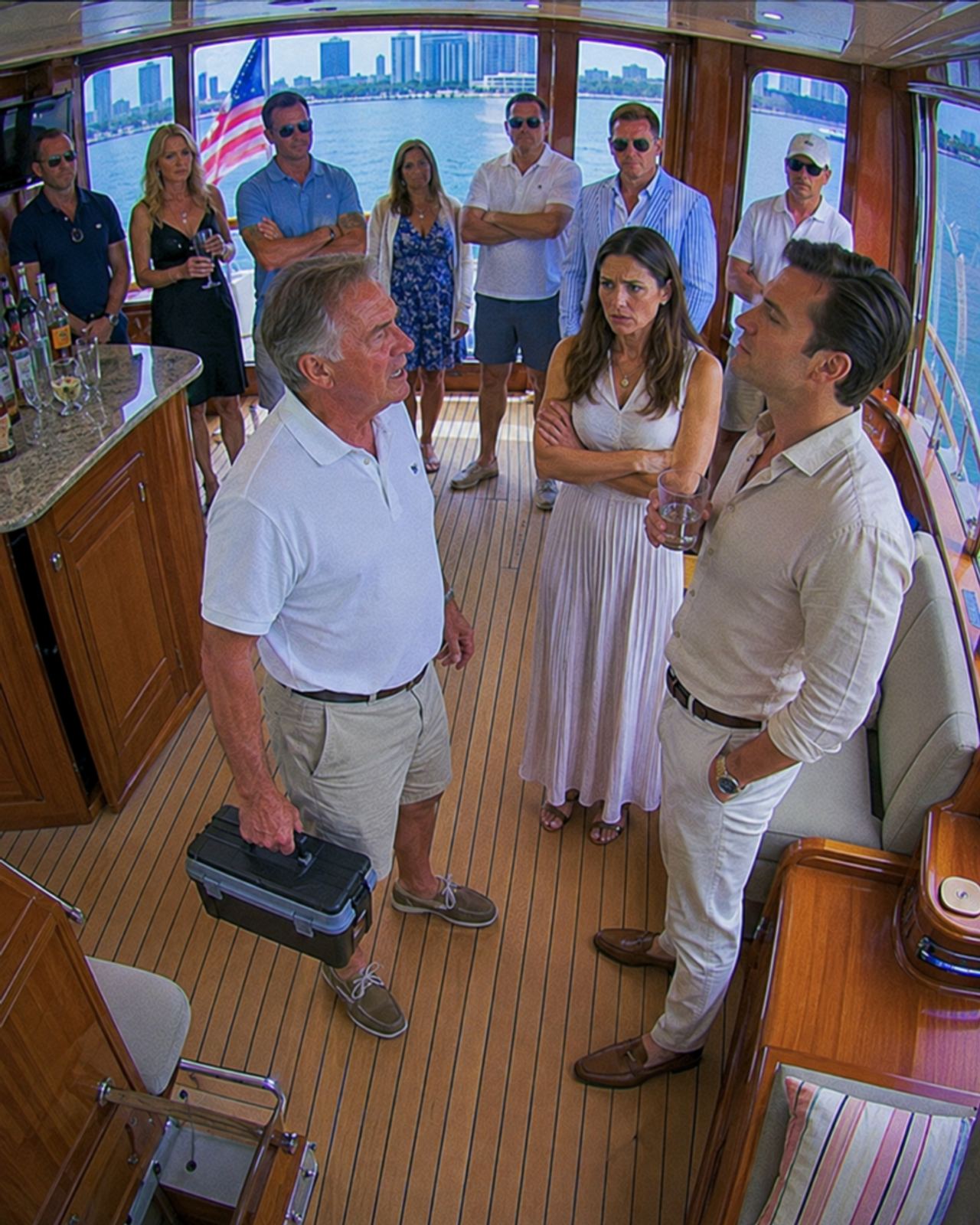
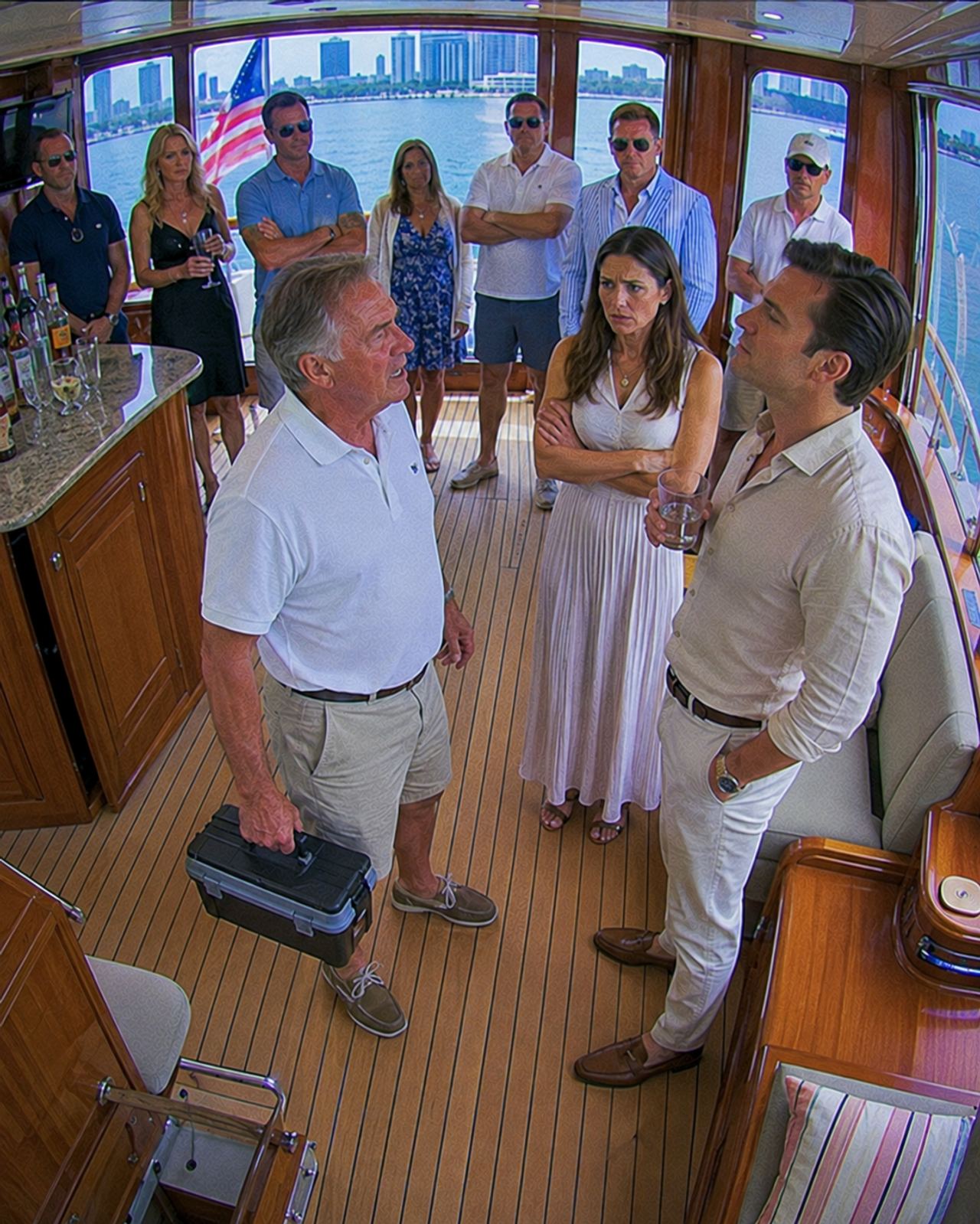
“You know,” he said, loudly enough for everyone on deck to hear, “plumbers have no place here.”
He smiled.
His associates smiled.
It was meant to land as a joke. A light, clever remark everyone would laugh at before moving on. The kind of insult that relies on the target being too good-natured or too stunned to push back.
The deck went quiet.
Maria stopped talking. Jocelyn went still. Everett unfolded his arms and stood up straight. Elena turned from the water.
I looked at Preston Caldwell.
There he was, in his ironed linen shirt, standing on the teak deck of a yacht he had never owned a square inch of, drinking whiskey that belonged to me, in the fifth year of marriage to my daughter, a marriage I had subsidized in more ways than I would ever bring up.
I looked at him long enough for his smile to develop uncertainty at the edges.
I did not argue.
I did not raise my voice.
I gave him a slow nod, turned around, and walked to the helm.
Behind me, the silence was heavy. Everett made a short sound he turned into a cough. Preston cleared his throat and restarted his story louder and faster, the way people talk when they are trying to cover a crack in the wall with conversation.
I kept my hands on the wheel and my eyes on the water.
Inside me, something settled into place like a machine part that had been misaligned for a long time finally clicking into position.
Not yet, I thought.
But soon.
Here is what most people get wrong about revenge. They imagine it hot. Immediate. A shouted confrontation. A table turned over. A villain exposed in a single dramatic scene.
Real revenge, the kind that closes the account permanently, is cold and patient.
It is built the way a good engine is built, piece by piece, in a space where nobody is watching, until the time comes to turn the key and everything runs exactly as designed.
I spent the drive home thinking clearly.
Not stewing.
Not replaying the insult over and over.
Thinking.
What did I know? What did I see? What was the symptom telling me about the underlying cause?
I knew Preston was arrogant. I knew he was careless with other people’s dignity, and that is a meaningful kind of carelessness. It tells you a person has rarely depended on the goodwill of others. It tells you he has lived insulated enough to believe consideration is optional.
In the weeks leading up to the boat trip, I had begun noticing something else.
Money things.
Small things.
Elena reaching for the check at family dinners before Preston could. Her deflecting vacation questions with a brittle laugh. Preston mentioning, more than once, a particular investment that was “going to come good any week now.”
I have been working and living long enough to understand those words.
They are often the words of a man who bet on something, lost, and is not ready to tell anyone, possibly not even himself.
Three days after the yacht trip, I went downtown to my estate attorney’s office. He had handled my business filings for fifteen years. I sat across from him in a leather chair and signed a newly drafted will.
I removed Preston entirely.
If anything happened to me, his hands would never touch a dollar of what I built. If anything happened to Elena, her share would go into a protected trust handled by independent trustees, fully out of his reach.
But I was not done.

I called Everett after Diana was asleep. I sat in the garage with the door cracked open, my phone in one hand and a cup of coffee gone cold beside me.
“I need to know something,” I said when he picked up.
“About Preston,” Everett said.
He did not make it a question.
“Yeah.”
There was a pause. I heard him shift in his chair.
“I was wondering how long it would take you to make this call,” he said.
I sat forward.
“You know something already.”
“I know a few things,” Everett said. “I know Reed’s brother-in-law works at a title company downtown. I know that in the last several months, he has noticed unusual patterns in transaction records connected to a set of commercial properties Preston’s firm handled.”
“What kind of unusual?”
“The kind where the numbers going in do not correspond to the numbers coming out,” Everett said carefully. “And the difference seems to be resting somewhere comfortable and quiet.”
I was silent.
“Everett.”
“Yeah.”
“I’m going to need your help.”
“I know,” he said. “That is why I picked up the phone.”
People who have never worked with their hands often misunderstand trade work. They think it is only labor. It is not. You learn systems. You learn every system has rules and every rule has a reason. When something fails, it failed because one of those rules was violated somewhere along the line.
You learn to trace back.
Follow the chain from symptom to source, no matter how many bends it takes through dark spaces.
The chain on Preston’s finances took about six weeks to follow.
Everett connected me with Reed’s brother-in-law through a discreet conversation. Not to do anything improper. Simply to understand what was publicly recorded and what a professional eye experienced in those transactions could legitimately observe.
What we found, step by step, through public records and quiet conversations with people who knew how to look, was not complicated.
Preston’s firm had been involved in a series of commercial property investment vehicles over two years. On paper, they resembled legitimate products: pooled investor capital deployed into commercial real estate, generating returns distributed on a schedule.
In practice, something else was happening.
The deals had not performed the way Preston represented to investors. Losses had accumulated quietly. Rather than disclose those losses to the people whose money was at risk, Preston had done what men sometimes do when they believe they are smarter than the system.
He used new investor funds to preserve the appearance of returns for earlier investors.
Money moved between accounts in ways designed to obscure performance. Along the way, meaningful sums found their way into accounts with Preston’s fingerprints on them.
It was not sophisticated.
That was my first thought.
This was not sophisticated.
A man who believed himself a financial strategist had constructed one of the most basic forms of financial misconduct. The kind that works only until someone decides to look.
Nobody had decided to look yet.
I sat with what I knew for a full week before taking action.
That matters.
The week was not about anger. It was about Elena. Whatever I did would hit her life first. Her name was connected to this man. Her finances, to an extent I did not yet fully understand, were intertwined with his. Her future would be shaped by how this unfolded.
I was not going to be reckless with my daughter the way Preston had been reckless with everyone else.
So I called Elena.
I invited her to lunch at a diner we had been visiting since she was in high school. A place on the east side with bad lighting, excellent coffee, and counter staff who remember your order.
She arrived in scrubs straight from a shift, dark circles under her eyes imperfectly covered with makeup. She ordered eggs Benedict and black coffee, no substitutions, same as always.
I watched her across the table and tried to read her face the way I had been reading it since she was four years old and learning to hide when something was wrong.
“How are you?” I asked.
“I’m fine, Dad. Tired, but fine. Busy stretch at work.” She wrapped both hands around her coffee mug. “How’s Mom?”
“Good,” I said. “She’s good.”
Elena looked at me.
“How are things with Preston?”
The pause was not long. Maybe two seconds. But two seconds can be a long time between people who know each other well.
“We’ve had some stress,” she said. “Financial stuff. It’s nothing we can’t handle. Preston says it’s just a short-term liquidity crunch.”
That phrase landed on me like a dropped tool.
“What kind of financial stuff?”
She looked down at her coffee.
“It’s Preston’s department.”
“Really?”
“I don’t have much visibility into the business side. He handles it.”
“How long has he been handling it?”
A longer pause.
“About two years,” she said quietly.
I looked at my daughter.
“Elena, I need you to listen carefully.”
She looked up, and I saw something in her eyes I recognized. Not fear exactly. More like suspended breath. The expression of someone who has been waiting for a particular conversation and does not know whether to feel relieved or terrified that it has arrived.
“I’ve been looking into some things,” I said. “I want to be careful about what I tell you because I do not want to give you half a picture. But I need you to do something before we go further.”
“What?”
“Get your own attorney. Someone who has never met Preston, has no connection to his firm, and who you trust completely.”
She went very still.
“Dad, what did you find?”
“I foun…”
Read more stories
- A DEVASTATING INJURY ON A HIGH SCHOOL BASEBALL FIELD WAS SUPPOSED TO END HIS DREAMS — INSTEAD, IT PUSHED MORGAN WALLEN TOWARD THE BIGGEST STAGES IN COUNTRY MUSIC.
- Five Days After Giving Birth, I Came Home To Find My House Sold. My Husband Had Taken Everything And Run Off With His Mistress. I Sold My Wedding Ring To Buy Tickets Home. At The Station, I Used My Last Dollar To Buy A Stranded Old Man A Ticket. Two Weeks Later, A Black Limo Pulled Up Outside My Parents’ House… And The Driver Said My Name.
- My husband abused me every day. I was 5 months pregnant, fighting internal bleeding and three broken ribs, while my husband wept at my bedside: “She fell down the stairs, Doctor! Please save her!” He expected sympathy. Instead, the surgeon stared at my injuries with cold, piercing eyes. He didn’t ask a single question. He simply looked at my husband, pressed the alarm, and commanded: “Lock the doors. Call the police.”
- Wyatt had always been tall, broad-shouldered, with a presence that filled any room even when he wasn't saying a word.