
Human Stories
My wife stayed awake for two nights, preparing 38 dishes for 75 relatives at our granddaughter’s birthday celebration. Her hands were sore, but she still arranged every plate with care. My daughter-in-law looked at the food and said, “This is too simple. Let’s take everyone to a restaurant instead.” I didn’t argue. I quietly took one photo and made a single decision. By the next morning, they were calling nonstop and asking me to undo it.
A grandmother and her husband spend two nights preparing 38 dishes for 75 relatives, only for their daughter-in-law to dismiss the effort and leave the gathering for a restaurant. The aftermath exposes family disrespect, financial strain, and the grandmother’s decision to stop sacrificing for people who don’t appreciate her.

The list arrived at our kitchen table less than twenty-four hours before the party. My daughter-in-law, Tiffany, unfolded one sheet of paper and slid it toward my wife as casually as if she were handing over a grocery receipt.
“Mom, I just need you to handle the food.”
Gloria adjusted her reading glasses and studied the page.
Thirty-eight dishes:
Roast chicken with no garlic
Beef stew with extra onions
Gluten-free cornbread
Dairy-free macaroni and cheese
Vegan stuffed peppers
Homemade croissants
Three flavors of macarons
Red velvet cake
Peach cobbler
Fresh lemonade
Nearly every item had a separate instruction written beside it. Gloria looked up.
“How many guests?”
“Seventy-five,” Tiffany said. “It’s Kayla’s eighteenth birthday. You run a restaurant. This shouldn’t be that difficult.”
My son, Kevin, stood behind his wife with his phone in his hand. He glanced at the list, then immediately returned his attention to the screen. I waited for him to speak. He didn’t.
Gloria folded the paper carefully. “Okay.”
That one word had carried our family through forty years.
Okay when bills arrived early.
Okay when Kevin needed something we could barely afford.
Okay when Gloria’s little restaurant struggled and I drove extra shifts across Chicago to keep the lights on.
But this time, I heard something different beneath it.
Tiffany smiled. “I knew we could count on you.”
She and Kevin left ten minutes later. The moment the door closed, I picked up the list again.
“We don’t have to do this.”
Gloria was already opening the refrigerator and counting eggs. “It’s Kayla’s birthday.”
“That doesn’t make this reasonable.”
“No,” she said softly. “But Kayla didn’t make the list.”
An hour later, we were driving north through wet city streets, searching three different grocery stores for specialty flour, puff pastry, fresh basil, and ingredients Tiffany had decided were essential. The final receipt was $587.
I knew exactly where that money came from. Gloria had been saving her restaurant tips in a coffee can beneath the register because the oven at Gloria’s Corner needed repairs. She folded the receipt and handed it to me without mentioning the oven.
We reached home shortly before midnight. Gloria tied on her apron; I started coffee.
For the next several hours, our kitchen became a quiet production line:
Gloria: mixed dough, seasoned meat, prepared custard, rotated baking trays, and labeled dishes according to every dietary request.
Me: peeled potatoes and washed mixing bowls from a chair beside the kitchen island—twenty years of driving had left my lower back too stiff for long periods of standing.
At one in the morning, Tiffany sent another message: she had forgotten two guests who avoided red meat and another who was vegan. Could Gloria add a few more options?
“Nothing fancy,” the message said.
Gloria turned the phone facedown and continued kneading dough.
At 4:07, a sharp breath woke me. I had fallen asleep in the chair.
Gloria stood beside the oven with one hand pressed against the other. A red mark crossed two fingers where she had touched the edge of a hot rack.
“Sit down,” I said. “The croissants—”
“Can wait.”
“They can’t.”
For five minutes, I held a cold towel against her fingers while she watched the stove. Her eyes were red from exhaustion.
“Why didn’t you wake me?”
“You looked peaceful, Hank.”
That sentence stayed with me. She had spent the night carrying an impossible request, yet she was still protecting my rest.
By sunrise, nearly every surface in the kitchen held something she had made. Then, Gloria prepared two extra dishes that had never appeared on Tiffany’s list:
Tomato soup for Kevin, because it was the only thing he would eat when he was sick as a child.
Peach cobbler, because he had learned to make his first one in that very kitchen at fourteen.
She placed the soup near the end of the table where our son would sit.
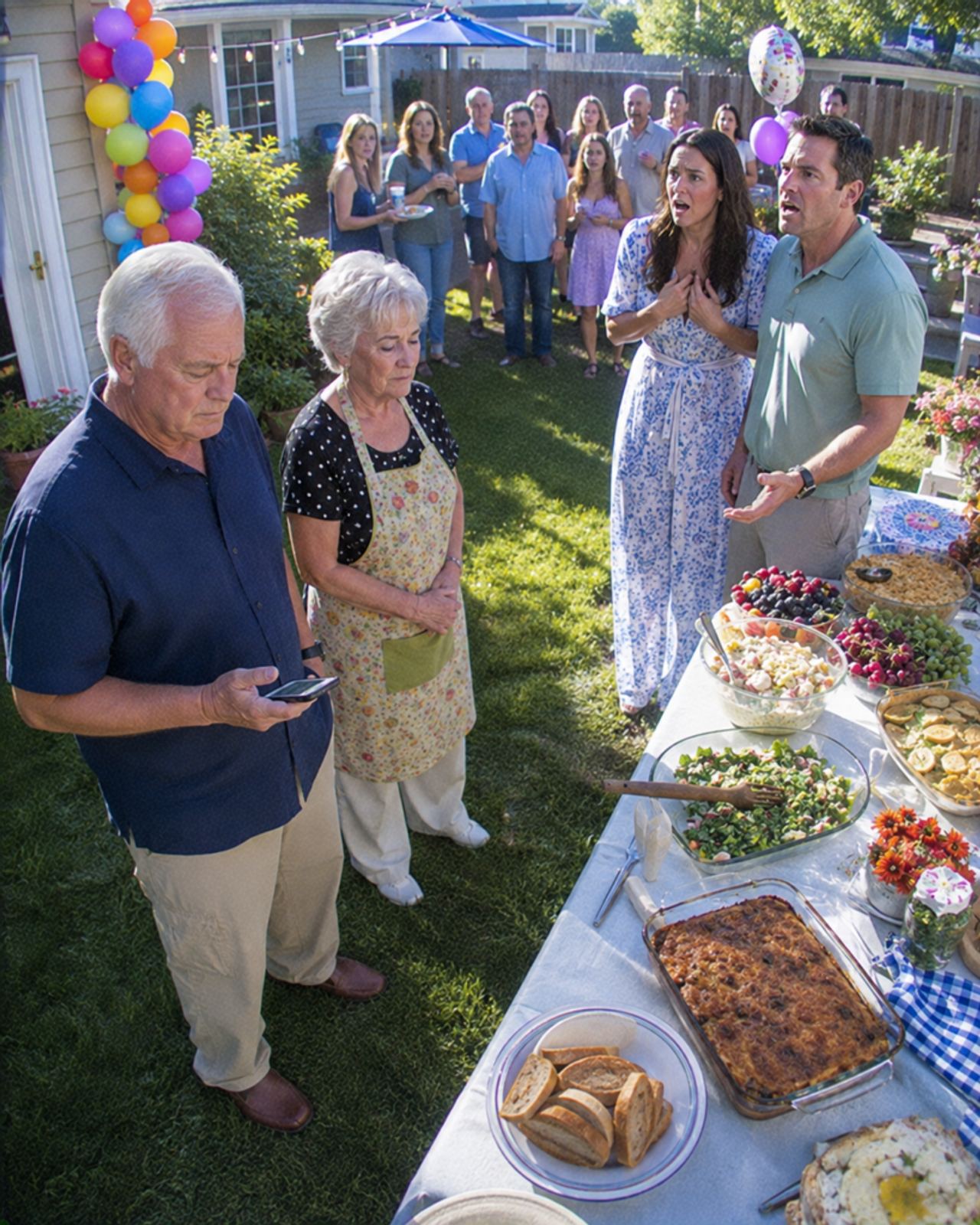
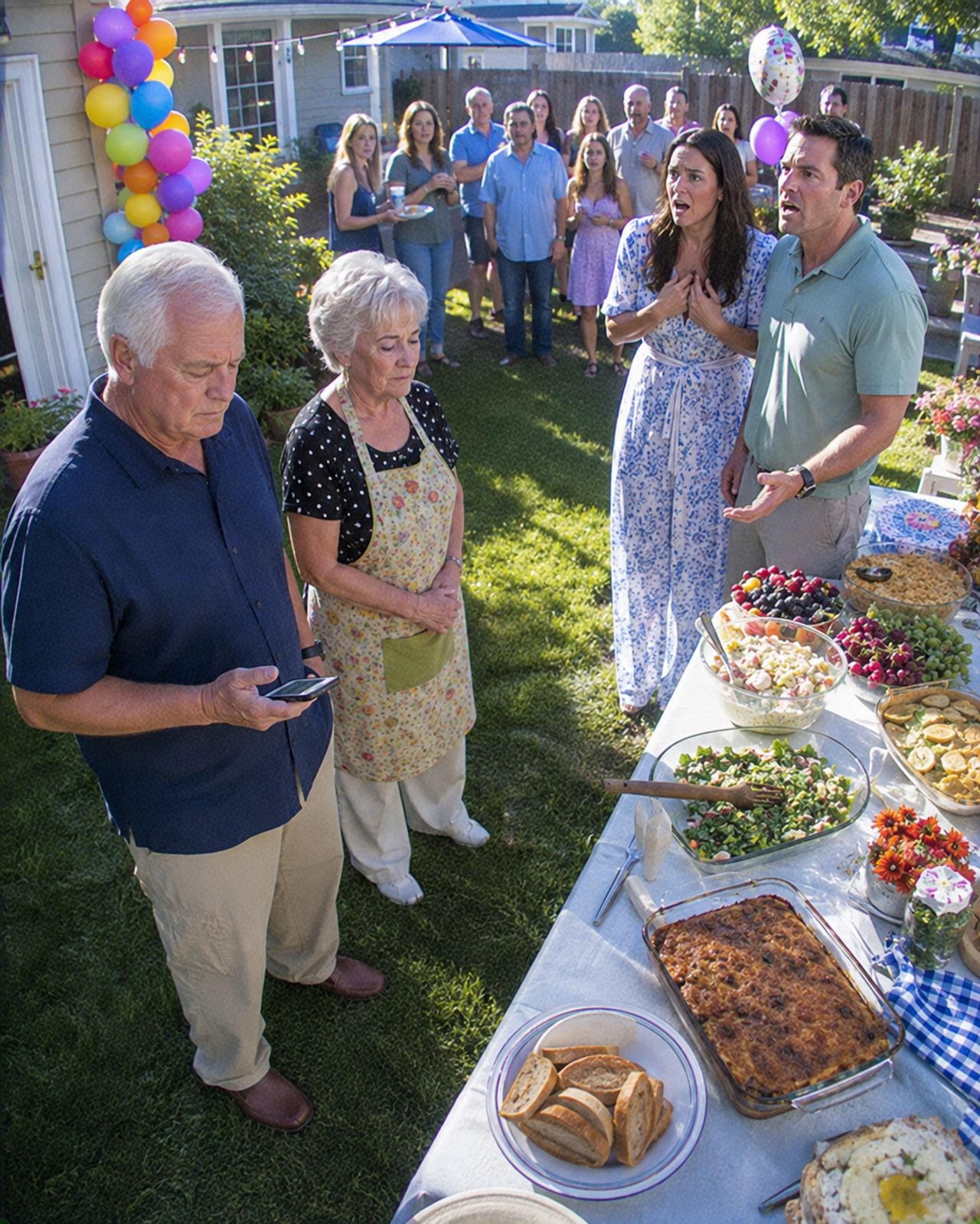
That afternoon, six folding tables stretched across our backyard beneath balloons and simple string lights. We had borrowed chairs from the church hall and neighbors along our block. Thirty-eight dishes waited beneath lids and sheets of foil.
Gloria stood beside me with a narrow bandage around her fingers.
“It’s beautiful,” I told her.
She leaned her head against my shoulder for one quiet second.
Kevin and Tiffany arrived early. Tiffany walked around the yard taking photographs before she greeted Gloria. Her parents arrived next and described the setup as “homey” with carefully polite smiles. Kayla entered with several friends; one girl held up her phone and filmed the tables as though our backyard were something amusing to share.
By three-fifteen, all seventy-five guests had arrived. Children moved between the chairs, relatives gathered near the garage, and the smell of roasted chicken, butter, herbs, and warm cobbler filled the October air.
For several minutes, I thought everything might be all right.
Then Tiffany picked up an empty glass and tapped it with a spoon. The yard became quiet.
“I have a little announcement,” she said.
She explained that she had reserved a private dining room at Rosewood. The restaurant was more elegant, and Kayla deserved “something special” for her eighteenth birthday. Then she looked toward Gloria.
“You can keep the food, of course. Don’t let it go to waste.”
No one spoke. A chair scraped across the concrete. Then another.
Guests began gathering purses, coats, and children. Some avoided our eyes; others offered quick goodbyes that sounded more uncomfortable than sincere.
Kevin walked past the tomato soup without noticing it. He did not look at his mother. Kayla followed her friends through the side gate without turning around.
Within minutes, the backyard was empty.
Six tables.
Seventy-five chairs.
Thirty-eight untouched dishes.
The balloons moved gently against the chain-link fence while steam still rose beneath the foil. Gloria stood in the kitchen doorway holding a single serving spoon, her fingers wrapped tightly around the cool metal.
The steam rising from the roasted chicken and peach cobbler slowly faded into the crisp October air. Beyond the doorway, six tables stood like silent monuments, flanked by empty chairs left at awkward angles where guests had pushed them back to leave. A blue balloon snapped quietly against the fence wire as a breeze blew through the yard.
I stood up from the patio chair, my lower back burning with a familiar dull ache. I walked over to the table where Kevin’s place setting had been arranged.
The bowl of tomato soup was still warm. A thin skin had formed across its surface. Beside it, the small dish of peach cobbler sat untouched, the crust golden and crisp around the edges, exactly the way he used to like it when he was fourteen and stood on his tiptoes to reach the high spices.
“Hank,” Gloria said softly.
I turned around. She hadn’t moved from the doorway. Her eyes were fixed on the empty path leading to the side gate.
“Let’s put the lids back on,” she said. Her voice didn’t shake. It was flat, carrying the same even tone she used when telling a supplier that an order of produce had arrived spoiled. “It will keep longer if we cover it.”
“Gloria—”
“Help me with the foil, Hank.”
We didn’t talk while we worked. For the next hour, the only sounds in the backyard were the rustle of aluminum foil, the clinking of Pyrex lids, and the hum of traffic from the main road two blocks away.
Thirty-eight dishes.
We packed the cold items into our refrigerator first, filling every shelf until the door barely latched. Then we carried the hot dishes into the small dining room, stacking the glass containers on the sideboard, the dining table, and the top of the upright piano Gloria hadn’t played in five years.
When the yard was clear, I went out with a pair of scissors and cut down the string lights. I unknotted the balloons and let them float up into the darkening gray sky.
At seven o’clock, the phone on the kitchen counter buzzed.
I reached for it before Gloria could, but she caught my wrist. Her fingers were cold, the narrow white bandage on her burned hand slightly damp from washing dishes.
“Don’t,” she said.
The screen showed Kevin’s name. It buzzed four times, went quiet, and then lit up again with a text message.
Hope you guys weren’t too offended. Rosewood was great. Kayla was so happy. We can come by later this week to help clean up the backyard.
I stared at the black text on the white background. My hands, calloused from forty years of gripping a steering wheel, clenched into fists until the knuckles turned white.
“He didn’t see the soup,” I said, my voice thick. “He walked right past it.”
Gloria took the phone from my hand, pressed the power button to turn the display off, and set it face down on the counter.
“He saw it, Hank,” she whispered, looking out the kitchen window into the dark. “He just didn’t want to look at why it was there.”
She walked into the living room, sat down in her worn armchair, and closed her eyes. She didn’t cry. I almost wished she would. In all our years together—through the nights when the restaurant’s bank account sat at double digits, through the winters when the heater broke and we slept in our coats—I had never seen her completely motionless.
At nine, I went into the hallway and pulled down the old metal coffee can from the shelf above the coat rack.
I tipped it over on the dining table, right beside three trays of untouched macarons. A small shower of crumpled five-dollar bills, tens, and loose quarters spilled onto the wood.
$587 was gone. The remaining bills inside the can totaled forty-two dollars and fifty cents.
The main heating element in the commercial oven at Gloria’s Corner had blown out two weeks ago. Without it, she couldn’t roast meats or bake her morning pastries. She had been doing small stove-top prep work for two local diners just to keep the lease current, saving every dollar of tips to buy the replacement part.
Now, the money was sitting in three trash bags of specialty groceries and thirty-eight aluminum containers of cold food that nobody was coming to eat.
I didn’t sleep that night. I sat on the edge of the mattress in the dark, watching the streetlights filter through the blinds, listening to the quiet, heavy rhythm of my wife’s breathing.
On Tuesday morning, Gloria put on her coat at six o’clock, just as she had done every weekday morning for thirty years.
“Where are you going?” I asked, standing in the kitchen in my slippers.
“The restaurant,” she said, tying a silk scarf around her neck. “The floor needs sweeping, and the ice machine needs to be emptied so the coils don’t freeze.”
“Gloria, the shop is closed.”
“The lease isn’t up until the end of the month,” she replied calmly. “And we have work to do.”
I drove her down to 47th Street. The sign in the window—Gloria’s Corner: Homestyle Cooking—was dark. The yellow paper notice hung inside the glass, polite and printed: Closed temporarily for equipment maintenance.
Inside, the air smelled of old coffee, floor polish, and stainless steel. It was cold. Without the main oven running, the large kitchen at the back felt like a storage locker.
Gloria didn’t hesitate. She walked to the commercial walk-in cooler, turned the latch, and propped the heavy door open.
“Bring the boxes from the car,” she said.
For the next three hours, we transformed the restaurant into an assembly line once again. But this time, we weren’t cooking. We were re-packaging.
Gloria brought out small plastic takeout containers, masking tape, and a thick black marker. She took the large foil trays of roast chicken, beef stew, and vegan stuffed peppers we had hauled from our house, and divided them into single-portion meals.
On each lid, she wrote the contents clearly: Beef Stew (Extra Onions), Gluten-Free Cornbread, Dairy-Free Macaroni.
“What are we doing with these?” I asked, taping a lid shut.
“Sister Mary at St. Jude’s said the shelter’s kitchen stove went out yesterday,” Gloria said, not looking up as her marker squeaked against the plastic. “They’re serving cold sandwiches until Thursday. They have a heating line, but no way to cook bulk raw food.”
I stopped wrapping a tray of red velvet cake. “Gloria, this cost five hundred—”
“I know what it cost, Hank,” she interrupted softly. She set the marker down and looked at me. Her face looked smaller, the lines around her eyes carved deeper by the fluorescent lights above us. “It cost forty years of thinking that if I just worked a little harder, held my tongue a little longer, and gave a little more, my son would turn into a man who respects his mother.”
The room was completely quiet except for the hum of the walk-in compressor.
“The money is gone,” she continued, her voice steady and clear. “The food is here. I am not going to let it rot in our refrigerator while I feel sorry for myself. And I am certainly not going to leave it here so Tiffany can drop by on Saturday to take half of it home for her book club.”
She picked up the marker again.
“Pack the cobbler, Hank. Use the small bowls.”
At noon, we loaded the trunk of my Buick with seventy-five individual meals.
When we pulled up to the side entrance of St. Jude’s, Sister Mary came out in her dark habit, her eyes wide as she looked into the back of the car.
“Gloria, where did all this come from?” the old nun asked, lifting a heavy box of roast chicken. “This looks like a catered banquet.”
“It was,” Gloria said, handing over a stack of soup containers. “The party was canceled.”
Sister Mary looked at Gloria for a long moment. Nuns who have run inner-city shelters for thirty years know the look of a specific kind of grief—the kind that wears an apron and keeps its shoulders straight. She didn’t ask any more questions. She just touched Gloria’s arm and said, “God bless your hands, my dear.”
We drove back to our house in silence.
When we pulled into the driveway, a late-model SUV was idling by our garage.
Kevin got out from the driver’s side. He was wearing his work suit, his tie loosened at the collar. He looked tired, but when he saw my Buick, he held up a hand and walked toward us.
“Hey,” he said as I cut the engine. “I tried calling you guys this morning. Mom’s phone went straight to voicemail.”
Gloria got out of the car, holding her handbag. She didn’t step toward him; she just stood by the passenger door.
“I was busy,” she said.
Kevin shifted his weight, putting his hands in his pockets. “Look, about Sunday… I know Tiffany kind of changed things at the last minute. But Kayla was really set on Rosewood, Dad. All her friends from school were talking about it, and Tiffany just wanted her to have a cool memory.”
I got out of the driver’s seat and stood on my side of the car, looking at my son across the roof of the Buick.
“She didn’t change things at the last minute, Kevin,” I said, keeping my voice low so the neighbors wouldn’t hear. “She announced it in our backyard after your mother stayed up sixteen hours to make thirty-eight different dishes.”
Kevin frowned, looking annoyed. “Dad, come on. It was a misunderstanding. Tiffany thought you guys were just doing basic snacks. She didn’t realize Mom was going to go all out.”
“She gave your mother a list,” I said. “Thirty-eight items. Written on paper.”
“Yeah, well, Tiffany writes things down when she brainstorms,” Kevin said, waving a hand dismissively. “It wasn’t supposed to be a demand. Mom took it too seriously. She always does that—she overcomplicates things and then gets hurt when nobody asked her to do it in the first place.”
I felt a sudden, hot burst of anger rise in my chest, but before I could speak, Gloria raised her hand.
“Kevin,” she said.
Her voice wasn’t angry. It was almost polite.
“Did you see the soup on the end table?” she asked.
Kevin blinked, caught off guard. “What? What soup?”
“Tomato,” she said. “I made it for you.”
Kevin looked confused, then let out a short, dry laugh. “Mom, I’m thirty-eight years old. I don’t need tomato soup. Why are you bringing that up right now?”
Gloria looked at him for five seconds. She looked at his polished shoes, his clean hands, and the expensive car idling behind him.
“You’re right,” she said softly. “You don’t need it.”
She turned and walked up the front steps toward the door.
“Mom, wait,” Kevin called out, taking a step forward. “Tiffany wants to know if we can grab the folding chairs. Her parents want to use them for a dinner party this weekend.”
Gloria stopped at the front door, key in hand. She didn’t turn around.
“The chairs were borrowed from the church, Kevin,” she said. “I returned them this morning.”
She unlocked the door, walked inside, and shut it firmly behind her.
By Thursday, the news had begun to move through our neighborhood the way news always moves among people who have lived on the same street for thirty years.
Mrs. Higgins from down the block came over with a batch of cinnamon rolls she had bought from the bakery, not realizing that Gloria wasn’t eating sweet things. Mr. Henderson from the hardware store stopped me while I was raking leaves to ask if Gloria’s Corner was really closing for good.
“I heard the oven went out, Hank,” he said, leaning on his rake. “My nephew does commercial gas lines. He said he could take a look at it for cheap if she needs help.”
“Thanks, Jim,” I told him, looking down at the red leaves around my boots. “It’s not just the oven.”
The truth was, the math had caught up with us.
That evening, Gloria sat at the kitchen table with her small green ledger book. The kitchen was completely clean now. Not a single tray remained. The counter was spotless, smelling faintly of bleach and lemon oil.
She had drawn a thick black line down the middle of a blank page.
On the left side, she wrote: Restaurant Expenses.
Lease: $1,200/mo
Electric & Gas: $480
Insurance: $210
Equipment Repair (Oven): $850
On the right side, she wrote: Savings.
Coffee Can: $42.50
Checking Account: $310.00
There was no column for profit. There hadn’t been a real profit for three years. She had been running the restaurant on pure endurance, serving six-dollar lunches to retirees and working-class men who needed a hot meal, cutting her own margins down to the copper wire just to keep the doors open.
I sat down across from her and set a mug of black coffee by her elbow.
“We can sell the Buick,” I said. “It’ll bring three thousand. Enough to fix the oven and pay the lease through the winter.”
Gloria looked up at me. She reached across the table and touched my hand. The bandage was off her fingers now, leaving a pale pink line across the knuckles where the hot rack had burned her skin.
“No, Hank,” she said quietly. “We’re not selling your car.”
“I don’t need it, Gloria. I can take the bus to the dispatch hall if I need to drive extra shifts.”
“You’re sixty-eight years old,” she said, her voice dropping to a whisper. “Your back hurts when you sit for more than an hour. You’ve driven two million miles across this city so I could have my little kitchen. I am not letting you drive another mile for a stove that bakes food for people who don’t even say thank you.”
She closed the ledger book with a soft thud.
“I’m turning the keys in on Monday,” she said.
My heart sank. “Gloria…”
“It’s time, Hank,” she said. She looked around our small kitchen, at the worn linoleum floor and the yellowed wallpaper we had put up when Kevin was five. “I loved that place because I thought I was building something. I thought… I thought if I built a place where people felt taken care of, my family would always have a place to come back to.”
She paused, swallowing hard.
“But a kitchen is just bricks and iron, Hank. If the people you’re cooking for don’t care that your hands are burning, you’re just burning yourself for nothing.”
On Friday evening, a package arrived on our front porch.
It was a large cardboard box from an upmarket department store downtown. Inside was a set of six crystal wine glasses, wrapped in bubble wrap, along with a printed card.
Dear Mom and Hank, Thank you so much for letting us use the backyard for Kayla’s birthday setup! We know it was a lot of clutter. Here is a little something for your china cabinet. Love, Tiffany and Kevin.
I stood in the hallway holding the card. The glasses were delicate, clear, and probably cost a hundred dollars at the mall. They were completely useless to us. We didn’t drink wine. We drank coffee out of heavy ceramic mugs that Gloria had bought at garage sales thirty years ago.
Gloria took the card, read it once, and then set it on the hallway table right next to the empty coffee can.
“Keep the box, Hank,” she said, her voice flat and empty. “We can use it to pack up my cookbooks from the shop.”
That night, for the first time in our forty years of marriage, Gloria didn’t make dinner.
I toasted two slices of bread, spread a bit of butter on them, and brought them to the living room on two paper plates. We sat side by side on the sofa in the dark, watching the local news without listening to the words, chewing our toast in the dark.
On Monday morning, the cold October wind had turned into a steady, freezing rain.
I drove Gloria down to 47th Street for the last time. The landlord, a short man named Mr. Henderson who ran an auto body shop next door, met us at the front entrance of Gloria’s Corner.
He held an umbrella over Gloria’s head as she unlocked the door and stepped inside.
The restaurant was completely dark. We had turned off the pilot lights on the stove on Saturday. The stainless steel tables gleamed under the gray light coming through the front window.
“You sure about this, Gloria?” Mr. Henderson asked, wiping his boots on the mat. “You’ve been here a long time. We could work out something on the rent until spring.”
“I’m sure, Frank,” Gloria said. She handed him a neat stack of three brass keys tied together with a piece of red string. “The grease trap is cleaned out. The refrigeration unit is defrosted and dry. The gas meter reading is written on the notepad by the register.”
Frank looked at the keys in his palm, then looked at Gloria. He sighed, shaking his head. “Neighborhood won’t be the same without your pork chops, Gloria.”
“Everything changes, Frank,” she said gently.
We were loading the last two boxes of her personal items—her battered aluminium measuring cups, her framed food handler’s license from 1986, and her collection of handwritten recipe cards—into the trunk of the Buick when a white sedan pulled up to the curb behind us.
Tiffany got out, holding a large designer umbrella over her styled hair. She was dressed in a beige wool coat, looking completely out of place against the greasy pavement and faded brick storefronts of 47th Street.
“Oh, good, you’re still here!” Tiffany said, walking briskly over to the Buick. “Kevin said you might be closing up early today.”
Gloria stopped putting a box into the trunk. She stood erect, her hands resting on the edge of the open trunk lid.
“Hello, Tiffany,” she said.
Tiffany reached into her handbag and pulled out an envelope. “I wanted to catch you before you went home. We’re doing a small dinner for Kevin’s boss on Thursday night—just eight people. I was thinking maybe you could do those mini quiches and the peach cobbler again? We can pay you for the ingredients this time, obviously.”
She held out the envelope toward Gloria.
I took a step forward, my chest tightening, but Gloria held up her right hand—the hand with the fresh pink scar across the fingers—and stopped me.
Glori…
Read more stories
- My Husband Broke My Leg Because I Refused To Give His Mother The 3 Million I Won In The Lottery. And When The Next Day He Happily Went To The Atm To Withdraw His Paycheck, He Was Horrified By What He Saw…
- Barefoot Girl Brought Newborn Twins to the ER. Then Police Found the Note
- Her Son-in-Law Smirked Until the DNA Envelope Opened
- My mother-in-law offered to take my son to his appointment. At 4:00 p.m., the hospital