
Human Stories
Barefoot Girl Brought Newborn Twins to the ER. Then Police Found the Note
A barefoot seven-year-old girl brings her newborn twins to the ER in a wheelbarrow, leading police to discover a heartbreaking note and the mother’s final instructions. The story reveals both a devastating family tragedy and the child’s astonishing courage in seeking help.

The first thing anyone noticed was the sound.
Not crying.
Not screaming.
A wheel.
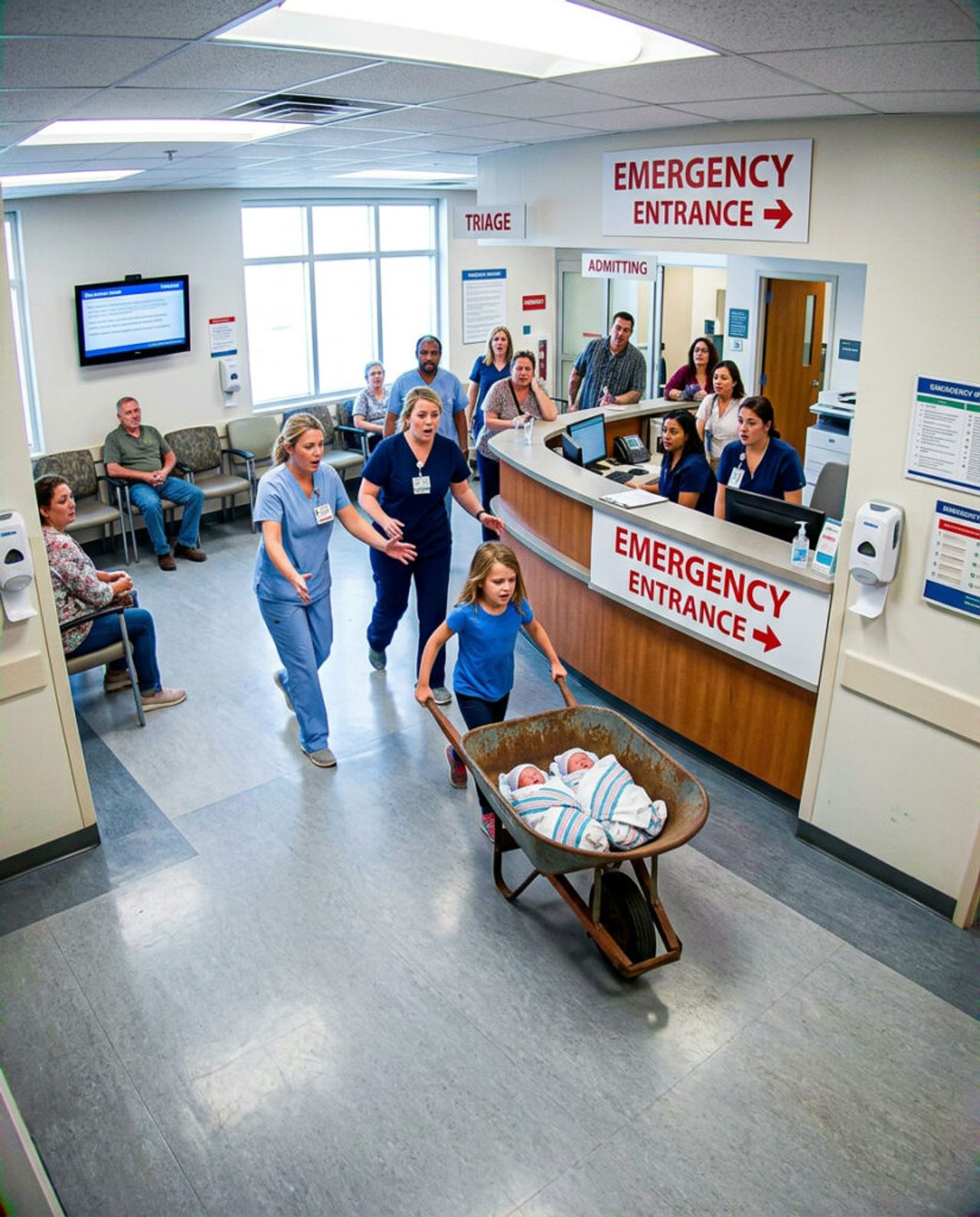
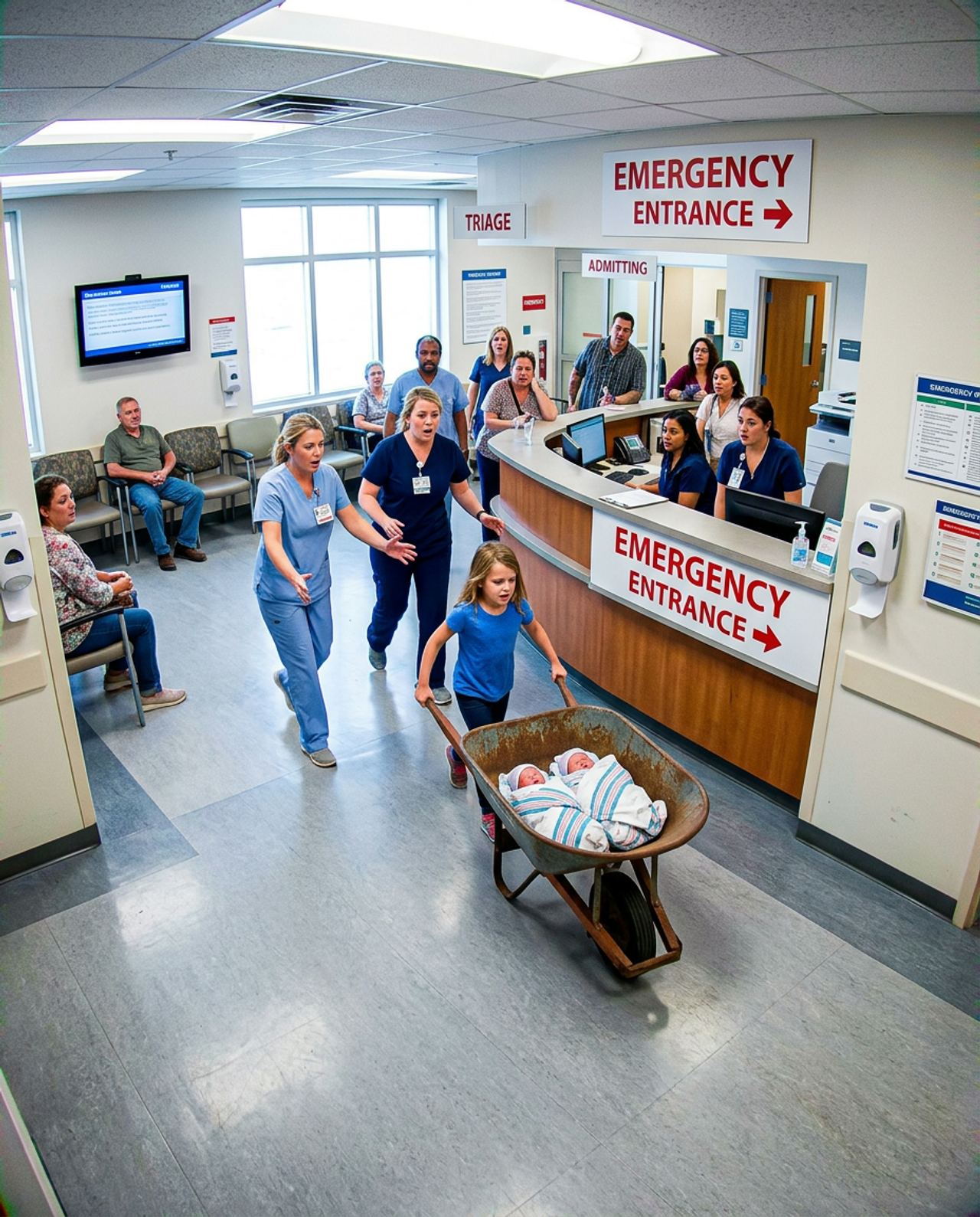
It squealed across the hospital tile in one long, wounded scrape, the kind of sound that made every head in the emergency room turn before anyone understood why.
At first, the receptionist thought a child had wandered in from the parking lot with a toy.
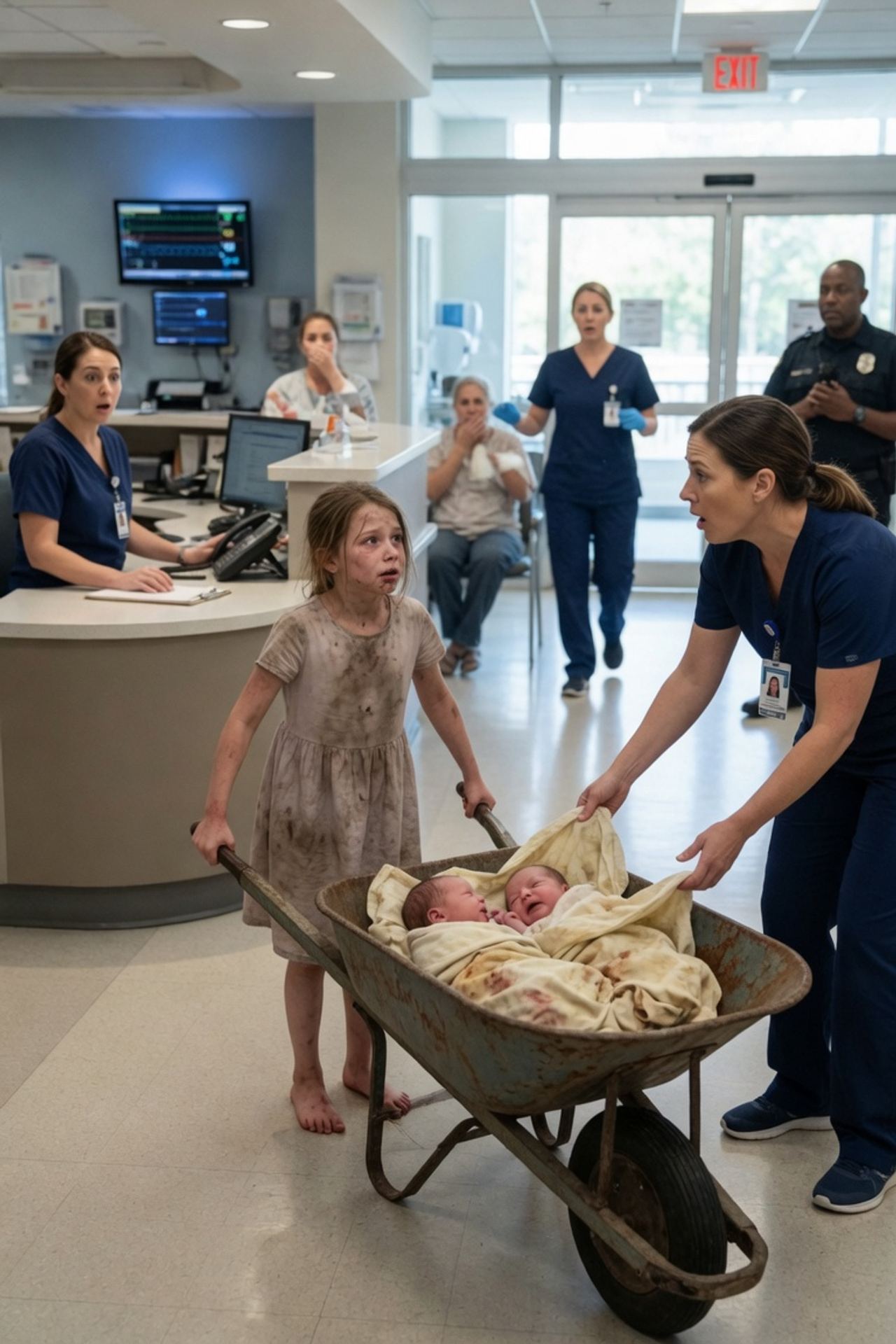
Then she saw the wheelbarrow.
It was dirty, rusty, and far too heavy for the little girl pushing it.
The girl was barefoot.
Her feet were cut along the heels and toes, and each step left a faint red mark on the polished floor.
Her dress hung crooked on her thin shoulders.
Dust clung to her knees.
Her hair was stuck to her cheeks in damp, stringy pieces, and her lips were split from thirst.
She was seven years old.
Maybe.
The receptionist stood halfway out of her chair with one hand still resting on the phone.
“Sweetheart?” she said. “Where are your parents?”
The girl tried to answer, but her voice came out like paper scraping stone.
“Help,” she whispered.
No one moved for one breath.
Then the little girl looked down at the wheelbarrow and said, “My little siblings won’t wake up.”
That was when the nurse at the side station dropped the chart in her hand.
The wheelbarrow had an old yellowish sheet folded inside it.
At first glance, it looked like laundry.
Then the sheet shifted under the nurse’s hands, and everyone saw two newborn faces.
Twins.
So small they almost disappeared in the fabric.
Their skin was pale.
Their mouths were still.
Their tiny hands curled against their chests as if they had tried to hold on to warmth that had already left them.
The nurse scooped the first baby up with the kind of care that turns a movement into a prayer.
A second nurse lifted the other.
Both women went quiet in the same instant.
The babies were cold.
Too cold.
The ER had seen panic before.
It had seen blood and broken bones and parents carrying children through the automatic doors while shouting for someone to do something.
But this was different.
This was silence arriving in a wheelbarrow.
The on-call pediatric physician came running from the back hall.
“How long?” he asked.
The nurse shook her head.
She did not know.
Nobody knew.
The little girl stood beside the wheelbarrow with both hands still gripping the handles, as if letting go might mean she had failed.
“Where is your mommy?” the nurse asked.
The girl stared at the floor.
A fluorescent light hummed overhead.
Somewhere behind them, a printer spat out a page and then another.
The world kept making ordinary sounds around an impossible moment.
“Sweetheart,” the nurse said, softer this time. “Where is your mommy?”
The girl’s chin trembled.
“My mommy has been sleeping for three days,” she said.
The words seemed to drain the air out of the room.
The doctor stopped moving for half a second.
The receptionist covered her mouth.
A man waiting with a towel wrapped around his hand lowered his eyes and stared at the floor like he had no right to witness what he had just heard.
“Sleeping?” the nurse repeated.
The girl nodded.
“She doesn’t move,” she said. “She doesn’t open her eyes anymore. And the babies stopped crying yesterday.”
The doctor swallowed and changed.
His face did not become less kind, but it became sharper.
Focused.
Professional.
Sometimes mercy looks like speed.
“Warmers,” he said. “Oxygen. Neonatal team. Now.”
The nurses moved at once.
The twins were carried toward the treatment bay under heated blankets.
The girl tried to follow, but her knees buckled.
One nurse caught her before she hit the floor.
Only then did anyone realize how exhausted she was.
Her palms were torn open from the wheelbarrow handles.
A blister had burst across the base of her thumb.
Her calves were scratched by weeds and gravel.
There were dark smudges under her eyes that did not belong on a child’s face.
The nurse guided her into a chair, but the girl tried to stand again.
“I have to go back,” she said.
“Not yet,” the nurse told her.
“I told Mommy I would go back for her.”
The nurse crouched in front of her.
“You came here first. That was the right thing.”
The girl shook her head.
“Mom said if something happened, I should come here. That you all help.”
The nurse had to press her lips together before answering.
There are sentences adults say to children because they are preparing for disaster.
There are instructions children remember because love has made them older than they should ever have to be.
This was one of those instructions.
At 2:17 p.m., the intake clerk opened the emergency chart.
She typed child arrived with two newborns and stopped because her hands were shaking too badly to finish the sentence.
At 2:19 p.m., the pediatric team began warming the twins.
At 2:21 p.m., security called county dispatch.
At 2:43 p.m., the police incident report was opened under suspected medical emergency involving unattended minors.
By then, the little girl had given them her first name, her mother’s first name, and the only directions she could remember.
The house was far.
That was how she described it.
Far.
Past the road with the broken fence.
Past the place where the dogs barked.
Past the blue mailbox that looked like it was falling into the ditch.
She did not know the street number.
She knew the mailbox.
She knew the road.
She knew that her mother had told her once, while pointing toward town, that the hospital was where people helped babies breathe.
The social worker arrived at 3:02 p.m.
She found the girl sitting in a pediatric exam room with a cup of water in both hands.
The girl did not drink until a nurse promised the twins were still being helped.
Then she took one tiny sip.
“What are their names?” the social worker asked.
The girl told her.
She said the names carefully, like she had practiced.
Then she asked, “Are they mad at me?”
The nurse turned from the counter so fast the cup lids rattled.
“Who?”
“The babies,” the little girl whispered. “Because I couldn’t make them warm.”
The nurse closed her eyes.
Just for a second.
Then she crouched again until her face was level with the child’s.
“No,” she said. “They are not mad at you. You saved them by bringing them here.”
The girl looked toward the door.
“Mommy said big sisters help.”
“You did.”
“I tried to wake her first.”
The room went still.
The social worker did not interrupt.
The nurse did not move.
The girl kept looking at the door as if she could see the house through it.
“I put water by her mouth,” she said. “But she wouldn’t drink. I put the babies close to her because they were crying. Then they didn’t cry anymore. So I found the wheelbarrow.”
Her voice did not break.
That was the worst part.
She had gone beyond crying somewhere on the road.
By 3:08 p.m., two officers were driving toward the address the child had pieced together from memory.
They passed the broken fence.
They passed the place where the dogs barked.
They found the blue mailbox, bent sideways near the ditch exactly as the little girl had said.
The driveway was dirt.
Long.
Washed thin in places by old rain.
One officer later wrote in his report that he saw wheelbarrow tracks pressed into the mud near the porch and followed them backward with his eyes toward the road.
The tracks were crooked.
They swerved where the wheel must have caught stones.
They stopped and started again in shallow gouges.
A grown person would have struggled with that load.
A seven-year-old had pushed it for miles.
The front door of the house was partly open.
The first officer knocked.
No answer.
He called out.
Still nothing.
Inside, the house was small and hot.
A sink full of dishes stood beneath the kitchen window.
A baby bottle sat on the counter, half-full and filmed over.
A towel had been folded on the floor beside the couch as if someone had tried to make a clean place in a room that had run out of strength.
The mother was in the bedroom.
She was lying on her side, one hand reaching toward the edge of the bed.
Near that hand was a kitchen chair pulled close, as if the little girl had climbed up beside her again and again to check whether she was breathing.
The officers called for medical backup, but they already knew.
The mother had been gone for some time.
On the kitchen table, they found the first note.
It was written in uneven handwriting on lined notebook paper.
The words were short.
Some were crossed out.
The first line read: If I don’t wake up, take the babies to the hospital.
The officer did not speak for several seconds.
Under the note was a hospital discharge packet stamped 11:38 p.m., three nights earlier.
There were three wristbands on the table.
One for the mother.
Two for the twins.
There was also a printed instruction sheet about postpartum warning signs, folded open and marked with a shaking circle around one section.
The discovery changed the way everyone understood the house.
It was not a house where a mother had ignored her children.
It was a house where a mother had tried to survive long enough to tell her daughter what to do.
In the trash, officers found opened formula samples.
Beside the sink was a measuring spoon.
On the counter was a page torn from a child’s workbook where the mother had written the hospital name in large block letters.
The little girl could not read all of it.
But she had remembered the direction.
She had remembered the promise.
She had remembered that help existed somewhere beyond the road.
The second officer found the envelope on a chair under the yellowish blanket’s matching pillowcase.
The girl’s name was written across the front.
Inside was one page.
It began, My brave girl.
The officer looked away before he finished reading it.
There are moments when procedure cannot protect a person from the humanity of a room.
He logged the envelope anyway.
He photographed the table.
He photographed the discharge packet.
He photographed the baby bottle, the wristbands, the note, the wheelbarrow tracks, and the blue mailbox.
Every detail became evidence.
Not because anyone was building a case against the mother.
Because the truth deserved to be handled carefully.
Back at the hospital, the twins were under warmers.
One had begun making a faint, uneven sound.
Not a full cry.
Not yet.
But sound.
The nurse who had first lifted him from the wheelbarrow put one hand over her own mouth when she heard it.
The second twin needed longer.
The doctor stood beside the warmer with his stethoscope tucked against his neck, watching the monitor as if he could persuade the numbers by refusing to look away.
The little girl had been cleaned up as much as she would allow.
Her feet were bandaged.
Her palms had ointment and gauze across them.
She kept asking for the wheelbarrow.
Finally, the nurse told her it was safe.
“It brought them here,” the girl said.
“Yes,” the nurse answered. “It did.”
“Can Mommy come now?”
The social worker looked at the nurse.
The nurse looked at the doctor.
No training makes that question easy.
The officer arrived at the hospital just before evening.
He did not come into the child’s room right away.
He stood in the hall with the social worker and spoke in a low voice.
The nurse watched the social worker’s face change.
The color left it slowly.
Then the officer handed her the envelope.
The social worker held it with both hands.
“She wrote to her,” the officer said.
The nurse turned toward the exam room window.
Inside, the little girl sat on the bed with her bandaged feet sticking out from under a blanket.
She looked impossibly small.
When the social worker entered, she sat down first.
She did not stand over the child.
She did not rush.
She asked whether the little girl wanted to hold the envelope.
The girl nodded.
“Is it from Mommy?”
“Yes,” the social worker said.
The girl pressed the envelope to her chest.
“Can you read it?”
The social worker’s voice held, but barely.
She read slowly.
The note told the little girl she was loved.
It told her none of this was her fault.
It told her that if the babies were crying and Mommy would not wake up, she had to go to the hospital.
It told her not to wait for anyone else.
The last line was the one that broke the nurse.
You are seven, but you are not alone.
The girl listened without moving.
Then she looked down at her bandaged hands.
“I was alone on the road,” she said.
The social worker nodded, tears standing in her eyes.
“I know.”
“But not now?”
“Not now.”
The first twin cried that night.
It was thin and angry and beautiful.
The sound carried through the unit, and three nurses turned at once.
The second twin followed before midnight.
No one cheered loudly.
Hospitals do not always allow big reactions.
But the nurse who had opened the yellowish sheet stepped into the supply room and cried into a stack of clean blankets.
The official findings came later.
Medical staff determined the mother had likely suffered a catastrophic postpartum complication after coming home with the twins.
She had been discharged late at night, exhausted, without anyone at the house strong enough to help her.
There was no partner listed.
No family member had signed the release forms.
No neighbor had known she was in danger until police lights appeared near the bent blue mailbox.
The part no one expected was not that she had died.
That was tragic enough.
The part no one expected was how hard she had tried to plan around her own death.
She had prepared bottles.
She had written directions.
She had marked the warning sheet.
She had told her daughter where people help.
And when her body failed, that little girl obeyed every word she could remember.
The wheelbarrow was later cleaned and stored by the county while the investigation closed.
The hospital kept the yellowish sheet only long enough to document it, then replaced it with two warm blankets from the neonatal unit.
The little girl asked whether the babies could keep those blankets forever.
A nurse said yes before anyone could explain policy.
Some rules are written for ordinary days.
This was not one.
In the weeks that followed, the girl stayed under protective care while relatives were located and reviewed.
The twins remained hospitalized until doctors were confident their temperatures, feeding, and breathing were stable.
The little girl visited them with her hands still bandaged.
She stood on a stool between their bassinets and whispered their names.
“I told you we were going to the help place,” she said.
The nurse pretended to adjust a monitor so the child would not see her wipe her eyes.
The story moved through the hospital quietly at first.
Then through dispatch.
Then through the county.
People talked about the wheelbarrow.
They talked about the bare feet.
They talked about the twins.
But the people who had seen her never told it like a miracle story.
They told it like a warning.
A warning about how invisible a mother can become when she is poor, tired, alone, and sent home with instructions instead of support.
A warning about how children notice everything adults pretend is manageable.
A warning about how help cannot only exist at the end of a road if the person who needs it cannot reach the road.
Months later, the nurse still remembered the sound of that wheel.
She remembered the red marks on the tile.
She remembered the girl asking whether the babies were mad at her because she could not keep them warm.
Most of all, she remembered what she had told the child in the exam room.
You did exactly right.
She would repeat it every time the girl needed to hear it.
Because a child should not have to push a wheelbarrow for miles to prove she loves her family.
A child should not have to measure love in miles.
But that day, a seven-year-old girl did the only thing left to do.
She followed the last instruction her mother gave her.
She walked until her feet bled.
She pushed until her hands tore open.
She carried her newborn siblings through dirt, heat, and fear because she believed one sentence with her whole heart.
That you all help.
And when she finally reached the hospital, the people inside did.