
Stories
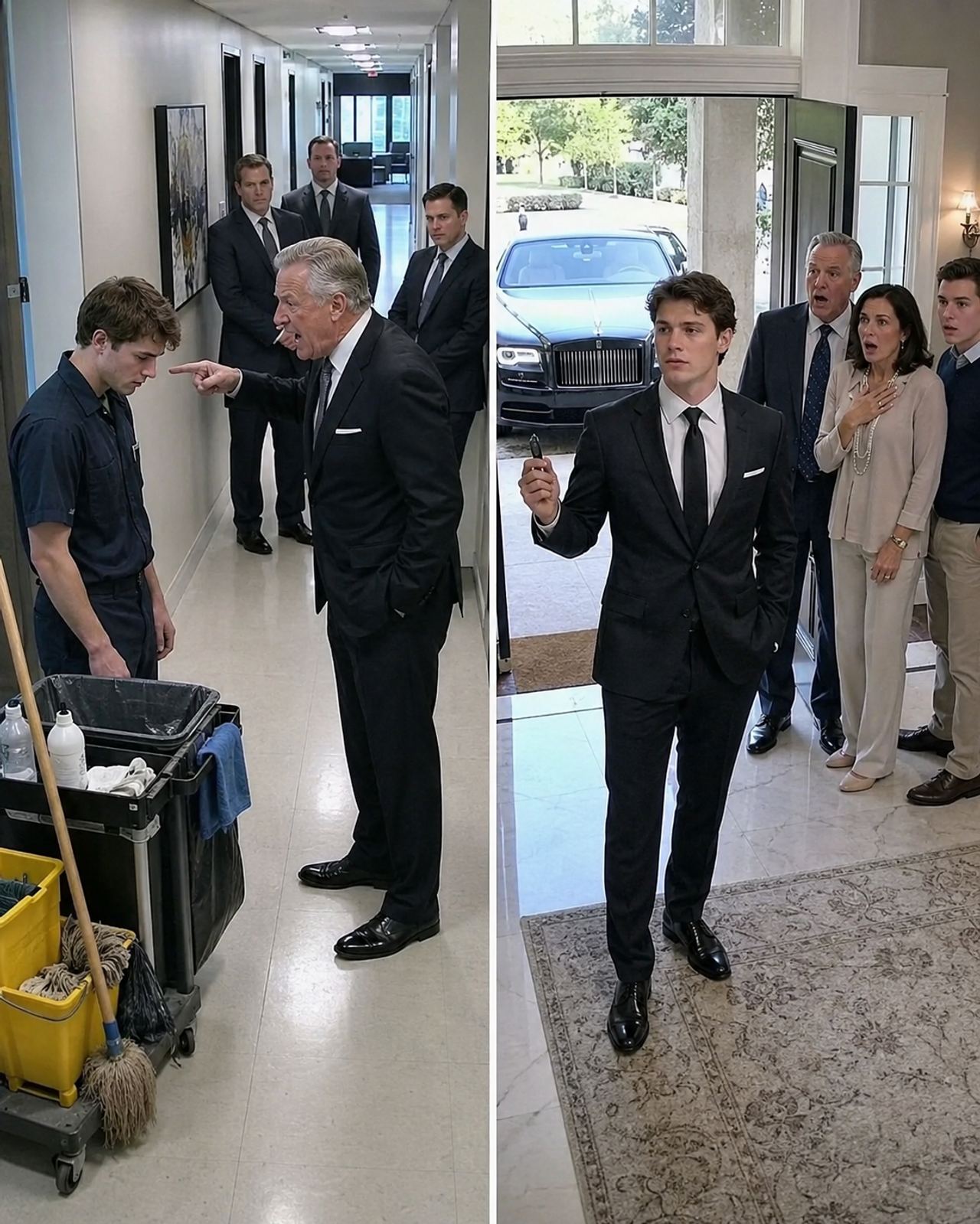
My family spent three years laughing at me for being a janitor while I quietly sat on $280 million in lottery money.
A neglected son quietly becomes a secret millionaire, building a hidden financial life while testing whether his family values him at all. After years of humiliation, he finally forces a reckoning that reveals exactly what his family is made of.

I kept the uniform, the old Corolla, and the basement room because I wanted to know if they loved me without status.
Yesterday, they called me a disgrace and kicked me out.
Today, I returned in a Bugatti to pick up my boxes—and my father fainted when he saw my face.
I remember the heavy silence more than anything else that happened in that small room.
It was not a scream.
It was not the sound of a chair scraping back against the floor.
And it certainly was not the wild laughter people imagine when someone wins a massive jackpot.
There was only the dying rattle of the old space heater in the corner and the steady drip of water behind the concrete wall.
The thin and distorted voice of the lottery host came through my battered laptop as he read the winning numbers one more time.
Four.
Twelve.
Twenty-eight.
Thirty-five.
Forty-two.
Mega Ball eleven.
I sat on the edge of a fold-out bed in the basement of my parents’ house in Fairhaven Cove, a polished coastal suburb where every lawn looked perfectly maintained and every family secret was hidden behind hydrangeas and fresh paint.
My laptop rested on three cardboard boxes stacked into a crooked tower. One of those boxes still had a label written in my mother’s elegant handwriting.
Unimportant storage.
The first time I saw it, I almost laughed at the irony.
Even a cardboard box had found a cleaner way to describe my existence than my family ever had.
Above my head, the rest of the house glowed with warm light and the sounds of celebration. A dinner party was unfolding on the main floor, and I could hear laughter drifting through the vents while forks clicked against expensive porcelain.
My father’s voice rose above the others, calm and commanding, because Harrison Miller was a man who expected every room to rearrange itself around him.
That night, my family was hosting what my mother called a small dinner, although nothing she ever did was actually small. There were two executives from Horizon Power, the clean energy company my father helped run, along with a city councilman and his wife, old friends whose bank accounts mattered more than their personalities, and a young woman my mother wanted my older brother, Colton, to meet.
I had not been invited to join them.
No one said that out loud.
They never did.
Exclusion in the Miller household was never announced. It was arranged. A missing chair. A place card that never existed. The way conversation paused when I entered a room and resumed only after I left.
Before the guests arrived, my mother had come down to the basement wearing pearl earrings and a silk blouse while her perfume filled the damp air like an accusation.
She glanced around the room as if she were embarrassed for the walls.
“Julian, please stay downstairs unless it is absolutely necessary for you to come up,” she said without looking me in the eye. “We have people over tonight.”
Those words had been the condition of my existence for as long as I could remember.
Stay downstairs.
Stay quiet.
Stay out of the frame.
I had nodded as she turned to leave.
Now, less than two hours later, the numbers on my screen had made me one of the richest men in the state.
I thought seeing those winning numbers would make me feel something violent and bright—joy, relief, disbelief, maybe even the urge to run upstairs and shout.
Instead, a heavy calm settled inside me.
It felt deeper than excitement and colder than happiness.
It felt like a steel door was finally closing between the life I had known and the one that was about to begin.
The lottery host announced the jackpot again.
Four hundred and fifty million dollars.
After taxes and the lump sum reduction, the final amount would be somewhere around two hundred and eighty million.
That was enough money to buy houses.
Companies.
Silence.
Enough money to stop asking permission to exist.
And, most importantly, enough money that no one in my family would ever be able to trace it back to me unless I wanted them to.
I opened the dented drawer beside the bed and pulled out a matte gray business card with two lines printed in understated type.
Eleanor Halbrook.
Private Counsel.
Trusts. Asset Protection. Discretion.
I ran my thumb along the edge of the card while Colton said something upstairs that made the dining room erupt in laughter.
My name floated down through the vent in a broken way. I couldn’t hear the whole joke, but I didn’t need to.
I knew the shape of it.
Julian the basement ghost.
Julian the failure.
Julian the cautionary tale.
Julian, proof that not every Miller was born to stand in the light.
I placed Eleanor’s card on the box beside me and stared at the screen until the numbers blurred into a glow.
For the first time in my life, I did not need them to stop laughing.
I did not need them to notice me.
I only needed them to keep being themselves a little longer.
The lottery had given me the power to wait.
And waiting was something I had learned to do better than anyone else in that house.
Three years before the winning numbers appeared, I walked into a gray limestone building in the old financial district carrying fifty thousand dollars in cash.
The building sat between a private art gallery and a watch boutique, and there was no sign on the glass front door. I was wearing my navy maintenance uniform from Horizon Power, and the name patch on my chest said JULIAN in stitched white letters.
No one in my family knew I worked at the company my father helped lead, even though Harrison Miller prided himself on knowing everything worth knowing.
He claimed he could sense a bad quarter before the accountants finished their reports. He claimed he could smell weakness in boardrooms, in vendors, in competitors, in men who shook hands too softly.
But my father only noticed people who mattered to his idea of the world.
The janitors, security guards, mailroom clerks, night-shift technicians, drivers, cafeteria workers, and maintenance staff who kept the company running after the executives went home were invisible to him.
I built my second life inside that blind spot.
When I stepped into Eleanor Halbrook’s office that first day, the receptionist gave my uniform a cautious look.
“I have an appointment with Ms. Halbrook,” I said.
She checked her calendar. Her expression changed when she saw my last name.
“Mr. Miller?”
I nodded.
Confusion crossed her face. The Miller family name meant something in Fairhaven Cove. It was printed on donor plaques, charity programs, country club rosters, board committees, and the sides of buildings my father liked to stand in front of during photos.
It did not usually appear on the chest of a man in a maintenance uniform carrying an old gym bag full of cash.
I followed her down a quiet hallway to an office overlooking the bay.
Eleanor Halbrook sat behind a desk with no family photographs, no flowers, no soft decorations. Just documents, a silver pen, and a view of white sailboats moving across afternoon water.
She was in her mid-forties then, with dark hair cut just below her jaw and the calm presence of someone who had heard every kind of lie and had learned to let silence do half the work.
She looked at me, then at the worn gym bag beside my chair.
“Is that cash?” she asked.
“Yes,” I said. “Fifty thousand dollars.”
She did not flinch.
That was the first reason I decided to trust her.
“Is there any reason this money cannot be deposited normally?” she asked.
“No. I just didn’t want anyone at my bank seeing it and making a phone call.”
“To whom?”
“My family.”
Her eyes sharpened.
“Are you hiding from creditors?”
“No.”
“A spouse?”
“No.”
“Tax authorities?”
“No. I want everything legal.”
“Then what are you preparing for?”
I looked out the window at the sailboats and struggled to find the right words.
“I want to know whether my family loves me,” I said finally, “or whether they only tolerate me when I am easy to ignore.”
Eleanor did not smile.
She did not pity me.
She folded her hands over a blank file.
“And you believe money will help you find that answer?”
“No,” I said. “I believe not telling them about the money will give me the answer.”
She tapped her pen once against the desk.
“Your family is already wealthy.”
I laughed softly.
“My family looks wealthy. They’re living on the edge of a cliff.”
From the outside, the Millers had everything: the stone house, tailored clothes, antique furniture, charity plaques, tasteful cars, curated vacations, framed portraits taken on Cape Cod. But I saw the refinanced mortgage, the late-night arguments over bills, the unopened envelopes in my father’s study, the way my mother’s hands shook when caterers required deposits in advance.
That is the advantage of being invisible.
People forget to hide the truth from you when they don’t believe you matter.
Eleanor opened a new folder.
“What are you building?”
“An exit.”
“From what?”
“From needing permission to exist.”
That was the moment Zenith Crest Holdings was born.
At first, it was only a name written in Eleanor’s hand.
Then it became a legal structure.
Layers of companies.
Nominee managers.
A blind trust.
A holding entity that could receive assets without exposing me.
Eleanor asked what kind of assets I expected to receive.
I told her the truth.
“I buy lottery tickets every week.”
She raised an eyebrow.
“The odds are not good.”
“I know.”
“And if the impossible never happens?”
“Then this still protects what I build on my own.”
She looked at me for a long moment.
“You are very patient, Mr. Miller.”
“I had to become that.”
I left her office with an empty gym bag and a strange new feeling of protection.
It was the first secret I had ever kept that existed to protect me from them instead of protecting them from me.
The Miller house sat on a low hill where the neighbors kept their lawns so perfect they looked computer-generated.
From the road, our house looked like success made permanent: white stone facade, tall black shutters, double-height windows, broad porch, copper lanterns, and a curved driveway lined with boxwood.
Every summer, my mother hosted garden parties and told guests that family was the most important thing in her life.
I usually heard that line from the kitchen or from the basement stairs.
In our house, family was a piece of theater where my father wrote the script and my mother arranged the lighting.
Harrison Miller had the kind of presence that made people straighten their backs when he entered a room. He believed in discipline, ambition, and hierarchy. He only cared about success that could be recognized by strangers.
He did not care if you were kind.
He cared if people clapped.
I never gave him answers he knew how to value.
My brother Colton did.
Colton spoke early, ran fast, and learned young that confidence could be mistaken for competence if he acted aggressively enough. He had my father’s jaw, my mother’s golden hair, and the natural talent of entering any room as if applause were running late.
I was the quieter child.
The one who read in corners.
The one who noticed when adults lowered their voices to lie.
The one who remembered numbers, patterns, receipts, pauses, tone changes, and the way my mother’s smile became thinner when she saw me standing too close to important people.
My mother, Beatrice, was not cruel in a way outsiders could easily recognize.
She simply withdrew warmth by degrees.
A slight pause before answering me.
A smaller birthday cake.
A dress shirt purchased off-season while Colton’s were tailored.
A framed family portrait where I stood near the edge, half-shadowed by a plant. In one photo, half my shoulder was cut off. In another, my eyes were closed. My mother never noticed.
I spent years telling myself it was an accident.
They were busy.
They were stressed.
Colton needed more.
I was easier.
I stopped inventing excuses when I was twelve years old and baked a lemon cake for their anniversary.
I found the recipe in my grandmother’s old notebook. She was the only person who ever called my gentleness a strength.
The first cake collapsed.
The second one burned.
The third looked like a real offering to me.
I placed it on the dining table with two small candles just as my parents came home arguing about something.
My mother saw the cake.
For one second, her face softened.
I believed, foolishly, that she might love me in a way I could see.
Then she frowned.
“Julian, did you make a mess in my kitchen?”
My father loosened his tie.
“You should have asked before using the expensive equipment.”
Colton walked past, glanced at the cake, and laughed.
“It looks like a construction brick.”
No one ate a single bite.
Later that night, I found the cake in the trash.
I pulled it out and sat on the back steps in the dark, eating every dry, clumped bite while the house glowed behind me.
Some wounds do not arrive like a stab.
They fall like dust until you realize you have been buried alive.
The basement became my permanent room when I was twenty-two, after my father announced that I needed to learn responsibility.
I had left college because I could not afford the next semester. My family refused to pay for what they called an uncertain investment.
They still leased new cars for Colton.
They still donated to the arts.
They still sponsored charity luncheons.
But there was no money for me.
My father said, “A man stands on his own feet.”
My mother said, “Maybe this will help you find direction.”
Colton said, “Basement suits you.”
So I moved downstairs.
Temporary, I told myself.
Time has a way of turning cruelty into routine.
Three years later, no one asked why I still lived there.
The people upstairs did not want to know.
I got the job at Horizon Power on a rainy Tuesday in March when the human resources department did not recognize my name.
I used my full legal name, Julian Elias Miller, but the supervisor only cared if I could work night shifts and clean executive bathrooms without complaining.
“I can do the work,” I said.
That was how I became a janitor at the company my father treated like a kingdom.
Horizon Power was the pride of Fairhaven Cove. At parties, my father called it the place where serious people built the future.
I called it the place with thirty-seven trash cans and four restrooms that clogged regularly on the executive floors.
My shift started at six in the evening just as salaried employees were leaving. I pushed a cleaning cart through glass corridors and wiped away footprints of people who made big decisions.
No one looked at me.
No one acknowledged me.
That became my greatest education in business.
People took private phone calls while I changed trash bags. They left sensitive documents on desks. They discussed deals, layoffs, scandals, promotions, betrayals, and strategy in front of me because they did not think I was capable of understanding them.
I did not steal information.
But I listened.
Then I went home and learned.
I learned that my father had tied his reputation to several risky bets that were not going well.
I learned that Colton often did not understand the documents he signed in corporate development.
I learned that Horizon Power’s public confidence had become thinner than anyone admitted.
After shifts, I returned to the basement, opened my laptop, and read filings, market data, analyst notes, acquisition patterns, supply-chain documents, patent disputes, and energy-policy briefs.
Then I started investing the small amounts I saved from my job and from my grandmother’s inheritance.
My first big return came from a thermal-storage manufacturer in Oregon that everyone else dismissed as too niche. I bought early. Two years later, the company was acquired, multiplying my money seventeen times.
Most of that money went through Eleanor.
“What exactly are you building?” she asked during one meeting, looking over the accounts.
“A way out.”
“You already said that.”
“Then I’m building a better one.”
By the time the lottery ticket hit, Zenith Crest was already a fully functional machine waiting for fuel.
I claimed the prize quietly.
Two weeks later, the news reported that an anonymous winner had taken the lump sum.
Commentators speculated about the identity.
A shipping magnate.
A retired teacher.
A hedge fund partner.
A syndicate.
No one guessed it was the janitor from the twelfth floor.
I did not quit my job.
I did not move out of the basement.
Eleanor became furious with me.
“You can leave tonight,” she said in her office, closing the folder harder than necessary. “You can buy an island. A building. Half of Fairhaven Cove. Why are you still sleeping under people who treat you like mildew?”
“Because I want the answer.”
“You already have it.”
“No,” I said. “I have the old answer. I want the final one.”
“What if the final one destroys you?”
I looked at her.
“It can’t. The money did one thing already.”
“What?”
“It proved I have somewhere else to go.”
Eleanor stared at me for a long time.
Then she said, “Waiting for people to love you can become another form of self-harm.”
“I know.”
“Do you?”
“No.”
She sighed.
Still, she helped me build the walls higher.
After the lottery, I began saving my family from the shadows without them ever knowing.
I did not do it because they deserved it.
I did it because some pathetic, loyal part of me still wanted to be useful to them in a way that might eventually become visible.
The first thing I fixed was the mortgage.
My father had refinanced the house too many times to keep up appearances. Zenith Crest purchased a portion of the note through a subsidiary and adjusted the repayment structure to keep the bank from pushing harder.
That evening, my father lifted his wine glass and said, “The system finally remembered who it was dealing with.”
Colton grinned.
“That’s how Dad handles business.”
I sat at the end of the table and said nothing.
The second problem was Colton’s gambling debt, which he called data-driven sports investing to sound intelligent.
Private lenders threatened to expose him.
I paid them off through a legal settlement and airtight confidentiality agreement.
Two weeks later, Colton bought a new watch and told my mother the market had finally turned in his favor.
She smiled proudly.
“Colton always knows how to land on his feet.”
The third crisis was a tax audit on my mother’s arts foundation. Her administrator had mishandled deductions and routed donations badly. I hired the best tax attorney in the state and shielded payment through a donor-advised fund.
At a luncheon, I heard my mother tell her friends, “It is encouraging to know people still value the arts.”
I was standing behind the kitchen door holding a tray of cookies.
One of her friends asked, “Is Julian still living at home with you?”
My mother paused just long enough for the answer to hurt.
“Yes,” she said. “He is still finding his direction.”
By then, I owned three luxury apartments, controlling stakes in several companies, and enough capital to buy the entire street where she stood.
I kept saving them.
I acquired shares in Horizon Power when the company faced a hostile takeover from Titan Energy.
When a board member tried to push my father out, I leaked the right truth to the right people to shift the threat elsewhere.
Colton was promoted because an anonymous consultant sent a strategic analysis to his team. He presented it as his own.
My father clapped him on the shoulder.
“Real leadership instincts,” he said. “Not everyone has that.”
I stood near the kitchen and listened to ice melt in his glass.
Once you see a magic trick from behind the curtain, the applause becomes absurd.
One winter night, I tried to pass the dining room unnoticed, but my father called my name.
“Julian.”
I stopped.
He was reading an email on his phone. My mother sat beside him with a glass of white wine, scrolling through fabric samples. Colton was stretched across the sofa, shoes on a pillow my mother would have scolded me for touching.
“There are designers coming tomorrow to assess the basement,” my father said.
“For what?”
“We’re considering a renovation,” my mother said lightly. “A wine room, perhaps. Or a media lounge.”
I looked at her.
“My room is in the basement.”
She blinked once, as if she had forgotten.
“Of course, sweetheart. We would find somewhere temporary for you.”
Colton laughed.
“The laundry room has space.”
My mother smiled before remembering she should not.
I looked at my father.
He did not look up from his phone.
“Don’t be difficult. We’ll discuss it after the assessment.”
No, I thought.
We won’t.
But I said nothing.
I went downstairs and sat on my bed for a long time.
I was not angry.
Anger requires expectation.
I was running out of those.
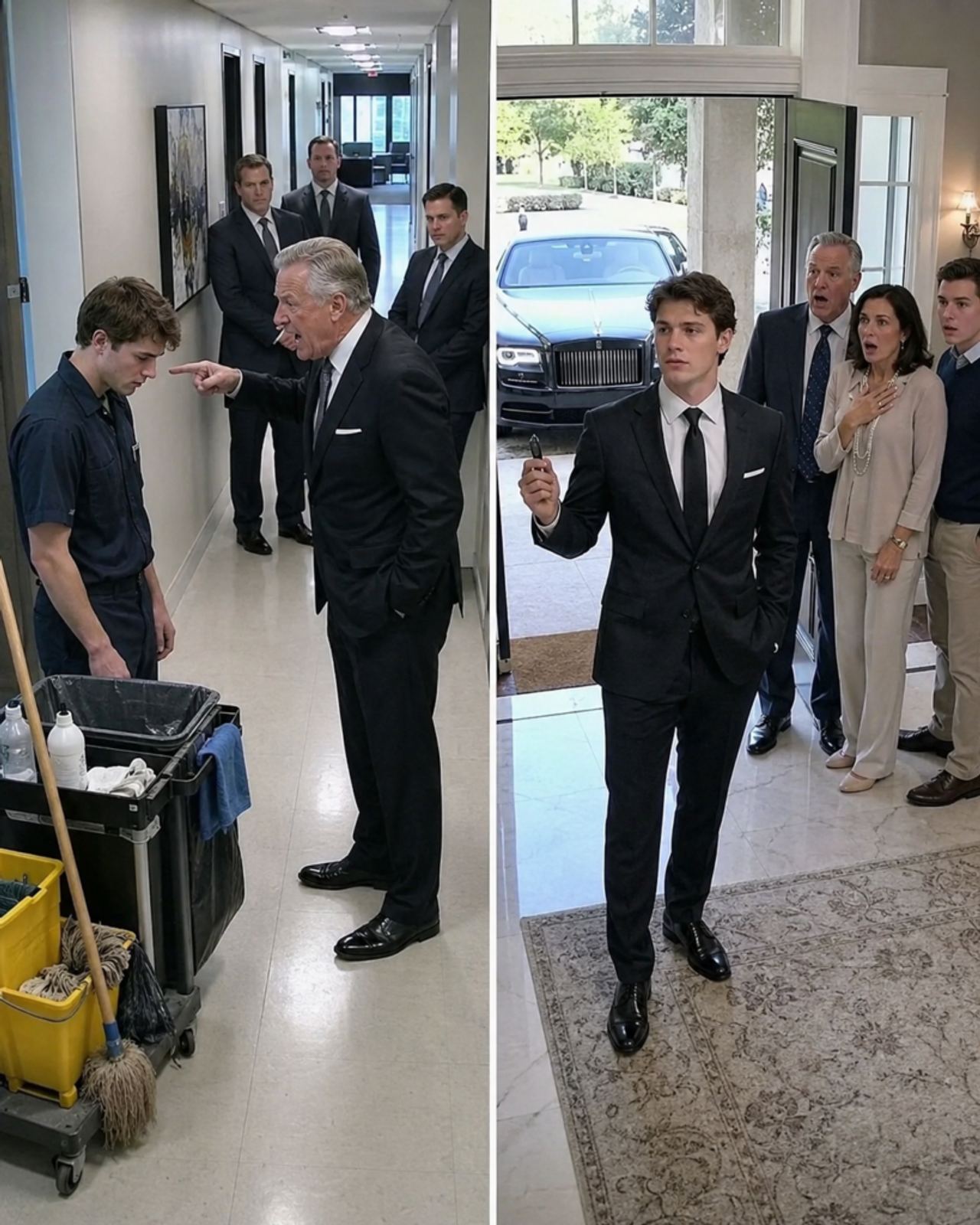
I never intended for my father to discover I worked at Horizon Power as maintenance staff.
One Thursday night, my shift changed. I was wiping a coffee stain near the conference room when the elevator opened.
My father stepped out with two men in suits.
I lowered my head, hoping invisibility would do what it had always done.
“Julian?”
The word cut through the polished corridor.
I stood.
The two men stopped, looking at my uniform, my name patch, then my father’s face.
“Hello, Father,” I said.
His expression shifted through confusion, shock, then embarrassment.
He told the men to give him a minute. They walked away pretending not to listen.
“What are you doing here in that uniform?” he hissed.
“Working.”
“At my company?”
“It isn’t your company.”
His face darkened.
“Do you understand how this looks to my colleagues?”
“I needed a job.”
“You could have come to me if you were that desperate.”
“I did. For tuition. For car repairs. For help.”
He adjusted his cuff, as if my need had become lint on his sleeve.
“You were humiliating yourself. Now you’re humiliating me.”
There it was.
The only injury he recognized.
His.
“You told me to stand on my own feet,” I said quietly.
“Not in front of people who know me.”
That sentence stayed in the air between us.
He stepped closer, cologne overpowering floor cleaner.
“Quit. Immediately.”
“No.”
His eyes widened.
It may have been the first clean no I ever gave him.
“No?”
“I won’t quit.”
His voice became low and lethal.
“Then make sure I never see you here again.”
He walked away.
I did not quit.
I moved to a later shift.
Three months later, Zenith Crest finalized the deal that gave me effective control of Horizon Power.
At the celebration dinner announcing that a private investor had “restored confidence,” my father raised a glass and said, “The right kind of capital always finds the right kind of leadership.”
I stood in the kitchen and smiled at the floor.
My parents’ thirty-fifth anniversary party was organized like a major society event.
Imported flowers.
A string quartet.
A champagne tower.
Caterers from Newport.
My mother spent months planning the menu, the lighting, the seating chart, and the floral arch under which she and my father would renew vows no one had asked to hear again.
No one asked if I was free that evening.
That afternoon, I baked one last lemon cake from my grandmother’s recipe.
Not because I believed they would eat it.
Maybe because I needed to know whether the child on the back steps still lived in me.
I mixed the batter by hand in the prep kitchen. The smell of lemon filled the room. The cake came out with a small crack on top, but it was warm and real, unlike most things in that house.
I placed it on a white plate and carried it upstairs into the living room full of bright lights and guests.
My father saw me first.
His face hardened.
“What are you doing?”
“I made a cake for your anniversary.”
My mother’s eyes widened with panic.
Not gratitude.
Panic.
It was something inappropriate entering the perfect frame.
“Not now, Julian,” she whispered, social smile fixed in place. “We already have a professional cake.”
A woman nearby asked, “Is this your younger son?”
My mother touched the woman’s arm.
“He just wanted to help.”
Wanted to help.
That was the approved translation for my existence.
My father reached for my elbow to lead me away.
I did not move.
Colton looked at the cake and laughed.
“Are we recreating the brick-cake disaster?”
A few guests chuckled politely.
I looked at my mother.
This was it.
The final chance.
Not because cake mattered.
Because memory did.
She could have said thank you.
She could have taken it to the kitchen.
She could have done one small, human
Read more stories
- They Demanded Her Baby’s Surgery Fund in the Delivery Room—Then the Lawyer Opened One Folder That Changed Everything
- HE TURNED DOWN A POSITION AT WEST POINT TO SWEEP FLOORS IN A NASHVILLE STUDIO — A CHOICE THAT COST HIM HIS FAMILY BUT GAVE HIM HIS TRUE VOICE. Kris Kristofferson passed away peacefully at his home in Maui at the age of 88.
- I Married My High School Sweetheart at 73 Because It Was His Final Wish – After His Funeral, His Lawyer Knocked on My Door and Said, ‘You Walked Right Into His Trap
- My Brother Let His Wife Blame Our Injured Mother—But One Message From Me Changed Everything