
Human Stories
My Brother Saw My CT Scan, Then Exposed the Crime My Husband Had Hidden for Years
After years of vague symptoms, Maren’s CT scan reveals that her husband secretly arranged for her kidney to be removed during a drugged trip to Savannah. With help from her surgeon brother, she uncovers a web of forged consent, organ theft, and financial fraud.

My husband kept his hand on the small of my back as we walked through the automatic doors of St. Mercy Regional, and for the first time in twelve years of marriage, the touch made my stomach turn.
Not because he was rough. Not because he was cold. Trent had never been the kind of man who shouted in public or slammed doors where neighbors could hear. He smiled at nurses. He held doors for old women. He remembered birthdays, anniversaries, and the names of people’s dogs. He had built a whole personality out of being the calm one, the steady one, the husband every woman’s mother said she should be grateful to have.
But lately, every time he touched me, I felt a strange crawling panic under my skin, as if some buried part of me knew something my mind had not been allowed to know yet.
“You’re shaking,” Trent said softly.
“I’m fine.”
“You’re not fine, Maren. That’s why we’re here.”
He said it with that gentle patience that made me feel foolish, childish, difficult. I tightened my grip around the strap of my purse and stared at the polished hospital floor.
For nearly a year, my body had been betraying me.
It started with exhaustion so heavy I sometimes sat on the edge of the bed for twenty minutes before I could stand. Then came nausea, bruises I couldn’t explain, fainting spells, and a dull ache in my left side that woke me before dawn. My hands trembled when I signed checks at the elementary school office where I worked. My blood pressure swung from normal to terrifying. I lost weight even though Trent insisted I was eating enough.
Every doctor Trent took me to said some version of the same thing.
Stress.
Hormones.
Anxiety.
Maybe grief.
That last one became his favorite. Grief had been his explanation for everything since my mother died two years earlier, though he never seemed to remember that grief did not usually leave a person doubled over on the bathroom floor at three in the morning, sweating through her nightgown.
My brother, however, had never accepted the easy answers.
Dr. Caleb Whitaker was three years older than me and had been bossing me around since we were kids in Ohio, back when he used to check my bike tires before I rode and interrogate my middle school boyfriends like a tiny district attorney. Now he was chief of surgery at St. Mercy Regional in Columbus, and when I finally called him after collapsing in the grocery store parking lot, he didn’t ask if I was anxious.
He asked, “Has anyone done a full abdominal CT?”
I told him no.
There was silence on the line.
Then Caleb said, “Come to my hospital tomorrow.”
Trent didn’t like that.
He pretended he did, of course. He kissed my forehead and said, “Anything that helps you feel safe.” But I saw the flicker in his eyes. I saw how his jaw worked when I told him Caleb wanted to run tests himself. I saw him step into the garage to make a phone call he ended the moment I opened the kitchen door.
Now, standing in my brother’s hospital with Trent’s palm pressing lightly against my back, I wondered why I had ever mistaken control for care.
At the radiology desk, a young woman with copper-red braids smiled at us. “Maren Doyle?”
“That’s me.”
“Dr. Whitaker has everything ready. We’ll get you checked in.”
Trent leaned over the counter before I could answer. “I’ll stay with her.”
The woman glanced at her screen. “For the CT, she’ll go back alone.”
“She gets nervous,” Trent said.
“I’m okay,” I said quickly.
He looked down at me. “Honey.”
It was one word, soft as velvet and tight as a leash.
“I’m okay,” I repeated.
Something changed in the receptionist’s face. Not much. Just enough. Her smile became smaller, more professional. “Mrs. Doyle, you can follow me.”
As I walked away, I felt Trent’s hand slide off my back.
The CT room was cold enough to raise goose bumps on my arms. The technician, a broad-shouldered man named Luis, explained every step in a calm voice. I lay down on the narrow table, stared at the white curve of the machine, and tried to breathe normally.
“You’re doing great,” he said from behind the glass.
The table moved.
The machine hummed.
A voice told me when to hold my breath.
For those few minutes, I felt almost peaceful. There was something comforting about being scanned, measured, looked at by something that had no opinion of me. The machine would not ask why I was tired. It would not tell me to try yoga. It would not call my symptoms grief. It would simply show what was there.
Then the scan ended.
Luis came back into the room, unhooked the IV line, and helped me sit up. He was still polite, still professional, but the warmth had drained from his face.
“Is everything okay?” I asked.
He didn’t answer right away.
His eyes flicked toward the control room. Then back to me. “Dr. Whitaker is going to speak with you.”
“My brother?”
“Yes, ma’am.”
“Did you see something?”
Luis swallowed. “He’ll explain.”
The air felt suddenly too thin.
I changed back into my clothes with clumsy fingers. When I stepped into the hall, Trent was already standing from his chair.
“What took so long?” he asked.
Before I could answer, Caleb appeared at the end of the corridor in a white coat, his expression so strange that I almost didn’t recognize him.
My brother had always been steady. Even at our mother’s funeral, he had been the one who signed papers, thanked guests, carried casseroles to the refrigerator. But now his face was pale, his mouth set hard, his eyes burning with something that looked too much like fear.
“Maren,” he said. “Come with me.”
Trent stepped forward. “What’s going on?”
Caleb did not look at him. “I need to speak with my sister.”
“I’m her husband.”
“I know who you are.”
The hallway went quiet around us.
Trent gave a small laugh. “Caleb, don’t be dramatic.”
Caleb’s eyes finally moved to him. “Sit down.”
Two words. Flat. Surgical. Commanding.
Trent’s smile faded.
I had never seen anyone speak to my husband like that. I had certainly never seen him obey. But something in Caleb’s voice made even Trent pause.
“Maren,” Caleb said again, softer now. “Please.”
I followed him.
He led me past radiology, past a nurses’ station, and into an administrative hallway I had never seen before. At the end, he opened a door marked Director of Clinical Operations. Inside, a gray-haired woman in navy scrubs stood beside a desk, her face grim.
“This is Dr. Helen Park,” Caleb said. “Hospital director.”
My heartbeat thudded in my ears. “Why is she here?”
Caleb closed the door behind me.
Then he locked it.
“Caleb,” I whispered.
He turned toward a monitor mounted on the wall. His hands were trembling.
I had never seen my brother’s hands tremble.
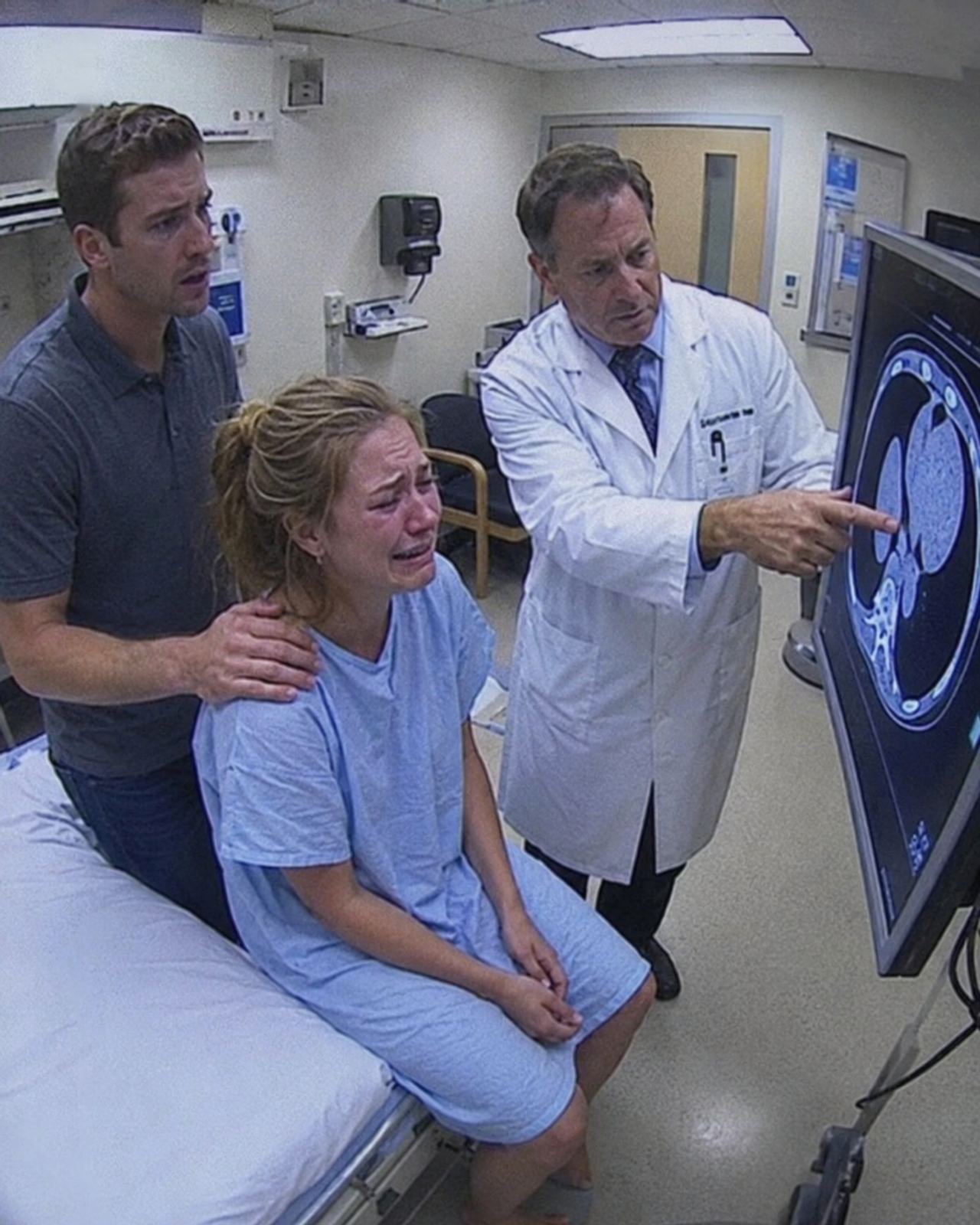
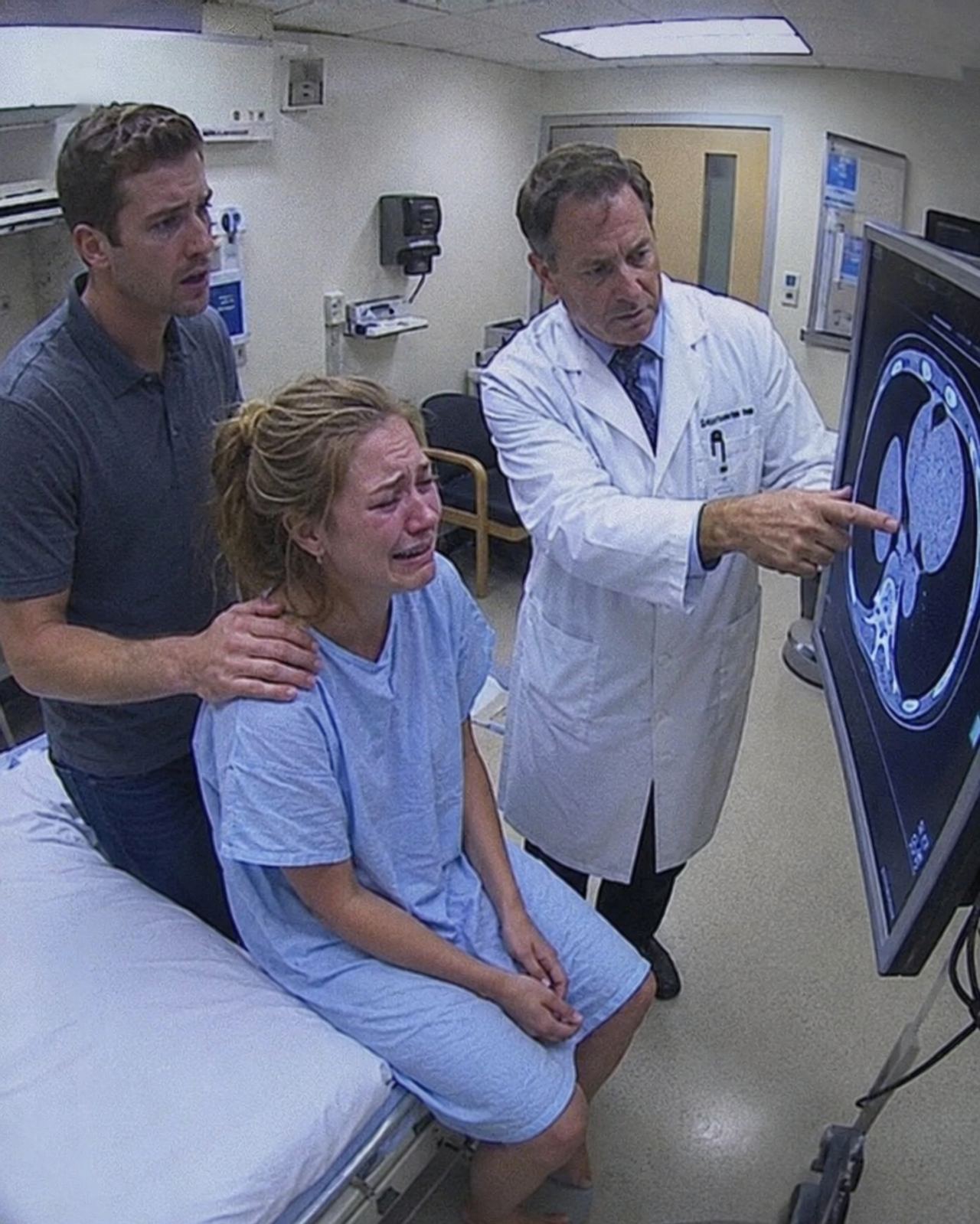
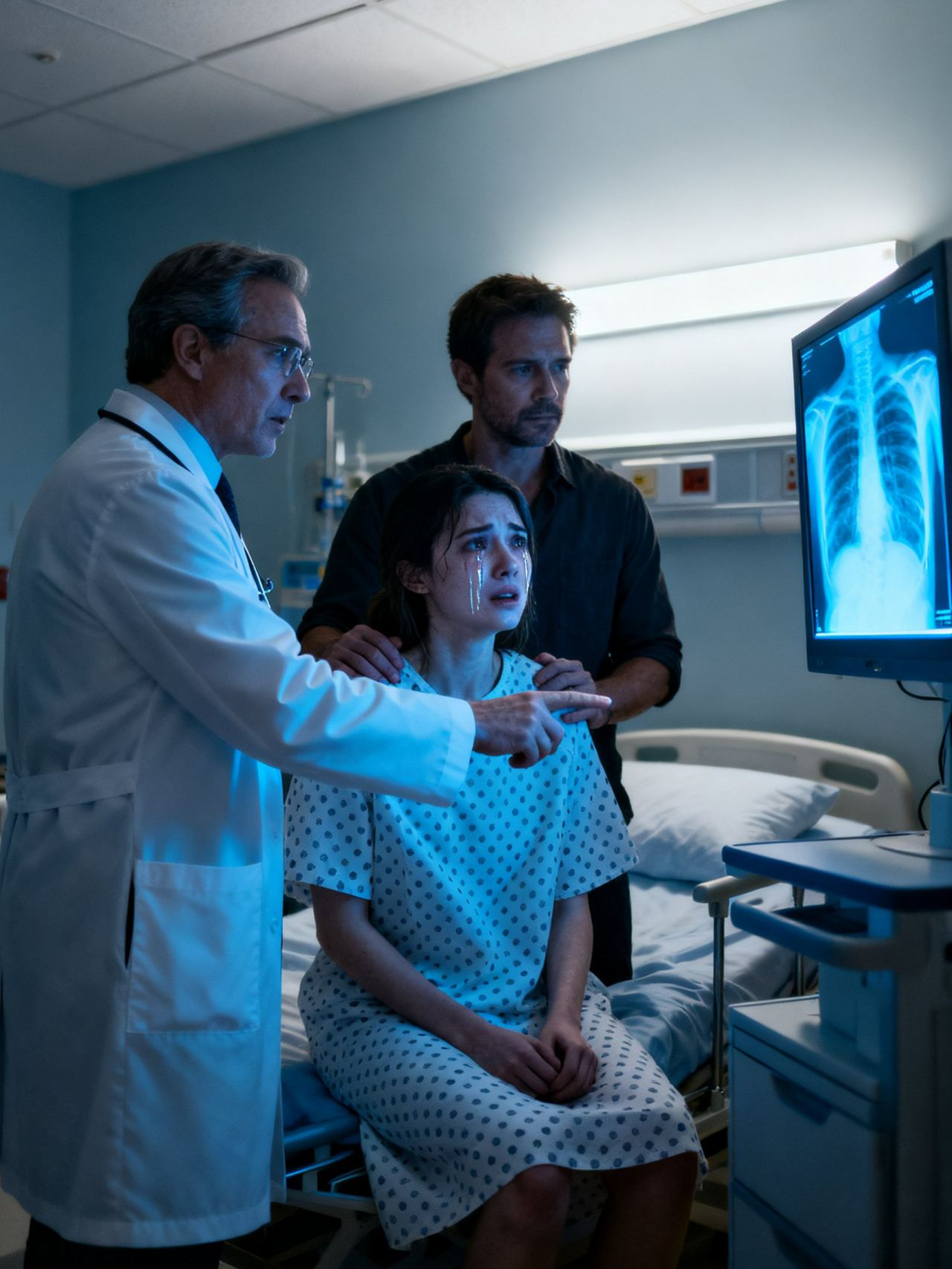
He brought up an image in black, white, and ghostly gray. At first, it meant nothing to me. Shapes. Shadows. The secret architecture of my own body.
Then Caleb pointed.
“In your body,” he said, voice breaking. “Maren, look at this.”
I leaned closer.
There was empty space where something should have been.
My mind refused to understand it.
Caleb clicked to another image. Then another. He pointed again, not just at the absence, but at a row of tiny bright marks that looked like metal teeth.
“Surgical clips,” he said. “Old ones.”
“What does that mean?”
His throat moved. “Your left kidney is gone.”
The room tilted.
I grabbed the edge of the desk. “No.”
“Maren—”
“No. That’s not possible.”
Dr. Park stepped closer, but Caleb lifted a hand. He knew me. He knew touching me would make it worse.
“You weren’t born with one kidney,” he said. “I checked your childhood records. You had an abdominal ultrasound at fifteen after that soccer injury. Two kidneys. Normal anatomy.”
I stared at the monitor. “No.”
“There are removal clips. Scar tissue. Whoever did this knew what they were doing.”
My mouth opened, but no sound came out.
A memory flashed in my mind: waking up in a dim room with beige curtains, my throat raw, Trent sitting beside me and telling me I’d had an emergency procedure for a ruptured ovarian cyst while we were on our anniversary trip in Georgia.
I remembered pain.
I remembered bandages.
I remembered Trent saying, “Don’t scare yourself with details. The doctors handled it.”
I remembered asking for paperwork and him kissing my forehead.
“I have it all at home,” he had said. “Rest.”
I never saw the paperwork.
Caleb’s face twisted as he watched me remember.
“That trip,” I whispered.
“What trip?”
“Savannah. Last May. I got sick. Trent said I had surgery.”
Caleb closed his eyes for one second.
When he opened them, he looked older.
Dr. Park picked up the phone on her desk.
Caleb said, “I’m calling the police now.”
The words landed like ice water.
“No,” I said automatically, though I didn’t know why.
“Yes,” Caleb said. “Maren, this is assault. This is organ theft. This is a major felony, and he is sitting twenty feet away from you.”
The door suddenly rattled.
“Maren?” Trent called from the hallway. “Open the door.”
My blood turned cold.
Caleb moved in front of me.
The handle jerked again.
“Maren, what is going on?”
Dr. Park spoke into the phone in a low, controlled voice. “This is Dr. Helen Park at St. Mercy Regional. We need hospital security and Columbus Police to radiology administration immediately.”
Trent knocked harder. “Caleb, open the damn door.”
My brother did not move.
For the first time, I understood that the man outside the door was not simply my husband.
He was evidence.
And I was the crime scene.
Security arrived before the police.
Two guards in dark uniforms positioned themselves in the hallway while Dr. Park opened the office door only halfway. Trent’s face appeared through the gap, flushed and furious beneath the smile he was trying to force into place.
“There’s been a misunderstanding,” he said.
Dr. Park’s voice was calm. “Mr. Doyle, please wait with security.”
“I want to see my wife.”
Caleb stepped forward. “You lost that privilege.”
Trent’s eyes snapped to him. There it was, finally. The real thing under the manners. Hatred, sharp and naked.
“Maren,” he said, looking past Caleb. “Whatever they told you, don’t panic. Your brother has always hated me.”
I almost laughed.
It came out as a broken breath.
“My kidney,” I said.
The hallway went still.
Trent blinked once.
That was all. One blink. One fraction of a second. But I saw it. Caleb saw it. Dr. Park saw it.
A guilty man does not always confess. Sometimes he simply fails to be surprised.
“Maren,” Trent said carefully, “you’re confused.”
My legs went weak.
Caleb turned and caught my elbow before I fell.
“You had a complicated emergency surgery,” Trent continued. “You were septic. They had to make decisions quickly.”
“What hospital?” Caleb demanded.
Trent looked at him. “I don’t have to answer you.”
“You do if you want to explain why my sister’s kidney was removed without her knowledge.”
Trent’s jaw tightened. “She consented.”
The room seemed to shrink.
I whispered, “I didn’t.”
“You don’t remember,” he said quickly. “You were in pain. You were frightened. I signed because you asked me to handle it.”
“No,” I said.
His voice warmed, softened, became the voice he used when guests were over and I contradicted him about something small. “Sweetheart, this is exactly what I mean. Your memory has been unreliable for months.”
Caleb took one step toward him.
Security moved too.
Trent lifted both hands. “I’m just telling the truth.”
But the truth had finally developed edges, and they were cutting through everything.
The police arrived in pairs. Uniforms. Radios. Questions. I answered what I could from Dr. Park’s office while Trent sat down the hallway under security’s watch. Caleb stayed beside me, not speaking unless I looked at him.
The first officer, a woman named Daniels, had kind eyes and a notebook already half full.
“Mrs. Doyle, do you feel safe going home with your husband tonight?”
“No.”
It came out before fear could stop it.
Trent heard me from the hallway.
“Maren!” he shouted.
Officer Daniels looked toward the door. “That answers that.”
Within an hour, the hospital became something else. Not the place where I had come to look for a diagnosis, but the place where my life split open. A detective arrived. A social worker sat with me. A forensic nurse photographed the faint laparoscopic scars on my abdomen, scars I had been told were from a cyst.
Caleb pulled old records from every system he could access legally. My childhood ultrasound. My employee health screening from five years earlier. A scan after a minor car accident when I was twenty-eight.
Two kidneys.
Always two.
Until last May.
The detective asked about the Savannah trip.
I told him everything I remembered.
Trent had surprised me with it for our anniversary. A restored bed-and-breakfast. Cobblestone streets. Spanish moss. Dinner by the river. I had felt dizzy after dessert. Trent said I probably had food poisoning. Then pain. Then confusion. Then fragments: a car at night, a sign I couldn’t read, a woman’s voice saying my blood pressure was dropping, Trent’s hand squeezing mine too hard.
When I woke up, he told me we were in a private surgical center outside Savannah. He said a cyst had ruptured. He said I was lucky. He said I almost died.
I cried because I believed him.
For weeks afterward, he changed my bandages, controlled my medications, answered calls from worried friends, and told everyone I needed rest.
When Caleb asked for the name of the facility, Trent said he had it handled.
When I asked, he said he didn’t want me reliving trauma.
When bills never came, he said insurance covered it.
I had thanked him.
That was the part that almost destroyed me.
I had thanked him for hiding a crime inside a story of devotion.
By evening, Trent was no longer in the hallway.
He had not been arrested yet, Caleb told me, but police had taken him for questioning after he tried to leave the hospital parking lot. They had also taken his phone. A judge would have to approve more searches.
“Come home with me tonight,” Caleb said.
I was sitting on the edge of an exam bed with a paper cup of water untouched in my hands.
“What if he comes there?”
“He won’t.”
“You don’t know that.”
Caleb’s face hardened. “Then he’ll regret it.”
For a second, he was not Dr. Whitaker, respected surgeon, hospital leader, steady professional.
He was my brother, who once punched a seventeen-year-old boy for spreading a rumor about me and then came home with a black eye and no apology.
I should have felt comforted.
Instead, I felt hollow.
“My house,” I said. “My clothes. My things.”
“We’ll get them later.”
“My whole life is there.”
Caleb sat beside me. “Maren, your whole life is here.”
He put two fingers lightly against my wrist, checking my pulse the way he had when we were children pretending to be doctors in our basement.
“You’re alive,” he said. “That’s what matters tonight.”
I broke then.
Not loudly. I did not scream or collapse. I simply folded forward, and the sound that came out of me did not feel human.
Caleb wrapped his arms around me and held on.
For the first time in almost a year, nobody told me I was overreacting.
The next morning, I woke up in Caleb’s guest room beneath a blue quilt his wife, Dana, had made during lockdown. Sunlight pressed against the curtains. Somewhere downstairs, their golden retriever barked once, then sneezed.
For three beautiful seconds, I did not remember.
Then my hand went to my left side.
Gone.
The word was too small for what had been taken.
A kidney was not a necklace, not money, not a piece of furniture that could be replaced. It was part of me. It had lived inside me since before I had a name. It had grown with me, survived fevers and heartbreaks and cheap college beer and my mother’s funeral.
Someone had cut it out of me.
Someone I had slept beside.
Downstairs, Dana was making coffee. She hugged me carefully, like I was bruised glass.
“You don’t have to talk,” she said.
“I don’t know how not to.”
Her eyes filled.
Caleb came in wearing yesterday’s shirt and a face that told me he had not slept.
“They searched the house,” he said.
I gripped the mug Dana handed me. “Already?”
“Warrant came through early this morning.”
“What did they find?”
He hesitated.
“Tell me.”
Caleb sat across from me. “A locked file box in Trent’s office.”
I waited.
“Copies of medical forms. Some with your signature.”
“I didn’t sign anything.”
“I know.”
“Caleb.”
He rubbed both hands over his face. “They also found a life insurance policy you didn’t know about.”
Dana made a small sound behind me.
“How much?” I asked.
“Two million.”
The mug shook in my hands.
“And emails,” Caleb continued. “Not all recovered yet, but enough to connect him to a surgeon in Georgia whose license was suspended five years ago.”
I stared at him. “Why?”
Caleb looked at Dana, then back at me.
“What?” I demanded.
“He had debt.”
I thought of Trent’s suits. His polished shoes. The renovated kitchen he insisted we could afford. The way he scoffed at coupons but always checked the mailbox before I did.
“What kind of debt?”
“Gambling, from what detectives told me. Sports betting. Private loans. Bad people.”
I laughed once, sharp and ugly. “So he sold my kidney?”
Caleb didn’t answer.
He didn’t have to.
The official answer would take months. The human answer was already sitting in my chest like a stone.
My husband had looked at my body and seen a solution.
Over the next week, the story became bigger than me.
Detectives found the surgical center first. It was not in Savannah proper but forty miles outside the city, tucked behind a wellness clinic with white columns and a fountain out front. It had changed names twice in six years. The doctor who operated on me, Dr. Russell Vance, had once been a transplant surgeon before an opioid scandal ended his legitimate career.
Police found records, but not under my name.
I had been admitted as Melissa Crane.
The consent forms listed me as a willing donor.
My signature was a careful imitation, but not good enough. Not once compared to my driver’s license, my school paperwork, my real hand.
The recipient’s identity was sealed at first. Later, through leaks and legal filings, we learned he was the adult son of a man Trent owed money to. Whether the son knew the kidney had been stolen, I never found out. Part of me wanted to know. Part of me never wanted to hear his name.
Trent was arrested three days after my CT scan.
He was leaving a hotel outside Dayton with a duffel bag, twenty-eight thousand dollars in cash, and my passport.
My passport.
That detail did something to me.
Until then, a small sick piece of my mind had still tried to bargain. Maybe Trent had panicked. Maybe he was trapped. Maybe someone threatened him. Maybe somewhere under the monstrous thing he had done was the man who brought me soup when I had the flu and danced with my mother at our wedding.
But he had my passport.
He had been planning an exit that included my documents but not me.
Or worse, one that included me without my consent.
The detective called Caleb first, then Caleb told me.
I stood in his kitchen, listening.
My face went numb.
Dana asked if I wanted to sit.
“No,” I said. “I want a lawyer.”
Caleb blinked.
It was the first solid thing I had said since the hospital.
“I want a divorce lawyer,” I said. “And I want a criminal victims’ advocate. And I want every bank account frozen before he moves a dollar.”
Dana’s mouth trembled into something like a smile.
Caleb nodded once. “I’ll make calls.”
“No,” I said.
They both looked at me.
“I’ll make them.”
My voice shook, but it was mine.
That mattered.
The next months were brutal in ways television never shows.
There were no dramatic courtroom confessions at first. No instant justice. No single moment where everyone who had doubted me fell to their knees and begged forgiveness.
There were interviews.
Medical evaluations.
Legal filings.
Insurance calls.
Nightmares.
I had to tell strangers what had happened to my body while they nodded and wrote notes. I had to learn words like nephrectomy and coercive control and forged medical consent. I had to sit in rooms where men in expensive suits described my stolen kidney as “the alleged organ removal” while Caleb clenched his fists under the table.
Trent pleaded not guilty.
Of course he did.
His attorney suggested I had known more than I admitted. He suggested my health issues had affected my memory. He suggested Caleb had influenced me because he disliked my marriage.
The first time I heard that argument, I threw up in the courthouse bathroom.
The second time, I stayed in my chair.
By the third, I looked straight at Trent and let him see that I was still there.
He changed in jail. Or maybe jail stripped away the costume. His hair grew longer. His face thinned. The charm came out in flashes, desperate and oily.
At a preliminary hearing, he caught my eye across the courtroom and mouthed, I love you.
I did not look away.
I mouthed back, I know.
Because that was the horror of it.
I knew exactly what his love was worth.
My body recovered slowly. Living with one kidney was possible; millions did it. Caleb reminded me of that gently and often. But my remaining kidney had been strained by months of mismanaged medication and whatever Trent had given me before and after the surgery. There were appointments, lab work, diet changes, blood pressure monitoring.
Every morning, I took my pills and felt angry.
Then grateful.
Then angry again.
Healing, I learned, was not a clean road out of pain. It was a house with many rooms, and some days I opened the wrong door.
The worst room held my memories.
Once the police found more evidence, the fragments of that Savannah night became sharper.
Trent had drugged me at dinner. Not enough to kill me. Enough to make me compliant, confused, easy to move. The restaurant’s security footage showed me leaning heavily against him as we left, my feet dragging slightly while he smiled at the hostess.
At 11:42 p.m., his car appeared on a traffic camera heading away from downtown.
At 12:28 a.m., I was admitted under a false name.
At 1:16 a.m., a forged consent was scanned.
At 2:03 a.m., Dr. Vance began removing my kidney.
At 5:40 a.m., Trent texted my phone from my own hand.
Having bad food poisoning. Turning phone off. Love you.
He sent it to Caleb.
To Dana.
To my best friend Rachel.
To everyone who might have worried.
My own phone had lied for him while I was unconscious on an operating table.
When Caleb learned that, he walked out of the room and punched a vending machine hard enough to split his knuckles.
I found him in the hallway, blood dripping onto the tile.
“You’re a surgeon,” I said weakly. “Your hands are kind of important.”
He looked at me, and for one wild second we both laughed.
Then he cried.
I had seen my brother angry. I had seen him sad. I had never seen him cry like that, standing under fluorescent lights with blood on his hand because he could not go back in time and save me.
I took his wrist and pressed a paper towel to his knuckles.
“You got me now,” I said.
He shook his head. “I should have pushed harder.”
“I wouldn’t have listened.”
“You don’t know that.”
“I do.”
And I did. That was one of the hardest truths. Trent had isolated me so gradually I mistook it for marriage. He answered texts because I was tired. He handled bills because numbers stressed me out. He spoke to doctors because he was “better at being firm.” He turned concern into interference and independence into ingratitude.
By the time Caleb suspected something was wrong, Trent had already trained me to defend him.
That realization made me furious, but it also freed me.
A cage is easier to hate once you can see the bars.
Rachel flew in from Denver the week after the arrest.
She had been my college roommate, maid of honor, and the only person besides Caleb who never fully warmed to Trent.
“I thought he was too smooth,” she said, sitting cross-legged on Caleb’s living room rug with a glass of wine untouched beside her. “But I didn’t think he was kidney-stealing smooth.”
I laughed so hard I cried.
Rachel cried too.
Then she helped me make lists.
Password changes.
Credit freezes.
New phone.
Divorce paperwork.
Victim compensation forms.
Medical binder.
Therapist appointment.
She put everything in color-coded folders because Rachel believed chaos could be bullied into submission with office supplies.
One folder was red.
On the tab, she wrote: BURN HIS LIFE DOWN LEGALLY.
For the first time in months, I felt something like joy.
The divorce moved faster than the criminal case. Trent fought
Read more stories
- My family laughed when I sat alone at my brother’s Trident ceremony—until the SEAL commander
- She Woke From A Coma To The Lie Her Parents Tried To Keep Buried
- HE TRADED A SECURE FUTURE IN MEDICINE FOR A $30 UPRIGHT PIANO — AND BET EVERYTHING ON A VOICE NOBODY WANTED TO HEAR.
- “THE MORNING RYAN ABANDONED ME, HE DIDN’T SLAM A DOOR OR SHOUT A FINAL INSULT. HE SIMPLY ZIPPED HIS SUITCASE, KISSED MY CHEEK LIKE I WAS A NEIGHBOR, AND LEFT ME STANDING IN THE RAIN WITH NEWBORN TWINS AT MY FEET.