
Stories
He Threw Me Out of the Mansion I Secretly Owned
A woman watches her husband and his family discover that the mansion they believe they own was secretly purchased by her years earlier. After exposing years of hidden financial support, assault, and deception, she reclaims the property, ends the marriage, and rebuilds her life on her own terms.

Rodrigo looked down at his phone, then back at the gates as they rolled open, and for the first time that night, he looked afraid.
He stood barefoot on the front steps in his party clothes, one hand still half-raised from the violence he had used on me, the other gripping a phone that had just delivered the first truth of his marriage.
The message had come from my attorney.
Occupancy rights revoked pending immediate property review.
Freeze all discretionary family accounts.
Security en route.
He stared at it as if the words might rearrange themselves into something that still favored him.
They did not.
From the back seat of my car, I watched the black sedan glide up the curved driveway and stop beside the fountain Evelyn loved to brag about to guests.
Two security professionals stepped out first.
Behind them came Daniel Reeves, my attorney, in a dark coat, carrying a slim leather folder under one arm.
Rodrigo marched down the steps so quickly he nearly slipped.
“What is this?” he shouted.
Daniel did not raise his voice.
“This is the beginning of a correction.”
The front door opened behind Rodrigo.
Evelyn emerged with one hand on the frame, pearls at her throat, silk scarf around her shoulders, chin lifted high in practiced outrage.
“Who let these people in?” she demanded.
Daniel glanced at the gate, then at the house, then at the folder in his hand.
“The owner did.”
It was amazing how much silence one sentence could create.
Even from the driveway, I could see Evelyn’s expression falter before she caught it and rearranged it into contempt.
“Rodrigo,” she snapped, “make them leave.”
He pointed toward my car.
“She is trying to extort us.”
Daniel looked at him as though he had spoken in a language too foolish to answer.
Then he opened the folder and drew out a document.
“This property,” he said, “is held by Halston Residential Holdings, acquired six months before your marriage.
My client is the controlling owner of that holding company.
Tonight’s incident triggered an immediate review of access, expenditures, and occupancy.”
Rodrigo blinked.
“No.”
Daniel held out the deed.
It was not dramatic paper.
It was not glowing.
It did not arrive with music or thunder.
It was simply official, stamped, signed, and devastating.
Rodrigo looked at the address.
Then the acquisition date.
Then the company name.
Finally, he looked at me through the windshield.
His face changed in layers.
Disbelief.
Calculation.
Fear.
Behind him, Evelyn descended one step at a time, as though moving carefully enough might prevent reality from reaching her.
“This is absurd,” she said.
“This house belonged to my husband.”
“It did not,” Daniel said.
“Your husband’s trust liquidated years ago under debt pressure.
The property entered a distressed sale.
My client purchased it quietly at the request of your son, who represented that public knowledge of the sale would cause you unnecessary harm.”
Evelyn slowly turned to Rodrigo.
The silence between them was new.
I had seen her humiliate him.
I had seen him obey her.
I had seen them blame me for whatever preserved their fantasy.
But I had never seen her look at him with suspicion.
“You told me the trust was being restructured,” she said.
He swallowed.
“It was complicated.”
Daniel continued as if they were discussing weather.
“In addition to the property purchase, my client funded monthly support in the amount of nine thousand dollars for your living expenses after the trust was exhausted.
Those transfers were routed through an intermediary account to preserve your dignity.”
Evelyn’s face drained.
“No,” she whispered.
“Yes,” I said through the barely lowered window.
It was the first word I had spoken to her since leaving the foyer.
Her eyes snapped to mine.
I stepped out of the car.
The sting in my cheek had deepened into a hot throb, but standing upright in that driveway felt steadier than sitting had.
The night wind moved through the trees.
Somewhere inside the house, the band had finally stopped playing.
I looked at Evelyn’s pearls.
“I bought those for your birthday last year,” I said.
“The same month I covered your medical plan, your driver’s salary, and your Palm Springs trip.”
Evelyn’s fingers flew to her necklace.
Rodrigo recovered enough to get angry again.
Anger had always been his bridge between weakness and performance.
“You hid all of this from me,” he said.
I almost laughed.
“You never asked.”
That hit him harder than the deed.
Because it was true.
Rodrigo had spent years enjoying outcomes he considered his birthright.
Mortgages vanished.
Debts cleared.
Vendors were paid.
His company survived losses that should have buried it.
Each time, he accepted rescue as proof that life naturally bent around him.
He had never wanted to know how the machinery worked.
Knowing would have required humility.
And humility was the one expense he never covered.
Evelyn descended the final steps and stopped in front of Daniel.
“This is a misunderstanding.
I have lived here for years.”
“You have occupied this property at the owner’s pleasure,” he said.
“That pleasure ended tonight.”
She drew herself up.
“You cannot put a grieving widow out on the street in the middle of the night.”
Daniel’s expression remained neutral.
“No one is being placed on the street.
A hotel suite has been arranged through tomorrow afternoon.
Personal necessities may be packed under supervision.
The rest will be inventoried.”
“Supervision?” Rodrigo barked.
“Do you think we’re thieves?”
Daniel reached into his coat and removed a printed transaction slip.
“At 7:42 p.m., Evelyn Sanders used an authorized-user card belonging to my client to make a $3,500 purchase at Bellori Jewelers.
That card has been terminated.
The purchase is now under review.”
Evelyn’s mouth opened, then closed.
I watched the memory land on her face.
The stop she had made after lunch.
The private little indulgence.
The assumption that the account feeding her life had no owner she needed to fear.
Then another voice cut across the driveway.
“What’s happening?”
Rodrigo’s sister, Marissa, had come out onto the porch with two cousins behind her.
More relatives clustered in the foyer, pretending not to stare while doing exactly that.
Evelyn turned toward them and instantly switched to performance.
“She has brought strangers to terrorize this family.”
Daniel did not even glance at her.
“Body-camera footage from the foyer has been preserved.
Interior surveillance has also been secured.”
Rodrigo went still.
I saw it happen.
He had forgotten the cameras.
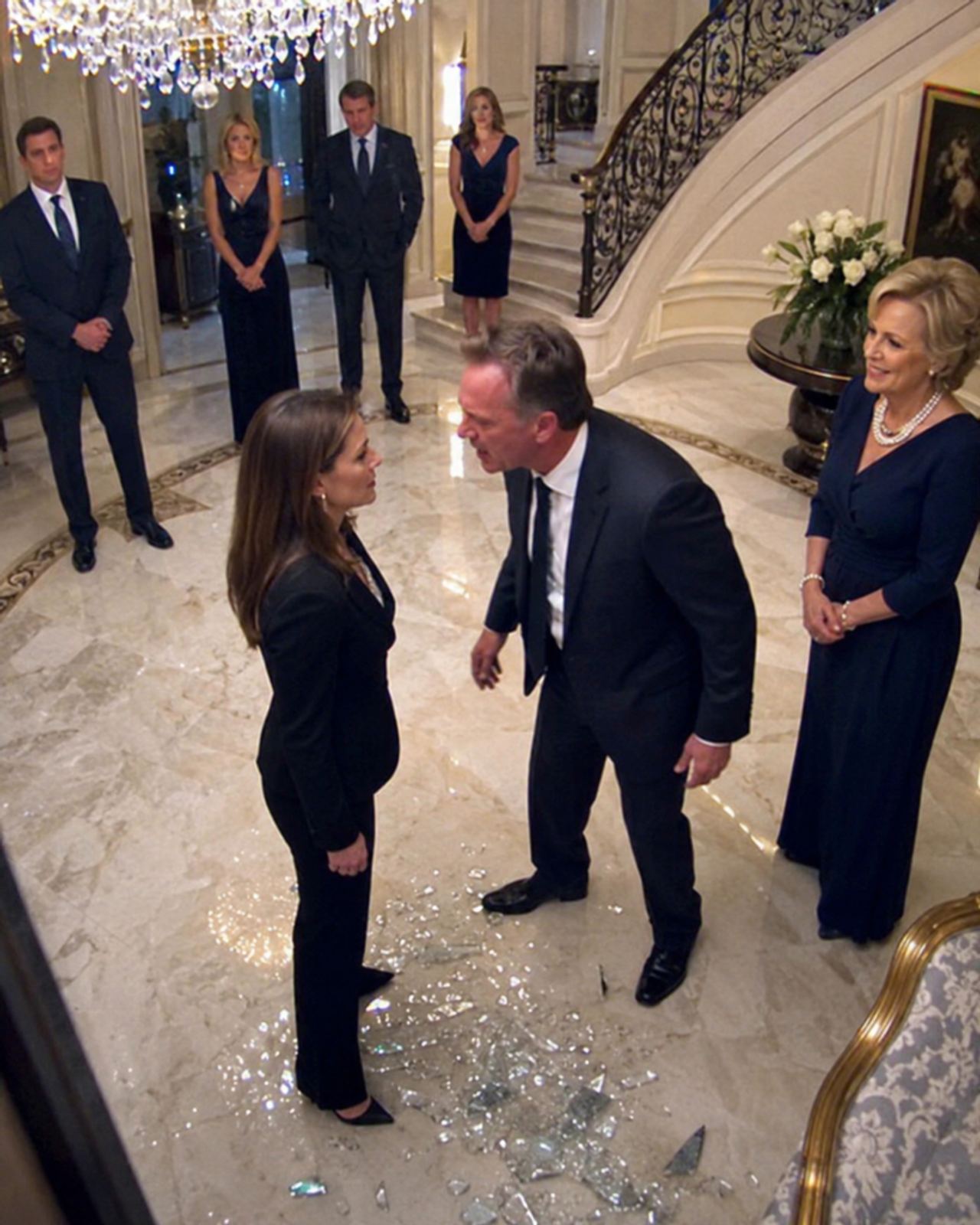
Or maybe he had believed, as people like him often do, that evidence only mattered when it served them.
“Delete it,” he said reflexively.
One of the security professionals looked at him with professional boredom.
“Already backed up.”
That was when the room inside the house shifted.
People who had been comfortable as witnesses to humiliation were suddenly less comfortable as witnesses to assault.
His uncle, the one who had finally stopped Rodrigo from hitting me a second time, stepped onto the porch.
He was a hard man, not sentimental, but he was not foolish enough to ignore legal risk.
“Rodrigo,” he said, “did you hit her on camera?”
Rodrigo spun toward him.
“Stay out of this.”
His uncle did not move.
“Answer me.”
No one answered for him.
Because everyone knew.
I reached into my purse and removed my phone.
My reflection in the black screen showed the mark on my cheek more clearly now.
I handed the phone to Daniel, who had already asked me for one final thing before he entered the property.
“Please initiate it,” I said.
He tapped the screen, then handed it back.
Across the driveway, Rodrigo’s phone rang.
Then Evelyn’s.
Then, a moment later, the house line could be heard faintly inside the foyer.
Daniel spoke with perfect clarity.
“That would be notice of account suspension, change of access credentials, and revocation of all discretionary transfers linked to my client’s personal trust.”
Evelyn’s hand shook as she looked at her phone.
“What do you mean, revocation?”
“I mean,” I said, “the nine thousand dollars stops tonight.”
She stared at me as though I had struck her.
The difference was, I had used paper.
Not my hand.
“You can’t do that,” she said.
“I already did.”
Rodrigo lunged one step toward me before both security professionals shifted at once.
He stopped, but his voice came out hoarse and ugly.
“After everything I gave you—”
I cut him off.
“You mean your surname?”
That landed in front of his relatives like broken glass.
He had nothing to answer with.
Because every useful thing in his life had been subsidized by someone he felt superior to.
Marissa came slowly down the porch steps.
She looked from me to Rodrigo to Evelyn and back again.
“Is this true?” she asked her brother.
He didn’t answer.
She looked at their mother.
“You knew?”
Evelyn turned on her with desperation sharpened into anger.
“Of course I didn’t know.
Why would I let that woman play benefactor in my house?”
My house, I thought.
But I did not say it yet.
Some truths are more useful when allowed to spread on their own.
Daniel opened the leather folder again.
“There is one further matter.”
Rodrigo closed his eyes briefly, as if bracing.
“Over the past eighteen months,” Daniel said, “my client extended emergency financing to Sanders Urban Build through Carroway Capital Partners, a lending entity wholly controlled by her.
Payroll, tax deficiencies, subcontractor settlements, and debt rollovers were covered.
Personal guarantees were not fulfilled by Mr.
Sanders.
That means several representations he made to vendors, banks, and family members regarding solvency were materially false.”
Now even the cousins looked alarmed.
Rodrigo’s company was his pride, his shield, his stage costume.
He had spent years using it to posture at family dinners, to sneer at my schedule, to imply I was too corporate to understand real work.
And all along, I had been quietly carrying the weight he wore as vanity.
“You lent to my company behind my back?” he said.
“I saved your company in front of your back,” I replied.
“You just never looked around.”
His uncle let out one hard breath that might have been a laugh if the moment had been less poisonous.
Evelyn was unraveling faster.
“This is revenge,” she said.
“Because of one family argument.”
Daniel’s face remained politely blank.
“A family argument does not generally involve assault, attempted dispossession of the legal owner, unauthorized use of funds, and false claims of title in front of witnesses.”
That sentence broke whatever remained of the party.
Relatives started murmuring.
One cousin slipped back inside.
A waiter disappeared toward the kitchen.
Marissa looked sick.
Rodrigo took another step and pointed at me.
“You’re enjoying this.”
I met his eyes.
“No,” I said.
“I enjoyed defending you when I thought you were weak.
This is just what happens when I stop.”
It was the truth.
The hardest part of loving Rodrigo had never been supporting him.
It had been translating him to myself.
Making excuses for his vanity.
Calling his dependence devotion.
Calling his silence stress.
Calling his cowardice complexity.
But some moments clarify a marriage forever.
A hand across your face in front of people who wait to see whether you deserve it is one of them.
Daniel turned to the security team.
“Escort Mrs.
Sanders and Mr.
Sanders inside.
They may collect medication, identification, and a change of clothes.
Inventory begins immediately.”
Evelyn recoiled.
“I am not being escorted out of my own home.”
Then Daniel finally used the word.
“It is not your home.”
He looked at Rodrigo next.
“And as of this moment, without the owner’s consent, it is not yours either.”
Rodrigo’s face went white.
He seemed to understand at last that there would be no private fix, no charming call in the morning, no mother’s tears strong enough to reverse paper.
He was not arguing with a hurt wife anymore.
He was standing in the wreckage of an assumption.
He tried one last turn toward me.
“Please,” he said, and somehow that was more repulsive than the shouting.
“Let’s not do this in front of everyone.”
I thought of my cheek.
Of my child.
Of the table of relatives who had watched me be stripped of dignity in a house I had paid to preserve.
“You already did it in front of everyone,” I said.
He had no answer.
The next hour moved with brutal efficiency.
Medication.
Toiletries.
Documents.
Clothing for one night.
No jewelry not personally documented.
No card access.
No office files removed without review.
Evelyn argued over handbags, framed photographs, a silver box, and a set of antique serving pieces she insisted were family heirlooms.
An inventory specialist noted each claim and set the disputed items aside.
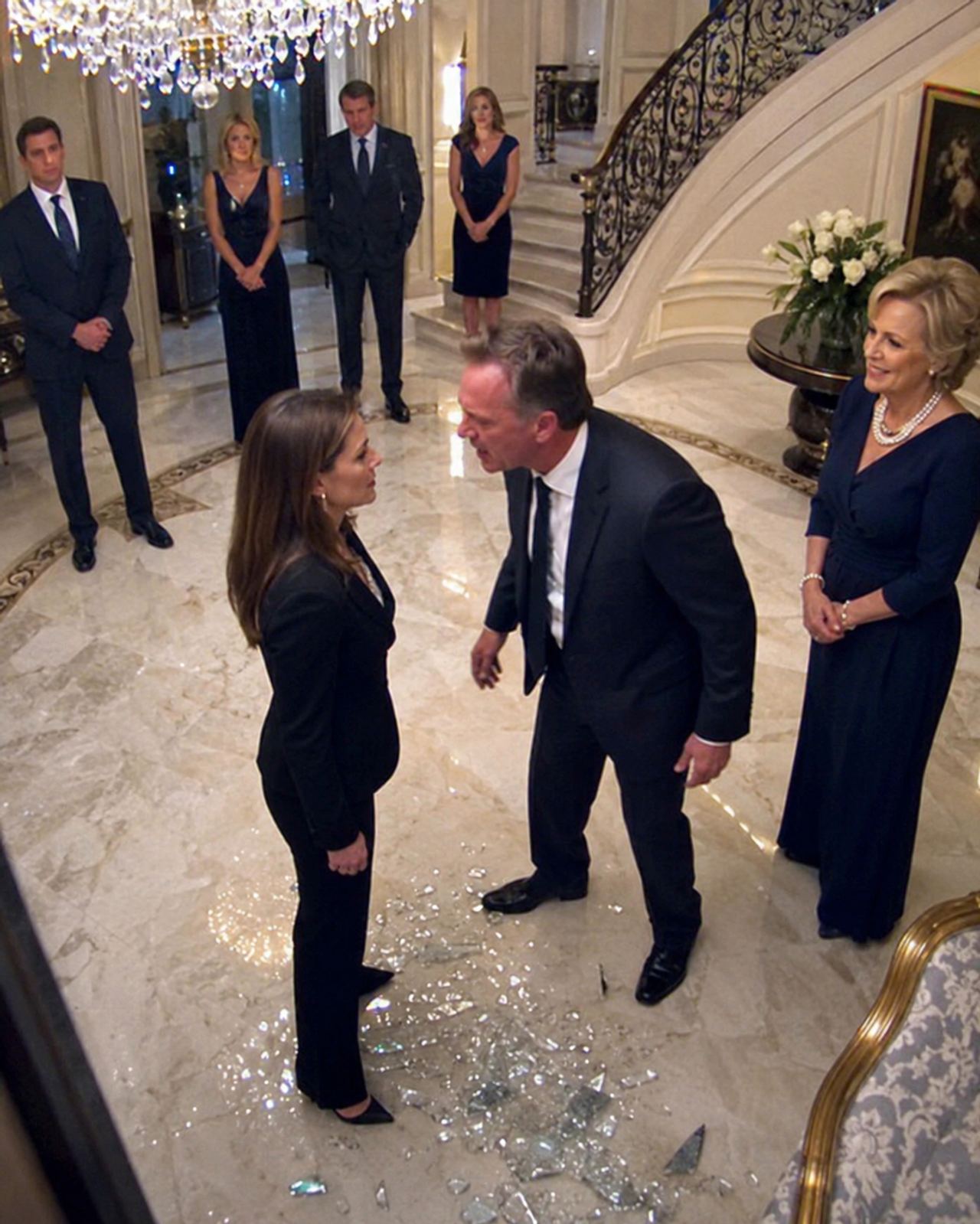
Rodrigo tried to enter his home office and found the lock code no longer worked.
He looked at me in disbelief.
“When?”
“On the drive over,” I said.
The truth was, the lock change had taken Daniel thirty seconds.
The preparation for it had taken me years.
When they came back downstairs with their overnight bags, the family pretended not to watch.
But humiliation is magnetic.
It pulls eyes no matter how much pride resists.
Evelyn stopped at the doorway and turned to me.
Without the house behind her, the band, the staff, and the certainty of her own mythology, she looked suddenly older.
Not weaker.
Just exposed.
“You let me thank my husband’s memory for money that was yours,” she said.
“Rodrigo asked me to,” I replied.
“He said the truth would break you.”
For the second time that night, she turned to her son as if seeing the shape of him without my resources holding him upright.
It was not love in her face then.
It was fury.
And blame.
He looked away.
They were driven to the hotel in separate cars.
That was not my instruction.
That was hers.
By midnight, my doctor had documented the injury to my face.
By 1:00 a.m., I had filed a police report and made a statement supported by the interior footage.
By 2:30 a.m., Daniel had petitioned for an emergency protective order.
By dawn, the staff had been informed that management of the property was changing hands visibly instead of invisibly.
For the first time since I bought the mansion, everyone working in it knew who signed their checks.
It changed the temperature of every room.
The weeks that followed were ugly in predictable ways.
Rodrigo sent messages that moved from rage to apology to accusation to nostalgia.
He blamed stress, grief, alcohol, humiliation, pressure from his mother, my ambition, the loss of the baby, his business troubles, my secrecy, my schedule, the family dynamic, and finally the one thing he should have blamed from the start: himself.
I saved every message.
Evelyn attempted to reclaim status through gossip.
She called relatives and described me as manipulative, masculine, vindictive, barren, unstable, obsessed with control.
It might have worked if the footage had not existed, if the deed had been less real, if the card charges had not been traced, if the monthly transfers had not been documented, if the hotel invoices had not landed in her inbox under a name she recognized too late.
Paper is not emotional.
That is why it wins.
Rodrigo’s company did not collapse overnight, but it finally had to stand on its own legs.
They were weak legs.
Without my quiet lending, creditors became less patient.
Vendors asked sharper questions.
A bank reopened a review.
One partner withdrew.
His office manager resigned after learning how much had been hidden from staff.
The myth of competence survives until invoices start speaking.
The divorce moved faster after the assault report and financial disclosures were filed.
My attorneys were thorough.
His were noisy.
Noise is expensive and rarely persuasive.
At one point, Rodrigo asked for a private meeting without counsel.
I declined.
Then he wrote me a letter by hand.
In it, he said he had loved me the only way he knew how.
That sentence sat on my kitchen counter for two days before I threw it away.
Because knowing how matters.
And not knowing is not an excuse.
Evelyn, meanwhile, had to leave the hotel and move into a smaller leased condo once it became clear no trust was reviving to rescue her.
She sold jewelry.
She let the driver go.
She stopped attending the club when acquaintances began asking harmless questions with dangerous precision.
Who handles your accounts now?
How are you enjoying the condo?
Was the Beverly Hills place sold?
Society can be cruel, but it prefers cruelty dressed as curiosity.
I did not orchestrate her social fall.
I simply stopped financing the staircase she had been standing on.
Months later, during one of the final divorce hearings, Rodrigo saw me in the courthouse hallway and almost approached.
Then he noticed Daniel beside me and the expression on my face and thought better of it.
He had aged.
Not dramatically.
Just enough to show where certainty used to be.
The judge signed the last relevant order just before noon.
Property confirmed.
Separate business liabilities clarified.
Support denied.
Protective terms extended where appropriate.
Simple language.
Permanent consequences.
When I walked out of the courthouse, the air felt oddly light.
Not triumphant.
Clean.
There is a difference.
Triumph needs an audience.
Clean needs only truth.
I went back to the mansion that evening alone.
The house looked different after exposure, even though nothing structural had changed.
Same stone.
Same garden.
Same long entry.
But the energy of a place shifts when deceit no longer lives there rent-free.
I stood in the foyer where Rodrigo had hit me.
The console table had been repaired.
The floor shone.
The camera above the staircase blinked its quiet red light.
The chandelier warmed the marble in gold.
I touched my cheek without thinking.
The bruise was gone.
The memory was not.
But memory is not the same as ownership.
I owned the house.
I owned the documents.
I owned the choice to keep the truth hidden for too long.
And finally, I owned the decision to stop hiding it.
My assistant had asked whether I planned to sell the property after the divorce.
For a while I thought I would.
Too many ghosts, too much theater, too much humiliation trapped in expensive walls.
Instead, I renovated the dining room.
Not because a new table erases an old cruelty.
Because rebuilding something on your own terms is sometimes the most precise form of closure.
The first dinner I hosted there afterward was small.
No band.
No spectacle.
No one performing wealth they had not earned.
Just people who knew the truth and did not need it sweetened.
At some point, someone asked whether I regretted funding Rodrigo for so long.
I thought about the woman I had been when I bought that house quietly to protect his mother from the collapse of her fantasy.
The woman who covered payroll so his employees would not suffer for his pride.
The woman who mistook silence for loyalty and endurance for love.
“I regret the silence,” I said.
“Not the generosity.”
Because generosity is not shameful.
Giving to people who despise your giving is.
After everyone left that night, I walked through the house and turned off the lights one by one.
In the foyer, I paused beneath the staircase camera and looked up.
Months earlier, it had captured the worst moment of my marriage.
Now it watched a woman standing alone in perfect quiet, not abandoned, not exiled, not disposable.
Just finished.
I locked the front door myself and kept the keys.
Read more stories
- “We’re removing you from the family trust,” Dad announced proudly, and when Mom added, “It’s for successful members only,” I nodded quietly, because my banker was already calling to ask if he should freeze the $200 million credit line to their business.
- “This restaurant is way above your budget,” my sister sneered at her wedding dinner, Dad
- My parents ignored my urgent calls from the hospital because my sister was having a meltdown over paint colors. So I had my lawyer visit me in the ICU—and when they finally showed up, they learned the true cost of their neglect.
- He Threw Out His Pregnant Wife