
Stories
“We’re removing you from the family trust,” Dad announced proudly, and when Mom added, “It’s for successful members only,” I nodded quietly, because my banker was already calling to ask if he should freeze the $200 million credit line to their business.
At a family trust meeting, Maya Harrison is publicly cut off for being seen as unemployed and unsuccessful. Quietly, she reveals she controls major financing and investments tied to her family’s empire, setting up a dramatic reversal of power.

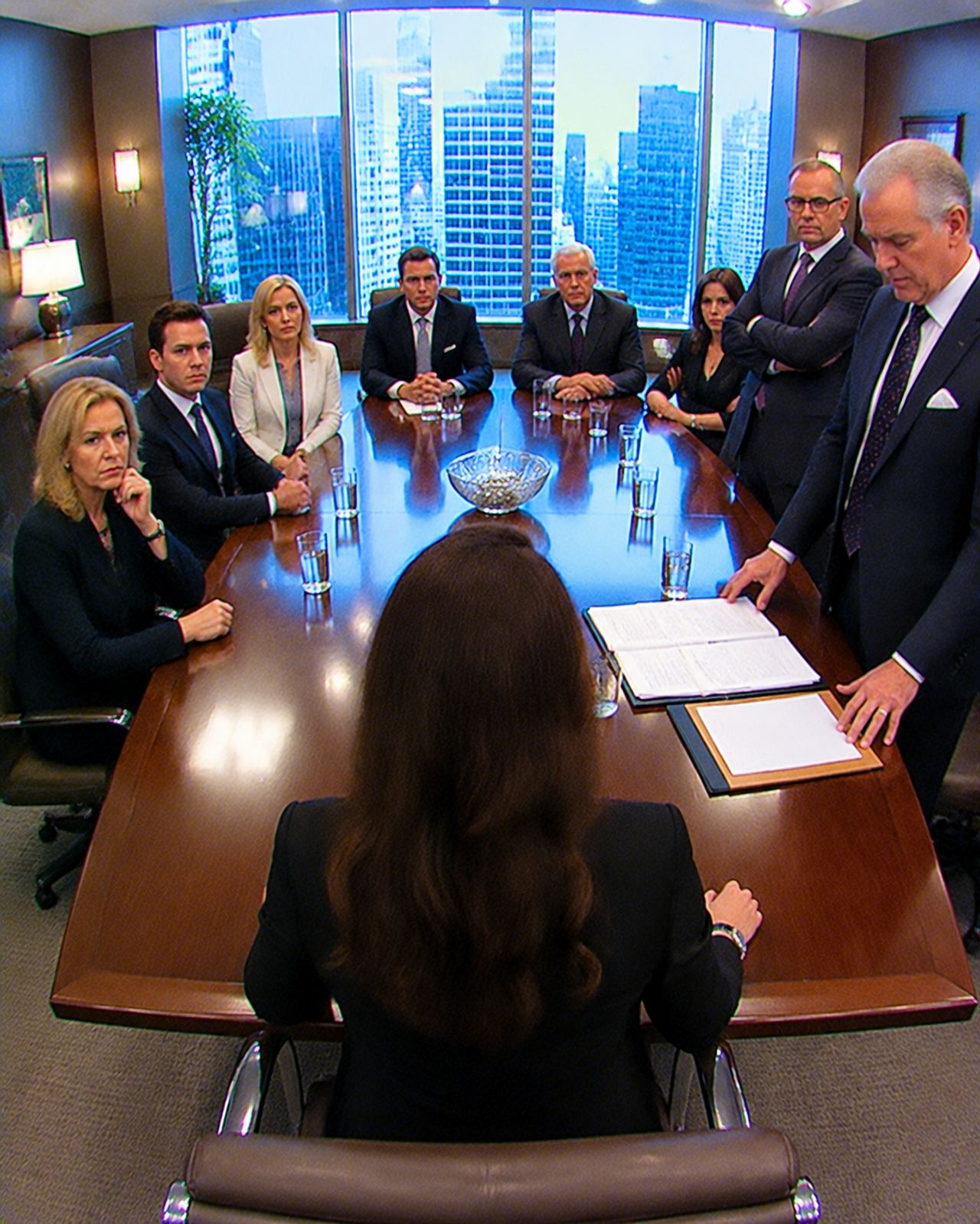
The conference room at my father’s headquarters had been designed to intimidate.
Everything about it said money before anyone opened their mouth. Floor-to-ceiling windows overlooked downtown Chicago, where the river cut between towers of glass and steel and Lake Michigan sat beyond the skyline like a sheet of cold metal. The mahogany table could seat twenty people, and every chair around it cost more than most people’s monthly rent.
I sat in the chair farthest from the head of the table.
That was where I had been sitting at family meetings since I turned eighteen. Not close enough to matter. Not far enough away to be excused. Just present enough to be judged.
Today was different.
Today, all fifteen voting members of the Harrison Family Trust had been summoned.
My father, Richard Harrison, sat at the head of the table like a king holding court. He wore his usual navy suit, the one tailored so perfectly it made every room look like it belonged to him. His silver hair was combed back. His cufflinks caught the light every time his hand moved over the stack of documents in front of him.
My mother, Patricia, perched beside him with her legs crossed and her posture perfect. Her manicured nails tapped lightly against a leather portfolio. Tap. Tap. Tap. She always did that when she was pretending not to be impatient.
My three older brothers, Marcus, Jonathan, and Steven, flanked them like lieutenants.
Marcus had the satisfied look of a man who had already won before the meeting began. Jonathan had his laptop open, spreadsheets waiting on the screen, his CFO face in full effect. Steven leaned back with his arms crossed, broad shoulders filling his chair, his expression blunt and bored.
My sister Victoria sat across from me.
She did not meet my eyes.
The extended family filled the other seats. Uncle Thomas and Aunt Margaret. Cousins Bradley, Amanda, and Jennifer. My father’s business partners who had married into the family. The people who mattered inside the Harrison empire. The people who got invited to the country club dinners, the charity galas, the private boxes at Bulls games, the Aspen trips, the Fourth of July weekend at the lake house.
Everyone who mattered.
Everyone except me, apparently.
And the funny thing was, they still did not know that in twenty minutes, I would have to decide whether to freeze their company’s entire $200 million credit line.
My father cleared his throat.
The room settled instantly.
“Thank you all for coming on such short notice,” he began, his voice carrying the kind of boardroom authority that had built a commercial real estate empire worth $800 million. “We’re here to discuss a necessary change to the family trust structure.”
I sipped my water and waited.
The glass was cold in my hand. A thin ring of condensation formed on the polished table, and I watched it spread instead of watching my family arrange their faces into concern.
“As you know,” my father continued, “the Harrison Family Trust was established to protect and grow our collective wealth. Its purpose is to ensure that future generations of successful Harrisons continue to thrive.”
Marcus leaned forward.
“Successful being the key word, Dad.”
Several people chuckled.
Not loud enough to seem cruel. Just loud enough to let me know they had rehearsed this.
I noticed Victoria shift in her seat.
My mother opened her leather portfolio with a crisp snap.
“The trust currently includes all direct descendants and spouses,” she said. “However, we need to implement performance standards. This is a business legacy, not a charity.”
Uncle Thomas nodded heavily.
“We’ve been discussing this for months,” he added. “The trust should only benefit those who contribute to the family’s success.”
Months.
That word sat in the air longer than it should have.
They had been discussing this for months.
I had known where this was going from the moment the invitation arrived the day before, with mandatory attendance printed across the top. Richard Harrison did not call emergency family meetings to share good news. He called them when he wanted witnesses.
Jonathan stood and clicked a remote.
A presentation appeared on the screen behind my father.
“Let’s review current family contributions to Harrison Enterprises,” Jonathan said.
The first slide showed Marcus’s photo beside his title.
Vice President of Development.
Forty-seven properties acquired.
$340 million in value.
My father smiled with genuine pride.
“Marcus has been instrumental in our expansion into the Southeast markets,” he said.
Marcus lowered his gaze in practiced humility, but the corner of his mouth gave him away.
Jonathan clicked again.
His own slide appeared next.
Chief Financial Officer.
$500 million in financing secured.
Operational costs reduced by 18%.
He did not smile. Jonathan never smiled at his own achievements. He preferred to let the numbers do it for him.
Then came Steven.
Director of Construction.
Twenty-three projects completed under budget and ahead of schedule.
Steven gave a small nod, as if the slide had simply confirmed what everyone already knew.
Victoria’s slide appeared next.
Marketing Director.
Brand recognition increased by 64%.
Social media engagement up 200%.
Victoria looked embarrassed, but my mother touched her arm approvingly.
Then each cousin had their moment.
Bradley managed the Chicago portfolio. Amanda oversaw property management across twelve states. Jennifer handled legal compliance. Each slide had a polished headshot, clean formatting, glowing numbers, and the kind of corporate language people use when they want ambition to sound noble.
Then my slide appeared.
The photo was from my college graduation.
Seven years old now.
My hair was shorter. My smile was wider. My cap sat crooked because Victoria had bumped my elbow right before the picture was taken, and we had laughed so hard my mother almost told us to behave in front of the photographer.
That memory flickered and disappeared.
Beside the photo, in small text, were the words:
Various positions.
Currently unemployed.
The room fell silent in that particular way that told me everyone had been waiting for this moment.
Not surprised.
Prepared.
“Maya,” my father said.
I heard the disappointment he had perfected over thirty-two years of being my father.
“We need to talk about your situation.”
“My situation,” I repeated calmly.
My mother’s voice sharpened.
“You’re thirty-two years old. You’ve had every advantage. The best schools. The best connections. Opportunities other people work their entire lives to reach. And what have you done with them?”
Marcus did not wait.
“You worked at the company for six months after college before quitting.”
Jonathan leaned forward.
“You tried that nonprofit thing that went nowhere.”
Steven added, “You’ve been consulting for three years, which, as far as we can tell, means you’re living off your trust distributions.”
I took another sip of water.
My phone buzzed in my pocket.
Probably Richard Chin from Capital Meridian Bank.

I ignored it.
“We’ve supported you,” Jonathan continued. “We’ve been patient. But at some point, Maya, you have to contribute. This family is not a welfare program.”
Uncle Thomas cleared his throat.
“The girl has a degree from Wharton, for heaven’s sake. She should be running something by now. Building something.”
Steven looked directly at me.
“Instead, you’re a burden. Let’s just call it what it is.”
Victoria’s head lifted.
“That’s harsh, Steven.”
“But accurate,” my mother interjected.
Her voice softened as she turned to me, and somehow that made it worse.
“Sweetheart, we love you. But love doesn’t mean enabling failure.”
Failure.
There it was.
The word they had wrapped this whole meeting around.
My father stood, and the room adjusted around him.
“The trust currently distributes $500,000 annually to each beneficiary. That money comes from our collective success. Money you haven’t earned.”
He let that land.
Then he picked up a document.
“We’ve drafted an amendment to the trust documents. Beneficiaries must meet certain criteria to receive distributions. A management position within Harrison Enterprises, documented annual income of at least $300,000 from outside sources, or ownership of property assets exceeding $2 million.”
I looked at the document without reaching for it.
“I don’t meet those criteria,” I said quietly.
“No,” my father agreed. “You don’t.”
Marcus pulled out another document, as if he had been waiting for his cue.
“We’re not kicking you out of the family, Maya,” he said. “But the trust is for successful members only. People who’ve earned their place at this table.”
Jonathan clicked off the presentation.
“We’re voting today,” he announced. “To remove Maya Harrison from the beneficiary list, effective immediately.”
My mother looked at me with something that might have been pity.
“This is for your own good, darling. Sometimes people need tough love to reach their potential.”
“You’ll thank us eventually,” Uncle Thomas said. “When you finally build something of your own.”
Bradley raised his hand.
“I move to vote on the amendment.”
“Seconded,” Amanda added immediately.
My father looked around the table.
“All in favor of removing Maya Harrison as a trust beneficiary.”
Fifteen hands went up.
Marcus first.
Jonathan next.
Steven without hesitation.
My mother, smooth and composed.
Uncle Thomas. Aunt Margaret. Bradley. Amanda. Jennifer. The spouses. The partners. The people who smiled at me during Christmas dinner and asked whether I was still “figuring things out.”
Only Victoria hesitated.
For one second, her hand hovered near the table.
Then she raised it too.
My father nodded.
“The motion passes unanimously. Maya, you’re removed from the trust effective today. Your final distribution will be processed this month.”
I nodded slowly.
“Can I say something?”
My mother sighed.
“Maya, we’ve made our decision. Arguing won’t—”
“I’m not arguing,” I said calmly. “I just want to understand the timeline.”
That made Jonathan look up.
“When exactly does this take effect?”
Marcus answered before my father could.
“Today. Effective immediately means immediately.”
“So, by close of business today,” I said, “I’m no longer a trust beneficiary.”
“That’s correct,” my father confirmed.
My phone buzzed again.
This time, I pulled it out and glanced at the screen.
Richard Chin had sent three messages.
So had Catherine Morrison from Silver Lake Capital.
So had David Kumar from my investment fund.
I locked the screen and placed the phone facedown beside my water glass.
“Thank you for clarifying,” I said, standing.
My mother blinked.
“That’s it? You’re not going to argue? Defend yourself?”
“What would I say?” I asked. “You’ve made your decision based on the information you have. I respect that.”
Steven frowned.
“You’re taking this awfully well.”
“I’m thirty-two years old,” I said. “I should probably stop depending on family money anyway. You’re right about that.”
My father actually looked disappointed that I wasn’t fighting.
“Well,” he said. “Good. I’m glad you’re being mature about this.”
Jonathan added, “The trust documents will be filed with our attorneys by end of day. Your access to the trust information portal will be revoked at five p.m.”
“Understood,” I said. “If we’re done here, I have some calls to make.”
I walked out of the conference room with my head up and my phone already ringing in my hand.
Nobody followed me.
Nobody asked if I was all right.
The elevator doors closed behind me, and the silence inside the elevator was almost peaceful.
Then I answered Richard Chin’s call.
“Maya, thank God,” he said immediately. “I’ve been trying to reach you for an hour.”
“I was in a meeting.”
“We just received notice that Harrison Enterprises is trying to draw down the full $200 million credit line we have with them. They’re citing a major acquisition in Miami.”
The elevator opened into the parking garage. Concrete pillars, black SUVs, the smell of rubber and winter salt. Somewhere above me, my family was probably congratulating themselves on a difficult but necessary decision.
I stepped out.
“When did the request come through?” I asked.
“Twenty minutes ago. But here’s the thing. You required us to notify you of any draws exceeding $50 million. That’s in the loan covenants.”
“I remember.”
“Maya, if they pull $200 million right now, they’ll be at eighty-seven percent leverage across all their credit facilities. One market downturn and they’re in a difficult position.”
I unlocked my car and sat in the driver’s seat without starting the engine.
“Richard,” I said, “who’s the actual borrower on that credit line?”
“Harrison Enterprises LLC.”
“And who guaranteed the loan?”
He paused.
“You did personally.”
“The full $200 million?”
“Yes. The full $200 million is backed by your guarantee and the collateral in your investment portfolio.”
“And who has the contractual right to freeze or terminate the credit line?”
Another pause.
“You do. As the guarantor, you have the right to pull your guarantee with thirty days’ notice, which would trigger an immediate repayment requirement.”
I looked through the windshield at the row of executive parking spaces near the elevators. My father’s black Mercedes sat in the first one. Marcus’s Range Rover beside it. Jonathan’s Porsche. Steven’s truck.
“Send me the loan documents,” I said. “All of them.”
“Maya, are you thinking of pulling the guarantee?”
“Just send them. I need to review some things.”
I hung up and immediately called Catherine Morrison at Silver Lake Capital.
She answered on the first ring.
“Maya, did you get my messages?”
“I did. Tell me.”
“Harrison Enterprises is trying to execute on the option to buy out the minority stake in their Chicago portfolio company.”
“Let me guess,” I said. “They need board approval.”
“Yes. Emergency board meeting called for Monday. They’re offering $180 million for full acquisition of Lakefront Properties Group. They claim they have financing in place.”
“Do they?”
“According to their CFO, yes. But Maya, you control forty percent of LPG through your Silverlake Investments. You have board seats. They can’t do this without your vote.”
I pulled up my portfolio on my phone.
Through various investment vehicles, holding companies, and strategic acquisitions over the past seven years, I had built positions in seventeen companies. My family did not know because I had used my mother’s maiden name, Maya Thornton, for all my business dealings.
It had started as privacy.
Then it became protection.
My Wharton professors had helped me set up the structures during business school. The nonprofit my family mocked as “that thing that went nowhere” had been a preliminary vehicle. I had later dissolved it and moved those assets into more sophisticated holdings.
The consulting work they dismissed was real.
I advised three venture capital firms on real estate technology investments. My fee was often equity instead of cash. It looked unimpressive from the outside because I had designed it to look that way.
“Catherine,” I said, “I need you to send me a complete analysis of Harrison Enterprises’ debt structure. Every credit line, every mortgage, every bond issuance. I want to know who holds what and when it comes due.”
“That’s going to take some time.”
“You have until five p.m. today.”
“Maya, that’s less than six hours.”
“I know. Call in your whole team if you need to. Bill me whatever it costs.”
My phone buzzed with another call.
David Kumar.
“Catherine, I have to go. Send me what you find.”
I switched over.
“David.”
“Maya, what is going on?” he asked. “I just got a very aggressive call from Jonathan Harrison asking about our investment criteria for the Harrison Real Estate Innovation Fund.”
Despite everything, I smiled.
The Harrison Real Estate Innovation Fund was something I had put together three years earlier. It invested in property technology startups and provided bridge financing for real estate developments. My family thought it was run by some California venture capital group.
They did not know I had provided one hundred percent of the capital.
All $300 million of it.
“What did Jonathan want?” I asked.
“He’s claiming Harrison Enterprises is entitled to preferential investment terms because of the family name. He wants a $75 million commitment for their Miami expansion at a below-market rate.”
“What did you tell him?”
“I told him I’d have to consult with our managing partner. He got pushy.”
“That sounds like Jonathan.”
“He said the Harrison family built this industry and deserved respect.”
This time I almost laughed.
“Maya,” David said carefully, “the man has no idea he’s talking about you.”
“Keep it that way for now,” I said. “Deny the investment request. Cite insufficient collateral and leverage concerns.”
“Consider it done. But I have to ask. Is something happening? Three calls in one day about Harrison Enterprises. All of them desperate for capital.”
“Just a family meeting,” I said. “Nothing to worry about.”
I hung up and sat in my car, thinking.
My phone showed 1:47 p.m.
By five p.m. today, my father’s attorneys would file the trust amendment removing me as a beneficiary.
By five p.m. today, Harrison Enterprises would realize it could not access the capital it needed for the Miami acquisition.
By five p.m. today, my family would start understanding that something had gone very, very wrong.
But they would not know what.
Not yet.
I started my car and drove to my condo in the financial district.
Not the fancy penthouse my parents expected me to own. They didn’t know I had sold that years ago. This was a modest two-bedroom I had bought under my business name. The lobby had polished stone floors, a doorman who knew how to keep quiet, and a view of the Chicago River that looked better at night than it did in the brochure.
My real office was in the second bedroom.
My family had never seen it.
Three monitors stretched across a custom desk. Direct feeds to four investment banks. Real-time portfolio tracking. Private equity dashboards. Secure messaging channels. Legal files. Debt maps. Alerts from companies my brothers thought were too small to matter.
The combined value blinking across the screen sat just over $800 million.
I had built it piece by piece.
It started with the $2 million inheritance from my grandmother when I was twenty-three. The same grandmother who had watched my father turn every family dinner into a performance review and told me, very quietly, “Your father thinks money is power. He’s wrong. Money is protection. Never let anyone know how much you have until you need to use it.”
I had listened.
I invested in property technology companies before they went public. I provided mezzanine financing to developers my father rejected because their projects were “too early.” I bought minority stakes in companies my brothers considered too small to take seriously. I accepted equity when other consultants wanted cash. I studied contracts at two in the morning, asked questions nobody expected me to ask, and learned how capital moved when powerful people thought nobody was watching.
Over seven years, I had quietly become the largest outside investor in the Harrison family empire.
I pulled up my complete portfolio.
$200 million credit line to Harrison Enterprises, guaranteed by me.
Forty percent ownership in Lakefront Properties Group through Silverlake Capital.
$75 million in convertible debt held by Harrison Development Partners.
Thirty percent ownership in Harrison Construction Supply Company.
Strategic investments in twelve of Harrison Enterprises’ vendor companies.
If I totaled it all, I had direct or indirect influence over $680 million of my family’s $800 million empire.
They thought I was unemployed.
They thought I was a burden.
They thought the trust distribution of $500,000 a year was charity.
They had no idea I had been subsidizing their growth for seven years.
My phone rang.

Victoria.
I answered.
“I’m sorry about today,” she said quietly.
Her voice sounded smaller than it had in the meeting.
“It’s fine, Vic.”
“It’s not fine. They humiliated you, and I just sat there and voted with them.”
“You did what you had to do.”
“No, I did what I was afraid not to do.”
I looked at my monitors. Lines of numbers refreshed in real time, each one tied to a company my family depended on without knowing it.
“Are you okay?” Victoria asked. “Do you need anything?”
“I’m fine.”
“Really?”
“Yes.”
“Come to dinner this weekend,” she said. “Just us. I’ll cook.”
“Maybe. I might be busy.”
“Busy with what?”
I did not answer.
“Maya,” she continued, “I know you’re probably devastated right now, but maybe this is a good thing. Maybe it’ll motivate you to—”
“I have to go, Vic. Another call coming in.”
I hung up before she could finish the sentence.
The unknown number on my screen was local.
I answered.
“Is this Maya Thornton?” a woman asked.
“Speaking.”
“This is Rebecca Walsh from Harrison Enterprises Accounting. I’m calling about some irregularities in our credit line documentation with Capital Meridian Bank.”
I leaned back in my chair.
“What kind of irregularities?”
“The paperwork lists Maya Thornton as a guarantor, but that doesn’t make sense with our internal records. Do you know Maya Harrison?”
I smiled.
“I am Maya Harrison. Thornton is my business name.”
Silence.
Then, carefully, “You’re Richard Harrison’s daughter?”
“That’s correct.”
“But you guaranteed our $200 million credit line?”
“Yes.”
“The entire line?”
“Yes.”
More silence.
This silence felt different.
This was not the silence from the conference room. That silence had been rehearsed, heavy with judgment. This one was fresh. Confused. Afraid of what it had just found.
“I need to call you back,” Rebecca said.
She hung up.
I checked my watch.
3:15 p.m.
My email dinged.
Catherine Morrison had sent her analysis.
I opened it and began reading.
Harrison Enterprises debt structure.
$200 million credit line with Capital Meridian, guaranteed by me.
$150 million in corporate bonds held by institutional investors, including funds I influenced.
$180 million in property-specific mortgages held by banks where I had relationships.
$75 million in vendor financing from companies where I held equity stakes.
Total debt exposure: $605 million.
Current assets: $800 million in real estate holdings.
On paper, it looked solid.
But the Miami acquisition they were announcing would cost $220 million. They needed to draw $200 million from the credit line and secure another $20 million in bridge financing.
The Chicago buyout of Lakefront Properties Group would cost $180 million.
The Southeast expansion they had announced last month needed $90 million.
Total capital needed: $490 million.
They thought they had it lined up.
But every single source of that capital either ran through me or required my approval.
My phone rang again.
Jonathan.
I let it ring twice before answering.
“Maya, I need to talk to you about something,” he said, his CFO voice fully activated.
“About what?”
“We’re getting strange inquiries from our banking partners. Do you know anything about Maya Thornton?”
“That’s my business name,” I said calmly.
“Your what?”
“My business name. I use it for investments.”
“Why would you need a business name? You don’t have a business.”
“Actually, I do. Several, technically.”
“Maya, this isn’t funny. Our bank is telling us you personally guaranteed our credit line. That’s impossible, right? You don’t have that kind of money.”
I turned slightly in my chair and looked at the skyline through the window.
“Jonathan, did you ever wonder where I got the capital to live in the city, travel, and maintain my lifestyle without a job?”
“The trust distributions are $500,000 a year.”
“I spend about $100,000 annually. Where did you think the rest went?”
Silence.
“What are you saying?” he asked.
“I’m saying Grandmother left me $2 million when I was twenty-three. I invested it. I’ve been investing for nine years. I’ve been very successful.”
“How successful?”
“Successful enough to guarantee a $200 million credit line.”
I heard him inhale sharply.
“You’re telling me you have $200 million?”
“I’m telling you I have enough assets to guarantee a $200 million loan. There’s a difference.”
“My G…”
Read more stories
- “This restaurant is way above your budget,” my sister sneered at her wedding dinner, Dad
- My parents ignored my urgent calls from the hospital because my sister was having a meltdown over paint colors. So I had my lawyer visit me in the ICU—and when they finally showed up, they learned the true cost of their neglect.
- He Threw Out His Pregnant Wife
- My father smirked across the courtroom and said, “You don’t even have the money to hire a lawyer,” loud enough for strangers to laugh