
Celebrities & Music
At small mountain outposts near the Pakistan border, Toby Keith left his band behind and s
At small mountain outposts near the Pakistan border, Toby Keith left his band behind and sat on wooden ammunition crates to play acoustic guitar for 25 soldiers

There was nothing flashy about the moments that many soldiers remembered most. At small mountain outposts near the Pakistan border, Toby Keith sometimes left his band behind, picked up an acoustic guitar, and sat on wooden ammunition crates to play for 25 soldiers at a time. Far from giant stages and roaring crowds, these were stripped-down performances in places where even a brief visit from home could feel almost unreal.
Across 11 USO tours between 2002 and 2019, Keith became known not only for showing up, but for asking to go farther than many expected. While most visiting stars stayed at major hubs such as Bagram or Kandahar Airfield, where thousands of troops could gather under heavy security, Keith often requested helicopter flights to small Forward Operating Bases in the Hindu Kush mountains. Among the places mentioned were FOB Frontenac and outposts in Paktika and Kunar provinces. Reaching them meant flying through deep canyons under the constant threat of ambush, a detail that says a great deal about how seriously he took the mission of visiting service members wherever they were.
Small outposts, unforgettable moments
These remote stations were not built for concert production. With only 20 to 30 troops at some of the posts, there was no room and no power for the Easy Money Band. So Keith adapted. He brought only an acoustic guitar, and that choice changed the feeling of the performance entirely. Instead of distance between artist and audience, there was closeness. Instead of a polished show, there was a shared moment.
Sometimes the schedule itself sounded almost impossible. He might play a morning set for 25 soldiers, fly to a 50-soldier post that afternoon, and then return to a main base to perform for thousands that night. That rhythm captures the unusual scale of his USO work. He could move from an intimate circle in the dust to a large crowd in a single day, carrying the same purpose into both settings.
For troops stationed at those border locations, the impact was magnified by isolation. Many had spent months in the mountains, cut off from the rhythms of ordinary life. In that setting, seeing a helicopter land and Toby Keith step out into the dirt was more than a celebrity sighting. It was a reminder that people back home were thinking about them.
Why the acoustic sets meant so much
Many of these visits happened without reporters or cameras. That matters, because it helps explain why the stories endure. They were not built around publicity. They lived on because of what the soldiers felt in the moment. Keith would sit on empty ammo crates or sandbags just a few feet from the group and sing unplugged in the wind. The image is a simple one, but that simplicity is exactly what makes it powerful.
He also did more than sing. He ate MRE rations with the unit, learned every soldier’s name, and listened to stories about home. That kind of attention can mean as much as the music itself. In an environment defined by pressure, routine, and separation, being seen as an individual matters. The gesture says: you are not forgotten, and your life beyond the uniform still exists.
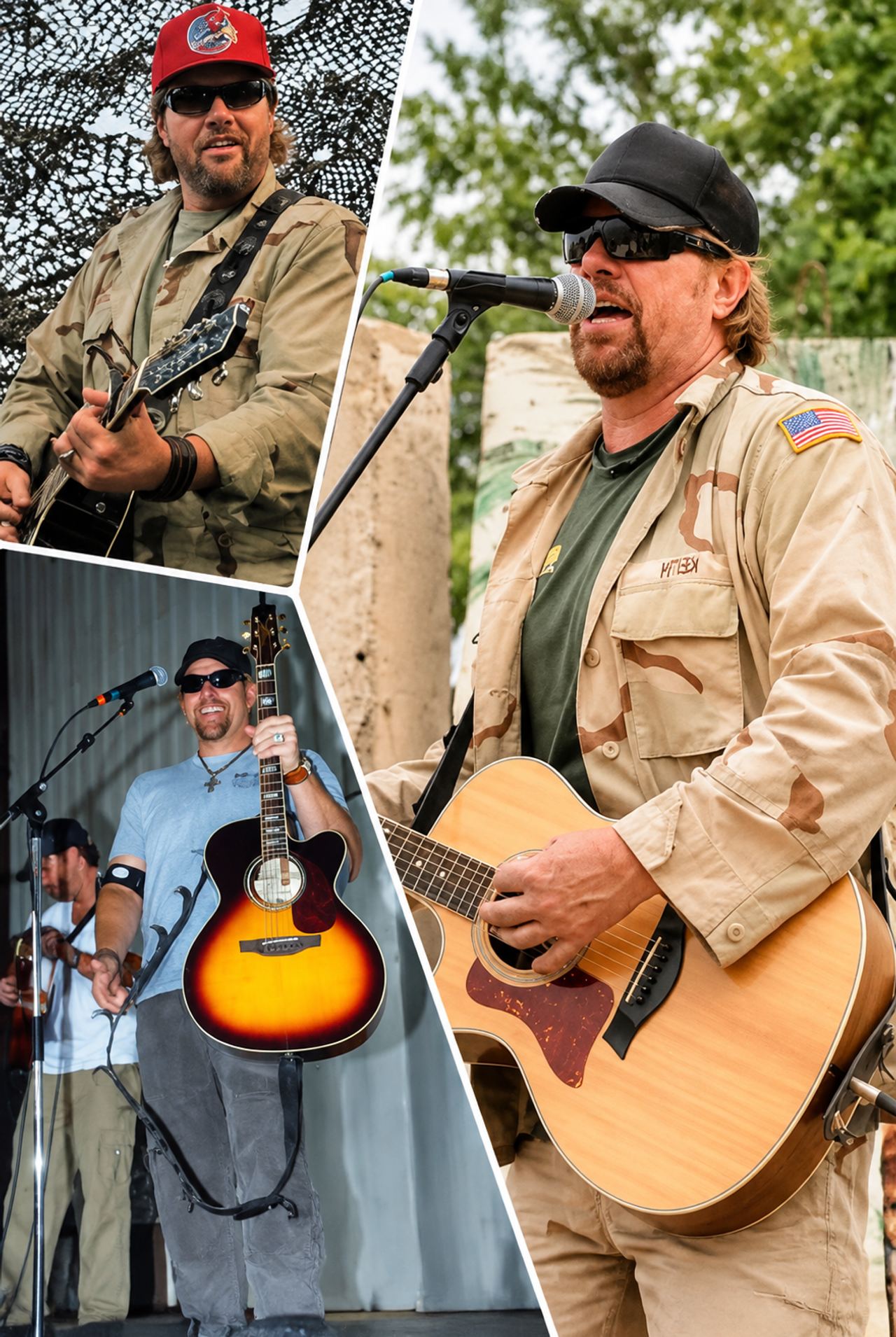
Keith later reflected on the contrast between these visits and stadium performances in America. In a 50,000-seat venue, the audience could blur into one distant mass. On the Pakistan border, he was close enough to watch the lines in each soldier’s face relax and their eyes brighten. It is a striking comparison because it shifts the idea of performance away from scale and toward human connection. Bigger is not always deeper. Sometimes the smallest audience carries the greatest emotional weight.
A different kind of legacy from the USO years
When the helicopter lifted off after those visits, Keith did not leave with elaborate souvenirs. The keepsakes he brought home were American flags signed by all 25 members of a platoon. That detail says a lot. These were reminders not of celebrity, but of shared afternoons in isolated places where one guitar and a handful of songs could cut through distance and fatigue.
Until his passing in 2024, he kept those flags from the border visits. That fact gives the memory an added tenderness. It suggests that these were not minor stops folded into a long career, but experiences he carried with him. For fans, it adds another layer to how they remember him. For service members and their families, it helps explain why his USO years continue to stand out.
Toby Keith was, of course, widely known as a country star, but stories like these show another side of public life: what happens when fame is set aside and presence becomes the real gift. There is something especially moving about the idea that some of his most meaningful performances may have happened without lights, cameras, or even a proper stage.
Why these stories still resonate
The reason these acoustic stops remain memorable is not only because of who made them, but because of what they represented. They brought a sense of home into places defined by distance and danger. They narrowed the gap between the world troops had left behind and the world they were living in every day. For a platoon of 20 to 30 soldiers, even a short visit could become a story told for years.
It also speaks to a broader truth about morale. Grand gestures have their place, but often it is the personal, direct moments that last. A song sung a few feet away. A meal shared from the same rations. A famous voice taking the time to learn a name and listen. Those things can stay with people long after the helicopter disappears over the ridge.
In that sense, these afternoons along the Pakistan border became part of a larger picture of Toby Keith’s USO years. They were not the loudest moments, but they may have been among the most meaningful. For the soldiers gathered in those circles, the message was unmistakable: home had not forgotten them.
If these stories bring back memories or leave an impression on you, share your thoughts and what stands out most about these quiet, powerful moments.
Read more stories
- Before the Platinum Records, Sammy Kershaw’s First Marriage Was Lost to the Long Road
- Before the Breakthrough, Kid Rock Was a Young Single Father in Detroit
- Kenny Rogers’s ‘Super Saturday’: The Weekend Ritual That Mattered More Than Stardom
- At sixteen, Miranda Lambert broke down crying inside a Nashville recording studio and walked out on the music industry before her career had even started.

