
Stories
My Sister Accused Me Of Using Fake Documents At The Airport—Then The TSA Supervisor Recognized My Last Name.
Natalie Hartwell is publicly accused by her sister of using fake documents at the airport, triggering a humiliating TSA inspection. The incident unravels a deeper family conflict over a trust, inheritance, and an attempt to remove Natalie from control of her grandmother’s company.

My sister waited until I was barefoot in the international security line, my laptop sitting in a plastic tray, my passport open in one hand and my boarding pass folded in the other, before she decided to destroy me in front of half an airport.
At first, I did not understand what I was hearing. The terminal was too loud, too bright, too full of the ordinary impatience of people trying to leave the country. Wheels clicked over polished floors. Children whined near the rope barriers. Announcements rolled through the ceiling speakers in a calm female voice that made even delays sound civilized.
Somewhere behind me, a man was arguing with his wife about whether their neck pillows had been packed in the carry-on or checked luggage. Ahead of me, the security bins moved forward inch by inch, swallowed by the scanner and returned with people’s shoes, jackets, phones, and private lives exposed under fluorescent lights.
Then Vanessa stepped out of line.
She had been two people behind me all morning, close enough that I could smell the expensive vanilla perfume she wore when she wanted to feel untouchable, far enough that she could pretend we were not together. She had not spoken to me in the car. She had not spoken at the curb when my mother hugged her goodbye longer than necessary and touched my shoulder as if contact with me required courage. She had not spoken when my father checked his watch for the fourth time, though we were early enough that any normal person would have relaxed. Vanessa had stood there in her tailored beige coat with her dark hair shining, her lips pressed into that delicate expression she used whenever she wanted people to think she was carrying pain with dignity.
I should have known then. My sister had never done silence casually.
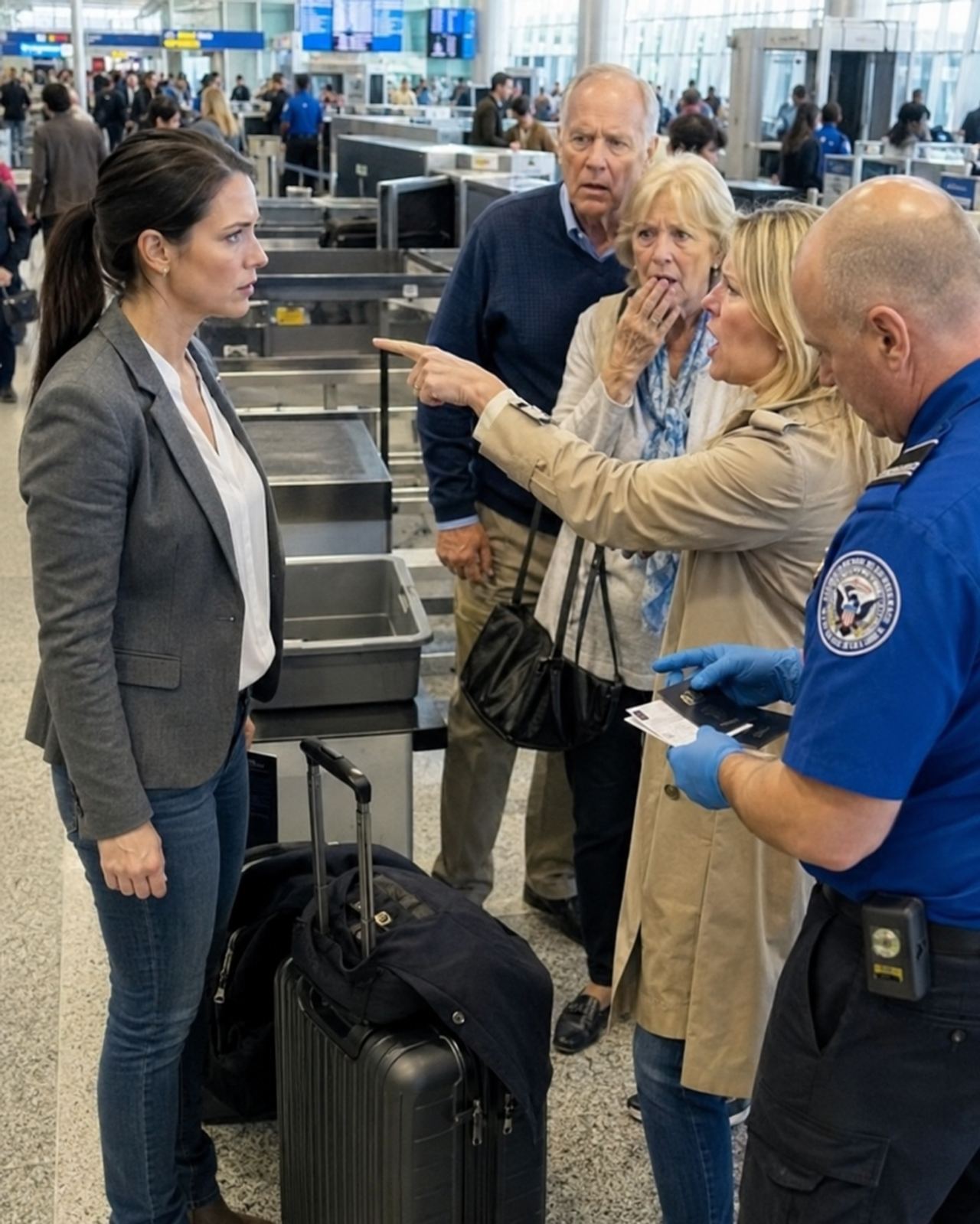
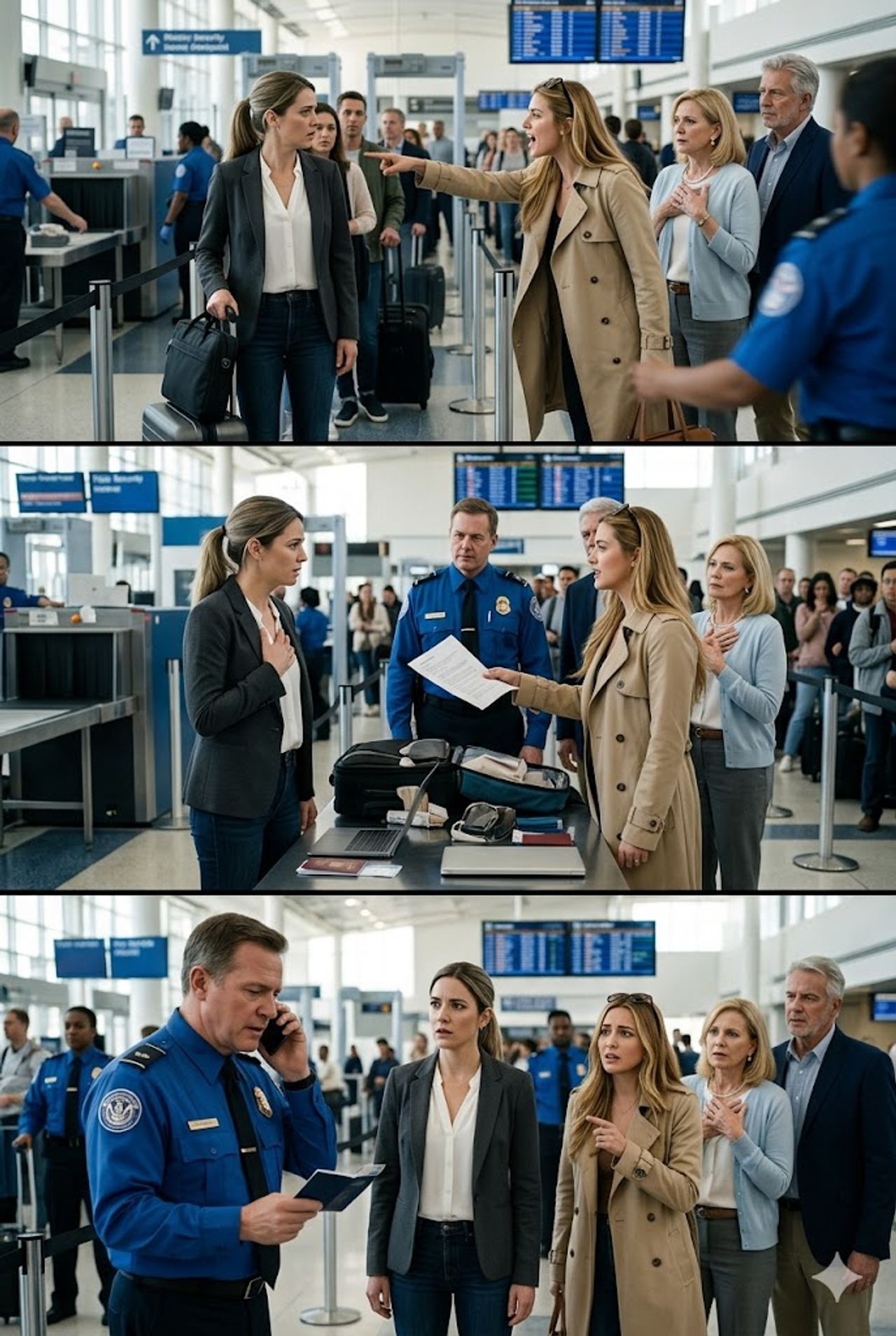
She leaned toward a TSA officer standing near the side of the line. She covered her mouth with one hand, the gesture theatrical enough to seem discreet from a distance, and spoke in a voice that carried perfectly.
“She is using fake documents.”
The line stopped moving around me.
Not all at once, not dramatically, but in that strange human ripple that happens when danger enters a public space. A woman ahead of me turned her head without moving her feet. The man behind me whispered, “What did she say?” A teenager lifted his phone chest-high before his mother pushed it down. I felt heat climb up my neck and into my face, so sudden and fierce that for a second I wondered if everyone could see it, a red flag of humiliation rising beneath my skin.
The TSA officer looked at Vanessa, then at me. His eyes dropped to my passport. Then to my boarding pass. He was young, with a trimmed beard and the wary patience of someone trained to treat every lie as potentially true until proven otherwise.
“Ma’am,” he said, “step to the side, please.”
I stared at him. “I’m sorry?”
“Step to the side with your documents.”
My flight to London boarded in forty minutes.
The number appeared on the monitor above the checkpoint in cool white letters, indifferent to whatever my sister had just set in motion. I looked past the officer toward the rope barrier outside security, where my mother stood with one hand pressed against her chest. My father stood beside her, arms crossed, jaw set. He was not surprised. That was the first thing I truly noticed. Not anger. Not confusion. Not even fear. Annoyance. He looked like I had made the morning inconvenient by requiring him to watch the trap close.
Vanessa was not frightened either.
She had prepared for this.
I stepped out of line. People moved around me like water diverting around a stone in a stream. A woman tugged her suitcase closer to her body as if dishonesty might be contagious. The officer took my passport. Then my boarding pass. Then my driver’s license. Each item left my hand with the small, sickening finality of a door shutting.
Vanessa folded her arms.
“I didn’t want to do this here,” she said, soft enough to sound wounded, loud enough to make sure strangers caught every word.
I looked at her. “You didn’t want to do this here?”
She turned her face slightly toward the officer. “She has been unstable for months.”
My mother made a small choking sound behind the barrier. Not grief. Performance. I had heard it enough times growing up to recognize the mechanics: inhale sharply, cover mouth, widen eyes, let people imagine the suffering beneath the restraint.
My father stepped forward. “We tried to handle it privately.”
The officer did not respond to them. He looked at my passport again, then at me. “What is the purpose of your travel today?”
“A contract review.”
“Where?”
“London.”
“For what company?”
“Hartwell Meridian Logistics.”
Vanessa laughed once. Small. Sharp. Surgical.
“She works in a warehouse office.”
There it was. The family version of me. Clipboard girl. Paper pusher. The anxious younger daughter who could handle forms and filing cabinets but not leadership, not decisions, not power. The one who wore sensible shoes, checked invoices, and existed somewhere beneath Vanessa’s more marketable shine. They had repeated that version of me for so many years that even cousins I barely knew described my job as “helping out with warehouse paperwork,” though I had reviewed customs contracts large enough to keep entire ports awake at night.
The officer turned my passport sideways under the light. He checked the photograph. Then he looked at my face again. My flight number flashed on the screen above us.
Boarding in thirty-five minutes.
“I can explain everything,” I said.
My father stepped forward again. “No, she cannot.”
The officer raised one hand. “Sir, please stay behind the line.”
My father’s face tightened. Martin Hartwell hated being corrected in public, especially by a man in uniform. He had built half his adult life on the ability to make rooms bend when he entered them. He was not a police officer, not military, not government, but he carried himself like authority had been handed down with the family name. At Hartwell Meridian Logistics, people stepped aside when he walked through the warehouse bays. Drivers lowered their voices. Office managers pretended not to see what he took for granted.
But airports belong to rules that do not care about family mythology.
Vanessa reached into her purse and pulled out a folded sheet of paper. She did it carefully, almost reluctantly, as if handing over evidence broke her heart. I recognized the paper before she opened it. I had seen the corner of it the night before on my mother’s kitchen counter, half-hidden beneath a magazine. At the time, I had told myself not every folded page was a threat. That was what exhaustion does. It bargains with intuition.
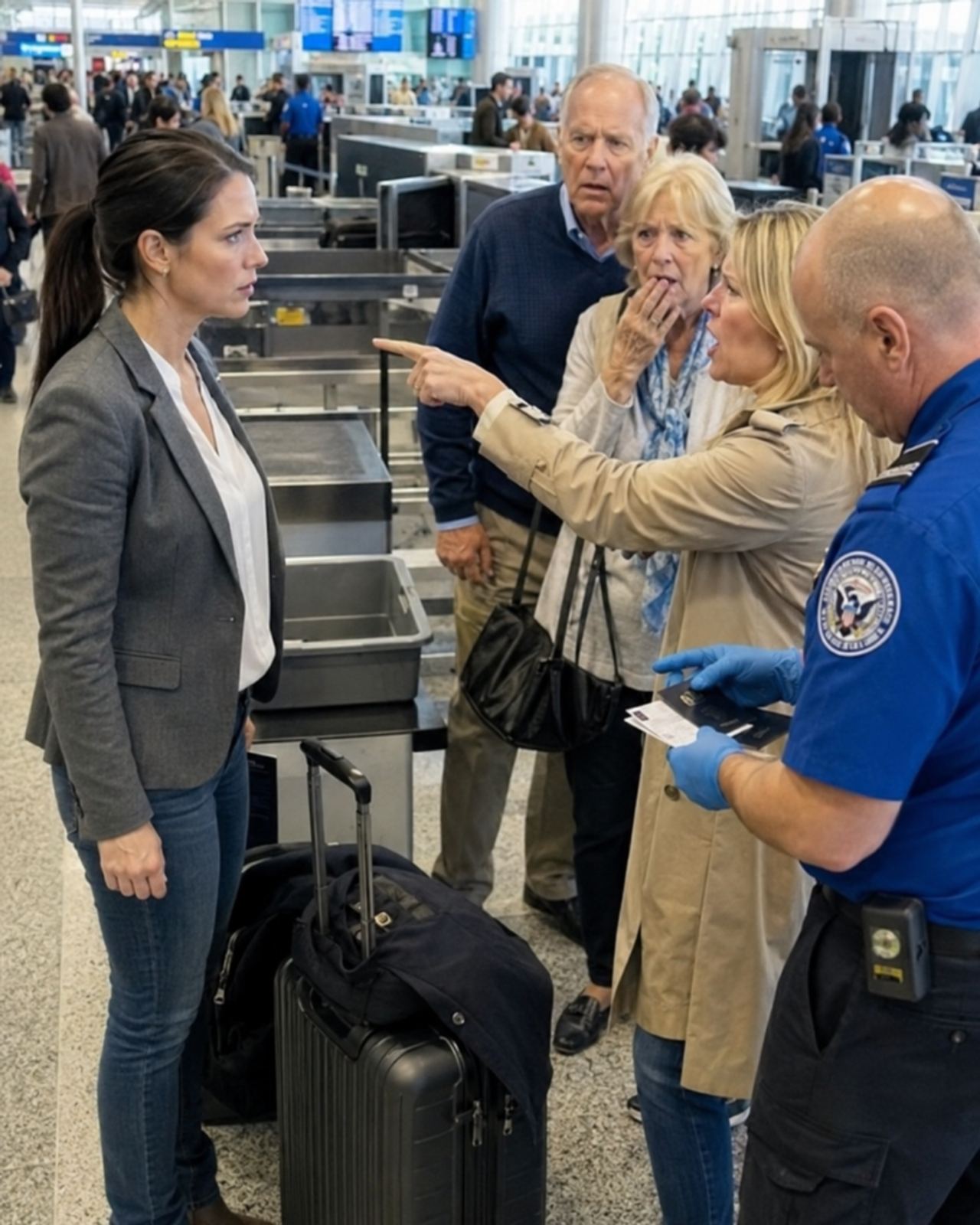
“I printed the email,” Vanessa said.
The officer looked at her. “What email?”
“The one proving her documents are suspicious.”
My stomach tightened.
She handed it over with trembling fingers. They were not truly trembling. Vanessa had trained her hands the same way she trained her tears, releasing them just enough for witnesses. The officer unfolded the page and read the first line. His expression changed, but not toward belief exactly. Toward procedure. That was worse. Procedure has no emotion to appeal to. It does not know your childhood, your grandmother’s office, your father’s temper, your sister’s envy. It only sees a claim and activates.
“Ma’am,” he said, “wait here.”
Then he radioed for a supervisor.
That was when everyone started staring openly.
I stood beside a metal inspection table with my shoes untied and my belt in a tray somewhere behind the scanner. My laptop was still moving through the machine, swallowed by a black tunnel. My coat had been taken off, leaving me in a navy blouse too thin for the terminal’s cold air. I felt undressed in a way that had nothing to do with clothing. My documents were in another person’s hand. My family was behind me pretending concern. My flight was becoming less possible by the minute.
My mother moved closer to the rope.
Her perfume reached me before her whisper did, powdery and floral, the same scent she wore to charity luncheons and family funerals.
“Just come home, Natalie.”
I did not answer.
She hated when I stayed silent. Anger gave her material. Tears gave her leverage. Silence forced her to hear the shape of her own words.
My father leaned in behind her. “You pushed this too far.”
I looked at him. “My flight leaves in thirty-five minutes.”
His eyes flicked to the screen. “I know.”
That was the second thing I noticed.
He knew exactly how much time I had.
A TSA supervisor arrived two minutes later. He was older than the first officer, gray-haired, compact, and calm in the way experienced people become calm around panic. His badge read Whitaker. Daniel Whitaker. He took my passport, license, boarding pass, and Vanessa’s printed email without theatrics. He asked the first officer for a summary, listened without interrupting, then looked at me.
“Natalie June Hartwell?”
“Yes.”
His eyes dropped to the passport again. Something moved across his face, not recognition of me, but recognition of something near me.
“Hartwell,” he said quietly.
Vanessa’s lips parted. My father’s shoulders shifted. It was not much. Anyone else might have missed it, but I had grown up measuring my father’s moods by millimeters.
Supervisor Whitaker looked down again. “I know this last name.”
My father stepped forward. “This is unnecessary.”
Whitaker did not look at him. He pulled out his phone and made a call.
Vanessa said, “Is there a problem?”
He held up one finger. “Give me a moment.”
For the first time all morning, uncertainty touched my sister’s face. It was brief, quickly buried, but I saw it. Vanessa did not like scenes that moved without her direction.
The supervisor spoke into the phone. “Yes, I have a Hartwell at Terminal Four.” He listened. “Natalie June Hartwell. International departure. London.”
My mother whispered, “Vanessa, what is happening?”
Vanessa did not answer.
Whitaker’s eyes moved to me while he listened. Then he said one sentence that changed the pressure in the air.
“She is right here with family members.”
His voice altered slightly on the word family. A careful pause. A professional caution. I knew that tone. I had used that tone myself when reading contracts that looked normal until one line revealed the knife.
My phone buzzed inside my coat pocket, unreachable because my hands were visible on the metal table as if I were already guilty. The first officer stood near my laptop tray. Vanessa watched my face with almost hungry concentration. I think she expected me to unravel in front of everyone. Maybe she had imagined tears, apologies, confusion. She had always believed I was smaller than the paperwork I carried.
I almost broke. Not because I had done anything wrong, but because I suddenly understood how long this moment had been waiting for me.
It had not started at the airport.
It had started with my grandmother.
Eleanor Hartwell was not warm in the way mothers in greeting cards are warm. She did not bake cookies, did not soften bad news, did not praise children for breathing. She believed in straight backs, clean records, labeled drawers, and signatures that could survive a courtroom. She wore silver hair in a twist, navy suits even on Saturdays, and glasses that hung from a thin gold chain around her neck. When I was little, I was half afraid of her and half fascinated by the way adults became sharper in her presence.
She built Hartwell Meridian Logistics from two delivery vans and one warehouse lease she signed against the advice of every man who told her freight was no business for a woman. By the time I was sixteen, the company held airport service contracts and customs support agreements. By twenty, I had watched her expand into three states and negotiate with men who underestimated her until they realized she had memorized every clause they were hoping she had skipped. She did not raise her voice. She did not need to. Facts stood up for her.
My father told everyone he built the company.
He had worked there, yes. He chaired meetings, barked orders, leaned over conference tables, and treated warehouse supervisors like soldiers under his command. He understood movement, scheduling, pressure. He could intimidate a late vendor into compliance with one phone call. He knew the language of logistics well enough to sound like ownership. But he had not built Hartwell Meridian. He had inherited proximity to it and mistaken proximity for creation.
Grandmother knew the difference.
When I was fourteen, she caught me in her office reading a stack of customs forms while the rest of the family ate cake in the break room for Vanessa’s birthday. I expected to be scolded. Instead, she closed the door, placed a yellow legal pad in front of me, and asked me to explain what I thought I was seeing. I told her three invoice numbers repeated with slightly different weights. I told her one signature looked photocopied. I told her the delivery time on one page could not be right because the receiving warehouse closed at six and the form was stamped at seven-thirty.
She studied me for a long moment.
Then she said, “Never fear paper, Natalie. Fear people who rush you past it.”
That became our beginning.
While Vanessa learned how to hold rooms with beauty and charm, I learned how to read the rooms people thought were empty. File rooms. Dispatch offices. Archive closets. Customs binders. Insurance riders. Chain-of-custody logs. My grandmother gave me small tasks at first, then larger ones. By college, I was working part-time in the compliance department while studying international business and accounting. I learned how fraud looked when it dressed itself in procedure. I learned how families hid theft behind trust. I learned that signatures could be copied, emails could be spoofed, access logs could betray liars, and originals mattered because ink had a memory that scans often failed to imitate.
Vanessa found all of this boring.
Our family encouraged her opinion because it suited them. She had our father’s charisma and our mother’s ability to make cruelty look like concern. At dinners, she talked about branding, expansion, leadership, client relationships. I talked about audit trails and risk exposure, and everyone’s eyes glazed over except Grandmother’s. Vanessa said I was paranoid. Dad said I needed to stop treating the family business like a criminal investigation. Mom patted my hand and told me I was brilliant “in my own quiet way,” which meant she liked me best when I remained useful and unthreatening.
Grandmother died on a rainy Thursday in November, two years before the airport.
Her death did not crack the family open immediately. At first, grief made everyone behave. My father stood beside her coffin with a solemn expression and accepted condolences from employees who called him “the man of the company.” Vanessa wore black silk and cried beautifully. My mother moved through the funeral reception touching people’s arms, thanking them, telling them Eleanor would have wanted unity. I stood near the back with a stack of sympathy cards in my hands, watching men my grandmother had defeated in negotiations praise her strength now that it no longer inconvenienced them.
The will reading happened one week later.
My father expected controlling authority. Vanessa expected a board-track appointment and voting influence. My mother expected whatever kept her life polished. I expected nothing except perhaps the brass pen Grandmother kept on her desk and once promised me if I learned to stop chewing cheap ballpoint caps during audits.
Instead, Grandmother left controlling shares in a trust.
Not to my father.
Not to Vanessa.
To me.
The room went so silent that I could hear the attorney’s watch ticking.
The trust structure was precise, layered, and almost brutal in its clarity. My father retained a salaried advisory role pending board approval. Vanessa received a generous but restricted distribution tied to measurable company contributions, not titles. My mother received personal assets and a lifetime allowance separate from operational funds. I was named primary trust controller with authority over share voting, compliance, and major international filings, subject to board oversight and documentation standards.
Documentation standards.
Even dead, Grandmother had smiled through paper.
My father did not explode in the attorney’s office. That would have embarrassed him. He sat very still, jaw flexing. Vanessa stared at me as if I had stolen something from her purse. My mother began crying softly and asked whether Eleanor had been “in her right mind.” The attorney, a woman who had clearly been chosen for her immunity to Hartwell theatrics, explained that multiple competency evaluations and witness statements were attached.
I remember looking down at my hands and feeling no triumph. Only weight.
I loved my grandmother. I respected her judgment. But I also understood, before anyone said it, what she had done. She had not given me power as a gift. She had made me a lock.
Locks are rarely loved by the people trying to open doors they should not open.
For the first year, my family pretended. Dad told outsiders the structure was temporary. Vanessa began introducing herself as “strategic lead,” though no such title existed. Mom kept telling me that family leadership required flexibility, by which she meant I should sign things without reading them. I kept working from what everyone called the warehouse office, reviewing contracts, customs filings, payment approvals, and board materials. My name appeared on documents. My authority existed in legal systems. Still, at family gatherings, I remained Natalie who handled paperwork.
It was easier for them that way.
Every conflict came disguised as hurt feelings.
Dad would slide forms across the table and sigh when I read them before signing. “Your grandmother trusted me for decades.”
“She also wrote a trust requiring review.”
“Because she was old and suspicious.”
“Because she was experienced.”
Mom would call late at night, voice soft with disappointment. “Your father feels humiliated, sweetheart. Men of his generation aren’t used to asking their daughters for permission.”
“He isn’t asking permission. He’s trying to move money from a restricted account.”
“Listen to yourself. Restricted. Permission. Audit. Is that how family talks?”
Vanessa preferred mockery. “Do you sleep with those folders under your pillow? Or just cuddle them when you’re lonely?”
Sometimes I wondered if I was becoming what they said. Rigid. Suspicious. Cold. Paper can protect you, but it can also isolate you. I spent long nights in my apartment comparing forms while my family called me paranoid. I declined family dinners because I knew they would become ambushes. I learned to keep my voice level while my father shouted, which made him shout more. My mother said I was changing. Vanessa said power had gone to my head. They all agreed on one thing: if I would just relax, just trust them, just stop making everything official, the family could heal.
But every time I reviewed what they wanted me to sign, I found another reason not to.
A vendor connected to one of Dad’s friends with inflated rates. A consulting payment for Vanessa without deliverables. A travel reimbursement for my mother attached to a “client relations” trip that included spa receipts. A proposed restructuring that would give family members emergency oversight in the event of my incapacity. That last one made the back of my neck go cold.
When I refused to sign, my father stopped shouting and started watching.
That was worse.
Three weeks before the airport, my London attorney called.
Priya Sandhu had been retained by our overseas board counsel. She was efficient in the way people become efficient after years of cleaning up rich family disasters. Her emails were short, her questions exact, and her patience limited to facts. When she called outside scheduled hours, I knew something had shifted.
“Natalie,” she said, “are you alone?”
I was standing in my apartment kitchen with a mug of tea cooling beside my laptop. Rain tapped against the window. “Yes.”
“I need you to listen carefully. A filing request came through the London trust office this morning.”
“What kind of request?”
“A petition to remove you as acting controller pending review.”
I sat down slowly. “On what grounds?”
“Medical concern.”
For a moment, the words meant nothing. Then they meant too much.
Priya continued. “The letter states that you have displayed cognitive instability, paranoia, erratic decision-making, and an inability to manage international legal obligations. It claims your family has been attempting to intervene privately.”
My fingers tightened around the phone.
“Who signed it?” I asked.
Priya was quiet just long enough for the answer to arrive before she spoke.
“Your father provided the primary statement. Your mother supplied supporting observations. Your sister witnessed it.”
I looked across my kitchen at the blue folder on my desk, the one holding notarized trust documents, passport copies, board letters, and original signature references. I had built it because Grandmother’s voice lived in the back of my mind. Originals matter. Copies are gossip. Ink is testimony.
“What happens now?” I asked.
“There is a deadline. The original trust documents are held in London. You must appear with your passport, verify identity, and sign an objection before two o’clock London time on Friday. If you fail to appear, they can argue non-response and request temporary family oversight.”
Temporary. Families loved that word. It made theft sound polite.
I booked the flight that night.
I did not tell my family at first. I informed Priya, the board chair, and my supervisor. I arranged leave from work. I checked my passport three times, then placed it in a protective sleeve. I assembled my documents in the blue folder and added a sealed envelope containing the original trust amendment Grandmother had made me sign in person, witnessed and notarized. It included my signature, passport copy, thumbprint, and witness log. At seventeen, after I broke my wrist falling off a bike in the warehouse parking lot, my handwriting changed permanently. My capital N developed a dip, a small break where pain had retrained muscle memory. Grandmother had noticed, of course. She noticed everything.
“Useful,” she had said, examining my signature.
I had laughed then. “My bad handwriting?”
“Distinctive handwriting.”
Years later, I understood.
My family learned about the flight two days before departure. I still do not know exactly how. Maybe someone in the office told my father. Maybe Vanessa accessed a calendar she should not have been able to see. Maybe my mother found the itinerary printed on my desk during a visit she had no reason to make. However it happened, the atmosphere changed immediately.
Dad called first. He did not ask why I was going to London. He said, “You’re making a mistake.”
Mom called next, weeping. “This will destroy your father.”
Vanessa texted: dramatic much?
I answered none of them.
Then, on the night before the flight, Mom invited me to dinner.
I should not have gone. I know that now. But family training is not erased by intelligence. Some part of me still hoped for a clean break, a final conversation, an adult acknowledgment that we had reached a legal disagreement instead of war. My mother said she wanted to pray for safe travel. She said she wanted to send me off with love. She said Grandmother would hate seeing us divided, which was both manipulative and untrue. Grandmother believed division was sometimes the only honest shape a family could take.
I went because hope is stubborn even when evidence is overwhelming.
Dinner was quiet. Vanessa barely looked at me. Dad drank bourbon and checked his phone. Mom served chicken I barely tasted and asked about my packing with a sweetness so false it made my teeth ache. On the kitchen counter, partly hidden beneath a magazine, I saw the corner of a folded sheet of paper. An email header. My name. A line about document irregularities. When Mom noticed my gaze, she moved a bowl over it.
I left early.
That night, I slept poorly, passport beneath my pillow like a child hiding treasure from monsters.
The next morning, my father insisted on driving me to the airport.
“You shouldn’t leave your car there for a week,” he said. “Parking fees are ridiculous.”
“I can take a rideshare.”
“Don’t be difficult.”
Mom added, “Let us do this one thing.”
Vanessa came along, claiming she had errands nearby. She…
Read more stories
- Two Years After My Husband Said I Had Become Difficult To Look At, He Found My Face On The Cover Of A National Arts Magazine. He Sent A Message Saying He Had Underestimated Me. I Did Not Reply. He Had Not Misjudged My Potential. He Had Deliberately Taught Me To Doubt It.
- When My Son Got Married, I Kept Secret The $90 Million My Late Wife Left Me. It Turned Out To Be The Smartest Decision I Ever Made—Because Just Days Later, His New Wife Showed Up Uninvited At My Front Door… With A Lawyer At Her Side.
- A Six-Year-Old Crawled Seven Blocks to Save His Little Sister
- IN 1991, A NEWSPAPER CALLED THEM “THE SAINT AND THE SINNER.” THEY WERE ON THE SAME TOUR BUS.