
Human Stories
When My Son Got Married, I Kept Secret The $90 Million My Late Wife Left Me. It Turned Out To Be The Smartest Decision I Ever Made—Because Just Days Later, His New Wife Showed Up Uninvited At My Front Door… With A Lawyer At Her Side.
A grieving widower discovers his son and new daughter-in-law may have forged documents to evict him from his home, only to uncover an even deeper betrayal. Using his engineering background and a hidden alibi, he begins to methodically prepare his defense.

I asked myself, staring blankly at the kitchen wall. Why the intensely aggressive 72-hour timeline in the ruthless world of commercial real estate and legal evictions?
72 hours is an impossibly narrow window. It is intentionally designed to induce immediate panic. It is a psychological warfare tactic meant to completely overwhelm the victim, forcing them to frantically scramble for moving boxes instead of securing a competent defense lawyer.
They desperately wanted me disoriented. They wanted me exhausted and deeply humiliated hauling black trash bags into the back of my old pickup truck before the weekend was even over.
They knew perfectly well that if I had enough time to think clearly, if I had sufficient time to boldly contest the eviction through the proper legal channels, their fraudulent power of attorney would not hold up for a single second under the strict scrutiny of a federal judge. The aggressive speed of their sudden attack was their only real tactical advantage.
They were relying entirely on the arrogant assumption that a 70-year-old widower seemingly living on a modest fixed pension income would completely lack the massive financial resources and the emotional stamina required to fight back against a slick, well-funded corporate law firm. They wrongly assumed I would simply bow my tired head, pack my cherished memories into cheap cardboard boxes, and quietly disappear into whatever miserable low-income housing facility I could manage to afford.
I leaned back heavily in the wooden bar stool and let out a slow, steady, calculated breath. The antique grandfather clock in the living room chimed the quarter hour.
It was a beautiful, deeply resonant sound. I was not going anywhere. The naive, overly trusting father, who had proudly stood in a tuxedo at his son’s lavish wedding exactly seven days ago, was permanently gone.
He had officially died on that front porch the precise moment Monica stubbornly refused to take off her dark sunglasses. In his place was a resolute man who secretly possessed a hidden $90 million fortune and the limitless patience required to systematically dismantle their entire criminal operation piece by piece.
I carefully gathered the fraudulent legal documents and slid them neatly back into the thick manila envelope. I stood up from the kitchen island, feeling a strange, powerful, undeniable surge of energy coursing rapidly through my veins.
The crucial first phase of my strategic response required absolute unwavering emotional control. I needed to hear my son’s voice.
I needed to hear exactly how he would cowardly attempt to justify this sudden nightmare. I walked deliberately over to the old landline phone securely mounted on the kitchen wall.
I stared at the worn plastic buttons for a moment, steadying my racing heart. I picked up the heavy receiver, listened to the steady hollow dial tone, took one final deep breath to completely mask my burning anger, and dialed Lucas’s number.
I picked up the phone and dialed his number. “Dad,” Lucas finally said. His tone was remarkably calm.
There was no surprise in his voice, absolutely no hesitation. He sounded exactly like a man waiting for a scripted cue.
“Lucas,” I said, allowing my voice to tremble just enough to sound overwhelmed. “What is happening?
Monica was just here. She brought a lawyer. They handed me papers saying I have to leave my house in three days.
Please tell me this is some kind of terrible misunderstanding.” I waited for the crack in his facade.
Instead, I heard a heavy theatrical sigh. “Dad, please calm down,” Lucas said softly. “I know this is a shock.
I wanted to be there to tell you in person, but I was afraid of how you would react. I could not bear to see you upset.
But we had to do this. We had no other choice.” “No other choice,” I echoed, leaning heavily against the granite countertop to sell the illusion of a broken man, even though he could not see me.
“This is my home. You forged my signature, Lucas. You sold my house.”
“Dad, stop it,” he interrupted gently. “Do not say things like that. Nobody forged anything.
You signed those papers last month. You just do not remember doing it.” The sheer audacity of the gaslighting was breathtaking.
“I do not remember?” I asked, letting my voice crack perfectly. “What are you talking about?”
“It is not, Dad,” Lucas replied, his tone shifting into the patronizing cadence one might use to address a frightened child. “We have talked about this.
The doctor warned Monica and me that your dementia is rapidly advancing. You are having severe memory lapses.
You are becoming a danger to yourself.” “Dementia?” I repeated, genuinely stunned by the depth of his fabrication.
“I have never been diagnosed with dementia in my life. I have not even seen Dr. Ayers in over a year for anything other than a routine cholesterol check.”
“Dad, you are in denial,” Lucas continued smoothly. “Do you not remember the gas stove incident last week?
You left the burner on high. You nearly burned the entire house down. If Monica and I had not stopped by to check on you, you could have died.
We cannot let you live alone anymore. It is simply not safe.” I closed my eyes.
The gas stove incident. The memory played back in my mind with crystal clarity. Lucas had come over to make us a pot of soup.
He had specifically asked me to go out to the garage to find an old socket wrench for him. While I was outside, he must have cranked the burner up intentionally, letting the broth boil over onto the open flame.
He orchestrated a fire hazard just to build a fake medical narrative against me. He had laid the groundwork for this betrayal right in front of my face.
I vividly remembered wiping the greasy soot off the expensive ceramic stovetop after they abruptly rushed out the door. “I did not leave the stove on, Lucas,” I whispered, injecting a note of desperate pleading into my tone.
“You were cooking the soup. You asked me to go to the garage.” “See, this is exactly what the doctor warned us about,” Lucas said, his voice brimming with counterfeit heartbreak.
You are fabricating memories to cover up the blanks. You are confusing the details. Dad, it breaks my heart to hear you like this.
It really does. But it only proves that Monica and I made the right decision. We sold the house to secure you a spot in a premier assisted living facility.
We took the equity and paid for a comprehensive care package. You will have round-the-clock medical supervision, hot meals, and a safe environment.
We did this to save your life. A premier assisted living facility. The words sounded luxurious, responsible, and incredibly fake.
I knew exactly how much my house was worth, and I knew how much those facilities cost. The math did not add up.
If they had truly secured a place for me, they would have involved me in the transition. They would not have sent a corporate lawyer with a 72-hour eviction notice and a threat involving the local sheriff.
“Lucas, please,” I said, forcing a sob into my throat. “You cannot force me out of my home.
I built this house with your mother. Her garden is here. Her memories are here.
You cannot just pack me away like an old piece of furniture.” I waited in the heavy silence, wondering if the mention of his mother would pierce his armor.
Evelyn had adored Lucas. She had spoiled him, protected him, and believed he would grow into a man of honor.
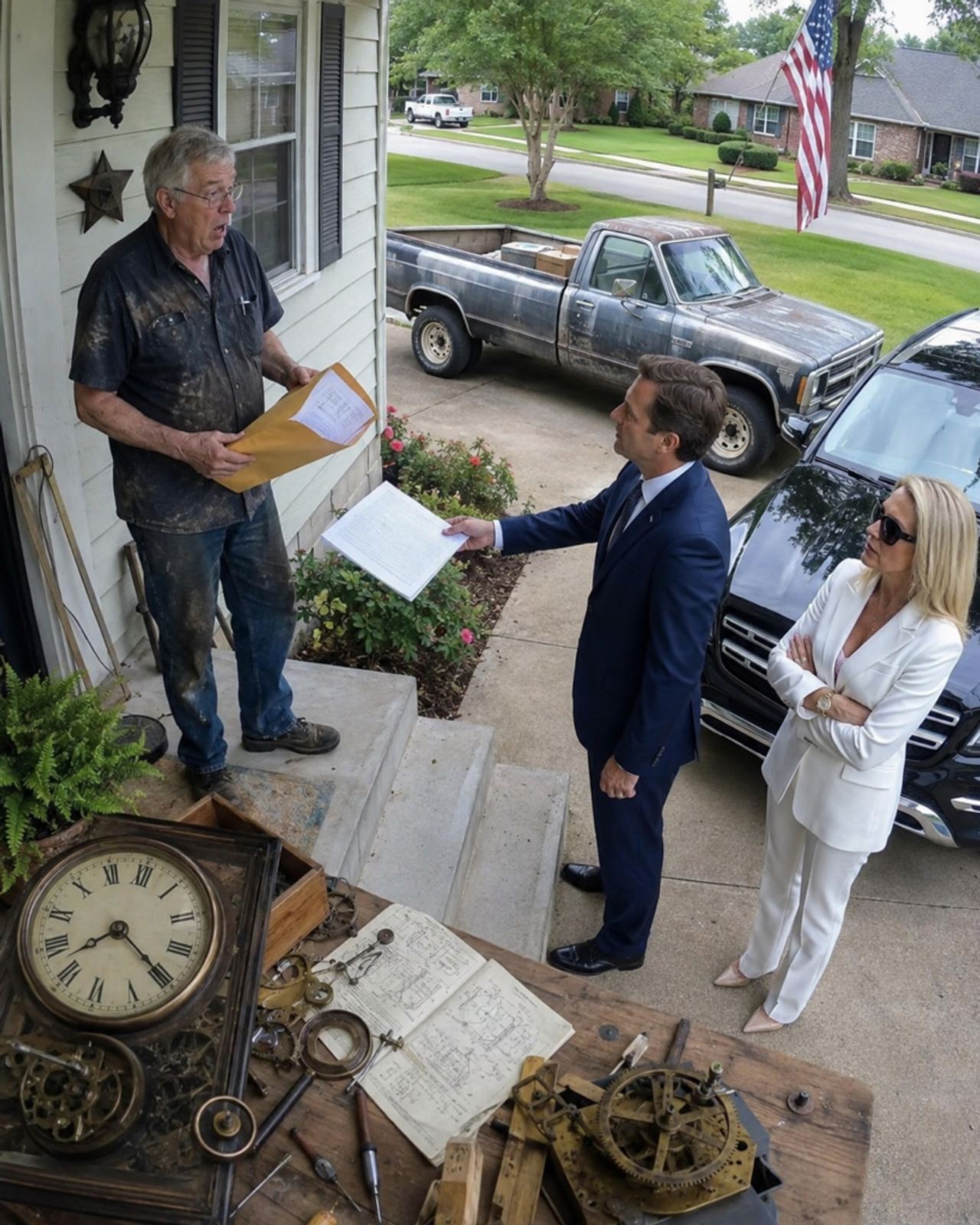
For a brief second, the line was completely quiet. “Dad, Mom is gone,” Lucas finally said.
His voice was completely devoid of emotion now. The sympathy had evaporated, leaving behind a cold, hard pragmatism.
And if she were here, she would want you to be safe. She would agree with us.
You are no longer capable of making adult decisions. You are sick. You need to accept that the cruelty of using his dead mother to justify his crime was the final confirmation I needed.
My son was gone. The boy I raised had been entirely replaced by a desperate, greedy stranger willing to discard me for a quick payday.
The movers will be there on Monday morning at 8 sharp. Lucas continued stepping fully into his role as the absolute authority.
You need to have your clothes and personal items packed. Do not try to take any of the large furniture or appliances.
Those were included in the sale of the property. Monica will bring by a rental car to drive you to the new facility.
Do not make this harder than it has to be, Dad. We are doing this out of love.
We want what is best for you. I took a slow, steady breath. I gripped the receiver tightly, feeling the hard plastic against my palm.
I had to swallow every instinct that screamed at me to expose his lies to tell him I knew about the forgery to promise him ruin. But I needed more time.
I needed to execute my plan flawlessly. “Okay, Lucas,” I whispered, sounding utterly defeated. “Okay, I will pack my things.
I am just so confused. I am so tired.” “I know, Dad,” he replied smoothly.
“Just rest. We will handle everything.” He hung up.
I slowly placed the receiver back onto the wall hook. The soft plastic click echoed through the empty hallway.
The sheer magnitude of their betrayal settled over me like a suffocating blanket. They had successfully stolen my past, and they believed they had completely dictated my entire future.
They were absolutely terribly mistaken. I walked over to the kitchen sink and splashed cold water onto my face.
I dried my hands on a cotton towel, staring at my reflection in the window pane above the faucet. I was old, yes, but I was far from finished.
The real war had only just begun. I stood there by the kitchen sink, the cool water slowly dripping from my chin, physically grounding me in the immediate present moment.
The sheer audacity of Lucas’s words still echoed loudly in the otherwise quiet room. Dementia. He had planted that terrible seed with such casual calculated precision.
I dried my face completely with a cotton towel, intentionally letting the rough fabric pull me back from the dangerous edge of blind rage. As a retired mechanical engineer, I had spent my entire professional career diagnosing massive catastrophic structural failures.
When a complex system completely breaks down, you do not simply stare at the surrounding wreckage and shout uselessly at the twisted metal. You carefully trace the microscopic fault lines all the way back to their very origin.
You look for the tiny stress fractures that silently appeared long before the final devastating collapse. My own son was not just lying to cover up a spontaneous opportunistic theft.
He was ruthlessly executing a meticulously designed long-term strategy. He had been quietly laying the foundation for my supposed mental decline for weeks, perfectly preparing the medical narrative, so that when the final blow eventually fell, no one in the world would ever question his motives.
The burning anger inside my chest began to crystallize, freezing into a sharp crystalline clarity. I deliberately walked away from the sink and sat back down on the heavy wooden bar stool.
I needed to systematically dissect his alibi. I needed to critically examine the structural integrity of his elaborate lies.
And the central weight-bearing pillar of his entire fabrication was the terrifying incident with the gas stove. I closed my eyes and allowed the memory of that specific afternoon to play back in my mind frame by frame, examining every tiny detail I had previously overlooked.
It had happened exactly 10 days ago. Lucas had stopped by the house completely unannounced on a random Thursday afternoon.
He had cheerfully brought two bags of premium organic groceries, insisting that he wanted to cook his old man a healthy batch of homemade vegetable soup. It had seemed like such a rare, deeply touching gesture of filial affection at the time.
I had sat at this very kitchen island, happily watching him chop carrots and celery, feeling a warm, familiar swell of pride for the son I had raised. He had filled the large stainless steel pot, placed it directly on the front right burner, and ignited the bright blue flame.
Then came the crucial pivot. The exact moment the microscopic stress fracture occurred. Lucas had turned to me, calmly, wiping his hands on a kitchen towel, and asked a highly specific question.
He casually asked if I still had that specific set of metric socket wrenches securely stored out in the garage. He confidently claimed he desperately needed to borrow them to fix a loose rattling bracket on Monica’s expensive car.
He knew exactly where I kept them buried at the very bottom of my heavy steel toolbox in the darkest, most cluttered corner of the detached garage. It was a tedious task that would take me at least 10 or 15 minutes to properly complete.
I had smiled genuinely happy to be useful to my son and walked out the back door without a single trace of suspicion. The very moment my boot stepped outside onto the concrete, the deadly trap was set into motion.
While I was struggling in the stifling oppressive heat of the garage, shifting heavy metal trays and blindly searching for the specific metric sockets, Lucas had not been waiting patiently in the kitchen. He had intentionally turned the gas burner up to its absolute maximum setting.
He had coldly ensured the soup would boil over rapidly, effectively drowning the open flame while leaving the heavy toxic gas, freely pumping into the enclosed kitchen space. And then he simply walked out the front door and drove his car away.
He did not bother to say goodbye. He did not wait for the wrenches he supposedly needed.
He completely abandoned the house, leaving his own father to walk back inside to a kitchen, rapidly filling with highly combustible, suffocating smoke. I vividly remembered coughing violently, my eyes watering intensely as the shrill, deafening shriek of the smoke alarms suddenly pierced my ears.
I had rushed forward in a panic, desperately waving a dish towel to clear the thick gray fog, and twisted the plastic knob to firmly shut off the hissing gas line. Less than 5 minutes later, Lucas and Monica had burst violently through the front door, panting heavily and looking completely terrified.
They convincingly claimed they had driven halfway down the street, realized they had forgotten to say a proper goodbye, and turned around just in time to see the dark smoke pouring from the kitchen window. They had rushed directly to my side, grabbing my shaking shoulders, acting deeply traumatized by the event.
Lucas had looked me dead in the eye and asked with perfect heartbreaking sincerity why I had turned the stove up so high and carelessly wandered off. I had been so utterly disoriented by the thick smoke and the blaring alarms that I had actually doubted my own memory.
I had apologized to them. I had apologized genuinely believing I had made a foolish, incredibly dangerous mistake due to my advancing age.
Now sitting alone in the absolute silence of my kitchen, the horrific truth slammed into my chest with devastating, undeniable force. It was not a lapse in my memory.
It was a carefully staged crime scene. Lucas had orchestrated a potentially lethal fire hazard just to forcefully manufacture a documented incident of my supposed cognitive decline.
He was aggressively building a fake medical history, a solid paper trail of incompetence to legally justify his fraudulent power of attorney. He had actively risked my life simply to steal my home.
The realization was so profoundly dark and twisted that it immediately stripped away every last lingering trace of paternal affection. My son was operating with the cold, ruthless efficiency of a corporate predator.
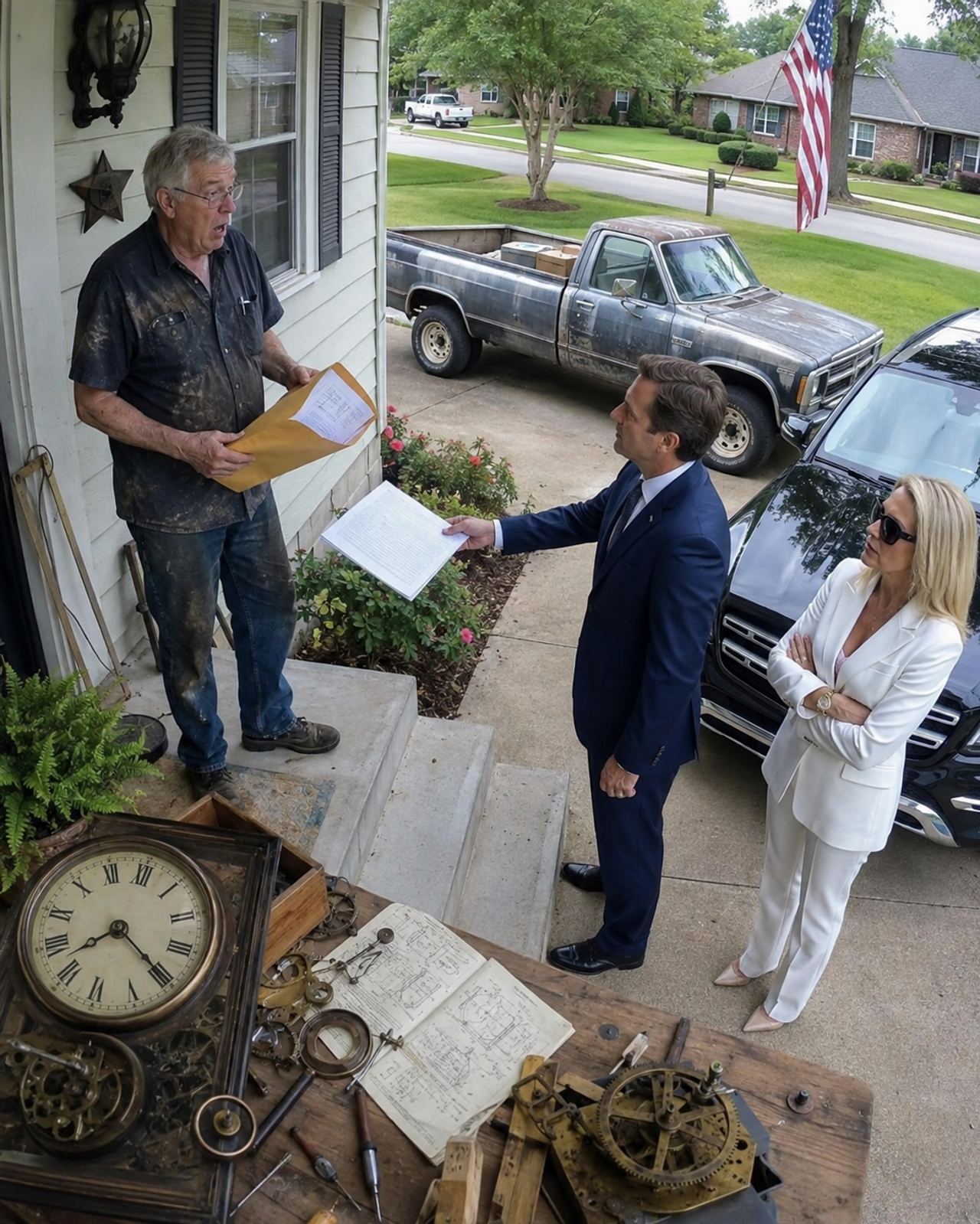
If I simply marched over to his house right now, wildly waving my arms and shouting loudly about forgeries and staged fires, I would be playing directly into his carefully crafted deceptive narrative. I would look exactly like a paranoid, deeply confused old man suffering from aggressive late-stage dementia.
The local authorities would look at his perfectly forged legal documents, listen to his remarkably sympathetic, practiced lies about the kitchen fire, and kindly escort me away to the psychiatric ward. Fighting them with honest, righteous outrage was a guaranteed, undeniable path to total ruin.
I could not use brute force to win this battle. I had to use complete deception.
I remained seated at the island, staring at the empty air, actively embracing my new reality. I had officially gone undercover in my own life.
They wanted a helpless, compliant victim, and I was going to give them an award-winning performance. My son thought he was the master architect of my ultimate demise, completely unaware that he had just willingly handed me the exact blueprints to his own total destruction.
I stepped away from the wooden bar stool, leaving the kitchen island to walk down the hall toward my private study. The heavy silence of the house pressed against my shoulders, but my mind was operating with a sharp singular focus.
I needed my tools. A mechanical engineer never relies solely on the naked eye when investigating a catastrophic structural failure.
He relies on precision. I opened the top drawer of my heavy oak desk and pulled out my silver framed reading glasses, settling them firmly onto the bridge of my nose.
Right beside them lay my old jeweler’s magnifying loupe, a small, heavy brass instrument I had used for decades to inspect hairline fractures in aircraft grade titanium. I picked it up, feeling its comforting weight in my palm, and walked deliberately back into the kitchen.
I pulled the thick manila envelope back toward me and carefully slid out the stack of legal documents. I set aside the eviction notice and the transfer of ownership deed, isolating the single most important piece of paper in the entire stack.
The power of attorney declaration. I smoothed the white sheet flat against the cool granite countertop.
I leaned over, fitting the brass magnifying loupe over my right eye, and brought my face just a few inches from the paper. I had already confirmed that the signature itself was a masterful forgery, a near perfect tracing of my own handwriting.
But a signature alone does not make a legal document binding. It requires a witness. It requires a state seal.
I dragged my focus away from the ink of my fake signature and slowly scanned down to the bottom left corner of the page. There, pressed sharply into the paper, was the official circular stamp of a Texas notary public.
I adjusted the angle of the overhead kitchen lights to illuminate the faint embossed ridges of the blue ink. I read the tiny typed print inside the circular seal.
The notary name was completely unfamiliar to me, likely a corrupt associate Bradley Thorne kept on his payroll specifically for dirty tasks like this. But it was not the name that made my breath catch in my throat.
It was the date block located just below the seal. The printed text clearly stated that I, Harrison Caldwell, had personally appeared before this notary in Dallas, Texas.
The date typed on the official line was August 14th. I stared at that specific date through the magnifying glass, letting the numbers burn themselves into my memory.
August 14th. I slowly pulled the brass loupe away from my eye and set it down onto the granite counter.
A cold, hard smile tugged at the corners of my mouth. My son was incredibly intelligent, holding an advanced business degree and managing high-level corporate accounts.
He had meticulously planned this entire fraudulent takeover, staging a kitchen fire to build a fake medical history and hiring a ruthless lawyer to execute the eviction. But in his arrogant rush to steal my home, he had made a fatal, sloppy administrative error.
He had picked the wrong date on the calendar. I left the kitchen once again and walked back to my study.
I bypassed the filing cabinets and walked directly over to the tall wooden bookshelf nestled in the corner of the room. I reached for a thick weather-beaten leather journal sitting on the middle shelf.
It was my personal fishing log. Since Evelyn passed away, I had made it a point to take one major completely off the grid fishing trip every single year, documenting every catch, every weather pattern, and every location with the meticulous detail of an engineer.
I carried the heavy leather book back to the kitchen and dropped it onto the island right next to the forged legal document. I flipped through the thick parchment pages, the smell of old paper and dried sea salt rising into the air.
I bypassed the entries from the spring and early summer, my fingers tracing the margins until I landed squarely on the middle of August. There it was, written in my own unmistakable handwriting, backed by detailed sketches and coordinate locations.
On August 14th, I was not in Dallas, Texas. I was not anywhere near a lawyer office or a notary public.
On the exact day this document claimed I had personally signed away the rights to my home, I was over 3,000 miles away. I was standing on the freezing wet deck of a commercial deep sea fishing charter right off the rugged coast of Kodiak, Alaska.
The memories flooded back with absolute clarity. The biting icy wind whipping across the bow of the boat. the massive churning gray waves crashing against the hull.
I remembered the distinct smell of diesel fuel and fresh bait. I remembered wrestling with a 60-pound halibut for nearly 40 minutes.
But most importantly, I remembered the isolation. We were out in open water completely beyond the reach of any cellular towers or communication networks.
I had not sent an email, made a phone call, or received a single text message for five entire days. I looked from the open pages of my fishing log to the fraudulent legal document.
The contrast was beautiful. My son had tried to build an inescapable trap, but he had accidentally given me an ironclad indisputable alibi.
I had receipts for the plane tickets. I had the official passenger manifest from the charter company.
I had credit card charges for the fishing gear rented at the marina. And I had 15 other fishermen on that boat, including the seasoned captain and his crew, who could absolutely testify under oath that I was stranded in the middle of the Alaskan ocean.
On the very day I supposedly walked into a Dallas office to sign away my estate, the power of attorney was not just slightly questionable. It was undeniably criminally fraudulent.
The legal foundation of their entire scheme was built on a provable lie. I closed the leather journal, my mind racing through the mathematical probabilities of what this meant.
If you find one critical structural flaw in a seemingly sound building, you must automatically assume the entire foundation is compromised. Lucas had willfully committed a severe federal crime to steal this house.
He had crossed a line that most people would never even approach. If he was willing to finally risk years in a federal penitentiary just to forge a property deed, what else had he touched?
What other vital systems had he compromised while I was not looking? The chilling implications began to spread through my mind like a dark stain.
The house was merely a physical asset that could be bought and sold. But my life was interconnected with dozens of other vulnerable points.
If Lucas had successfully bypassed the legal safeguards to transfer a deed, he could easily bypass the security protocols on my standard finances. He knew my social security number.
He knew my mother’s maiden name. He had all the answers to my security questions. I pushed the documents aside.
The time for investigating the past was over. I needed to check my personal bank accounts immediately.
I left the quiet solitude of my study and walked down the short hallway to the small spare room I used as a home office. It was a modest space filled with old drafting tables, rolled up blueprints, and a sturdy, unremarkable desktop computer sitting in the corner.
I sat down in my worn leather desk chair and pressed the power button on the computer tower. The machine hummed to life, the cooling fan whirring softly in the otherwise silent house.
While I waited for the outdated operating system to load, I thought about the specific financial boundaries I had established with my son over the past decade. When Evelyn passed away and left me the…
Read more stories