
Human Stories
My daughter-in-law smashed a plate over my head because I told her “no” – she thought I was just a weak 71-year-old, not the woman who’d already made three phone calls that would blow her whole world apart…
A 71-year-old woman is assaulted by her daughter-in-law after refusing to sign over her home and guarantee a massive loan, but she has already taken steps to expose the fraud. With help from an attorney and elder-abuse detective, she turns the tables and reclaims control of her house and life.

The plate broke against my skull before I even saw Vanessa raise her arm.
One second, I was standing in my own kitchen with the smell of burnt coffee in the air and the soft hum of the refrigerator behind me. The next, white light flashed behind my eyes, ceramic skidded across the hardwood floor, and my daughter-in-law’s voice came through the ringing like she was scolding a dog.
“Maybe now you’ll learn not to say no to me.”
I was seventy-one years old, five foot two, and bleeding into the collar of the pale blue blouse I wore to church most Sundays. My hand found the edge of the counter before my knees could give out. Warm blood ran past my ear, and the broken plate lay around my slippers in bright little pieces.
Vanessa stood over me in cream silk trousers and diamond earrings she bought with money she kept claiming she didn’t have. My son, Daniel, stayed near the refrigerator with one hand on the stainless-steel door, pale as paper and just as useless.
“Mom,” he whispered, not to her, not with horror, not with any of the anger a son should have when his mother is bleeding in front of him. “Just sign the papers.”
On my kitchen table sat a deed transfer for my house and a personal guarantee for a two-million-dollar business loan.
My house.
Thomas and I had paid that mortgage off with forty years of double shifts, clipped coupons, packed lunches, and quiet Saturdays fixing what we could not afford to replace. He had built the back deck with his own hands. I had planted the oak tree by the driveway the spring Daniel turned six.
Before Thomas died, he made me promise one thing.
“Don’t ever let guilt make your decisions for you, Ruth. Love people. Help people. But don’t hand them the keys to your own ruin and call it family.”
For years, I thought that was just grief talking.
It wasn’t.
Vanessa’s luxury events company had been collapsing for months. She still posted champagne towers, ballroom flowers, and smiling clients online, but the truth had been leaking through the cracks:
Vendors calling my house.
Bank notices tucked into Daniel’s briefcase.
Her voice getting sharper every time I asked a simple question.
Daniel had moved back in with her after saying they were “between investments.” I let them stay because I was his mother, and because loneliness makes a house feel bigger than it is. I gave them the guest room, the garage code, the Wi-Fi password, and Sunday dinner every week.
Trust is not always handed over in one dramatic moment. Sometimes it is given in small, ordinary pieces until the wrong person realizes they have almost enough to trap you.
Within three weeks, Vanessa had:
- Replaced the side-door lock “for safety.”
- Dismissed my housekeeper because “outsiders make things messy.”
- Started telling relatives I had been forgetting things — a missing checkbook, a misplaced pill bottle, a doctor’s appointment I supposedly canceled and did not remember canceling.
Then came the forms.
First, she said I should “simplify” my estate. Then Daniel said the bank needed reassurance. Then Vanessa said if I loved my grandchildren — grandchildren she had never given me — I would want my son’s future protected.
That morning, at 9:14 a.m., while they were at brunch, I opened the locked drawer in Daniel’s office with the spare key he forgot I had watched him hide.
Inside were:
- Copies of my signature.
- Two forged medical letters saying I showed signs of cognitive decline.
- A draft petition about assisted living.
- Printed emails between Daniel and Vanessa discussing how quickly they could sell the house after “the old woman” was placed somewhere safe.
Somewhere safe.
That was what they called it when they meant somewhere silent.
I photographed every page. I laid the papers in order on the carpet, took wide shots, close shots, and one video scrolling through the email chain so nobody could say I had misunderstood.
At 9:32 a.m., I called Helen Price, the attorney who had handled my estate for twenty-six years.
At 9:48 a.m., I called Detective Marcus Bell at the county elder-abuse unit and gave him the words “forged medical letters,” “deed transfer,” and “physical coercion risk.”
At 10:07 a.m., I made the call Vanessa would never expect — to Cynthia Rowe, the chairwoman at the bank reviewing Vanessa’s loan.
By 11:26 a.m., they were back in my kitchen, and Vanessa was sliding the deed toward me with one manicured finger.
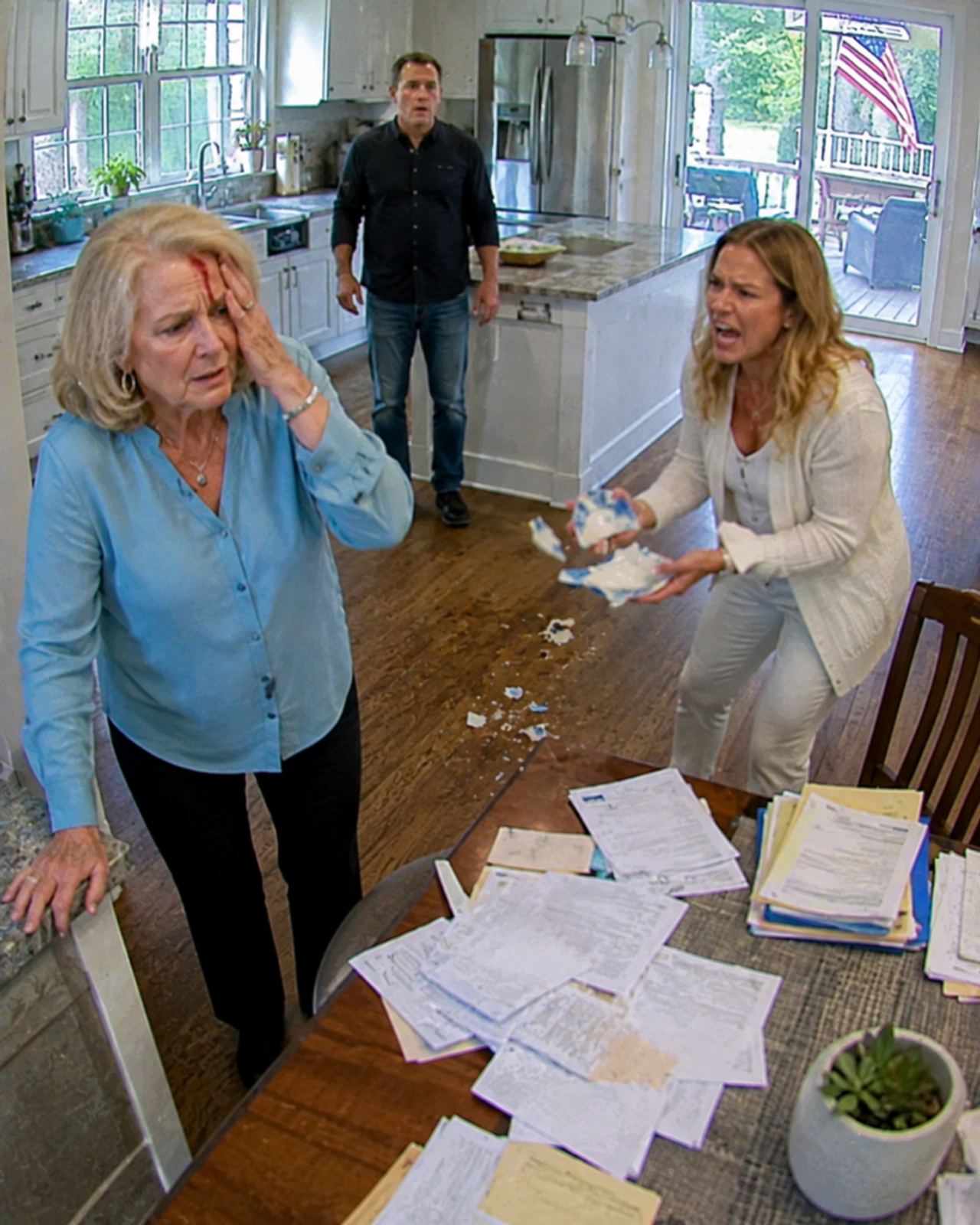
“Sign,” she said. “You’re making this ugly.”
“I didn’t make it ugly,” I said, pressing a dish towel to my head. “I only stopped pretending it was clean.”
Her eyes narrowed. “You don’t understand finance anymore. Daniel said your memory is slipping.”
That hurt more than the plate.
Not because Vanessa said it. Vanessa had always treated kindness like weakness and age like a locked door she could pick. It hurt because Daniel stood there and let her use my mind as a weapon against me.
I looked at my son. “Is that what you want?”
His eyes slid to the floor.
That was my answer.
The kitchen froze around us. The refrigerator kept humming. The coffee pot clicked as it cooled. Outside, a pickup rolled slowly past the mailbox, and the small American flag Thomas had hung on the porch lifted in the July heat like it was trying to remind me I still lived in my own house.
Vanessa leaned close enough for me to smell champagne on her breath. “Sign, or we’ll have you declared incompetent by Friday.”
For one ugly second, I wanted to slap the papers into her face. I wanted to scream Daniel’s name until the boy I had raised came back through whatever greed had done to him.
Instead, I lowered the bloody towel.
And I smiled.
Vanessa’s expression flickered.
She thought I was weak because I had chosen calm. She had no idea calm was the last kindness I intended to give her.
Then the doorbell rang.
And for the first time since she walked into my house, Vanessa stopped smiling…
The doorbell rang again, slower this time — not impatient, not confused. Certain.
Vanessa’s head snapped toward the front hallway. Daniel finally moved, but only one step, like his body had remembered fear before his conscience did. I kept one hand on the counter and the other on the bloody towel, watching the color drain from my daughter-in-law’s face as the ceramic pieces stayed scattered around my shoes.
“Who is that?” she demanded.
I looked at Daniel. “Why don’t you answer it?”
He didn’t.
That was when my phone buzzed on the kitchen table beside the deed transfer. The screen lit up with Helen Price’s name, and beneath it was a text preview I had been waiting for since 9:32 that morning:
Do not sign anything. Detective Bell is with me.
Vanessa saw only the name. She reached for my phone.
I put my palm over it first.
Her hand froze above mine, those diamond rings flashing in the kitchen light, and for the first time she looked less like a woman giving orders and more like a woman counting exits.
Daniel whispered, “Mom… what did you do?”
His voice cracked on the last word. Not because he was sorry. Because he was finally afraid the wrong person had been underestimated.
The doorbell rang a third time.
Then a man’s voice came through the front door, calm and official enough to make Vanessa’s hand fall away from mine:
“Mrs. Ruth Miller? This is Detective Bell with the county elder-abuse unit. We need to speak with you about a reported forgery and an attempted property transfer.”
Vanessa turned to me, mouth opening, but no sound came out.
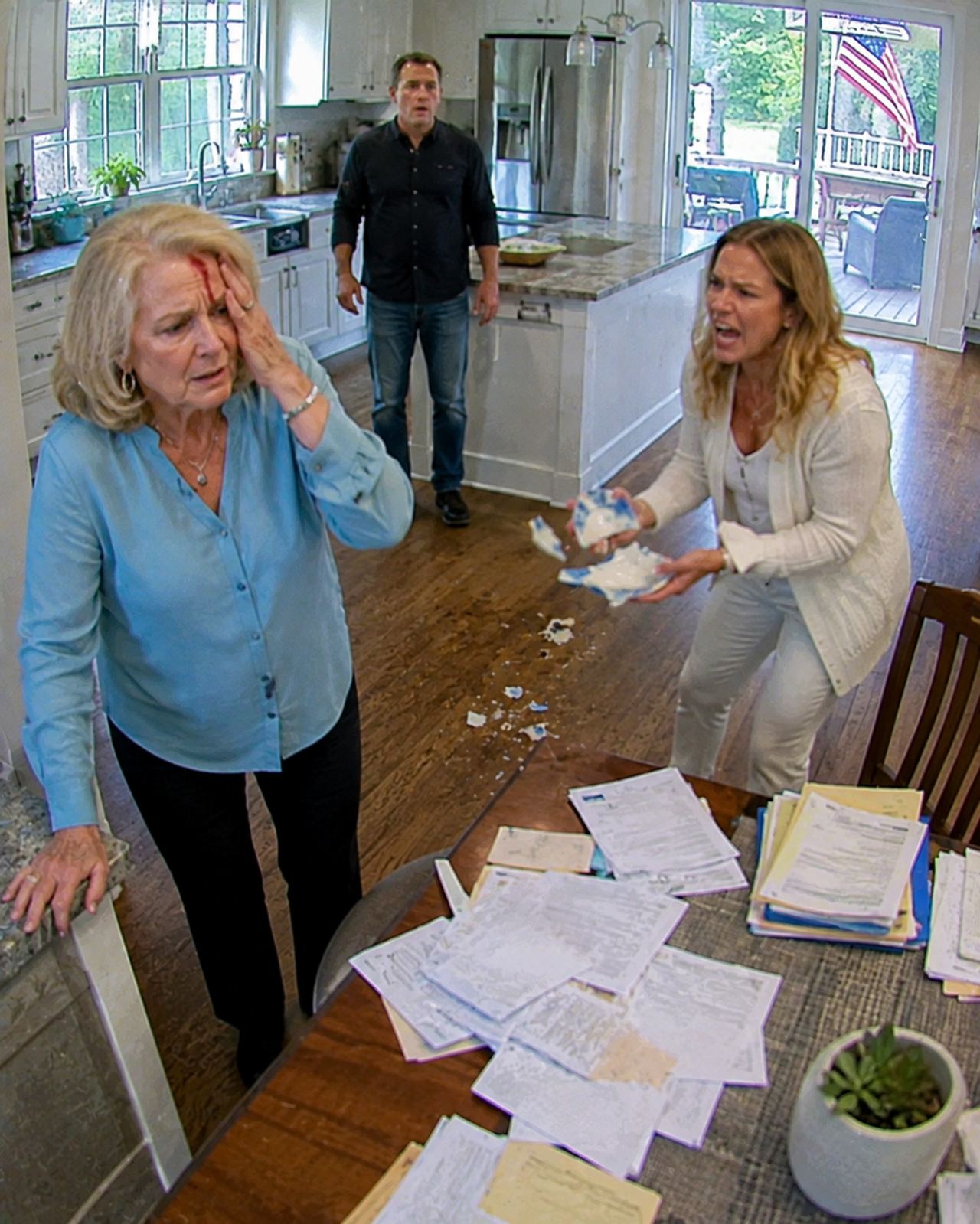
I picked up the deed, held it between two fingers, and said—
Part 2
The deed tore down the middle with a sharp, dry sound that cut straight through the silence of the room.
I let both halves flutter to the floor, where they landed right on top of the broken ceramics. “I’m taking out the trash.”
Vanessa’s mouth worked silently for two long seconds before her face twisted into something raw and feral. She lunged forward, her fingers clawing at my forearm to drag me away from the front door. “You crazy old bitch—!”
“Step back, ma’am!”
The front door clicked open—I had unlocked it minutes before they returned—and two men stepped into the entry hall. Detective Bell came first, broad-shouldered and sharp-eyed, his badge flashing at his belt. Right behind him was Helen Price, holding a leather briefcase like a shield.
Bell took in the scene with one sweeping glance: the blood soaking my collar, the scattered pieces of my favorite teacup plate, and Vanessa’s manicured hand still raised near my shoulder.
“Get your hands off her. Now,” Bell said, his voice dropping into an octave that made Daniel flinch.
Vanessa pulled her hand back as if she’d touched hot iron, smoothing her silk trousers with trembling fingers. “Detective, thank God you’re here. My mother-in-law had a fall. She’s confused… she’s been throwing things and—”
“Save it,” Helen interrupted, stepping between Vanessa and me. She pulled a printed pack of papers from her briefcase and held them up. “We have time-stamped digital copies of the forged medical letters found in your office drawer, Mrs. Miller. Along with the email chain discussing the sale of this property, sent from your personal domain at 2:14 a.m. last Tuesday.”
Vanessa’s head snapped toward Daniel, her eyes wild with betrayal. “You left the key out?”
Daniel didn’t answer. He was staring at the blood dripping slowly from my chin onto the counter. “Mom…” he choked out, taking a step toward me. “Mom, please tell them it’s a mistake. We were just trying to help you with the business… we were going to take care of you…”
“You were going to put me in the Oaks Nursing Facility, Daniel,” I said, my voice steady despite the faint dizziness lingering behind my eyes. “Section 4, paragraph 2 of your draft petition. You earmarked my late husband’s pension to pay for the first three months before selling the house to clear Vanessa’s debt.”
Detective Bell signaled to the uniformed officer who had followed him inside. “Vanessa Miller, you are under arrest for felony assault, attempted fraud, and financial elder abuse.”
As the steel cuffs clicked around her wrists, Vanessa lost the last bit of her polished composure. She screamed, kicking at the air as the officer marched her toward the door, her diamond earrings catching the sunlight one last time before she was forced into the back of the cruiser.
The house grew suddenly, heavy-quiet.
Daniel stood alone by the refrigerator, looking smaller than he ever had in his life. “Mom… what about me?”
I looked at my son—the boy who used to scrape his knees on the back deck Thomas built, the boy who used to help me water the oak tree in the front yard.
“The detective will want your statement, Daniel,” I said quietly, wrapping the dish towel tighter against my head. “And then I want you out of my house.”
Part 3
Six months later, the morning air had the crisp, clean bite of early November.
I sat on the back deck with a warm cup of black tea, listening to the quiet rustle of fallen leaves. The scar above my ear still throbbed occasionally when the weather changed, but the kitchen inside had been repaired. The blood was gone. The broken teacup plate had been cleared away long ago.
Helen Price had made sure the legal battle was swift. Vanessa was currently serving three years at a state correctional facility after pleading guilty to grand larceny and assault charges. Her luxury events company had vanished under the weight of liquidations and back taxes.
Daniel hadn’t gone to prison, but he hadn’t stayed clean either. He had accepted a two-year probation plea for complicity. He called me twice from a rented room across the state—crying, asking if we could ever go back to Sunday dinners.
I didn’t yell at him. I didn’t insult him. I just listened, remembered Thomas’s words, and gently hung up the phone.
Love people. Help people. But don’t hand them the keys to your own ruin and call it family.
A soft knock sounded on the front door.
I walked through the hallway, opening it to find a young girl from the county medical center holding a small clipboard, accompanied by a locksmith I had hired to install a second deadbolt.
“Mrs. Miller?” she asked kindly. “Just checking in for your routine follow-up after the incident.”
“I’m doing just fine, dear,” I smiled, stepping aside to let the locksmith work.
I walked out onto the front porch and stood by the railing, looking at the large oak tree Thomas and I had planted decades ago. Its leaves were a deep, vibrant red, standing tall and firm against the winter wind.
They had thought my age was a crack in the wall they could wedge open with fear and guilt. They thought forty years of quiet devotion meant I had forgotten how to protect what was mine.
I took a deep breath of the cold air, feeling the strength in my hands and the solid wood of my home beneath my feet.
I was seventy-one years old. I was still standing. And this house was still mine.
Read more stories
- I inherited a cabin while my sister got a Miami apartment. When she mocked me: “Fits you perfectly, you stinking woman!” and told me to stay away, I decided to spend the night at the cabin… When I got there, I froze in place at what I saw…
- She Changed the Locks After Her Husband Dismissed Her Promotion
- I went to my granddaughter’s wedding. Right at the entrance, my son stopped me and said, “Mom, your name isn’t on the list.” Two hundred guests were standing there, and all of them were looking at me. I replied, “It’s okay, son.” Then I turned around, went back home, and called my lawyer. The next morning, a letter was sent straight to his house.
- My husband thought taking his new bride, our teenagers, and his entire family overseas for his second wedding would humiliate me enough to make me disappear quietly before he returned. He even texted me that he hated old things and deserved a new life, as if twenty years of marriage, motherhood, and the home built on my father’s land were just clutter he could order removed. I let him believe I was broken. I let him enjoy every photo, toast, and beachside celebration while my attorney moved faster than he ever imagined I could. Then I parked down the road on the morning his plane landed, watched his car pull into the driveway, and saw his face turn white when he realized the house itself was gone…