
Human Stories
She Turned 18, Protected $45 Million, Then Her Family Demanded She Sign
A young woman turns 18 and uses her late father’s legal safeguards to protect a $45 million inheritance from her mother, stepfather, and half-sister, who try to pressure her into signing it over. The story reveals how quiet observation and careful documentation helped her outmaneuver their plan.

I was still 17 when I finally understood that the mansion I lived in was not really a home.
From the street, it looked like the kind of house people slowed down to stare at.
Glass walls caught the morning sun.
The driveway was always spotless.
The kitchen had imported marble, a built-in espresso machine, and a long island cold enough to make your fingers stiff if you rested your hand on it too long.
My mother loved that kitchen because it photographed well.
She loved the way guests reacted when they walked in.
She loved the quiet little gasp people made before they remembered to act casual.
To everyone outside our family, we looked rich, stable, and beautiful.
Inside, it was different.
Inside, I was a guest who happened to have a bedroom.
Not even a good bedroom.
Chloe, my half-sister, had the suite with the balcony and the ocean view.
I slept near the laundry room, where the dryer shook the wall late at night and the air always smelled faintly of detergent and warm lint.
My mother called it temporary.
It had been temporary for years.
My biological father’s last name was Whitman.
He had built a fortune in Silicon Valley before he died, and the one thing everyone in that house knew, even if they rarely said it out loud, was that he had left a trust for me.
When I turned 18, it became mine.
Forty-five million dollars.
That number changed the air around people.
It made adults use soft voices.
It made my stepfather speak about responsibility.
It made my mother touch my shoulder in front of other people.
It made Chloe call me “sweetie” when her friends were watching.
But the older I got, the clearer it became that none of them thought of that money as protection.
They thought of it as something they were waiting to access.
My father had meant it to give me choices.
They had decided it would save them.
Two weeks before my 18th birthday, I asked my mother for one thing.
A small dinner.
Not a party.
Not a rented room.
Not a video montage or a photographer or some performative family moment she could post later.
I wanted dinner at home, with no event manager, no brand people, and no strangers walking through the house acting like my life was a backdrop.
She agreed at first.
Then Chloe decided she needed the main floor and terrace for a skincare brand launch mixer.
My birthday dinner disappeared in one phone call.
My mother stood in the doorway of my room with her phone still in her hand and told me she knew I would understand.
Chloe barely looked up from her screen when she thanked me for being “so easy about it.”
There was a time when that would have crushed me.
By then, it only clarified things.
They were not careless by accident.
They were careful about what they valued.
I went upstairs and sat on my bed while people downstairs discussed lighting, floral arrangements, influencer attendance, and whether the terrace looked better at sunset or after dark.
I could hear Chloe laughing through the floor.
I could hear my mother’s heels on the marble.
I could hear my stepfather giving advice in that calm, expensive voice he used when he wanted everyone to believe he had already solved the problem.
His name was not Whitman.
But somehow, my father’s money had become his favorite subject.
At dinner the next week, he started again.
He talked about financial stewardship.
He talked about risk management.
He talked about how young people often made emotional decisions with money they had not earned.
My mother nodded along as if he were delivering wisdom instead of rehearsing control.
Chloe asked whether “the family” would finally have enough liquidity for serious brand investment after my birthday.
No one corrected her.
No one said, Chloe, that money belongs to your sister.
No one said, that was left by her father.
No one said, maybe do not talk about another person’s inheritance like it is a coupon code.
I looked down at my plate and kept eating.
That was what they expected from me.
Quiet.
Useful.
Manageable.
Silence looks like weakness to people who have never had to use it as armor.
They mistook mine for permission.
A few days later, I came home earlier than expected.
Chloe had a product shoot somewhere.
My mother was out.
My stepfather’s car was gone.
The house felt still in that strange way expensive houses can feel still, with every surface shining and no evidence that anyone actually lives there.
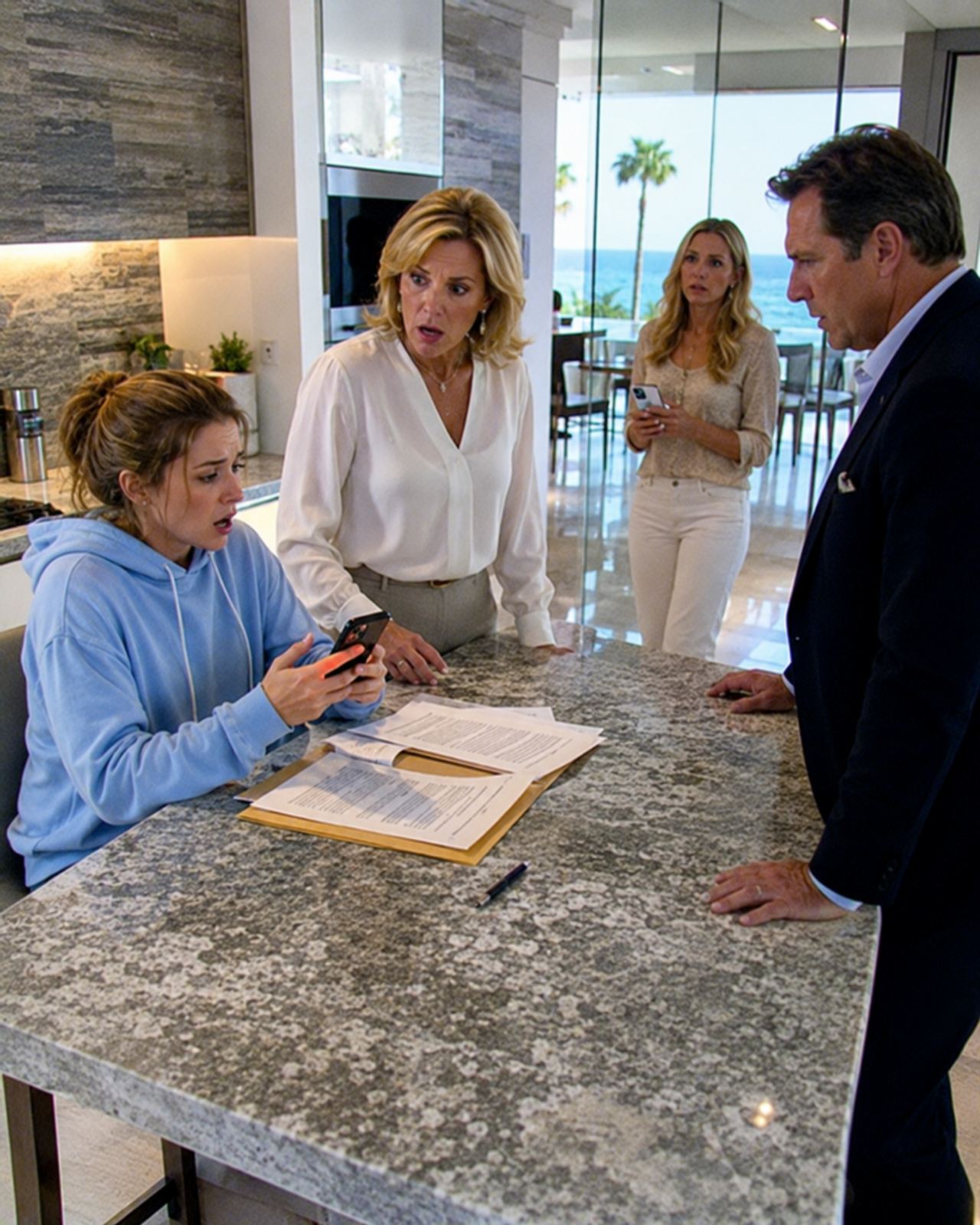
I dropped my backpack on the bench near the kitchen and saw the folder.
It was on the island beside my stepfather’s leather notebook.
The first page said, “Whitman Family Capital LLC execution draft.”
I stopped breathing for a second.
Whitman was my father’s last name.
I knew I should not touch it.
I also knew that if I walked away, I would spend the rest of my life wondering what warning I had refused to read.
So I opened it.
The document was forty-two pages long.
At first, the language was thick and formal.
Capital contribution.
Operating structure.
Management authority.
Voting rights.
Collateralization.
But the meaning sharpened as I turned the pages.
They intended to move 80% of my inheritance into a new family holding company.
My stepfather would control it.
My mother would hold a management position.
Chloe’s brand would receive funding through it.
My stepfather’s tech company would use my father’s money as collateral.
By the time I reached the last page, my hands had stopped shaking.
That frightened me more than panic would have.
Panic means part of you still wants someone to explain it away.
Calm means you already know the explanation.
This was not advice.
It was not family planning.
It was my life being stolen in legal language.
That night, they ate dinner like nothing had happened.
My mother asked whether I had thought more about my future.
My stepfather said I should not overwhelm myself with decisions after my birthday.
Chloe complained that her launch would not be taken seriously without a bigger production budget.
“People can smell cheap,” she said.
I remember looking at her manicure wrapped around her water glass and thinking that she had no idea how cheap greed could look when it forgot to hide itself.
My stepfather smiled.
“The family will have enough runway soon,” he said.
The family.
That was the word he liked.
Family meant his company.
Family meant Chloe’s image.
Family meant my mother’s comfort.
Family meant everyone except the girl whose father had left the money.
I went to my room after dinner and locked the door.
Then I started documenting.
I photographed the draft when nobody was home.
I saved dates.
I wrote down conversations.
I kept copies in a folder that did not sync to any family device.
I emailed nothing to myself because my stepfather had once mentioned he could “help” me clean up my accounts if I ever lost access.
I did not ask my mother whether she knew.
I already knew.
The next day, I contacted Malcolm Price.
Mr. Price had been my father’s attorney and closest advisor before he died.
When I was younger, he sent birthday cards in plain envelopes with neat handwriting.
He never wrote anything emotional, but he always remembered.
My father had trusted him.
That was enough.
Mr. Price met me in an office that smelled like paper, coffee, and old wood.
He read all forty-two pages without speaking.
Not once did he interrupt me with comfort.
Not once did he make me feel dramatic.
He simply read.
The slower he turned the pages, the colder my stomach became.
When he finished, he took off his glasses and placed them on the desk.
“They have been preparing this for a long time,” he said.
I asked him if they could force me.
“No,” he said.
Then he added, “But they may try to make you believe they can.”
That sentence stayed with me.
For the next several days, we worked quietly.
There were calls I took from my car.
There were forms I reviewed with my laptop brightness turned down at night.
There were drafts, confirmations, and instructions that had to be ready before midnight on my birthday.
Mr. Price explained everything twice.
He made sure I understood what irrevocable meant.
He made sure I understood control.
He made sure I understood that once the transfer was completed, my mother and stepfather could not simply pressure me into undoing it over breakfast.
The night before I turned 18, the house was full of Chloe’s people.
Her skincare mixer took over the terrace.
There were gift bags on the console table, champagne flutes near the pool, and strangers taking photos under lights where my birthday dinner was supposed to be.
My mother floated through the rooms in a white dress, glowing for everyone except me.
Chloe made a speech about women building their own futures.
I stood near the stairs and almost laughed.
Not because it was funny.
Because some lies have nerve.
Later, after everyone left, the mansion finally went quiet.
The ocean beyond the glass looked black.
The laundry room hummed through the wall.
At 11:58 p.m., I sat at my desk with my laptop open and my phone beside me.
At 12:01 a.m., the first official minute of adulthood, I authorized the transfer of my entire inheritance into an irrevocable corporate trust.
At 12:04 a.m., the confirmation came through.
The money was protected.
I stared at the screen for a long time.
I did not cry.
I did not celebrate.
I just breathed.
For the first time in years, the silence around me did not feel like loneliness.
It felt like a locked door.
The next morning, they were waiting in the kitchen.
That alone told me everything.
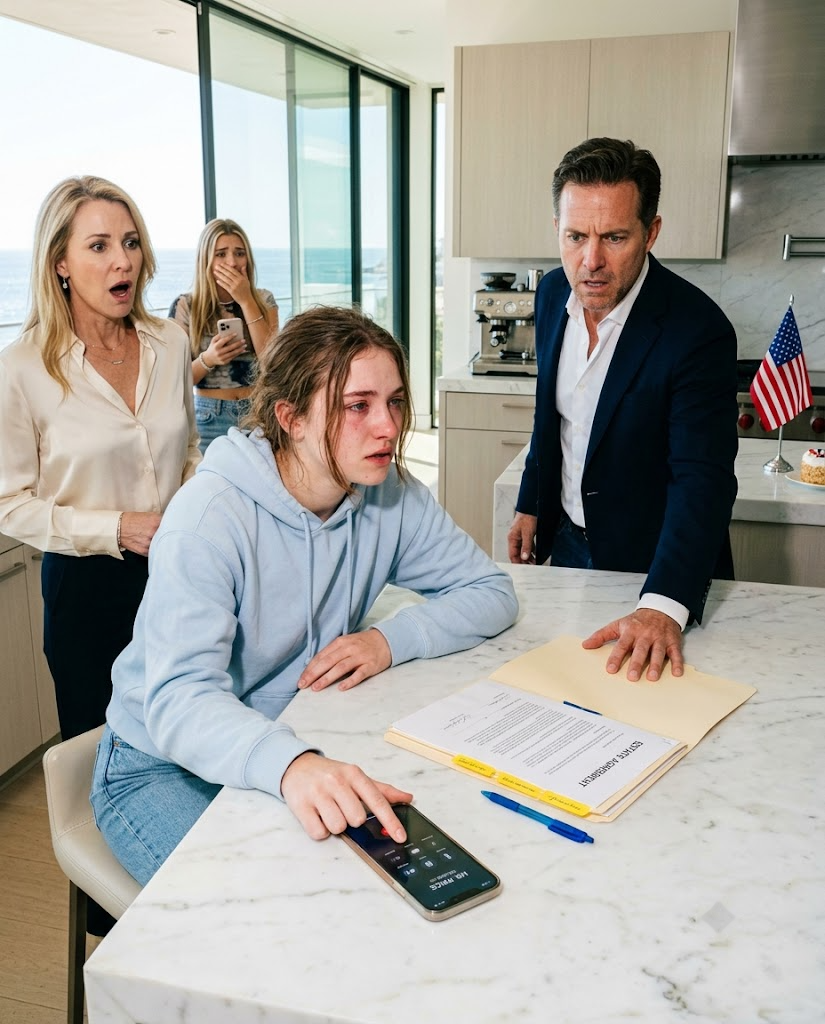
My mother had arranged a birthday pastry on the island.
One candle stood in the frosting, unlit.
Beside it was a thick manila folder with yellow signature tabs sticking from the edges.
My stepfather stood behind the counter with a cheap blue pen.
Chloe leaned near the cabinets with her phone in her hand, pretending she was not vibrating with excitement.
“Happy birthday, sweetheart,” my mother said.
Her smile was beautiful.
It always was when she needed something.
“We need to talk about that money.”
My stepfather slid the folder toward me.
“Just sign wherever you see the tabs,” he said.
He said it casually, like asking someone to initial a delivery receipt.
I sat down.
I opened the folder.
I read slowly.
Page after page.
The kitchen lights reflected off the marble.
The espresso machine blinked silently in the corner.
Chloe shifted her weight, impatient.
My mother’s smile stayed fixed.
My stepfather’s jaw tightened every time I turned another page without picking up the pen.
“This is standard,” he said.
“I’m reading it,” I replied.
His eyes hardened.
My mother gave a soft laugh.
“Honey, that is why we’re here. You do not have to carry this alone.”
I almost looked at her then.
I almost asked when she had decided motherhood meant waiting for my birthday like a deadline.
But rage is useful only if you do not spend it too early.
So I kept reading.
Chloe finally said, “Can we not make this weird?”
That was when I closed the folder.
The sound was small.
Still, everyone heard it.
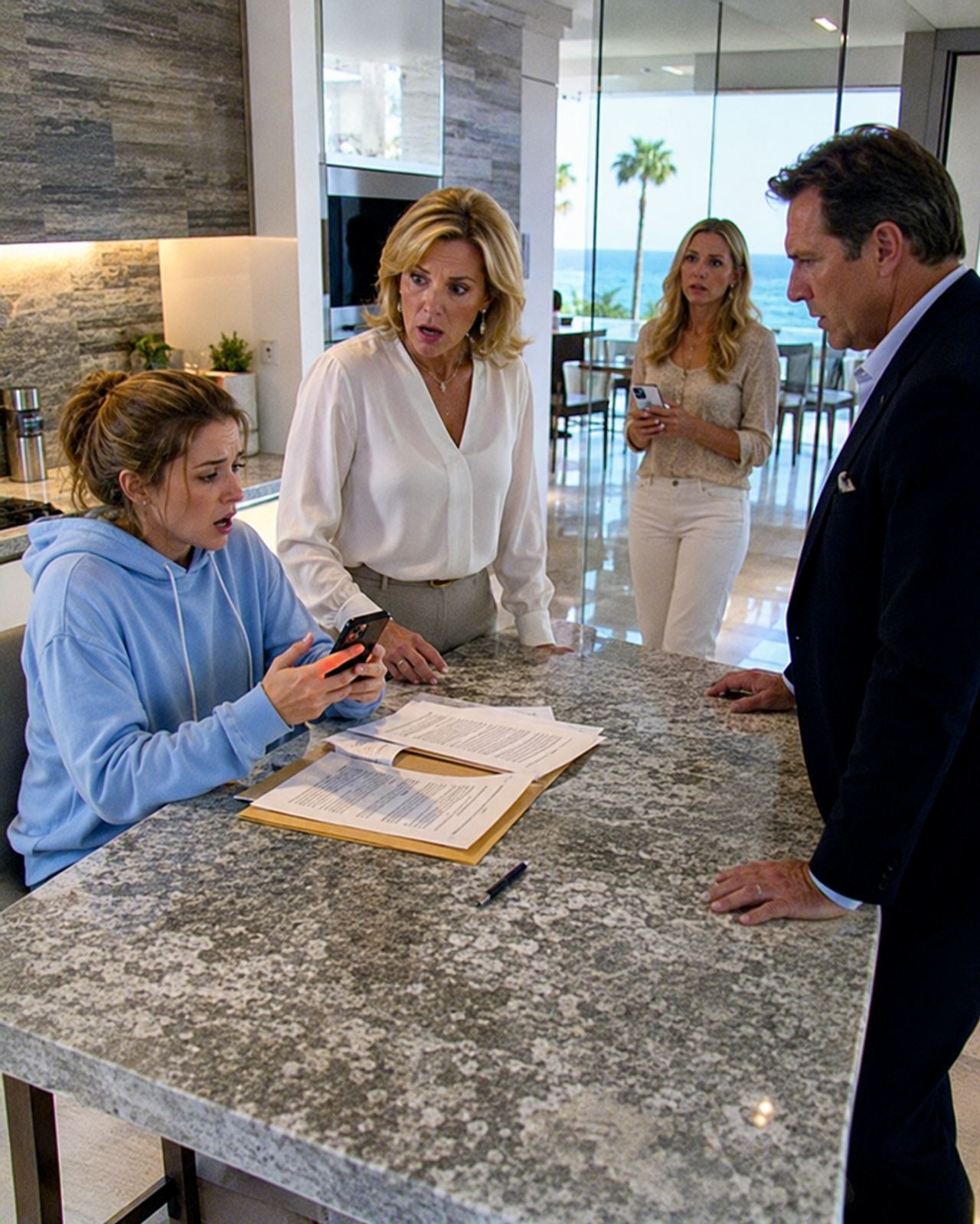
I placed my phone on the granite counter.
I tapped speaker.
“Mr. Price,” I said, “you’re on speaker.”
The whole room froze.
My stepfather stared at the phone.
My mother’s smile twitched.
Chloe lowered her own phone slightly.
“Good morning,” Mr. Price said.
His voice was calm and clear.
“As of 12:04 this morning, the full Whitman inheritance was transferred into an irrevocable corporate trust under the protective structure your father requested before his death.”
My stepfather’s face changed.
It was subtle at first.
A tightening around the eyes.
A small shift in the mouth.
Then the color began to leave him.
“That is not possible,” he said.
“It is completed,” Mr. Price replied. “Timestamped, filed, and confirmed.”
Chloe stepped back and hit the cabinet behind her.
My mother looked at me then, really looked at me, like I had become visible at the worst possible time.
My stepfather reached for the folder.
I put my hand on it first.
For one ugly second, I thought he might try to take it anyway.
He did not.
People like him understand witnesses.
They understand records.
They understand phones on speaker.
Mr. Price continued.
“There is also a copy of the Whitman Family Capital LLC execution draft in my office, including the provision moving 80% of her inheritance under your control.”
My mother went pale.
Chloe whispered, “Mom… you said she would sign.”
That was the first honest thing anyone had said all morning.
My mother turned on her so quickly the coffee cup beside her rattled.
My stepfather said my name like a warning.
Mr. Price spoke before anyone else could.
“Before anyone in that kitchen says another word, you should know her father left one final instruction if this exact situation ever happened.”
No one breathed.
“What instruction?” my mother asked.
Her voice had lost its polish.
Mr. Price did not answer her.
He addressed me.
“Do you want me to proceed?”
That was when I understood my father had known more than I ever realized.
He had not just protected the money.
He had anticipated the moment someone would try to turn love into leverage.
“Yes,” I said.
My stepfather stepped back from the island.
Chloe’s eyes filled with panic, not grief.
There is a difference.
Grief mourns what was lost.
Panic mourns what it expected to take.
Mr. Price explained that my father’s estate plan included a protective review clause.
Any attempted coercive transfer, family holding company demand, or forced management agreement triggered full outside oversight.
The trust would remain inaccessible to the household.
All further communication about the inheritance would go through counsel.
Any attempt to pressure me into signing financial documents could be formally documented.
My mother tried to recover first.
“This is ridiculous,” she said. “We are her family.”
Mr. Price’s voice did not change.
“Family is not a legal authorization.”
That sentence landed harder than shouting would have.
My stepfather tried a different approach.
He smiled, but the smile was thin.
“You are making an emotional mistake,” he told me.
“No,” I said. “I made the mistake years ago when I thought being quiet would make you kinder.”
Chloe started crying then.
Not loudly.
Not with the kind of tears that come from heartbreak.
She cried the way someone cries when the future in her head disappears before she has time to spend it.
“What about my launch?” she said.
I looked at her.
For years, she had occupied every room like my needs were furniture to move around.
For years, my mother had called that confidence.
Now Chloe stood in the kitchen with her phone hanging uselessly in her hand, asking what would happen to a brand built on money that had never belonged to her.
“I guess you will have to build it yourself,” I said.
The words were not cruel.
That made them worse for her.
My mother said my name sharply.
I stood up.
The pastry was still untouched.
The candle had never been lit.
The blue pen sat between us like a tiny failed weapon.
“I am leaving for the day,” I said. “Do not contact me about money again without Mr. Price present.”
My stepfather laughed once.
It was a brittle sound.
“You live in my house.”
I looked around the kitchen.
The marble, the glass, the ocean view, the machines, the flowers, the beautiful staged life that had made everyone believe I was lucky.
Then I looked back at him.
“No,” I said. “I lived in my father’s absence while you waited for his money.”
Nobody moved.
I picked up my phone.
Mr. Price was still on the line.
“Call me when you are outside,” he said.
“I will,” I answered.
Then I walked out of that kitchen without signing a single page.
For the first time, my mother did not call after me in that soft voice she used to pull me back.
For the first time, Chloe did not look amused.
For the first time, my stepfather did not look like a man in control.
He looked like a man who had reached for a door and realized it had been locked from the inside.
In the weeks that followed, the house became louder.
Not with parties.
With phone calls.
Closed-door arguments.
Legal warnings.
Financial conversations that stopped when I entered a room.
Chloe’s brand launch shrank.
My stepfather’s company suddenly had to find collateral somewhere else.
My mother tried several versions of apology.
Some were angry.
Some were tearful.
Some were dressed up as concern.
None of them included the sentence I needed most.
I was wrong.
So I stopped waiting for it.
Mr. Price helped me arrange housing, school plans, and a protected communication structure.
I learned more about my father’s planning in those months than anyone had told me in the years after he died.
He had not been careless.
He had not left me alone.
He had simply known that some protections have to sleep quietly until the day they are needed.
I used to think the mansion proved I had been given everything.
Now I know better.
A beautiful house can still teach a child to feel unwanted.
A full kitchen can still starve someone of safety.
A family can smile in public while waiting for the day a signature makes betrayal official.
But they made one mistake.
They thought the quiet girl near the laundry room had not been paying attention.
I had been paying attention for years.
And at 12:04 a.m. on the first morning of my adult life, I finally turned that silence into a locked door.
Read more stories
- THE SONG WAS WRITTEN YEARS EARLIER, BUT WHEN FOUR OUTLAWS DIVIDED THE VERSES IN 1985, IT BECAME A PROMISE OF IMMORTALITY.
- She Was Fired for Saving His Daughter—Then the Folder Opened
- A $60 MILLION DIVORCE USUALLY ENDS IN HEADLINES OF BITTERNESS — BUT KENNY ROGERS USED HIS TO PROVE A QUIET TRUTH ABOUT THE WOMAN WHO STOOD BY HIM.
- On the Third Day of Our Marriage, My Husband Kicked the Table and Shouted, “A Wife Has to Be Beaten If You Want Her to Obey.” I Didn’t Cry. I Quietly Took Out My Phone, Started Recording, and Asked Him One Question: “Can You Repeat Who Taught You That?”