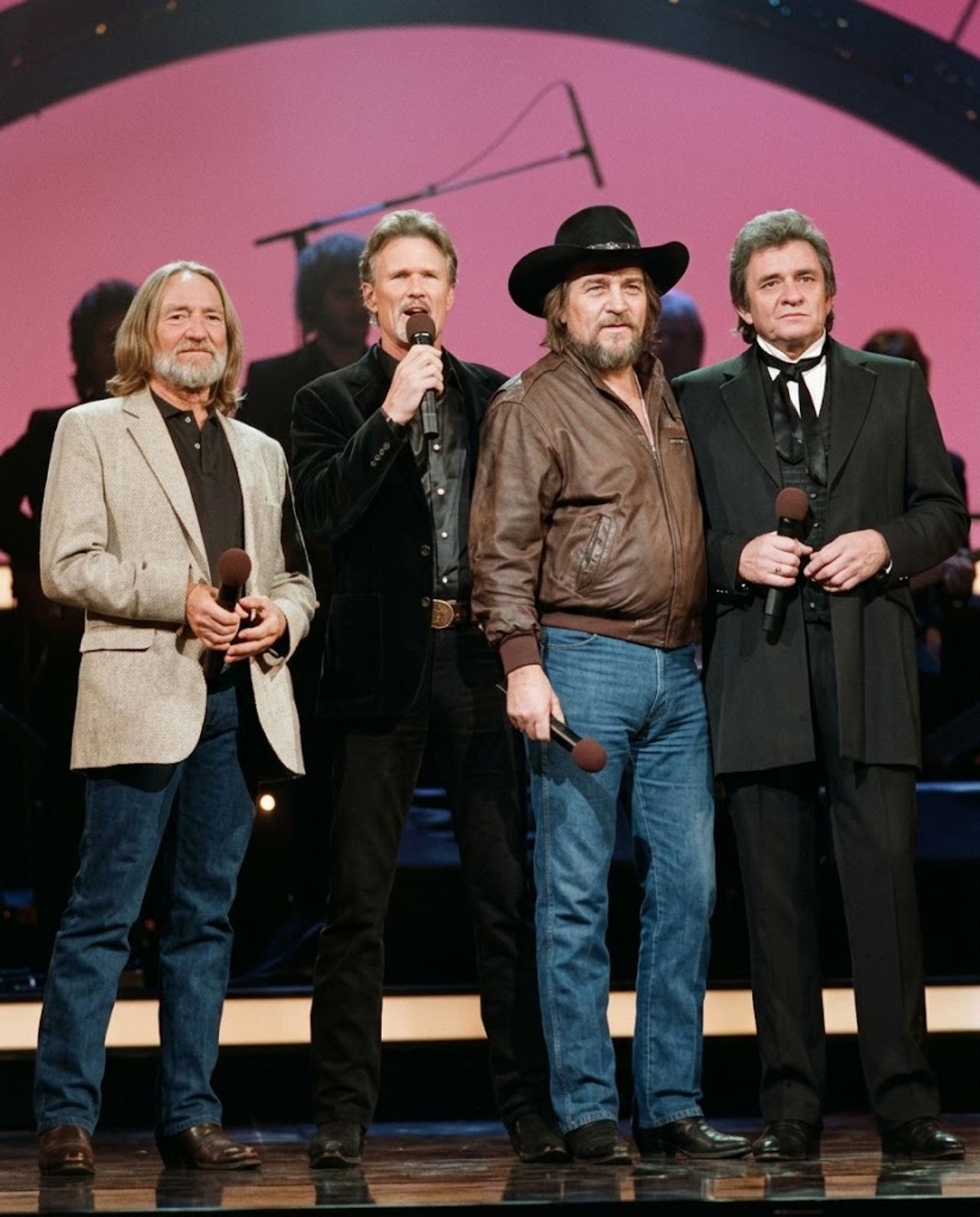
THE SONG WAS WRITTEN YEARS EARLIER, BUT WHEN FOUR OUTLAWS DIVIDED THE VERSES IN 1985, IT BECAME A PROMISE OF IMMORTALITY.
This article explains how Willie Nelson, Kris Kristofferson, Waylon Jennings, and Johnny Cash transformed Jimmy Webb’s song “Highwayman” into a defining country classic. It highlights the song’s unusual verse-by-verse character casting, its chart success, and its lasting legacy as the name of The Highwaymen.
In 1985, Willie Nelson, Kris Kristofferson, Waylon Jennings, and Johnny Cash stepped into a studio to record a Jimmy Webb song originally written in 1977. Previously recorded by Glen Campbell, “Highwayman” found its true destiny when it was broken into four distinct parts. The record soared to No. 1 on the Billboard Hot Country Singles chart and earned a Grammy for Best Country Song in 1986, ultimately giving the legendary supergroup its official name.
The casting of the verses was remarkably precise. Nelson opened with the dusty grit of a bandit, Kristofferson carried the poetic weariness of a sailor, and Jennings delivered the weathered resilience of a dam builder. But the final shift changed the atmosphere completely. Cash’s deep, echoing bass-baritone entered as a starship captain, pulling the song away from the earth and into the eternal.
They sang of souls dying and returning, an idea that mirrored their own survival in a shifting music industry. Their voices were not flawless; they were marked by smoke, miles, and survival. Every verse ended in a tragic fade—hanging, drowning, falling—yet they sang with the quiet defiance of men who had outlived their own myths.
Today, the repeating chorus of “I’ll be back again” sounds less like a lyric and more like a vow left behind by those who are gone. How the studio alignments were chosen—and how one vocal take transformed four solo legends into a single unbreakable unit—remains a defining chapter in country music history.
In 1985, Willie Nelson, Kris Kristofferson, Waylon Jennings, and Johnny Cash stepped into a Nashville studio to record a Jimmy Webb song originally written in 1977. Webb had penned the track in London after a vivid, frantic dream about an eighteenth-century bandit, waking up and writing the first verse in under an hour.
The song had been recorded before. Glen Campbell cut a version in 1979, but it failed to gain significant traction. Years later, Campbell played the track for Cash, who was in the process of making a quartet album with Nelson, Kristofferson, and Jennings. The track found its true destiny when it was brought to the supergroup. It soared to No. 1 on the Billboard Hot Country Singles chart and earned a Grammy for Best Country Song in 1986, ultimately giving the legendary collective its official name.
The idea to divide the track wasn’t a random studio decision. Country musician Marty Stuart, who was a member of Cash’s band at the time, recognized the potential of Webb’s four-verse structure.
Stuart pitched a specific concept: four different singers, each taking on a single character’s verse, with no vocal harmony required.
The alignment of those verses became one of the most brilliant casting choices in country music history. Nelson opened the track with the dusty grit of a bandit riding along the coach roads. Kristofferson carried the poetic weariness of a sailor navigating a schooner around the horn of Mexico. Jennings delivered the weathered resilience of a dam builder pouring concrete on the wild Colorado.
But the final shift changed the atmosphere completely. Cash’s deep, echoing bass-baritone entered as a starship captain, pulling the song away from the dirt and the sea, launching it into the eternal. As songwriter Jimmy Webb later noted, he had no idea how the men decided on the final order, but placing Cash in that closing role was like having God singing the final words.
They sang of souls dying and returning, an idea that mirrored their own survival. At a time when the country music industry was rapidly shifting toward a more polished, pop-oriented sound, these four outlaws were navigating their own professional rebirths. Their voices were not flawless. They were marked by smoke, miles, and survival.
Every verse ended in a tragic fade—hanging, drowning, falling—yet they sang with the quiet defiance of men who had outlived their own myths.
“I’ll find a place to rest my spirit if I can
Perhaps I may become a highwayman again
Or I may simply be a single drop of rain
But I will remain”
(Jimmy Webb)
For those wanting to read the complete story of the four reincarnations woven into the track, you can find the full, licensed lyrics by searching for the song on Google.
Today, the repeating chorus sounds less like a lyric and more like a vow left behind by those who are gone. The studio session did not just give a supergroup its name. It gave four legends a way to live forever.
Video can’t be loaded because JavaScript is disabled: The Highwaymen – Big River (American Outlaws: Live at Nassau Coliseum, 1990)
Video can’t be loaded because JavaScript is disabled: The Highwaymen – Highwayman (American Outlaws: Live at Nassau Coliseum, 1990)