
Stories
HE BROUGHT HIS MISTRESS TO THE GALA—THEN HIS “INVISIBLE” WIFE WALKED DOWN THE GRAND STAIRCASE
At a gala where Grant arrives with his mistress, Seraphina is publicly revealed as the powerful chairwoman behind the company supporting his business. What follows is a poised, humiliating confrontation that exposes years of dismissal and control in their marriage.

“You are still my wife,” Grant said quietly, “but that does not mean you belong in every room I enter.”
For several seconds, Seraphina heard nothing except the faint ticking of the clock above the kitchen doorway.
The words did not strike her like a slap. They landed more slowly than that, settling into places already worn raw by years of smaller dismissals.
Every forgotten anniversary dinner.
Every business reception Grant had attended alone.
Every time Mavis introduced her as “Grant’s wife” without mentioning her name.
Every time Seraphina had been told that her quietness was awkward, her simplicity embarrassing, her questions unnecessary.
She looked at the man she had married seven years earlier and searched his face for the person he had once been.
She remembered Grant at twenty-nine, standing beneath the awning of a small restaurant during a summer storm, laughing because the rain had soaked through his only good suit. He had been ambitious then, but not yet hard. He had taken her hand and said he wanted to build something worthy of the future they would share.
She had believed him.
Perhaps he had believed himself.
Now he stood before her in a tuxedo paid for by a company surviving on money he did not know belonged to her.
Delaney tightened her hand around his arm.
“We should leave,” she said. “Traffic will be terrible.”
Grant’s expression softened when he turned toward her.
It was a small change, but Seraphina saw it.
Patience where he had given his wife irritation.
Attention where he had offered her indifference.
“Of course,” he said.
Mavis picked up her silver clutch. “Brielle, are you coming with us or driving separately?”
“I’ll go with you,” Brielle replied.
Grant stepped around the broken porcelain.
As he passed Seraphina, he paused.
“Do not make tonight more difficult than it needs to be.”
Seraphina slowly rose to her feet.
A jagged piece of china rested in her palm.
“Was I ever going to be told?” she asked.
Grant looked back. “Told what?”
“That Delaney was attending in my place.”
His eyes flickered, but only for a moment.
“It was a business decision.”
Delaney did not look embarrassed. If anything, she appeared relieved that the secret had finally been placed in the open.
Seraphina turned to her.
“Did you know I believed I was attending?”
Delaney’s lips parted.
Grant answered for her.
“This is between you and me.”
“No,” Seraphina said. “You made it between all of us when you invited her into our home.”
The room became still.
Brielle shifted uncomfortably near the staircase. Mavis’s mouth tightened with disapproval, not at her son, but at Seraphina for speaking too plainly.
Grant’s voice hardened.
“I will not argue in front of everyone.”
Seraphina studied him.
He did not want privacy. He wanted control.
He wanted her to wait until they were alone, when he could lower his voice, call her emotional, and explain that she had misunderstood what was obvious.
For years, Seraphina had mistaken her restraint for patience.
That evening, she finally understood that other people had mistaken it for permission.
She placed the porcelain fragment on the counter.
“No,” she said softly. “You will not argue at all.”
Grant frowned.
But Seraphina had already turned away.
She walked to the sink, opened the faucet, and began rinsing the serving spoon that had fallen beside the dish.
Behind her, the family hesitated.
Perhaps they expected tears.
Perhaps Grant expected her to beg.
Instead, she washed the spoon as though the conversation had ended because, for her, something far larger had.
A minute later, the front door closed.
Then came the muted sound of car doors, engines, and tires moving across the circular drive.
Seraphina remained at the sink until the mansion fell completely silent.
Only then did she turn off the water.
Her hands were trembling.
She placed them flat against the marble counter and drew one careful breath after another.
The humiliation was real.
So was the grief.
She had loved Grant. Some part of her still loved the memory of him, and that made what she needed to do more difficult, not less.
She looked around the kitchen.
The candles on the dining table were still burning. Five places had been set, including one for Delaney. Mavis had known. Brielle had known. Even the staff might have known.
Everyone except the wife.
Seraphina walked to the dining room and extinguished the candles one by one.
When the last flame disappeared, she removed her wedding ring.
She did not throw it.
She did not break anything.
She simply placed the ring beside Grant’s untouched dinner plate.
Then she went upstairs.
In the bedroom she shared with her husband, a navy garment bag hung behind the dressing-room door.
Grant had not seen it.
He rarely entered her side of the closet.
Seraphina unzipped the bag and revealed a floor-length gown of deep midnight blue. The fabric was simple from a distance, but tiny hand-sewn crystals traced the neckline and sleeves like constellations.
It had belonged to her mother.
For years, it had remained packed away in cedar paper, carrying the faint scent of lavender and memory.
Seraphina touched the sleeve.
Her mother, Eleanor Bellamy, had worn the gown to a museum opening shortly before she became ill. In a photograph from that evening, Eleanor stood at the top of a staircase, one hand resting lightly on the banister, smiling as though she knew something the rest of the room had yet to discover.
Seraphina had never planned to wear it.
Tonight, however, was not about appearing beautiful beside Grant.
It was about being seen as herself.
Her phone rang on the vanity.
She knew who it would be before she looked.
“Mr. Vale,” she answered.
“Mrs. Holloway,” said a measured male voice. “The board has arrived. The museum director is asking whether the chairwoman will be making an entrance through the private gallery as arranged.”
Seraphina looked at her reflection.
She wore no makeup. A faint redness circled her eyes. A loose strand of dark hair had fallen across her cheek.
“Change of plan,” she said.
There was a pause.
Adrian Vale had served as Bellamy Holdings’ chief legal officer for almost twelve years. He had known Seraphina since before her father’s death, and he rarely expressed surprise.
Tonight, she heard it in his silence.
“How would you like to arrive?”
“Through the main entrance.”
“Understood.”
“And Adrian?”
“Yes?”
“Prepare the Holloway Meridian partnership files.”
This time, the silence lasted longer.
“All of them?”
“Yes.”
“May I ask whether something has happened?”
Seraphina closed her eyes.
“My husband attended the gala with another woman.”
Adrian did not respond immediately.
When he spoke, his voice remained professional, but it had lost some of its distance.
“I am sorry.”
“So am I.”
“Do you intend to terminate the partnerships tonight?”
Seraphina opened her eyes.
“No.”
That answer surprised even her.
She had the authority to withdraw Bellamy Holdings from several pending transactions. Doing so would force Grant’s company to seek emergency financing within weeks.
But thousands of employees worked for Holloway Meridian. Contractors, hospital planners, architects, accountants, security guards, receptionists, maintenance crews. Many had families and mortgages. They were not responsible for Grant’s choices.
Seraphina would not turn their lives into pieces on a board simply because she had been wounded.
“I want to understand exactly what we are supporting,” she continued. “No retaliation. No sudden decisions. We review everything properly.”
“Of course.”
“And do not tell anyone why.”
“I would not.”
She ended the call and stood before the mirror.
For years, she had allowed Grant to believe that the Bellamy name belonged only to her past.
He knew she had inherited family property. He knew her late father had been involved in investments. But Seraphina had encouraged his assumption that the old Bellamy fortune had been divided, diminished, and placed in trusts controlled by distant relatives.
The truth was more complicated.
After her father’s death, Seraphina had inherited voting control of Bellamy Holdings.
She had been twenty-seven, grieving and unprepared for the attention that came with immense wealth. Her father had spent his last months teaching her how to read balance sheets, question projections, and recognize the difference between a visionary and a skilled performer.
He had also taught her that visibility could become a cage.
So Seraphina had chosen discretion.
She chaired meetings through secured video conferences, attended negotiations under abbreviated credentials, and allowed Adrian Vale to serve as the public representative of the company.
Only a small circle knew that S. E. Bellamy, the private chairwoman mentioned in financial journals, was Seraphina Eleanor Bellamy Holloway.
Grant had never asked what the initials meant.
He had been too pleased to claim that the Bellamy partnerships were proof of his own talent.
Seraphina had allowed that, too.
At first, she had believed that protecting his pride was an act of love.
Later, it became habit.
Tonight, it felt like a lie they had created together.
She showered, dressed, and pinned her hair into a low twist. She used very little makeup, only enough to soften the evidence of the evening.
Before leaving the bedroom, she opened the drawer where she kept her father’s watch.
It was a plain gold timepiece with a worn brown strap. Worth far less than the limited-edition watch on Grant’s wrist, it had been the only watch her father ever wore.
She fastened it around her own wrist.
Then she walked downstairs.
The wedding ring still rested beside Grant’s plate.
Seraphina left it there.
Outside, a black sedan waited beyond the iron gates.
Adrian stepped out as she approached.
He was in his early fifties, silver-haired, calm, and dressed in a dark suit that looked expensive without asking to be noticed.
His gaze moved briefly to the gown.
“You look like Eleanor,” he said.
Seraphina’s composure nearly broke.
“Thank you.”
Adrian opened the rear door, then stopped.
“There is something you should know before we arrive.”
She looked at him.
“The museum director has been pressured to alter the seating arrangement.”
“By whom?”
“Holloway Meridian’s office.”
Seraphina felt a slow chill.
“What did they request?”
“That Grant Holloway and Delaney Cross be seated at the Bellamy Holdings table.”
She almost laughed, but there was no humor in it.
Grant had not merely brought Delaney to the gala. He intended to present her to the Bellamy leadership as though she were the woman beside him in both business and life.
“Was the request approved?”
“No.”
“Did Grant receive confirmation?”
“His office was informed that the chairwoman would personally finalize the table.”
Seraphina entered the car.
“Then let us not keep him waiting.”
The Atlantic Legacy Gala filled the Ocean Crest Museum with light.
From the street, the glass-fronted building looked like a lantern against the dark water. Valet attendants moved between luxury cars while photographers gathered beneath a canopy lined with white orchids.
Inside, a string quartet played near the entrance hall.
The central gallery had been transformed for dinner. Hundreds of candles glowed across long tables, reflecting against suspended sculptures of silver and blown glass.
Grant stood near the donor wall with Delaney beside him.
He should have felt triumphant.
Holloway Meridian had been included among the gala’s principal development partners. His photograph would appear in newspapers the following morning. Several investors he had pursued for months were finally in the same room.
Yet his attention kept returning to the Bellamy Holdings table.
Eight places had been set beneath a discreet gold sign.
Adrian Vale’s name appeared on one card. The museum director occupied another. Two hospital executives and the president of a regional foundation completed part of the table.
Three cards had been turned facedown.
Grant had already asked twice whether one belonged to him.
He had received no answer.
“Stop looking over there,” Delaney murmured.
“I am not looking.”
“You have checked the table every thirty seconds.”
Grant adjusted his cuff.
“This dinner is built around partnerships. We are one of their largest regional partners.”
Delaney glanced at him.
“One of theirs, or are they one of yours?”
He frowned.
“What is that supposed to mean?”
“It means you speak as though Bellamy Holdings needs Holloway Meridian.”
“They benefit from our access.”
“They provide most of the capital.”
Grant lowered his voice. “Not here.”
Delaney turned toward the crowded gallery.
For months, she had imagined this evening differently.
Grant had promised her that people would finally see them together. He had said his marriage had existed in name only for years. He had described Seraphina as distant, uninterested in business, and content to remain at home.
But the scene in the kitchen had unsettled Delaney.
Seraphina had not seemed distant.
She had seemed wounded.
There was a difference.
“Did you tell her about us?” Delaney asked.
Grant’s jaw tightened.
“This is not the time.”
“That means no.”
“I told you the situation is complicated.”
“You said you were going to speak with her last month.”
“I intended to.”
But you did not.
Grant looked toward a passing reporter and immediately smiled.
The reporter nodded politely and continued toward the reception hall.
When Grant’s smile disappeared, Delaney saw the impatience beneath it.
“You knew I was married,” he said.
“Yes.”
“And you agreed that tonight was important.”
“I agreed to attend a gala. I did not agree to walk through your front door while your wife was setting the table.”
“My mother invited you.”
“You knew I was coming.”
“Delaney.”
She removed her hand from his arm.
“I am not trying to create a scene. I am trying to understand whether you have been honest with either of us.”
Grant leaned closer.
“I brought you here because you understand what I am building.”
“And Seraphina does not?”
“No.”
The answer came too quickly.
Delaney studied him.
Before she could respond, Brielle approached.
Her pale gold dress shimmered beneath the gallery lights, but her expression was tense.
“Grant, Mom is asking for you.”
“Why?”
“She says the museum director moved her table.”
Grant exhaled.
“Of course she does.”
Brielle looked at Delaney, then back at her brother.
“Did Seraphina call you?”
“No.”
“She is not answering me.”
Grant’s face changed slightly.
“Why are you calling her?”
“Because we left her alone after what happened.”
“What happened?” he asked. “She was disappointed about a dinner.”
Brielle stared at him.
“You took another woman to a gala while your wife cleaned broken dishes.”
Delaney looked away.
Grant’s cheeks colored.
“You knew the plan.”
“I knew Delaney was attending. I did not know Seraphina believed she was coming too.”
“That is not my fault.”
“It became your fault when you did not tell her.”
Grant’s voice sharpened.
“Whose side are you on?”
Brielle seemed startled by the question.
Then her expression softened, not with agreement, but sadness.
“I do not think marriage is supposed to have sides.”
She walked away.
Grant watched her go.
For the first time that evening, a thin uncertainty entered his confidence.
It vanished when an event coordinator stepped onto the small stage near the staircase.
“Ladies and gentlemen, dinner will begin shortly. Before we take our seats, the Ocean Crest Museum is honored to welcome the evening’s principal benefactor.”
The conversations around the gallery faded.
Grant straightened.
Delaney’s gaze moved toward the staircase.
At the top stood Adrian Vale.
A ripple of recognition passed through the crowd. Cameras turned toward him.
Grant’s shoulders relaxed.
He had met Adrian twice and had always assumed the lawyer was the true authority behind Bellamy Holdings. The so-called chairwoman, in his opinion, was probably an elderly heiress whose name made the company useful but whose influence had been exaggerated.
Then Adrian stepped aside.
Seraphina appeared behind him.
For one suspended moment, Grant did not understand what he was seeing.
He recognized the curve of her face, the dark sweep of her hair, and the calm way she held herself.
But the woman at the top of the staircase did not fit anywhere inside the version of Seraphina he carried in his mind.
She was not wearing the simple dresses he considered too plain.
She was not standing behind his mother.
She was not waiting for his approval.
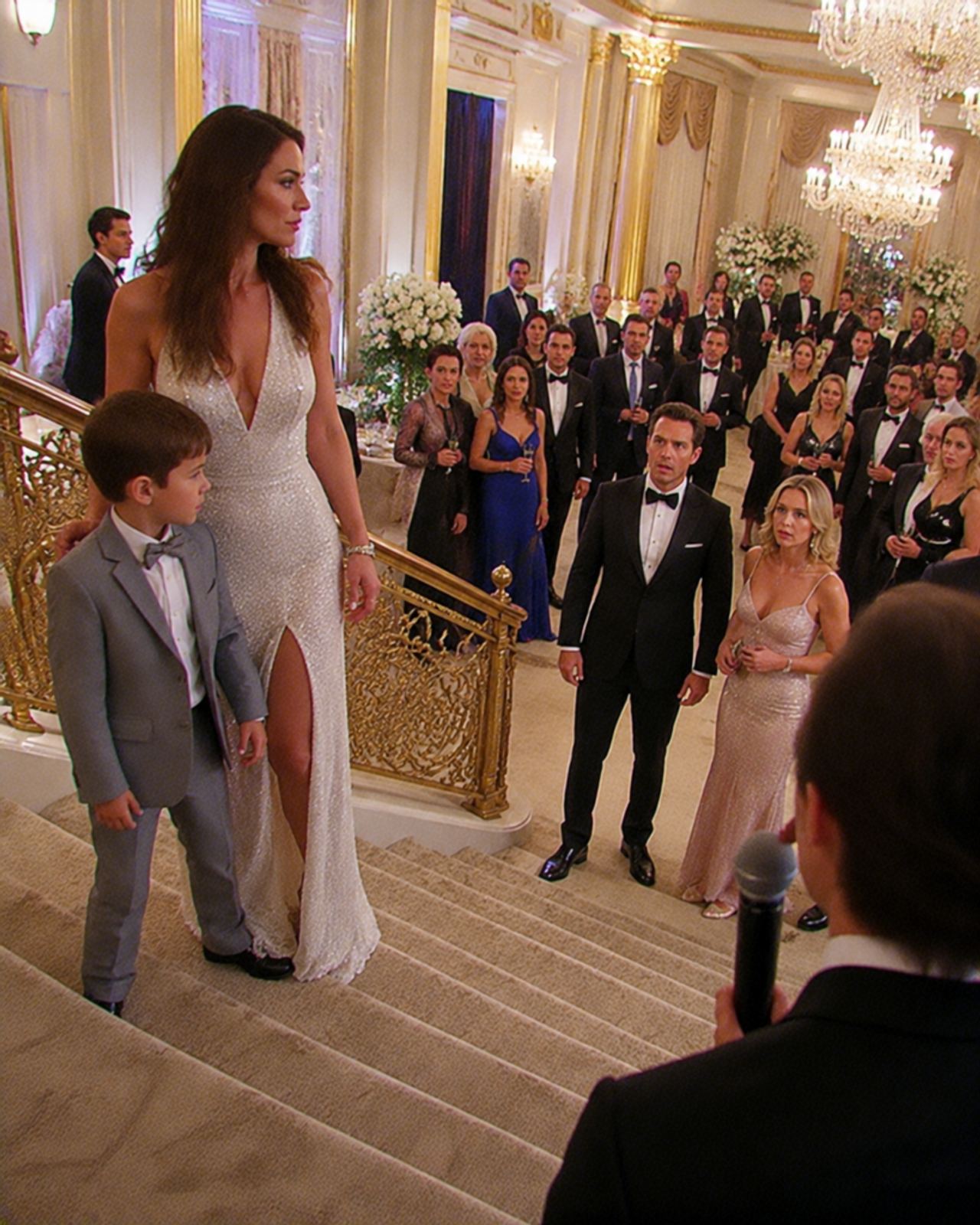
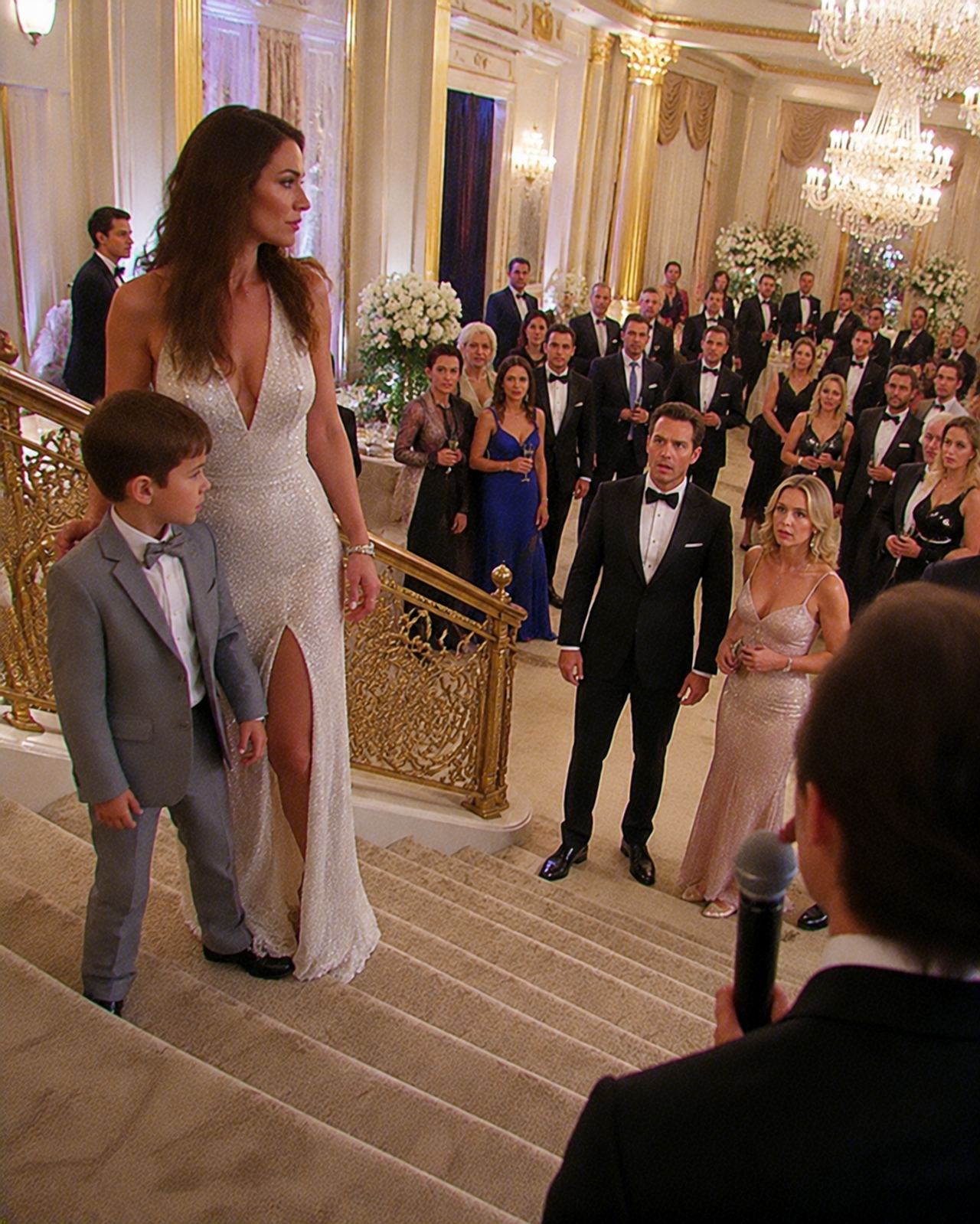
The midnight-blue gown followed her as she descended, its crystals catching the light with every step.
The room remained silent.
Not because she demanded attention.
Because she possessed it without effort.
Adrian descended one step behind her.
At the bottom, the museum director moved forward with both hands extended.
“Mrs. Bellamy Holloway,” she said warmly. “It is an honor to finally welcome you publicly.”
The words traveled farther than the microphone needed them to.
Grant’s expression emptied.
Beside him, Delaney inhaled sharply.
Mavis, who had joined a group near the front, froze with her champagne glass halfway to her lips.
The museum director turned toward the guests.
“For those who have known her only through the initials S. E. Bellamy, it is my privilege to introduce Seraphina Eleanor Bellamy Holloway, chairwoman and controlling shareholder of Bellamy Holdings.”
Applause rose through the gallery.
It began respectfully, then grew.
Seraphina reached the center of the floor.
She did not look at Grant immediately.
That was what unsettled him most.
She greeted the museum director, thanked the hospital executives, and spoke briefly with the foundation president. She knew their names. They knew hers.
These were not strangers meeting an heiress.
They were colleagues welcoming a leader.
Grant’s mind moved rapidly through five years of contracts.
Bellamy Sustainable Development Fund.
Bellamy Medical Infrastructure Partners.
Bellamy Atlantic Capital.
Different names, different entities, all represented by Adrian Vale.
All connected.
All hers.
The refinancing that had rescued Holloway Meridian after the Harbor Point project stalled.
The hospital expansion that had restored the company’s reputation.
The private credit line Grant had called evidence of investor confidence.
Seraphina had been behind all of it.
He remembered asking her once, casually, whether she knew anyone at Bellamy Holdings.
She had said, “A few people.”
He had laughed and told her family connections were not the same as understanding business.
Across the room, Seraphina finally looked at him.
Her face revealed no triumph.
Only recognition.
The kind one gave to a person standing on the opposite side of a truth.
Grant began walking toward her.
Delaney caught his sleeve.
“Do not.”
He pulled free.
“Seraphina.”
Several nearby guests turned.
She faced him calmly.
Grant stopped a few feet away, conscious of every watching eye.
“May I speak with you?”
“Of course.”
Her politeness made him more uneasy than anger would have.
He glanced toward Adrian.
“Privately.”
Seraphina considered this.
Then she gestured toward a small side gallery.
They walked past a row of maritime paintings and entered a room overlooking the ocean. The sound of the gala softened behind the closed glass doors.
Grant turned immediately.
“Why did you never tell me?”
Seraphina looked through the windows at the dark water.
“I did tell you about my family.”
“You never said you controlled Bellamy Holdings.”
“You never asked.”
“That is not an answer.”
“It is the truth.”
Grant ran a hand over his mouth.
“You let me negotiate with your company for five years.”
“Yes.”
“You sat across from me at breakfast while I discussed confidential transactions.”
“I never used information I was not legally entitled to receive.”
“That is not the point.”
“What is the point, Grant?”
“The point is that you made me look like a fool.”
Seraphina turned toward him.
There it was.
Not sorrow.
Not regret.
Not a question about why she had hidden part of herself inside their marriage.
Only humiliation.
Only how the truth reflected on him.
“I did not bring you here with someone else,” she said. “I did not introduce another person as though she belonged in my place. I did not tell you that you were unfit to enter a room that mattered to me.”
Grant’s eyes dropped.
“Delaney’s presence was business.”
“Was taking her hand in our foyer also business?”
“She reached for me.”
“And you allowed it.”
He paced once across the gallery.
“You have been emotionally absent for years.”
Seraphina felt the familiar instinct to defend herself.
To explain every evening she had waited for him.
Every attempt to ask about his worries.
Every conversation interrupted by his phone.
Every time she had made herself smaller because his success seemed to require more space.
She let the instinct pass.
“Perhaps I became quiet,” she said. “But I was not absent.”
“You never wanted to attend events.”
“You stopped inviting me.”
“You were uncomfortable at them.”
“You told people I was uncomfortable. Eventually, they stopped speaking to me.”
Grant looked toward the doors.
“Lower your voice.”
“I am speaking normally.”
“This is not the place.”
“No,” Seraphina said. “Our home was the place. You chose not to speak there.”
He flinched.
For a moment, the arrogance left his face, and she saw fear beneath it.
“Are you withdrawing the financing?”
Seraphina almost closed her eyes.
Even now.
His first concern was the company.
“No decisions will be made tonight.”
Grant stepped closer.
“Seraphina, you cannot let a personal misunderstanding damage thousands of people.”
“I have no intention of doing that.”
His shoulders eased slightly.
“But there will be a full review,” she continued.
The relief disappeared.
“Of what?”
“All active partnerships between Bellamy Holdings and Holloway Meridian.”
“Why?”
“Because I should have reviewed them more closely before now.”
“We have met every major obligation.”
“Have you?”
His expression shifted.
It was subtle, but she saw it.
“What is that supposed to mean?”
“I do not know yet.”
Grant’s voice lowered.
“You are angry.”
“Yes.”
“So this review is personal.”
“No. My failure to ask questions was personal.”
Before he could respond, the door opened.
Adrian stood in the doorway.
“Mrs. Holloway, the director is ready for your remarks.”
Seraphina nodded.
Grant looked between them.
“Adrian, surely this can be handled without creating unnecessary concern.”
Adrian’s expression remained neutral.
“The review has not been announced.”
“But it will become obvious.”
“Only if there is something unusual to discover.”
Grant’s face tightened.
Seraphina walked toward the door.
“Enjoy the dinner,” she said.
He turned after her.
“Where are you sitting?”
“At my table.”
The words were simple.
Yet they seemed to follow him after she left.
Seraphina’s speech lasted six minutes.
She spoke about the museum’s educational programs, the new pediatric rehabilitation center Bellamy Holdings was helping fund, and the need for private companies to build projects that remained valuable after the photographs and ribbon cuttings were forgotten.
She did not mention Grant.
She did not announce their marriage difficulties.
She did not expose Delaney or embarrass Mavis.
Instead, she spoke with the steadiness of someone who had spent years listening before deciding to be heard.
At the Bellamy table, one of the facedown cards was turned over for her.
Another belonged to a retired federal banking regulator.
The third remained facedown beside Adrian.
Across the room, Grant sat with Delaney at a table near the stage.
Mavis was placed two tables away.
The arrangement had not been designed to humiliate them. It simply reflected the gala’s actual hierarchy, one Grant had misunderstood.
During dinner, Seraphina spoke with the hospital executives and listened as the foundation president described a housing initiative for nurses and teachers.
She was engaged, informed, and unexpectedly at ease.
Grant watched her from a distance.
He had seen Seraphina host family dinners, comfort grieving friends, and speak gently with employees whose names he had forgotten.
He had never seen her like this.
Or perhaps he had never looked carefully enough.
Delaney barely touched her food.
At last, she said, “You truly did not know?”
Grant kept hi…
Read more stories
- The X-Ray That Exposed Her Husband’s Lie About Every Lost Pregnancy
- FOUR OUTLAW KINGS SHARED ONE STAGE IN 1990—BUT BENEATH THE WILD REPUTATIONS, ONE THREE-HOUR SHOW REVEALED THE QUIET BROTHERHOOD THEY CARRIED TO THE END.
- At my younger sister’s wedding, my mother looked at my dress uniform in front of two hundred guests and sneered, “What is a lowly soldier doing back here?”
- Stepmother Tried to Take My Beach House. Dad’s Secret Broke Us