
Human Stories
He Chose the Mall While His Wife Delivered Twins Alone
A woman in labor with twins is abandoned by her husband and his family while a retired nurse steps in to save her and the babies. The incident leads to emergency medical intervention, a police report, a custody battle, and ultimately divorce.

Claire’s words cut through the pain with terrifying clarity.
“Emily, the first baby is coming right now.”
I stared at her, unable to understand how an ordinary Saturday afternoon had become this.
Less than an hour earlier, my husband had been standing in our hallway with his car keys.
Now I was on the living room floor while a retired nurse knelt beside me and sirens grew louder in the distance.
Claire pushed the front door open with her foot and set her phone on speaker.
“The mother is conscious,” she told the dispatcher.
“Thirty-eight weeks with twins.
First baby is crowning.
Send neonatal support and notify the receiving hospital that the second twin may be in distress.”
The dispatcher asked whether anyone else was in the home.
Claire looked toward the empty driveway.
“No.
Her husband left her here.”
The sentence hurt almost as much as the contraction.
I gripped Claire’s wrist.
“One of them stopped moving.”
“I heard you,” she said.
“Stay with me.
We are going to get both babies help.”
She moved with the controlled speed of someone who had faced emergencies before.
She pulled clean towels from the hall closet, folded one beneath me, and told me when to breathe and when not to fight my body.
I kept asking whether my baby would survive.
Claire never offered a promise she could not keep.
“We’re doing everything we can,” she said.
“Look at me, Emily.
Not the door.
Not the driveway.
Me.”
The next contraction took over.
I screamed, pushed, and felt the world narrow to Claire’s voice.
Then a small cry broke through the room.
It was thin at first, almost uncertain.
Claire lifted my first daughter into her hands, cleared her airway, and rubbed her back with a towel.
The baby’s cry strengthened.
My whole body shook with relief.
“She’s breathing,” Claire said.
“Your first girl is breathing.”
I reached toward her, but another wave of pain crushed the breath from my lungs.
The front doorway filled with paramedics carrying bags and equipment.
One of them took the baby from Claire while another knelt beside me and placed monitors against my abdomen.
His expression changed.
“I have the second heartbeat,” he said.
“It’s slow.”
The room exploded into motion.
An oxygen mask covered my face.
Someone wrapped my first daughter in a warming blanket.
Another paramedic started an IV while Claire answered rapid questions about the timing of labor and delivery.
“We need transport now,” the lead paramedic said.
“Possible fetal distress.”
A police officer arrived as they lifted me onto the stretcher.
He stopped just inside the doorway, taking in the towels, the medical equipment, and the absence of any family member.
“Where is the husband?” he asked.
“At the mall,” Claire answered.
The officer looked at her as though he had misheard.
“She told him she was in labor,” Claire continued.
“He left with his mother, father, and sister.
The security camera may have recorded them.”
The officer glanced up at the small camera above the porch.
Its blue light was still blinking.
I was wheeled through the front door beneath it.
As the stretcher reached the ambulance, I saw Ryan’s SUV turn onto our street.
For one irrational second, I felt relief.
Some part of me still expected him to run toward me, apologize, and become the man I had believed I married.
Then the SUV stopped behind a police cruiser.
Karen stepped out first.
She was carrying two glossy shopping bags and the leather purse she had insisted she needed.
Ashley climbed out beside her, holding an iced coffee.
Frank remained near the passenger door, staring at the ambulance.
Ryan looked from the flashing lights to the open front door.
A paramedic crossed the living room carrying a bundle wrapped in a hospital blanket—our first daughter.
Ryan’s face lost all color.
He ran toward the house, but the police officer blocked him at the walkway.
“That’s my wife,” Ryan shouted.
“Those are my babies.”
The officer kept one hand raised.
“Stay where you are.”
Ryan looked past him and saw the towels on the floor, the overturned side table, and the emergency equipment scattered near the sofa.
His knees struck the pavement.
“Emily!”
Karen dropped one shopping bag.
The leather purse slid out onto the driveway.
“She was fine when we left,” she said quickly.
“She exaggerates everything.”
Claire turned toward her.
I will never forget the look on Claire’s face.
She was not shouting.
She did not need to.
“Your daughter-in-law delivered one baby on that floor,” she said.
“The second baby’s heart rate is falling.”
Karen opened her mouth, but no words came out.
Ryan crawled a step closer to the ambulance.
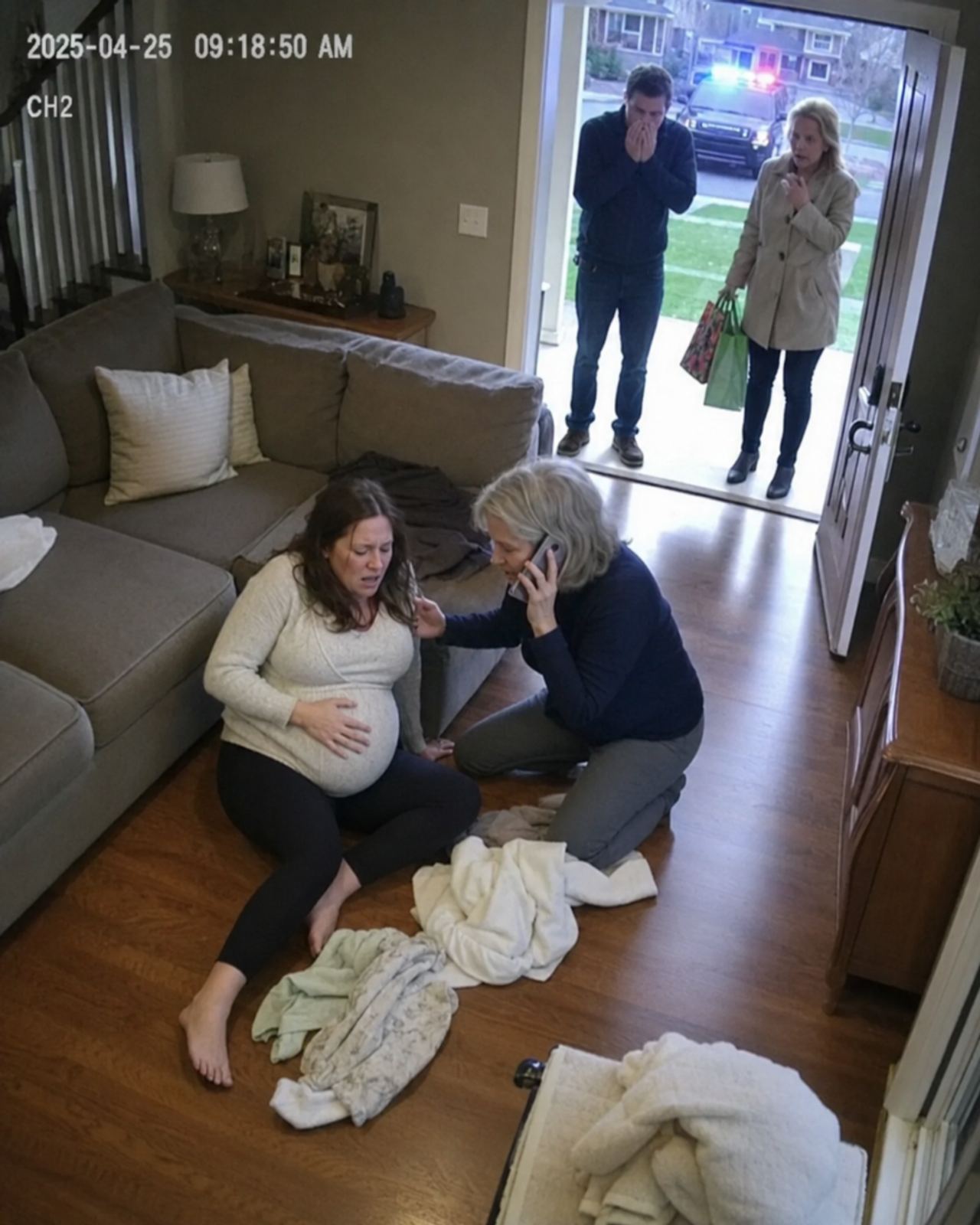
“Please let me go with her.”
I looked at him through the open doors.
He had left me begging on the kitchen floor.
He had watched my knees buckle and pulled away.
Now he was crying because strangers could see what he had done.
The paramedic asked whether I wanted Ryan in the ambulance.
“No,” I said.
It was the calmest word I had spoken all day.
The doors closed between us.
At the hospital, the obstetric team was waiting.
They rushed me into an operating room while the neonatal team examined my first daughter.
The second twin was positioned badly, and her heart rate continued to drop.
A doctor leaned close to me.
“Emily, we need to perform an emergency cesarean delivery.”
I signed the consent with a shaking hand.
Under the bright operating lights, I kept hearing Ryan’s voice from that morning.
Don’t move until I get back.
As though labor were disobedience.
As though my body and our daughters could be ordered to wait for his mother’s sale.
The second baby was delivered minutes later.
She did not cry immediately.
I heard urgent voices and the soft mechanical sounds of the neonatal team working beyond the curtain.
I tried to lift my head, but the anesthesiologist gently asked me to remain still.
“Is she alive?” I kept asking.
No one answered at first.
Then a small, angry cry rose from the other side of the room.
The anesthesiologist squeezed my shoulder.
“There she is.”
I began sobbing.
Both girls were alive.
My first daughter, whom I named Grace, needed oxygen and observation because she had been born outside the hospital.
My second daughter, Lily, was taken to the neonatal intensive care unit after the emergency delivery.
Her heartbeat stabilized, but the doctors wanted to monitor her closely.
I had also lost a dangerous amount of blood.
For several hours, I drifted between sleep and brief moments of awareness while the medical team treated me.
When I woke properly, Claire was sitting beside my bed.
She had changed clothes, but there was a small dark stain on one sleeve.
She held my hand and told me that both girls were stable.
“You saved them,” I whispered.
“You kept fighting,” she replied.
“I just happened to ring the bell.”
She explained why she had come over.
She had heard a scream while watering plants beside her kitchen window.
At first, she thought someone had fallen.
When the screaming continued, she crossed the yard and rang our bell.
A hospital social worker entered the room soon afterward.
Her name was Dana.
She spoke gently, but her questions were precise.
Had Ryan known I was in labor?
Yes.
Had I asked him to take me to the hospital?
Yes.
Had he refused?
Yes.
Did he prevent me from using the car?
He took the only vehicle parked at the house.
Did anyone else witness the conversation?
Karen, Ashley, and Frank had all been there.
Dana wrote everything down.
“Ryan is in the waiting area,” she said.
“His mother is demanding to see the babies.
Do you want either of them admitted?”
“No.”
She did not question me.
“Then they will not be admitted.”
A few minutes later, shouting erupted beyond the locked maternity doors.
Karen’s voice carried down the corridor.
“Those are my grandchildren! She cannot keep us out!”
Security escorted her downstairs.
Ryan called my phone twelve times.
When I did not answer, he sent messages.
The first said, “I didn’t know it was that serious.”
The second said, “Mom said first labor takes hours.”
The third said, “Please tell the police this was a misunderstanding.”
Not one message began with an apology.
Not one asked how Lily was doing.
He was already thinking about consequences.
The next morning, the officer who had been at our house visited my room.
He explained that Claire had given a statement and that the paramedics had documented my condition when they arrived.
Then he asked about the security camera.
The camera was connected to an account Ryan and I both used.
I gave the officer permission to preserve the recording.
We watched part of it together on a hospital tablet.
The video showed Karen stepping onto the porch with Ashley behind her.
Ryan followed, closing the door while I cried out somewhere inside the house.
Karen adjusted her sunglasses.
“She’ll still be there when we get back.”
Ashley laughed.
Frank said, “Women have been having babies forever.”
Then Ryan locked the door and answered, “She needs to learn that not everything is about her.”
The camera recorded the SUV leaving at 2:14 p.m.
It recorded Claire arriving at 2:51.
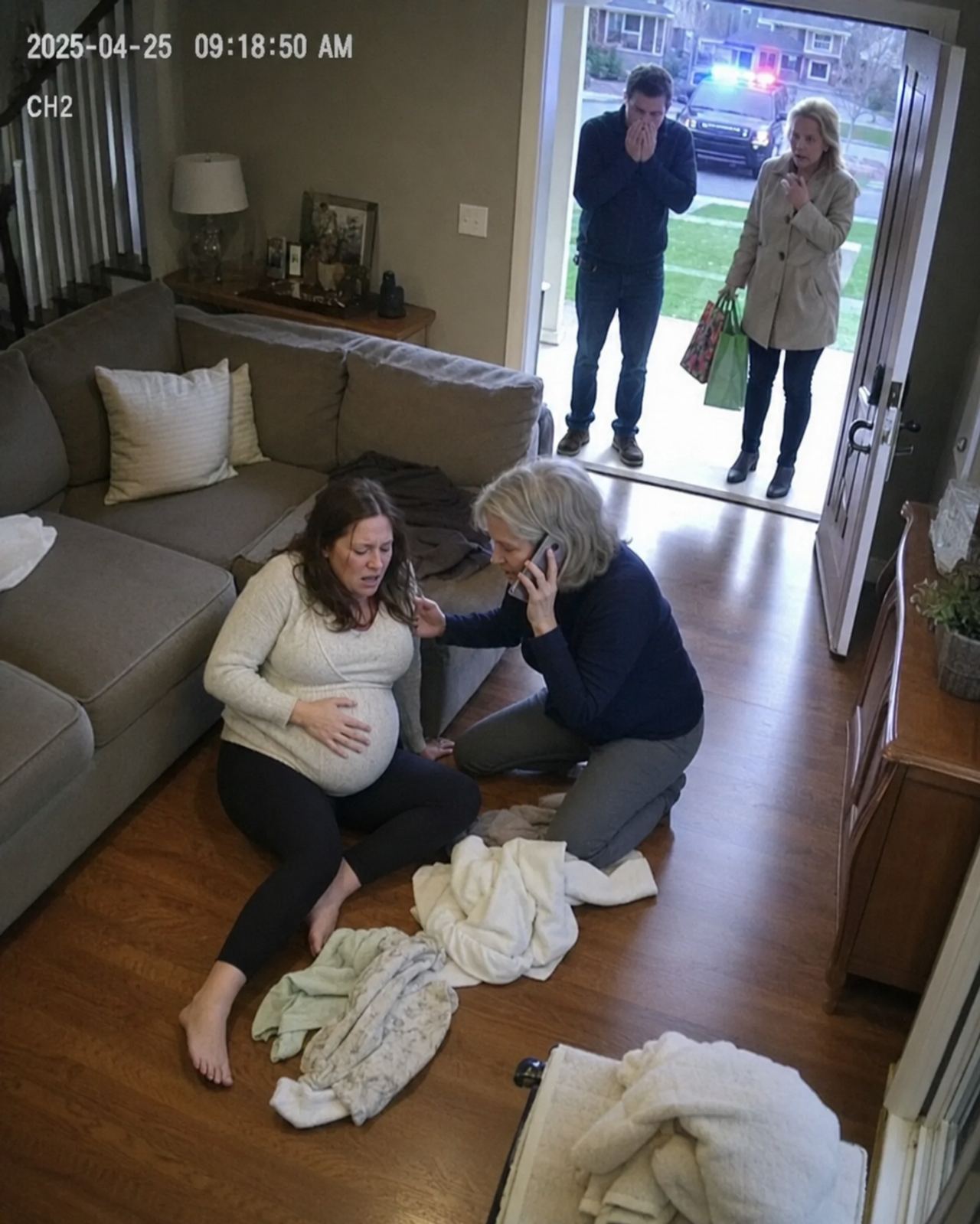
It recorded the dispatcher through Claire’s speakerphone, the ambulance arriving, and Ryan returning with his family at 3:19.
Beside the video were motion alerts, timestamps, and a clear view of Karen’s shopping bags.
There was no misunderstanding left to invent.
The officer told me the recording would be included with his report.
He was careful not to promise criminal charges.
Leaving a laboring spouse was cruel and reckless, but the exact legal consequences would depend on the investigation and local prosecutors.
The family consequences began immediately.
My parents flew home from Alaska as soon as they heard.
My mother arrived at the hospital still wearing the clothes she had traveled in.
My father stood beside Lily’s incubator with tears running silently down his face.
Ryan tried to approach them in the corridor.
My father stepped between him and the NICU doors.
“You watched my daughter collapse,” he said.
“Then you went shopping.”
Ryan looked down.
“I made a mistake.”
“A mistake is forgetting an appointment,” my father replied.
“You made a choice four times—when she asked for help, when she fell, when you locked the door, and when you drove away.”
Ryan had no answer.
Karen did.
She insisted the crisis was my fault because I had “panicked.” She told anyone who would listen that Claire had interfered and that the hospital was turning me against my husband.
Then she made the worst decision possible.
She sent me a message saying Ryan had rights as the father and warning that she would make sure he took the twins if I tried to leave.
Dana helped me contact a domestic-relations attorney from the hospital.
The attorney preserved every message, the police report, Claire’s statement, the paramedic records, the mall receipts, and the security footage.
Ryan had paid for Karen’s purse with our joint credit card at 2:43 p.m.—while I was alone in active labor.
That single receipt became one of the clearest pieces of evidence.
It showed that this was not a brief drive made before anyone understood the danger.
They had entered the store, browsed, and completed a purchase while my calls went unanswered.
Ryan eventually admitted that he had silenced his phone because Karen said I was trying to ruin her afternoon.
He made that admission during a recorded meeting with the hospital social worker.
Every time he tried to protect himself, he exposed another choice.
Three days later, Grace was cleared to leave the nursery.
Lily needed several more days of monitoring, but her doctors expected a full recovery.
I was discharged before she was, so my parents drove me to their house and brought me back to the hospital each morning.
Ryan was not permitted to visit without my approval while the hospital reviewed the safety concerns.
He sent flowers.
I returned them.
He sent a letter saying he had been under pressure from his mother.
I gave it to my attorney.
He finally sent the apology I had once wanted.
“I should have chosen you.”
By then, I understood the deeper truth.
A husband does not need to choose between his laboring wife and a shopping trip.
There was never a real choice.
There was only duty, and he had abandoned it because disappointing his mother felt harder than risking my life.
I filed for divorce before Lily left the hospital.
At the temporary custody hearing, Ryan’s attorney described the incident as a terrible lapse in judgment.
My attorney played the porch recording.
The courtroom became silent when my scream could be heard faintly through the closed door.
Then Ryan’s voice came through the speakers.
“She needs to learn that not everything is about her.”
The judge paused the video.
Ryan stared at the table.
Karen, seated behind him, went pale.
The judge granted me temporary sole physical custody.
Ryan received supervised visitation pending parenting classes, counseling, and a full review of the incident.
Karen was not approved as a supervisor, and after her threatening messages, she was ordered not to contact me directly.
The police investigation did not lead to the dramatic prison sentence Karen claimed I was seeking.
I had never asked for one.
The documented facts mattered most in family court, where the question was not revenge but whether Ryan could be trusted to put two vulnerable children ahead of pressure from his family.
For a long time, the answer was no.
Ryan moved out of our house.
Months later, the divorce was finalized.
He completed counseling and began supervised visits with the twins.
He never regained the easy access to my life that he once assumed was guaranteed.
Karen refused to apologize.
She told relatives that I had destroyed the family over “one afternoon.”
Claire answered that accusation only once.
“One afternoon is enough to reveal a person’s priorities.”
After that, no one in my family argued with her.
Grace and Lily grew stronger.
Grace remained the louder twin, as though she were still announcing her arrival on the living room floor.
Lily was quieter but determined, wrapping her tiny fingers around mine whenever I held her.
I sometimes returned to the house in my mind—the ticking clock, the empty driveway, the distance between my hand and the deadbolt.
For months, the sound of a door locking made my chest tighten.
But another sound slowly replaced it.
The doorbell.
Claire ringing twice.
Claire refusing to walk away.
Claire’s voice telling the dispatcher exactly what was happening when I could no longer explain it myself.
On the twins’ first birthday, my parents and I held a small celebration in their backyard.
Claire sat beside me while Grace crushed cake between her fingers and Lily laughed at the balloons.
I gave Claire a small silver key mounted inside a frame.
Beneath it were the words, “For the woman who opened the door.”
She cried when she read it.
I had spent months believing the worst moment of my life was the second Ryan drove away.
Eventually, I understood that the story did not end with the person who abandoned me.
It changed with the person who heard me.
Ryan’s family expected to find me helpless and crying when they returned from the mall.
Instead, they found police cars, an ambulance, a witness, a recording, and the consequences of every word they had spoken.
I did cry.
But I was never helpless again.
Read more stories
- A young man started visiting my 83-year-old neighbor every single day. At first, I thought he was simply being kind. Then I walked into her house and saw something that made my blood run cold.
- I Never Told My In-Laws My Dad Was the Chief Justice. When I Was 7
- A Powerful Millionaire Walked Away From His Wife
- My Family Forged My Signature to Save My Brother