
Human Stories
Broken Toy Car Revealed The Trust His Father Hid For My Little Son
A mother receives a broken toy car from her ex-husband on the day of his wedding, only to discover a hidden key and letter from the child’s late grandfather. The discovery reveals a protected trust for her son and exposes the father’s attempt to claim it.

The package arrived before breakfast, when the house was still quiet enough for me to hear the refrigerator hum and Eli’s bare feet slap softly down the hallway.
He was 7, which meant hope still came easily to him, even when adults had trained him to expect less.
He climbed onto the kitchen chair by the front window and pressed his forehead to the glass, because the tracking page said the delivery was close and because his father was getting married that day.
Mark had not invited us to the wedding, not that I expected him to, but Eli had decided on his own that maybe a wedding made people softer.
Maybe his dad would remember him.
Maybe the new life Mark was building still had one small corner for the little boy he left behind.
When the delivery driver knocked, Eli ran so fast he nearly slipped in his socks.
The box was small and light, addressed to him in Mark’s rushed handwriting, and Eli held it to his chest like it was something alive.
“Daddy sent it,” he said.
I smiled because mothers learn to make their faces do things their hearts refuse to do.
He opened the paper carefully at first, then faster, ripping through the tape with his teeth until I made him use the scissors.
Inside was an old plastic toy car, red once, now faded to the color of a sunburn, with scratches across the doors and one wheel hanging at a crooked angle.
There was no card.
There was no note.
There was not even a scrap of tissue paper pretending that thought had gone into it.
Eli stared down at the toy while the excitement drained out of his face in a way I will never forget.
“Is this it?” he asked.
The phone buzzed before I could answer.
Mark’s name lit up the screen, and the text beneath it was short enough to read without opening the message.
He’s nothing to me today.
For a second, the kitchen seemed to tilt around me.
It was not the worst thing Mark had ever said, but it was the smallest, and sometimes small cruelty lands deeper because it has no costume on.
I looked at Eli’s hopeful little hands and thought of every school play Mark had missed, every fever I had handled alone, every birthday where Eli asked if the doorbell might still ring.
I wanted to call Mark right then.
I wanted to make him repeat it where his new wife could hear him.
Instead, I slid my phone face down, told Eli the car was probably older than it looked, and said we could fix the wheel after dinner.
He nodded because children often protect the adults who disappoint them.
He carried the car to his room, set it on the shelf beside his good toys, and did not touch it again.
That was when my anger stopped being hot and became quiet.
By evening, every graceful lie I had told my son felt like a debt coming due.
That evening, he asked if Vanessa would be his stepmom now, and I said yes, if everyone was kind and careful.
After his bath, he fell asleep hugging his stuffed bear, one hand tucked under his cheek, his lashes still damp from the tears he thought I had not seen.
I walked back to the shelf and picked up the car.
It weighed almost nothing.
That made me angrier.
There was something insulting about how light it was, as if Mark had mailed the emptiness itself and expected our son to call it a gift.
Outside, the patio was bright under the porch light, the little square of concrete where Eli drew chalk roads in summer.
My phone kept lighting up with wedding photos from mutual friends who had forgotten to hide me from their posts.
Mark was smiling under string lights.
Vanessa was laughing with her hand on his chest.
A tiered cake stood behind them, elegant and ridiculous, and all I could think was that my son had gotten a broken car from a box in someone’s garage.
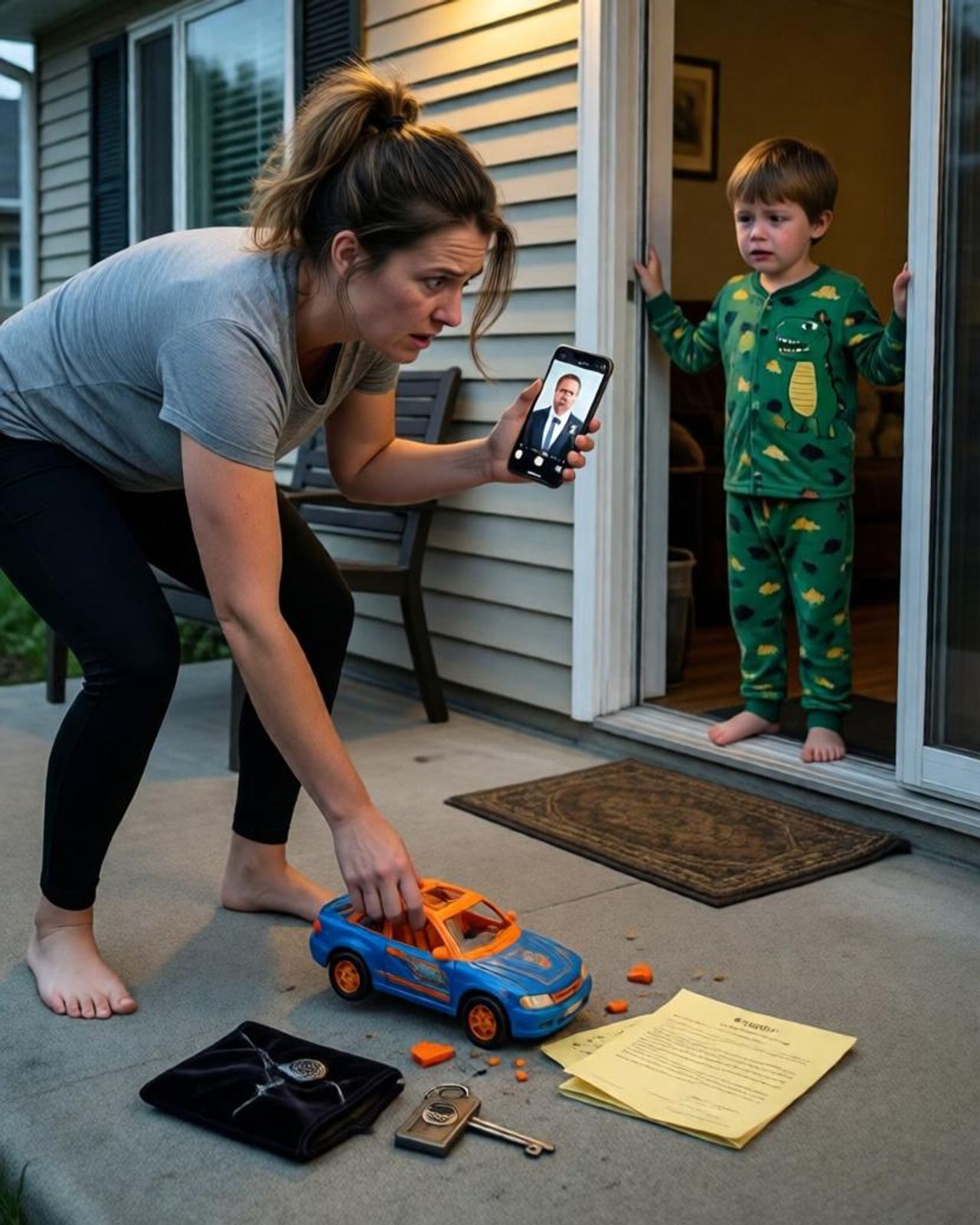
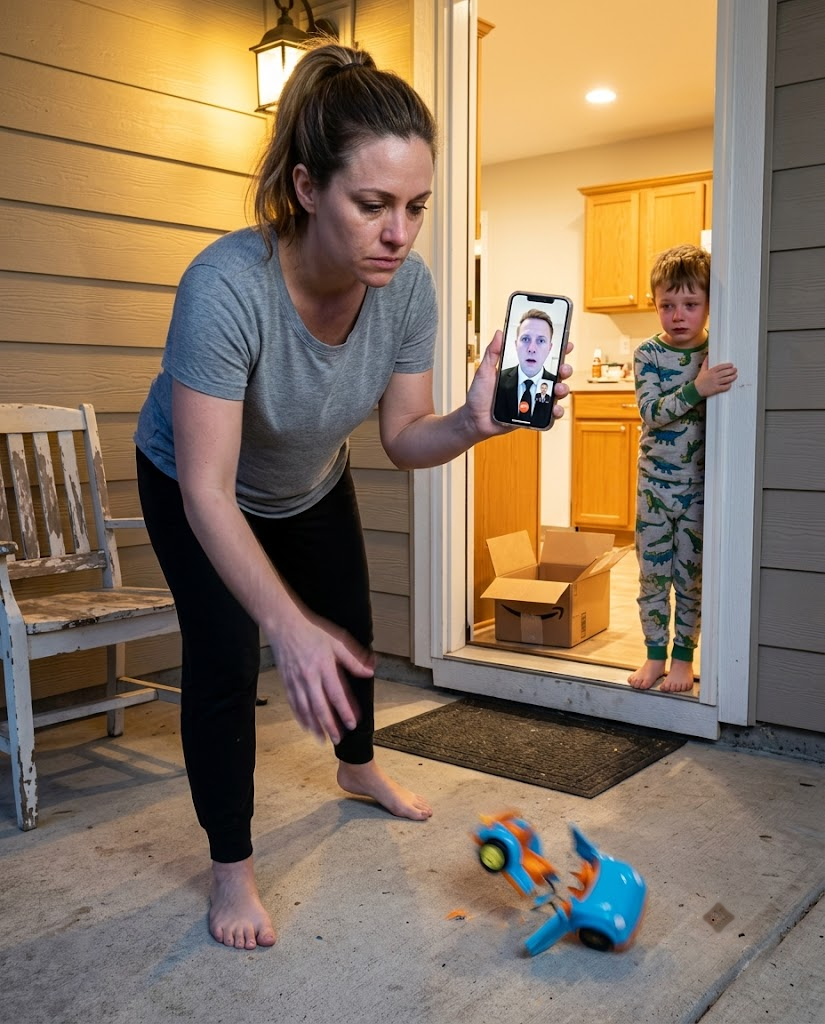
I raised the toy and threw it.
It hit the patio hard enough to crack open at the middle, and the sound snapped through the yard.
Pieces skidded across the concrete.
The loose wheel rolled under a chair.
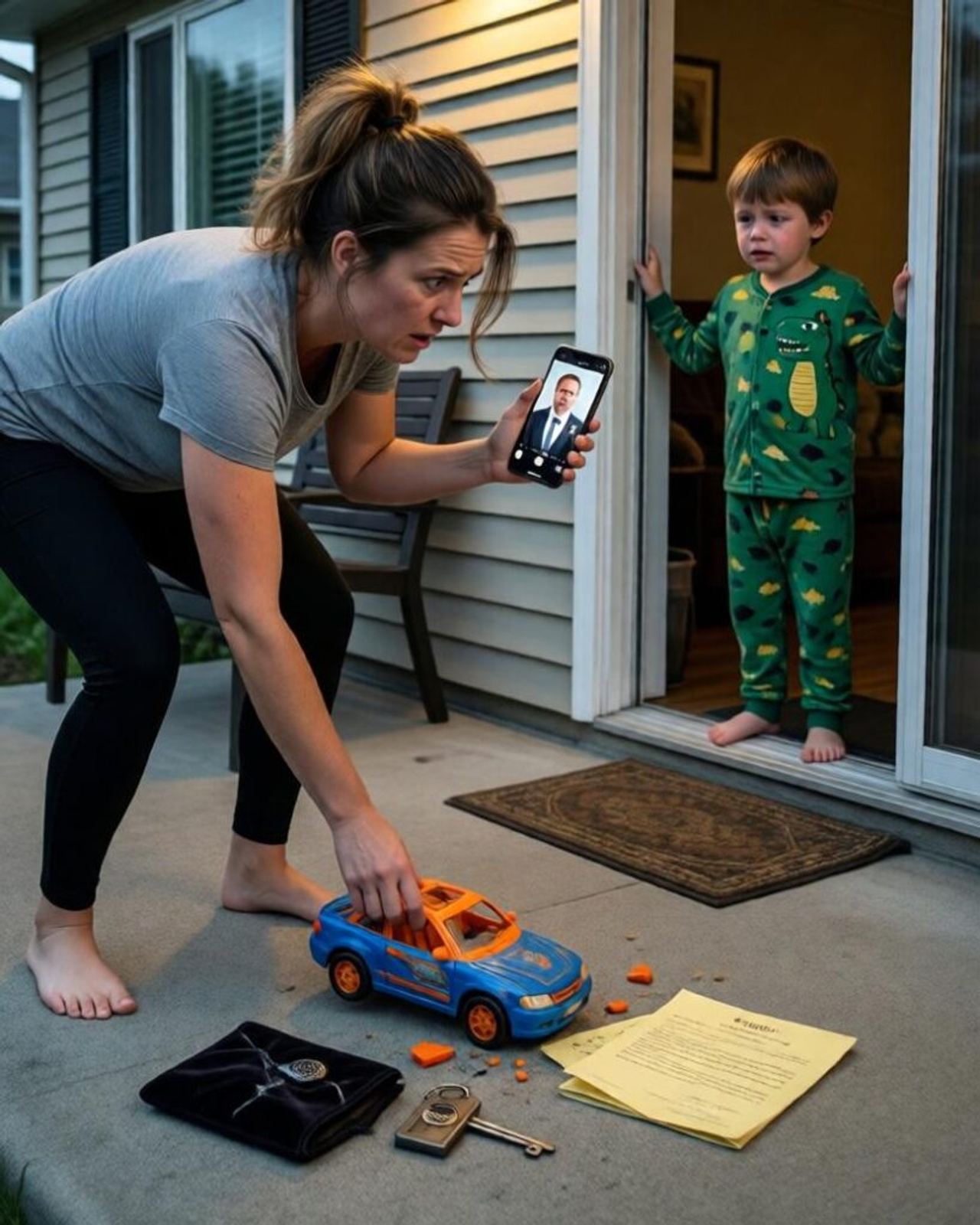
I stood there breathing like I had run a mile, ashamed of myself and also not ashamed at all.
Then something flashed near the step.
I crouched and saw a tiny velvet pouch caught in the broken shell of the car, the kind jewelry stores use, except this one was old and flattened.
Inside was a tarnished safe-deposit key.
Under the pouch was a folded letter, yellow at the edges, tucked so tightly into the hollow plastic that it must have been hidden there on purpose.
The handwriting stopped me before the words did, because it belonged to Henry, Mark’s father.
Henry had died three years earlier, and though he had never been an easy man, he had always softened around Eli.
I sat down on the cold patio and opened the letter.
It was addressed to Eli by his full name.
Henry wrote that box 214 at First National Bank held what he had put aside for his grandson, and that the key was hidden in the car because he did not trust Mark to deliver anything that did not make Mark look generous.
The sentence was so plain it hurt.
I read it again and again, waiting for it to become less impossible.
It did not.
I called Mark.
He answered on video by accident, or maybe because he wanted me to see the tuxedo and the rented glow around him.
Music thudded behind him, and for one ridiculous second I could see Vanessa over his shoulder holding a champagne flute.
“Can this wait?” he said.
I held the letter up, though I knew he could not read it through the screen.
Then I read every word aloud.
At first he frowned like I was interrupting him with some ordinary custody complaint.
Then his face changed.
The color left his cheeks, not slowly, but all at once.
He turned away from the reception lights and lowered his voice.
“Where did you get that?”
“From the trash you mailed your son,” I said.
There it was, the only line I gave myself.
He looked over his shoulder as if the entire wedding had become a room full of witnesses he did not want.
Vanessa called his name, and he said nothing to her.
For the first time since our divorce, Mark had no performance ready.
He asked me not to call the bank until he could explain.
That was the moment I knew I had to call before he finished explaining.
Morning came gray and heavy, and I waited until Eli was eating cereal before I stepped into the hallway with the key and the letter in my hand.
First National Bank transferred me twice, then a woman named Mrs. Delgado asked me to repeat the box number.
When I did, her tone changed.
She asked for Eli’s birth certificate, my custody order, a government ID, the original key, and the original letter.
Then she said something that made my hand tighten around the phone.
Someone had asked about that box once before.
She would not say who over the phone.
Banks are careful that way, and for once I was grateful for careful people.
I dressed Eli in his clean blue shirt and told him we had to go somewhere important.
At the bank, the lobby smelled like carpet cleaner and old paper.
Eli sat beside me swinging his legs under the chair, unaware that the adults around him were weighing the shape of his future.
Mrs. Delgado looked at the key, then at the letter, then at me.
She brought us into a glass office and asked Eli to spell his middle name.
He did it proudly.
Then she opened a visitor log and turned it toward me.
Mark’s signature was there, dated six weeks after Henry’s funeral.
The note beside it said inquiry about minor beneficiary box.
I felt cold, then embarrassed by how badly I had wanted to believe Mark had only been careless.
Mrs. Delgado explained that Mark had asked whether a surviving parent could close or transfer a minor’s safe-deposit holdings without the custodial guardian present.
The answer had been no.
He had left angry, she said, and the box had not been touched since.
I looked at Eli, who was drawing a crooked car on the back of an appointment card, and I understood that Henry had been right to hide the key from his own son.
Anger can open a door, but proof decides who walks through it.
Mrs. Delgado called in the branch manager and a notary, then asked if I wanted to proceed without Mark.
I said yes before fear could make me polite.
The safe-deposit room was colder than the lobby, all metal doors and quiet footsteps.
Box 214 slid out with a dull scrape.
Inside was not a pile of treasure like Eli imagined.
There were savings bonds, a folder of trust documents, a small envelope of family photos, and another sealed letter.
The trust was real.
Henry had set it up for Eli’s education, housing, and medical needs, with access restricted until adulthood except through a guardian approved by the bank and the court.
The guardian named in the first documents was me.
Not Mark.
Me.
Mrs. Delgado waited while I read that part, and I think she knew I needed a second to understand the mercy hidden inside the insult.
Henry had not only left Eli money.
He had left him protection from the man who would treat a child like an inconvenience on the happiest day of his own life.
The sealed letter was addressed to me.
My hands shook again, but this time I opened it in a room full of witnesses.
Henry wrote that he was sorry for the way his son had failed at fatherhood and that he had watched me do the daily work Mark applauded himself for mentioning.
He wrote that if the key had reached me through the broken car, then the plan had worked in the strangest possible way.
Then came the line I had to read three times.
You were never the backup parent.
I cried then, quietly, because I had spent years acting strong in places where nobody admitted strength had a cost.
Eli looked up from his drawing and asked if Grandpa had left him treasure.
“In a way,” I said.
Mrs. Delgado gave me tissues and pretended to study the paperwork.
The bank could not release anything instantly, and I did not want it to.
I wanted every signature checked, every lock respected, every page copied so Mark could never stand in front of a judge and say this was confusion.
My lawyer met us that afternoon.
He read the trust documents and said Henry had been precise, almost painfully so.
The money was Eli’s, held for him, protected from parental debt, remarriage, resentment, and anyone who mistook blood for entitlement.
Mark called seventeen times before dinner.
I let every call go to voicemail.
When I finally listened, the first messages were angry, then defensive, then soft in the way Mark became soft whenever consequences entered the room.
He said he had forgotten about the box.
He said his father had been confused near the end.
He said he only asked the bank because he was trying to organize old family matters.
Then, near midnight, he left one message that sounded more honest than the others.
“I knew there was something for Eli,” he said. “I didn’t know how much.”
There it was.
Not full confession, not full innocence, just the ugly middle where most harm lives.
He had known enough to ask.
He had not cared enough to protect.
The next week, Mark asked to meet without Vanessa.
I chose a coffee shop near my lawyer’s office and brought copies, not originals.
He looked older than he had at the wedding, which was unfair because the wedding had only been seven days earlier.
He tried to explain the text first.
He said he had been stressed.
He said Vanessa’s family was watching everything.
He said he did not mean Eli was nothing, only that the day was not about him.
That was almost worse.
I let that excuse sit between us without answering.
I placed the copy of Henry’s letter between us and let him read the part about not trusting him.
His jaw worked once, then stopped.
For years, Mark had treated guilt like a debate he could win if he found the right angle.
This time there was no angle.
There was only his father’s handwriting and his son’s name.
“You almost threw away the only thing he left Eli,” I said.
Mark covered his mouth with his hand.
I did not comfort him.
Comfort was no longer my job.
What I did give him was a chance to sit with Eli and tell the truth in language a child could hold.
Not the bank details.
Not the legal mess.
Just enough for Eli to understand that Grandpa had loved him, that the toy had carried something important, and that his father had been wrong to send it like trash.
We met at my kitchen table because Eli felt safest there.
Mark brought a new toy car, expensive and shiny, and I almost told him to take it back.
Then Eli saw it and smiled, so I swallowed my pride and let the child have one uncomplicated thing.
Mark apologized without blaming the wedding.
He said Grandpa Henry had left something for Eli and that he should have handled it carefully.
Eli asked if the old car was magic.
Mark’s face crumpled a little.
“No,” he said. “Your mom was careful when I wasn’t.”
That was the closest he came to giving me credit, and it was enough because Eli heard it.
The trust took months to formalize under my guardianship.
There were court filings, bank appointments, certified copies, and long emails from my lawyer that made my eyes cross after work.
Every step felt tedious until I remembered the alternative was a child’s future sitting forgotten in a garage box while adults congratulated themselves under wedding lights.
As for the broken toy, I kept the pieces in a clear box on the top shelf of my closet.
Eli knows they are part of Grandpa Henry’s story, but he does not yet know every sharp edge.
Someday, when he is old enough, I will show him the letter and tell him that love sometimes arrives disguised as an ugly little object nobody bothered to respect.
I will tell him his grandfather knew exactly who could be trusted.
I will tell him anger is not always something to be ashamed of, because sometimes it is the part of you that refuses to let a child be handed less than he deserves.
And I will tell him that the day his father treated him like an afterthought was also the day another man, already gone from this world, reached back through time and put a key in his hand.
Read more stories
- After refusing to help pay for my college when they watched me struggle alone, my parents now expect me to loan them money for my sister’s extravagant wedding — but I’m not letting it slide this time, not after everything.
- My Ex-Husband Called To Invite Me To His Wedding—So I Told Him I’d Just Given Birth. Thirty Minutes Later, The Groom Burst Into My Hospital Room… And What Happened Next Des.troy.ed Everything He Thought He’d Won.
- I was halfway through ignoring my buzzing phone when I saw the name flashing across the screen.
- “Walk home,” my mother-in-law said. “Maybe poverty will welcome you back.” Everyone in the van