
Human Stories
The second I turned 18, I quietly moved my late father’s $45 million inheritance into an irrevocable trust. Thank God I did, because the next morning in our Beverly Hil
Prudence Paul discovers that her mother, stepfather, and half-sister are plotting to seize control of her late father’s $45 million inheritance the moment she turns 18. She secretly moves the money into an irrevocable trust at 12:01 a.m. and seeks help from the attorney who once protected her father.

MY FAMILY TRIED TO STEAL MY $45 MILLION INHERITANCE THE MORNING I TURNED 18 — BUT I MOVED IT AT 12:01 A.M., AND BY BREAKFAST THEIR WHOLE EMPIRE WAS ALREADY DEAD.
My name is Prudence Paul.
At 11:59 p.m., on the last night of my legal childhood, I sat alone in the dark of my bedroom with my laptop open, my bedroom door locked, and a velvet armchair wedged under the handle.
Outside my window, the Pacific Ocean was hidden under a dense layer of coastal fog. The kind that rolled in from the water and swallowed the cliffs, the palm trees, the rooftops of the Pacific Palisades estates one by one, until every glass mansion looked suspended in a private universe.
Our house was one of those mansions.
Glass walls. Imported Italian marble. Infinity pool. A garage full of cars that looked more financially stable than the people who drove them. From the street, it looked like success had found a permanent address and moved in with custom lighting.
Inside, it was a museum of debt.
At 12:01 a.m., I opened a secure portal, verified my identity, and transferred every single dollar of my inheritance into an irrevocable corporate trust.
Forty-five million dollars.
My father’s money.
My future.
My last clean exit.
Thank God I did it.
Because the very next morning, my mother slid a manila folder across the granite kitchen island, smiled her camera-ready smile, and said, “We need to talk about that money.”
My blood did not run hot.
It ran cold.
They had been planning to strip me down to the studs.
They just did not realize they were dealing with the architect.
Two weeks before that morning, I still thought I had time.
That was the embarrassing part.
Not that I trusted them exactly. Trust had left our house years before, right around the time my biological father died and my mother discovered that grief was easier to perform in a black dress if the life insurance paperwork was already moving.
But some small, stupid, human part of me still believed there might be one day they would let belong to me.
My eighteenth birthday.
A quiet Italian dinner downtown. Nothing large. Nothing photographed. Nothing branded. I had asked for it six months earlier, casually, as if I did not care very much. In that house, wanting anything too openly was the fastest way to watch someone else take it.
My mother had said, “We’ll see.”
Which meant no.
But then, three weeks before my birthday, she surprised me.
“Fine,” Veronica said over breakfast, cutting a slice of papaya into surgical cubes. “If you still want that little restaurant, we can do it.”
That little restaurant was a family-owned place in Brentwood with dim lights, red booths, and pasta that did not need edible flowers to justify its price. My father had taken me there once when I was seven. Just the two of us. He had let me order tiramisu before dinner because, he said, “Life is too short for dessert to stand in line.”
That memory was why I chose it.
Veronica did not remember.
Or if she did, she treated memory the way she treated old jewelry: useful if it could be polished into presentation, otherwise kept in a drawer.
I should have known the dinner would not survive contact with Serena.
Serena was my twenty-three-year-old half-sister, my mother’s daughter with Harrison Vale, my stepfather. Technically, we shared blood through Veronica. Emotionally, Serena and I had lived in different countries since childhood.
Serena was the kind of person people described as luminous when they meant expensive.
She was a lifestyle influencer with a skincare brand that existed mostly in frosted-glass bottles, Instagram reels, and investor decks full of words like holistic, botanical, elevated, and disruptive. She had perfect hair, perfect nails, a corner suite with an ocean view, and the kind of soft, effortless voice that took years of practice to sound unplanned.
She got the imported cars.
She got the praise.
She got the terrace for golden-hour shoots.
I got the guest bedroom near the laundry room because my mother said the ocean view “distracted me from studying.”
In our house, love was a transaction.
Visibility dictated value.
And I studied data science in the shadows.
It happened on a Tuesday.
I was sitting at the kitchen island running a predictive model on my laptop, my code compiling in slow, blinking lines, when Veronica walked in wearing a silk robe the color of champagne and holding her phone like a royal decree.
She did not ask how my day was.
She tapped her manicured nails on the marble.
“Prudence,” she said, tone light but leaving no room for discussion, “we have to make a tiny adjustment to the calendar.”
I kept my eyes on the screen.
“What adjustment?”
“Serena secured a major sponsor for her new skincare line. It’s a very big deal. A wellness conglomerate. Actual acquisition potential.”
Behind her, the espresso machine hissed, filling the kitchen with the smell of burnt luxury.
“She needs the main floor and terrace next Friday for a brand launch mixer.”
Next Friday.
My birthday.
I looked up.
“We had dinner reservations.”
Veronica’s expression did not change. She had one of those faces that aged well because it had been trained not to move unless there was a camera pointed at it.
“We’ll push your dinner to next month.”
“Next month?”
“You understand, darling.” She waved one hand as if batting away a fly. “Serena is at a crucial point in her career. She needs the space. We all have to be team players.”
She did not look at me when she said it.
She looked at her reflection in the microwave door.
Serena drifted into the kitchen a moment later holding green juice in one hand and her phone in the other.
“Thanks for being so flexible, Pru,” she said, eyes fixed on her screen. “This mixer is going to scale my brand. I just need the aesthetics to be flawless.”
They expected tears.
They expected an argument.
That was what a normal teenager would do when her one birthday request was erased for a half-sister’s sponsored event.
But crying in that house was a tactical error.
Crying gave them a performance to manage.
So I did what I had trained myself to do for eight years.
I went flat.
“That works, Mom,” I said. “I have an algorithms final to study for anyway.”
Veronica exhaled, relieved that the furniture had not complained about being rearranged.
“See?” she told Serena. “Prudence is always so practical.”
Practical.
That was the word she used when she meant convenient.
I picked up my laptop and walked to my room. I closed the door. I sat on the edge of my bed and let the silence wash over me.
They thought my silence was submission.
They thought quiet meant slow.
They did not understand I was gathering data.
In exactly fourteen days, my father’s trust would legally transfer to my name.
Forty-five million dollars.
The money had been protected since my biological father’s death. David Paul had been a software pioneer in Silicon Valley, one of those rare men who could understand code better than people and still remain kinder than most people who called themselves emotionally intelligent.
He died when I was nine.
Suddenly.
A brain aneurysm while speaking at a conference in Palo Alto.
One minute, my father was explaining database architecture to a room full of engineers.
The next, he was on the floor.
By the following week, my mother was dressed in black silk, receiving condolences in our living room, and asking the estate attorney whether the trust could be accelerated “for household stability.”
It could not.
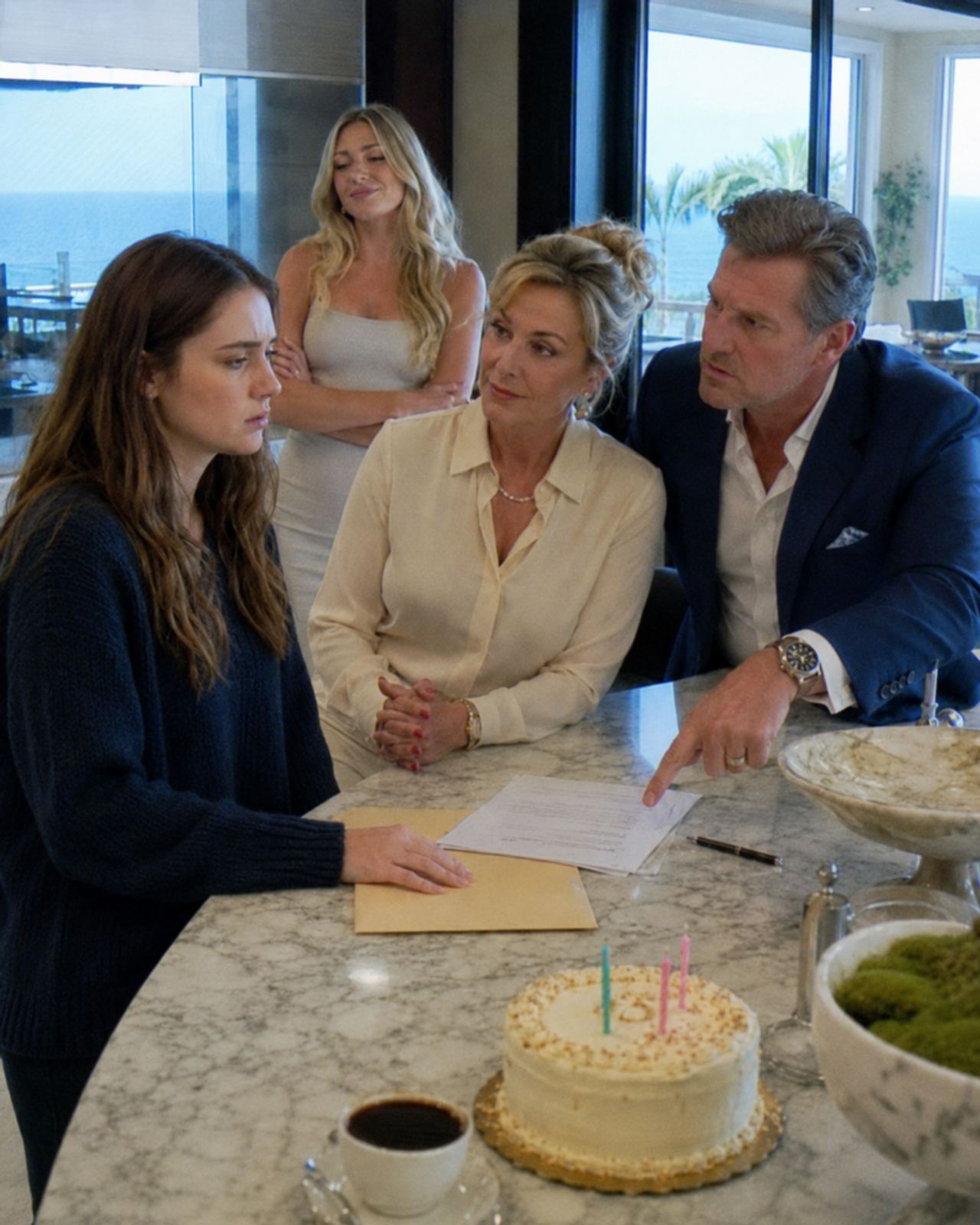
My father had planned too well.
He left Veronica enough to remain comfortable if she behaved like an adult, which she did not. He left the house partially protected, certain insurance proceeds, education funds, and a strict provisional trust for me that would mature when I turned eighteen.
For nine years, that money had sat beyond my mother’s reach.
For nine years, she had remarried, redecorated, overextended, leveraged, refinanced, and smiled.
And now the clock was almost up.
Veronica and Harrison had been dropping hints for months.
Family wealth management.
Generational protection.
Tax optimization.
Unified portfolio.
Words that sounded sophisticated until you noticed they always pointed toward one conclusion: my money should become easier for them to touch.
The canceled birthday dinner was not an oversight.
It was a symptom.
They did not see me as a person approaching a milestone.
They saw me as a waiting vault.
They just did not know I had already started changing the locks.
The real proof came two days later.
Thursday afternoon arrived wrapped in the dense coastal fog that often swallowed the Palisades. My data modeling group ended two hours early because the professor had a scheduling conflict, so I drove my ten-year-old sedan back up the winding canyon roads, engine straining against the incline, a sharp contrast to the sleek imported vehicles parked in every other driveway on our street.
The house was empty when I unlocked the front door.
That alone felt wrong.
There was always someone there—cleaning staff, Serena’s content assistant, Harrison’s driver, my mother’s florist, a wellness consultant, a brand photographer, a man installing something nobody needed.
But that afternoon, the silence inside felt heavy, like the air right before a pressure drop.
The cleaning staff had already left. Veronica was at her weekly charity luncheon, an event where wealthy women gathered to pretend they cared about the less fortunate while wearing shoes that cost more than my car. Harrison was supposedly in a meeting in the financial district. Serena was at a facial appointment because “stress toxins” had made her skin “visually defensive.”
I dropped my backpack by the stairs and walked into the kitchen to get a glass of water.
Late afternoon light filtered through the floor-to-ceiling windows, casting long geometric shadows across the pristine white marble of the island.
And there, right in the center of that marble slab, sat Harrison’s iPad Pro.
He never left it unattended.
Harrison treated that device like a biometric vault. He carried it from room to room, wiped the screen obsessively, used privacy filters even at family dinner. I once saw him nearly shout at a housekeeper for moving it six inches while dusting.
But today, perhaps in a rush, he had left it plugged into the charger.
The screen was dark.
I poured my water. I was turning to leave when the screen lit up with a soft chime.
A banner notification appeared across the lock screen.
The sender was Lance Bankroft.
I recognized the name.
He was an estate attorney who occasionally showed up at our house for quiet evening drinks with Harrison, a man who wore suits too shiny for real legal work and smiled with too many teeth.
The subject line of the email was fully visible.
Paul Family Capital LLC execution draft ready for Veronica’s signature.
My breath caught in my throat.
My biological last name was Paul.
Harrison and Veronica had been floating the idea of a unified family portfolio for months, using phrases like tax optimization and generational wealth protection. I set my glass down on the counter. It made a dull little clink against the stone.
I walked back to the island.
The iPad was not locked.
Harrison had disabled the auto-lock feature while reading an article, leaving the screen accessible with a single swipe.
I tapped the notification.
The email opened.
There was a PDF attachment titled Final Unification Agreement.
I tapped it.
The document loaded.
Forty-two pages of dense, suffocating legalese.
I did not panic.
I am a data scientist.
I analyze complex systems, locate hidden variables, and predict outcomes.
So I began to read the contract not as a daughter, but as an auditor.
The structure of their plan was laid out in stark, undeniable black and white.
The document established a new holding company: Paul Family Capital LLC.
Harrison was listed as the sole managing director, possessing unilateral authority over all asset allocation decisions.
Veronica was listed as successor trustee.
My name, Prudence Paul, appeared on page six, buried in a subsection beneath language about “voluntary beneficial alignment.”
The execution trigger was my eighteenth birthday.
The contract stipulated that upon reaching the age of majority, I would voluntarily assign eighty percent of the beneficial interest from my late father’s trust into this new LLC. The language was carefully crafted to look like a standard wealth management strategy, obscuring the reality that I would be handing control of my inheritance to a man whose ventures rarely yielded actual capital.
I scrolled down to the asset allocation provisions on page fourteen.
This was the road map of their greed.
The document explicitly authorized the managing director to leverage trust assets as collateral for external business ventures.
I knew exactly what those ventures were.
Harrison had spent the last three years pouring borrowed capital into a biometric wearable tech company that was currently suffocating under pending litigation. I had overheard fragments through walls, seen unpaid invoices abandoned near printers, noticed the way his voice dropped when banks called after dinner.
His creditors were circling.
He needed a clean, substantial injection of liquid capital to save his own skin.
My father’s money was going to be the life raft for Harrison’s sinking ship.
Then I found the section detailing the discretionary allowance.
The contract carved out a permanent unrestricted operational budget for Serena’s lifestyle brand.
My sister, whose business consisted of posting curated photos of herself holding expensive matcha lattes, was burning through cash at an astonishing rate. Her inventory suppliers were refusing to ship. Her marketing team had quit. Her so-called flagship serum cost more to package than it could reasonably earn.
This legal document was designed to turn my inheritance into a slush fund to finance her vanity project.
I checked the footer.
The date of the initial draft was six months ago.
They had been plotting this for half a year.
Every forced smile.
Every casual conversation about family unity.
Every time Veronica bought me a small gift or asked about my day.
It had all been part of a calculated campaign to ensure I remained compliant until the ink was dry on this paper.
They did not view me as a daughter.
I was a host organism, and they were the parasites waiting for the incubation period to end.
I did not scream.
I did not throw the iPad across the room.
Anger is an inefficient emotion when you are standing in a minefield.
I needed to act.
I opened the camera app on my phone. I took clear, high-resolution photos of every single page of the PDF. I captured the email thread, making sure Lance Bankroft’s email address and Harrison’s replies were legible. I captured timestamps. I captured metadata where I could.
My hands were perfectly steady.
Once I had all forty-two pages, I opened a secure encrypted email account I had set up months ago for university research. I attached the photos and sent the file to myself. Then I permanently deleted the sent message from my phone, closed the PDF, marked the email as unread, and pressed the iPad’s power button, plunging the screen back into darkness.
I took the edge of my sweater and carefully wiped the screen to remove any smudges from my fingers.
I left the device exactly where I had found it.
Positioned at the exact same angle.
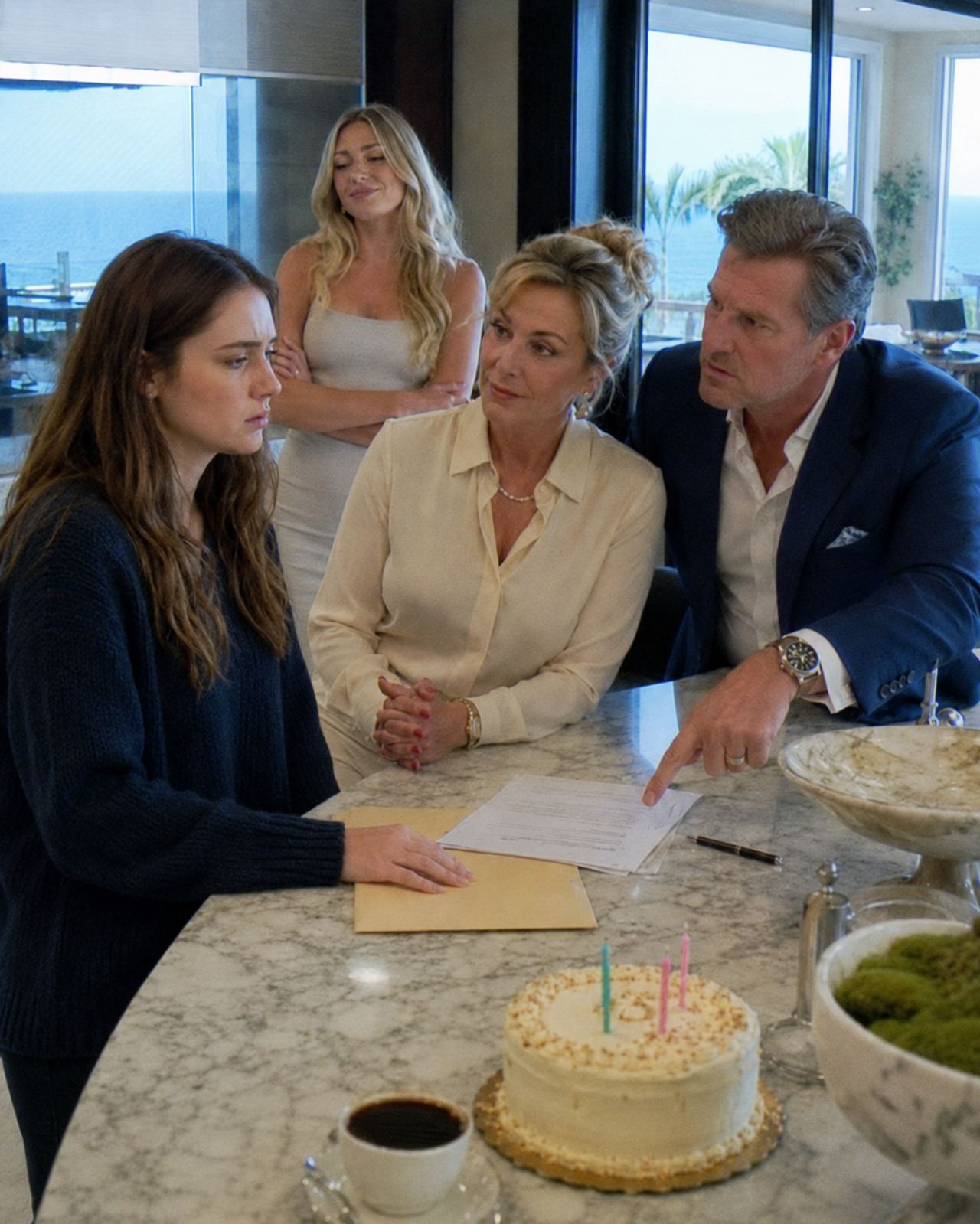
Three minutes later, I heard the heavy hum of Harrison’s SUV pulling into the driveway.
I picked up my glass of water, walked up the stairs, and closed my bedroom door.
I sat at my desk and opened a textbook, arranging my face into the mask of the quiet, unremarkable teenager they believed me to be.
The true psychological toll began that evening at dinner.
We sat around the formal dining table. The private chef had prepared seared scallops, asparagus, and lemon risotto. The silverware felt heavy in my hands. Veronica sat at the head of the table sipping Chardonnay, asking Serena about her latest social media metrics.
Serena complained that her aesthetic needed a higher budget to compete with other influencers.
“Don’t worry, darling,” Harrison said, cutting his scallop with unnecessary precision. He offered Serena a reassuring wink. “The financial tides are shifting in our favor very soon. We are going to have all the runway you need.”
He turned to me, his smile unnervingly bright.
“How was your study group, Prudence? You always work so hard.”
I looked into his eyes.
I knew he was planning to steal my future to cover his failures.
I knew Veronica had authorized it.
I knew Serena was waiting to spend it.
They sat there passing salt, pouring wine, playing the roles of a supportive family while tightening a noose around my neck.
“It was productive,” I said. My voice stayed even and mild. “I am learning a lot about how systems operate.”
“That’s my practical girl,” Veronica chimed in, reaching over to pat my hand.
Her skin was cold.
“Just keep your head down and stay focused. We’ll take care of the complicated things.”
I swallowed my food.
It tasted like ash.
The tension in my chest was a coiled spring, but I forced my breathing to remain shallow and rhythmic.
If I confronted them, Harrison would call Bankroft, lock down the accounts, and initiate a legal battle that would drag on for years. They had the resources to bury me in litigation until I was drained of every dollar and every ounce of will.
I could not fight them in their own house using their own rules.
I finished dinner. I politely excused myself, washed my plate, and returned to my room.
I sat in the dark and looked out the window toward the glittering lights of the city below.
My father had built his fortune with his own mind, navigating a ruthless industry filled with sharks. He had left that legacy to me.
I was not going to let a failed venture capitalist, an aging socialite, and a collapsing influencer tear it apart to fund a superficial illusion.
I realized I needed a different kind of weapon.
I needed a shark of my own.
I needed the man who had drafted the original trust.
The man who had protected my father from people exactly like Harrison.
I needed Elias Thorne.
The Santa Monica Freeway was a parking lot the next afternoon, a slow river of luxury vehicles, delivery trucks, and frustrated commuters. I maneuvered my ten-year-old sedan through the congested lanes with quiet efficiency.
I had skipped my afternoon data structures lecture.
My phone buzzed twice in the cup holder.
A text from Veronica asking if I wanted anything from the boutique bakery.
A performance piece for the digital record.
I ignored it.
I took the exit for Century City and navigated toward a towering glass skyscraper that pierced the smoggy skyline. This was the fortress of Thorne & Associates.
My biological father had built his software empire by seeing five steps ahead of his competitors. He did not surround himself with yes-men. He surrounded himself with apex predators who understood the brutal ecosystem of Silicon Valley.
Elias Thorne was the apex predator he trusted most.
Elias had defended my father against hostile takeovers, patent trolls, and greedy venture capitalists. Now I needed him to defend me against my own mother.
I parked in the subterranean garage, rode the brushed steel elevator to the fifty-second floor, and stepped into a reception area paneled in dark walnut.
The receptionist recognized my name immediately.
Within two minutes, I was ushered into a corner office that smelled of expensive leather and polished wood.
Elias Thorne stood by a floor-to-ceiling window overlooking Los Angeles.
He was in his late sixties, impeccably tailored in a charcoal suit, silver hair swept back from a sharp analytical face. He did not offer a patronizing hug. He extended a firm hand and motioned for me to take the seat across from his desk.
“You look like him,” Elias said, his voice a low, measured baritone. “You have his eyes. Evaluating. Calculating.”
I did not waste time with pleasantries.
I reached into my backpack, unlocked my phone, and pulled up the encrypted folder containing the forty-two screenshots.
I placed the device on the center of his desk.
“I need you to read this.”
My voice held steady.
Elias retrieved his reading glasses from his breast pocket. He picked up the phone. He swiped through the first image, then the second.
The ambient noise of the city far below faded into a dense, oppressive silence as he digested the legal framework Harrison had commissioned.
I watched Elias Thorne deliver a masterclass in stoicism.
But on the twelfth swipe, a muscle in his jaw twitched.
He set the phone down, intertwining his fingers.
“Who drafted this garbage?”
I pointed to the footer in the third image.
“Lance Bankroft.”
Elias let out a breath that sounded like a dry chuckle, though there was no humor in his eyes.
“Lance Bankroft is a scavenger,” Elias said, tapping one manicured finger against the mahogany desk. “He operates in the murky waters of estate law, targeting vulnerable heirs. He specializes in what certain circles politely call family unifications.”
“What does that mean?”
“A polite term for legal theft.”
The temperature in the office seemed to drop.
“Bankroft drafts cohesive portfolio documents designed to trap young, inexperienced beneficiaries,” Elias explained. “He creates holding companies that look legitimate on paper but function as private bank accounts for managing directors. He has faced two separate disciplinary reviews for fiduciary breaches, but he always manages to slither away by burying the evidence in shell companies and family settlements.”
I looked at the phone lying on his desk.
“What would happen if Harrison and Veronica cornered me on my birthday and forced me to sign?”
Elias did not soften the reality.
“If you put your name on that dotted line while residing under their roof, proving coercion becomes a monumental task. The burden shifts to you. They will argue it was a voluntary consolidation of assets for tax benefits. They will say you were informed. They will present your mother as a caring parent and Harrison as a seasoned financial advisor.”
He picked up a silver paperweight, turning it over in his hands.
“By the time we filed an injunction, Bankroft would have executed the transfer. Harrison would immediately pledge your trust as collateral for his failing ventures. If we fought in court, unwinding that fraud could take a decade of relentless litigation. You would spend your twenties sitting in deposition rooms while Harrison drained the capital to pay creditors and legal fees. By the time a judge ruled in your favor, the forty-five million could be gone.”
I sat back in the leather chair.
The magnitude of their betrayal pressed down on my chest.
They were not just stealing my money.
They were stealing my future, my independence, my ability to build a life free from their transactional love. They were chaining me to the sinking hull of their fabricated wealth.
“What would my father do?” I asked.
The question hung in the quiet office.
Elias studied my face for a long moment.
Then he unlocked the center drawer of his desk. He reached inside and retrieved a heavy black Montblanc fountain pen with silver trim.
“Your father sat in that exact chair nineteen years ago,” Elias said softly. “He was facing a hostile takeover from a board that thought they could outmaneuver him. They thought he was too focused on code to see the business trap they had set. He used this pen to sign the countermeasure that dismantled their entire operation.”
Elias stood, walked around the desk, and placed the Montblanc pen in my hands.
The metal was cool against my skin.
“He did not panic,” Elias told me. “He did not scream. He simply rewrote the rules of the game so they could not play. You are your father’s daughter, Prudence.”
The pen sat heavy in my palm.
“We are going to rewrite the rules.”
I gripped it.
“Tell me the plan.”
Elias returned to his seat and picked up a legal pad.
“We cannot fight Bankroft’s document after it is signed. We must render it legally impotent before they slide it across the table.”
He drew a sharp line across the paper.
“We will establish a new, ironclad, irrevocable trust. We will assign a corporate trustee—a neutral, impenetrable financial institution that cannot be manipulated by Harrison, Veronica, Serena, or their bottom-fee…
Read more stories
- Pineapple Bread Pudding
- For more than twenty years, I hid my real identity while my family mocked me like I was a total failure. At our annual cookout, my cousin, a sheriff’s deputy, slammed me into handcuffs just to show everyone who was in charge.
- Barbara Mandrell’s ‘Sleeping Single in a Double Bed’ Redefines Country Pop and Champions Female Empowerment in 1978-2
- Homemade Banana Bread