
News
The Montgomery Sidewalk Where Hank Williams Sang His Way Off the Street
In Depression-era Montgomery, a teenage Hank Williams busked outside the Jefferson Davis Hotel under his mother’s watchful eye until the sound that stopped passersby also opened the door to radio.


A boy on a cold corner
In the winter of 1937, fourteen-year-old Hank Williams stood on a busy Montgomery sidewalk with his guitar case open on the concrete, playing for coins in the cold. He was not there by accident, and he was not there alone. A short distance away, his mother, Lillie Williams, watched from a doorway, making sure her son kept singing no matter who passed, no matter how sharp the wind, no matter how thin the return.
The scene carried the hard logic of the Great Depression. The Williams family had left rural Georgiana for Montgomery, and survival in the city demanded improvisation. Hank’s frayed clothes and sore fingers marked him as a working boy rather than a prodigy in waiting, yet the contrast between him and the well-dressed people entering the nearby hotel only sharpened the drama of the moment: a teenager on the pavement, trying to turn music into food and rent.
Standing outside the Jefferson Davis Hotel, Hank Williams was not chasing fame so much as helping keep his family afloat.
Why Lillie chose that spot
Lillie’s choice of location was strategic. The family’s move to Montgomery had put them in a place where hustle could meet opportunity, and she understood that talent needed an audience with influence. She opened a boardinghouse and, by all accounts, pushed hard on every possible avenue of survival. The corner outside the Jefferson Davis Hotel was valuable because it was more than a busy patch of sidewalk.
Inside the hotel were the studios of WSFA, the radio station whose staff, managers, and producers moved through the lobby each day. Lillie positioned her son where the right ears might hear him before they ever knew his name. It was a form of stagecraft without a stage: the city itself as audition room, the sidewalk as waiting area, the revolving doors as the threshold between scraping by and being noticed.
The sound that carried across the street
What made people stop was not polish. Hank was still a teenager, still learning how to hold an audience, still working with the limitations of youth and poverty. But he already had the raw, aching phrasing that would later become inseparable from his music. That quality had been shaped in part by his time around Rufus Payne, the Black street musician whose influence on the young Williams has long been recognized in accounts of his early development.
On a crowded city street, that kind of voice could cut through noise in a way technical perfection often cannot. It sounded lived-in before it had fully been lived. The cadence was unvarnished, emotional, and direct, and it reached the people Lillie had hoped to reach. WSFA staff walking by stopped to listen. Then came the invitation that changed everything: come upstairs and audition.
From busking to broadcasting
The move from sidewalk to studio was swift and startling. One moment Hank was playing for sparse nickels from strangers; the next he was entering the building that had loomed over his street-corner performance. For a boy who had been singing outdoors in the cold, simply walking through those doors represented a dramatic shift in status. He was no longer only asking passersby to pause. He was being asked to perform.
WSFA gave him his own fifteen-minute radio show, paying him fifteen dollars a week. In Depression-era terms, that was not just encouragement; it was meaningful income and validation. Radio transformed his audience from a cluster of pedestrians into a listening public, and it gave structure to a talent that had been forced into the open by necessity. The station did not create Hank Williams, but it recognized something already present in the voice coming off the sidewalk.
A family gamble that worked
The story is often told as a discovery narrative, but it is also a story about maternal pressure, calculation, and belief. Lillie Williams emerges as one of the decisive figures in the scene: unsentimental, watchful, and unwilling to let pride interfere with earning. She had staked the family’s survival in part on her son’s ability to perform, and she placed him where performance might become employment.
That can sound harsh, but the circumstances were harsh. The Depression narrowed choices for families across the South, and the Williamses were hardly unique in turning children’s labor and talent into household strategy. What makes this episode memorable is the precision of the gamble. Lillie did not simply hope someone might hear Hank somewhere, someday. She put him exactly where hearing him could matter.
The moment before the legend
Looking back, the Montgomery sidewalk scene feels like a hinge in American music history, the instant before Hank Williams became Hank Williams. Yet its power lies in how small and precarious it was at the time. There was no guarantee that anyone from WSFA would stop, no certainty that an audition would lead to airtime, no sign on that cold day that the boy with the guitar would become one of country music’s defining voices.
What happened outside the Jefferson Davis Hotel was the conversion of desperation into trajectory. A teenager playing for change became a teenager with a radio slot. A family survival tactic became the beginning of a career. The image endures because it contains both realities at once: the poverty, the pressure, the racial and musical influences shaping his sound, and the sudden opening that can make a life look, in retrospect, almost fated.

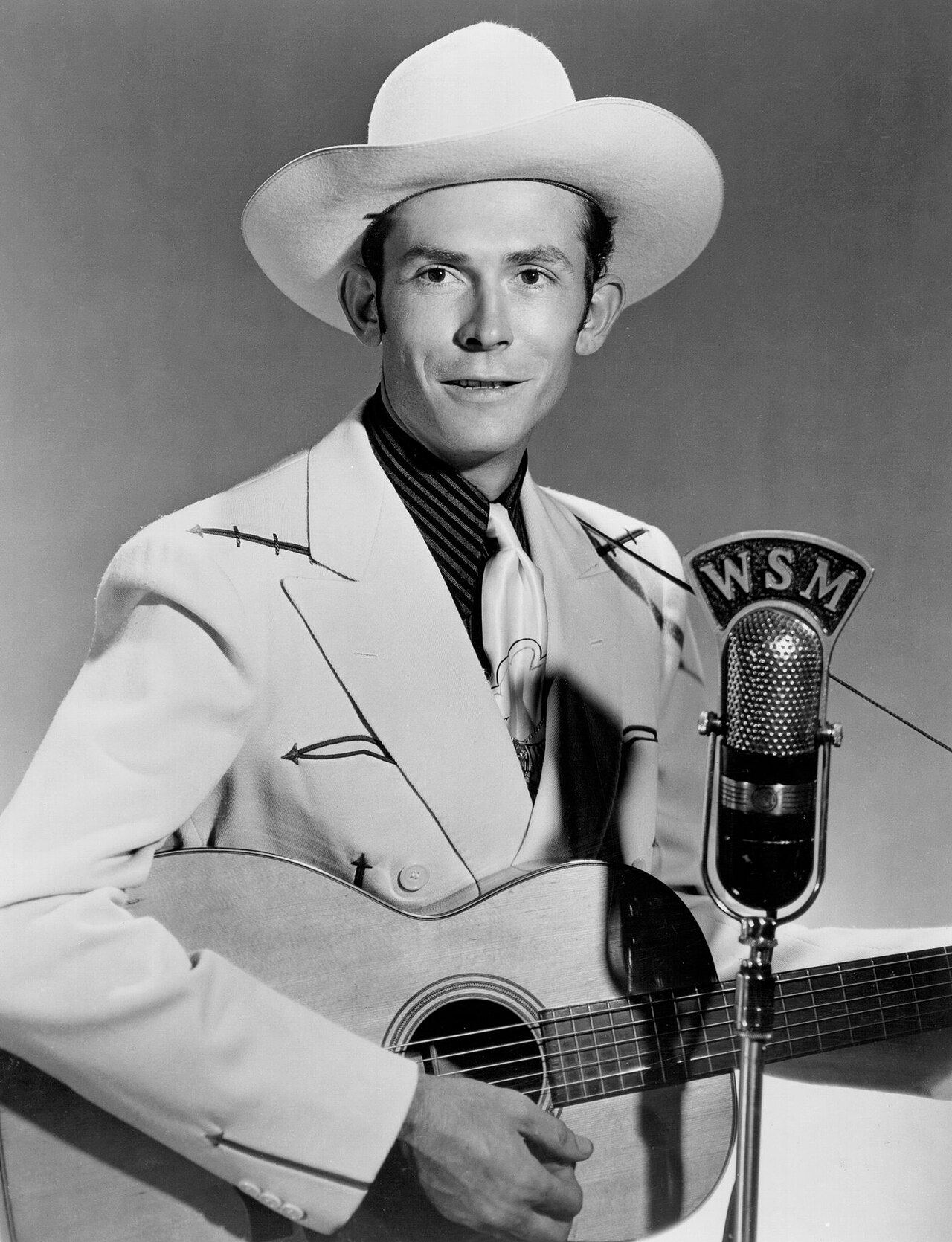
Quick Facts
- Who: Hank Williams, age fourteen
- Where: Outside the Jefferson Davis Hotel in Montgomery, Alabama
- When: Winter of 1937
- Why that corner: WSFA radio studios were inside the hotel
- Key family figure: His mother, Lillie Williams
- Early musical influence: Rufus Payne
- Breakthrough: An audition with WSFA staff who heard him busking
- First radio job: A fifteen-minute WSFA show paying fifteen dollars a week
Image credits: Andrea Klein / Wikimedia Commons / CC BY 2.0; Adambroachphoto / Wikimedia Commons / CC BY-SA 3.0; WSM radio / Wikimedia Commons / Public domain.

