
Human Stories
THE HOA PRESIDENT TRIED TO UNLOCK MY FRONT DOOR AT 3:00 A.M. WITH A “MASTER KEY,” THEN KICKED THE FRAME AND SAID SHE WOULD RETURN WITH A LOCKSMITH TO SEIZE MY TWO DOGS. SHE THOUGHT I WAS JUST ANOTHER HOMEOWNER SHE COULD BURY IN FINES. SHE DIDN’T KNOW BOTH DOGS WERE RETIRED POLICE K-9s… OR THAT I WAS THE SERGEANT WHO TRAINED HALF THE DEPUTIES IN THIS COUNTY.
An HOA president tries to force her way into a retired sheriff sergeant’s home at 3:00 a.m. using a fake master key and threatens to seize his retired police K-9s. But the homeowner has evidence, allies, and the experience to expose a years-long fraud operation built on forged bylaws and abusive fines.

THE KEY THAT OPENED NOTHING
At three o’clock in the morning, the first sound was not a knock.
It was metal scraping metal.
I opened my eyes in the dark and listened to somebody outside my front door forcing a key into the deadbolt, turning it the wrong way, pulling it out, shoving it back in, and trying again with the stubborn irritation of a person who believed the lock was the thing being unreasonable.
Caesar was already awake at the foot of my bed.
Bear rose beside him a second later, his toenails making one soft click against the hardwood before he became completely still.
Then came the kick.
The frame shuddered hard enough to tilt the photograph above my entry table. Caesar’s head lowered. Bear released a growl so deep I felt it through the floorboards before I heard it.
“Open this door!” a woman shouted from the porch. “This is the HOA. I have a master key!”
For a few seconds, I remained seated on the edge of my bed, barefoot, breathing slowly.
My name is Jack Hendricks. I had spent twenty-two years with the Dyer County Sheriff’s Department, the last eleven as sergeant in charge of the K-9 unit. I had taught deputies how to read rooms, how to survive traffic stops, how to know the difference between a frightened person and a dangerous one, and how to stop a working dog from using force when the dog knew better than the human handler that force would be easy.
Four years after retirement, I still woke quickly.
I also still knew evidence when it arrived at my door.
I took my phone from the nightstand and opened the camera system. The porch feed came alive in clean black-and-white night vision.
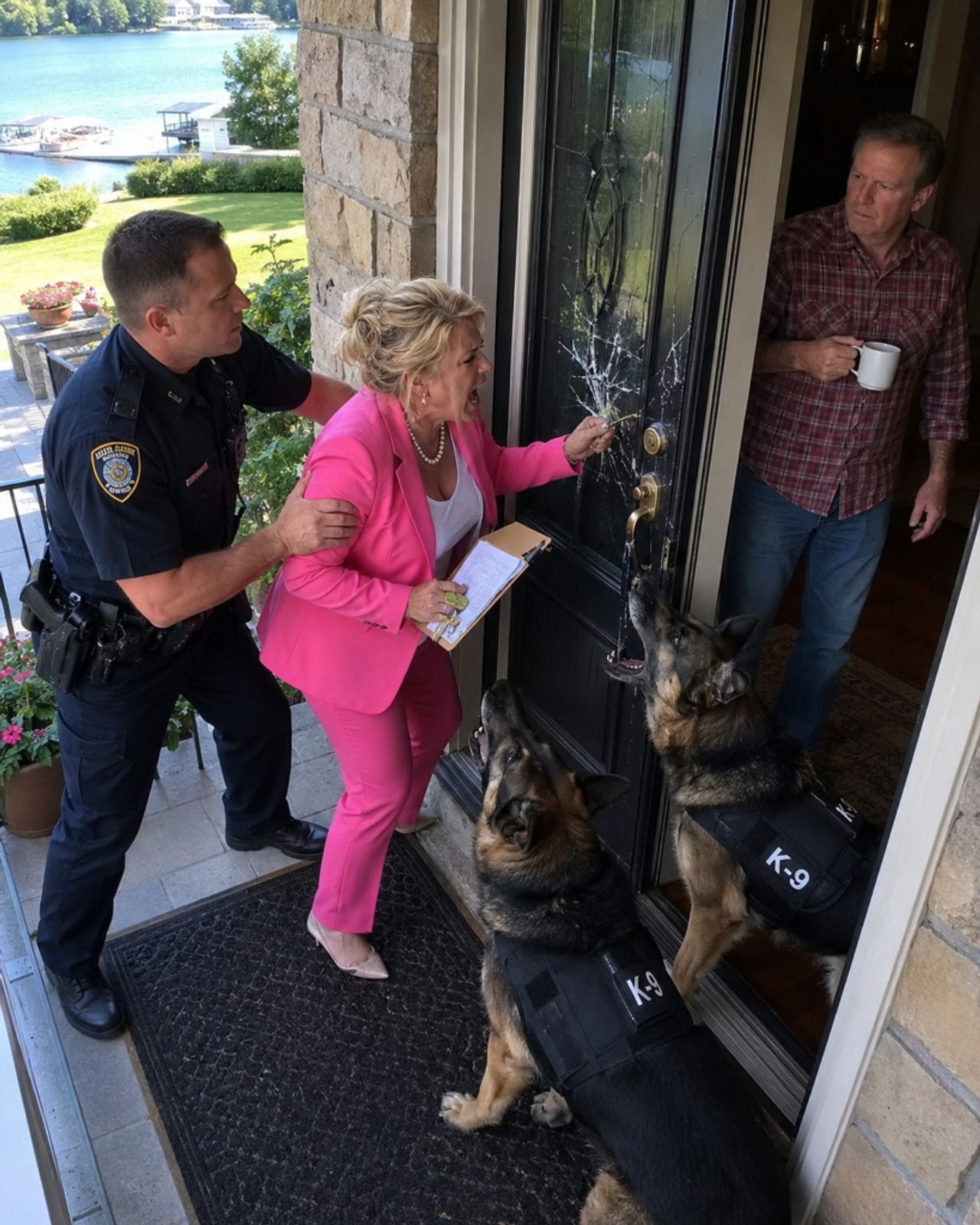
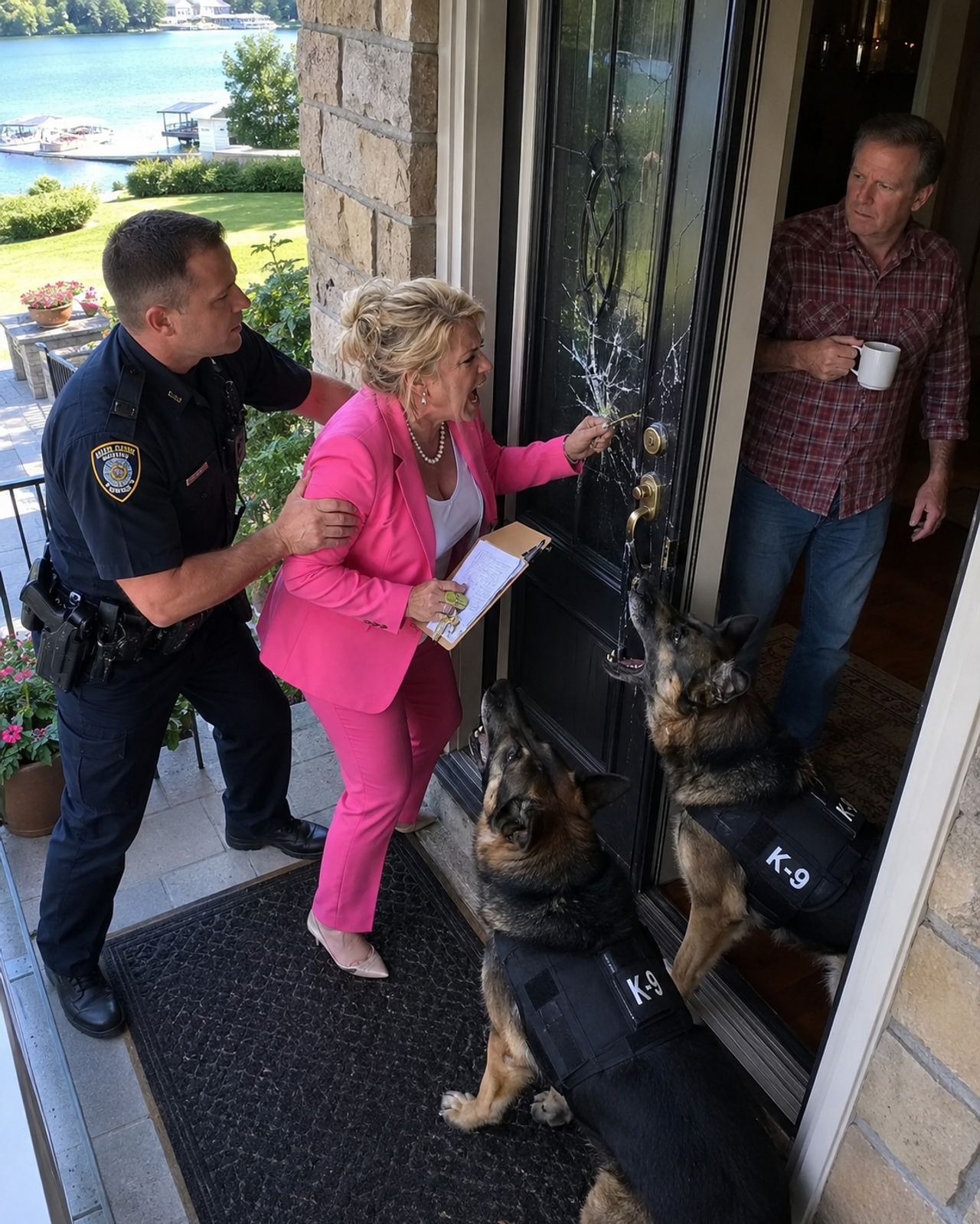
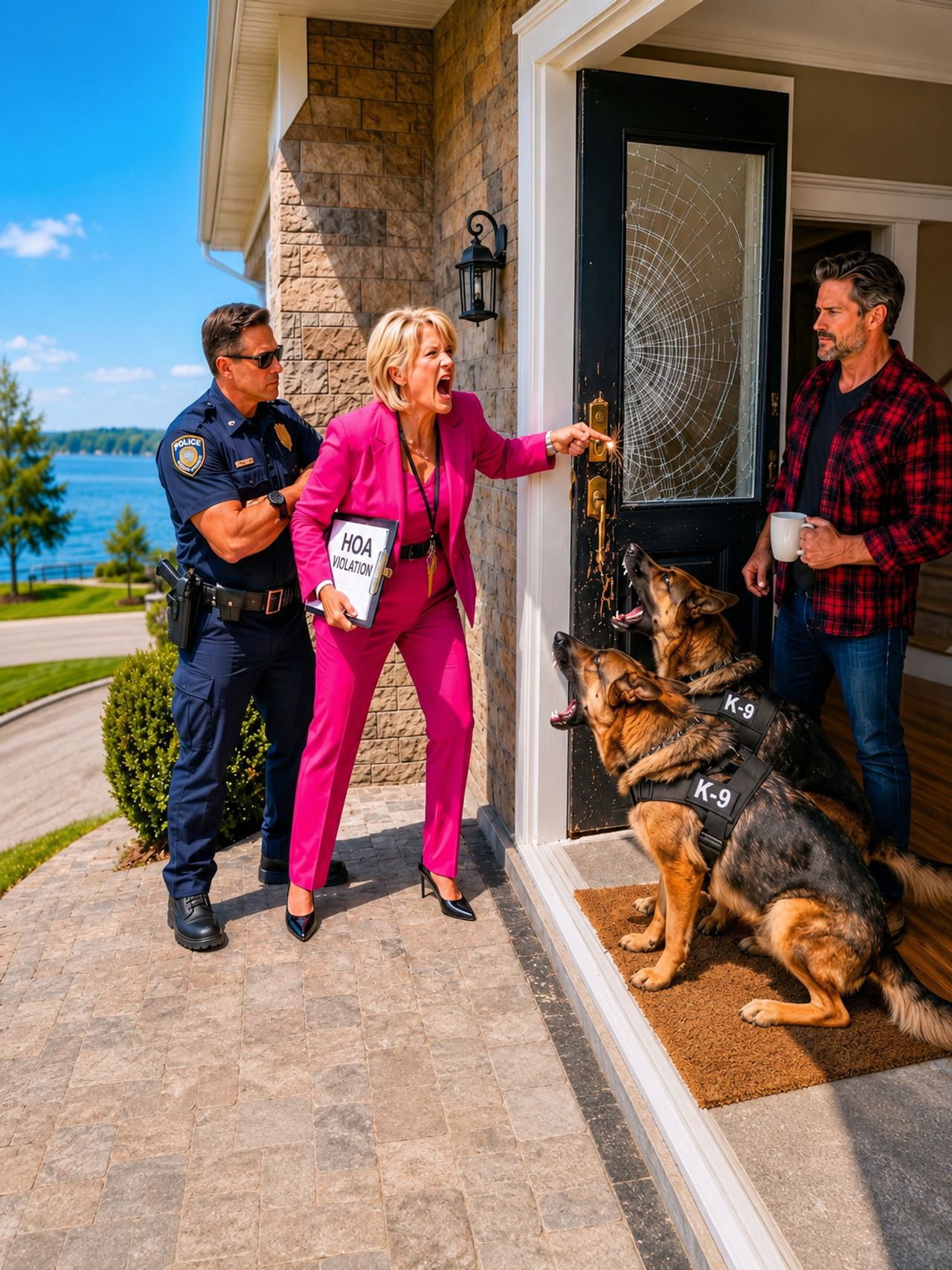
Karen Brener stood outside in a pink bathrobe over silk pajamas, slippers planted on my welcome mat, a clipboard tucked under one arm. Around her neck hung a black lanyard carrying a brass key. She held it forward like a badge, glaring at the deadbolt as though my house had insulted her office.
Karen was president of the Whispering Pines Homeowners Association.
She was also the reason I had not enjoyed one quiet month since moving into the subdivision.
I pressed record even though the doorbell system was already saving video to the cloud. Old habits. Redundancy mattered when another person’s lie was already halfway formed.
Then I walked into the hallway.
Caesar and Bear moved with me, one on each side. Caesar was twelve, broad-chested and black-and-tan, with a silvering muzzle and an old scar beneath his left shoulder where a man with a hunting knife had tried to keep him from ending a burglary pursuit. Bear was eleven, darker through the face and longer in the legs, the calmer of the two until calm was no longer useful.
Both had been mine in service.
Both had retired with me under the county’s law-enforcement canine retirement program.
Both now wore no more authority than the collars around their necks, because they were in their own house at three in the morning.
I gave one quiet command.
“Hold.”
The growl stopped. Their bodies did not relax.
I switched on the entry light, latched the security chain, and opened the front door six inches.
The dogs filled the gap beside my legs.
Karen lifted her clipboard, already prepared to speak. Then she saw Caesar. She saw Bear. Behind me, on two hooks beside the coat rack, hung their retired-service vests: DYER COUNTY K-9 UNIT stitched in white across black fabric.
Her face changed for a fraction of a second.
I had seen that change hundreds of times on the job: the moment when reality arrives before arrogance can reorganize itself.
Then her chin rose.
“Your animals are in violation,” she said. “The board has authorized an interior inspection. Step aside.”
I kept my hand on the door edge.
“Step off my porch, Mrs. Brener.”
“I am president of this association.”
“You are trespassing at my home at three in the morning.”
“I have authority under the bylaws.” She raised the brass key. “Every property in Whispering Pines is subject to inspection during an ongoing violation. Your dogs have been designated a community hazard.”
Caesar remained seated at my knee, eyes fixed on her. Bear did not blink.
I spoke carefully, every word intended for the camera.
“You do not have permission to enter my house. You do not have permission to touch my door. Leave now, or I will call law enforcement.”
Karen gave a harsh little laugh.
“I will call law enforcement. You just threatened an HOA officer with attack dogs.”
“The dogs are sitting.”
“They are intimidating me.”
“They are inside their home.”
She stepped closer and tried the key once more while the chain remained on the door.
The brass scraped uselessly against the lock.
“I am giving you notice,” she said. “I will return in the morning with animal control and a locksmith. When I return, that door will open, and those animals will be removed.”
For the first time that night, I felt anger.
Not because she threatened me.
Because Caesar’s ears shifted at the sound of her voice, and Bear leaned almost imperceptibly closer to my leg. They understood tension. They understood intrusion. After giving years of their lives to protecting people they would never meet again, they were standing in a hallway while a woman in a pink bathrobe promised to drag them from the only quiet home they had ever had.
I did not argue.
I said, “You have been warned to leave.”
Then I closed the door and locked it.
Through the camera feed, I watched her stalk down my walk, muttering to herself while the brass key bounced against her robe. When she reached the sidewalk, she turned once and pointed toward my house as if saving the gesture for the memory of an audience.
Only when her SUV pulled away did I sit on the small bench by the entry table.
Caesar came close enough to press his shoulder against my knee.
Bear sneezed once and sat beside him.
“Good hold,” I said quietly.
The video had captured everything. The scratching. The kick. Karen announcing she had a master key. Her attempted entry. Her threat to return with animal control and a locksmith.
The time stamp ran from 3:00:42 a.m. to 3:04:18 a.m.
Three minutes and thirty-six seconds of clean evidence.
I exported it to my laptop, copied it to an external drive, and emailed an encrypted backup to myself. Then I placed a call to dispatch.
Before a patrol unit reached my street, another sound came from outside: a small metallic clink on the porch.
Karen had fled quickly enough to leave her brass key jammed halfway into my deadbolt.
That was the moment I understood she had finally given me more than another complaint.
For eight months, I had let Karen Brener underestimate me.
I moved into Whispering Pines because I wanted a smaller life.
After twenty-two years of calls in the dark, emergency-room hallways, funerals, courtroom testimony, and dogs who came home limping after doing brave things without ever asking to be brave, retirement had seemed like a chance to stop carrying other people’s emergencies.
The house was modest but comfortable: a brick ranch on a quiet cul-de-sac with mature maple trees, a workshop in the garage, and enough fenced backyard for Caesar and Bear to sleep in the sun. The neighborhood had ninety-six homes, a pool beside a dated clubhouse, and winding sidewalks where people waved as though they still believed community was mostly about kindness.
The first yellow violation slip appeared eight days after I moved in.
LAWN HEIGHT EXCEEDS 3.5 INCH LIMIT. FINE: $75.
I took a ruler outside. The tallest blade near the mailbox was two and three-quarter inches.
I paid it anyway.
Some people would call that weak. It was not. During investigations, early confrontation sometimes taught a dishonest person to be careful. I wanted to know whether the violation was a mistake or a pattern.
The second note came two weeks later.
IMPROPER VEHICLE ORIENTATION IN DRIVEWAY. FINE: $100.
My truck was parked nose-out, the same way it had been every day since I moved in.
I paid that one too.
The first time I met Karen, she was standing in my driveway taking photographs of my living-room windows.
She wore a butter-yellow jacket, dark trousers, heels, and the same clipboard she would later carry to my door in her bathrobe.
“Mr. Hendricks,” she said, as though announcing a defendant. “Karen Brener. HOA president.”
“I gathered.”
She glanced toward the front window, where Bear was watching us from behind the glass.
“I see you own large dogs.”
“Two.”
“What breed?”
“German shepherds.”
Her pen moved.
“Whispering Pines has nuisance-animal standards.”
“My dogs do not create a nuisance.”
“They may be intimidating to residents.”
“They have not met any residents.”
Her smile tightened.
“Sometimes the appearance of a risk is itself a risk.”
I knew then that she was not interested in what Caesar and Bear did. She was interested in what she could say they might do.
Two days later, animal control arrived after receiving an anonymous complaint about “aggressive, uncontrolled dogs repeatedly threatening pedestrians.”
Officer Colin Garrison was polite at first. He stepped into my backyard, met both dogs, reviewed their county retirement registrations and veterinary records, and scratched Bear behind one ear before he left.
“These two are better behaved than half the humans I deal with,” he said.
A week later, he returned with another complaint.
The week after that, he returned again.
By the fourth visit, he stopped smiling.
“I’m sorry, Jack,” he said as Caesar sat obediently beside my porch chair. “Every complaint has to be checked.”
“I understand procedure.”
He looked toward the neighboring houses.
“Somebody has time on their hands.”
“I know exactly who has time on her hands.”
Garrison did not answer.
I began looking into Karen in November.
Public association records told one story. Karen had been president for seven years. Under her administration, the HOA had issued hundreds of violations and placed twenty-three liens on homes in a ninety-six-house neighborhood. Twenty-three. Almost one quarter of the community had lived under threat of forced payment, litigation, or sale.
Then I met Frank Hendricks.
We shared a surname but no relation. He lived two doors down, a retired cable technician with a weathered face and a habit of walking over with beer whenever he sensed someone needed warning more than company.
He came by one Saturday afternoon while I was sanding cabinet doors in my garage.
“You’re the dog guy,” he said.
“I suppose I am.”
“You’ve met Karen.”
“I suppose I have.”
He handed me a beer.
“Then you need the history lesson.”
We sat on folding chairs while Caesar lay in the sun and Bear watched squirrels with grave professional attention.
“Karen’s husband, Roy, developed this place,” Frank said. “He kept a developer’s board seat after the homes sold. Karen became president. Between them, they control everything.”
“Residents can vote them out.”
Frank laughed without humor.
“Residents who complain get violations. Residents who fight violations get fines. Residents who refuse fines get liens. People here are retired, widowed, raising families. Most cannot spend ten grand proving they should be allowed to paint a fence or park a work van.”
He took a drink.
“Karen claims she has a master key.”
I turned toward him.
“A master key to what?”
“Every house. Says the bylaws let her enter for emergency inspections. Mrs. Castellanos went to visit her daughter last year and came home to find a violation notice on her kitchen counter because Karen said she’d inspected a leaking window.”
“Did Mrs. Castellanos call the police?”
“She was seventy-eight and scared Karen would lien her house.”
“Has anyone read the actual bylaws?”
Frank looked embarrassed.
“Karen gives everyone a copy when they close. More than two hundred pages. People assume she knows what’s in them.”
That evening, I drove to the county recorder’s office before it closed and requested the official Whispering Pines declarations and bylaws.
I read every page at my kitchen table.
There was no master-key clause.
No emergency-entry authority.
No provision permitting an HOA president to let herself into a private residence.
There was also no power to impose retroactive nuisance fines dating back to purchase. No accelerated foreclosure process controlled by the board. No Article 14 at all.
The filed document ended at Article 13.
I printed the relevant sections, copied the complete recorded bylaws, and placed them in a folder.
Still, I said nothing.
If Karen thought I was another retired man who would pay fines to avoid stress, she would continue showing me exactly how her operation worked.
She did.
Two days before she came to my door at three in the morning, she approached me at the mailbox.
Her brass key was already hanging from the lanyard around her neck.
“We have received complaints that your dogs bark constantly at night,” she said.
“They do not.”
“The board determines nuisance behavior, Mr. Hendricks. I will be conducting an interior inspection of your home this week.”
“No, you will not.”
She smiled.
Then she lifted the key between two fingers.
“If you fail to answer, I will let myself in.”
I watched her walk away, feeling the case form around her one decision at a time.
The following morning, certified mail arrived.
The envelope contained three pages of charges totaling $4,800. Dog barking. Aggressive animal behavior. Landscaping failures. Improper vehicle placement. “General failure to maintain community standards.” At the bottom, in bold letters, Karen cited Article 14 and threatened foreclosure if the fines were not paid within sixty days.
Article 14 did not exist.
That Saturday morning, she crossed my lawn again with two board members behind her. Frank was watching from his porch. Across the street, Priya Patel was watering a planter with one hand while holding her phone low against her hip with the other.
Karen handed me a duplicate of the certified assessment.
“You have thirty days before lien procedures begin,” she said. “Sixty before foreclosure action.”
I had slipped a small recorder into my shirt pocket before stepping outside.
“Would you show me the section of the bylaws authorizing retroactive fines?” I asked.
One of the board members, a younger man named David Shore, shifted uncomfortably.
Karen did not even glance at him.
“I am the bylaws,” she said.
She delivered the words clearly, proudly, loudly enough for Priya’s phone and my recorder to capture them.
I accepted the papers.
“Thank you for documenting your position.”
Her lips curled.
“Proper channels begin and end with me, Mr. Hendricks.”
I went inside before she could say anything less useful.
Forty-eight hours later, she stood on my porch in a pink bathrobe trying to force a six-dollar brass key into my lock.
The patrol deputies arrived at 3:12 a.m.
One of them was Corporal Luis Reyes.
Reyes had been a twenty-four-year-old rookie when he attended my first K-9 familiarization course. He had been nervous around the dogs until Caesar demonstrated, with memorable enthusiasm, how quickly a fleeing suspect could be found behind a training shed. Reyes became one of the best patrol handlers of canine scenes I ever taught.
Now he stepped onto my porch, saw the damaged lock, saw Caesar standing calmly inside, and looked at me.
“Sergeant?”
His older partner glanced at him.
“I’m retired, Corporal,” I said. “Tonight I’m the reporting homeowner.”
“Yes, sir.”
They watched the footage. They photographed the boot mark on the doorframe. They bagged the brass key with gloves.
Reyes looked toward the empty street.
“You want us to locate her tonight?”
I considered it.
Karen had committed attempted unlawful entry and property damage. The video was enough for a criminal complaint. But I also knew her threats suggested more: animal control, locksmiths, fabricated authority, perhaps records that would disappear once she realized she had crossed beyond the safety of intimidation.
“I want to speak to counsel and the sheriff in the morning,” I said. “Document this fully. Do not alert her beyond routine procedure until your supervisors review the broader evidence.”
Reyes understood. His partner did too after looking at the folder I showed them: the real bylaws, the false assessment, the audio recording, the repeated animal complaints.
When they left, dawn had begun thinning the darkness above the rooftops.
At nine fifteen, Priya Patel knocked on my door holding a container of cardamom pastries and her cell phone.
“I saw her,” she said.
She was a small woman in her sixties, recently widowed, always neatly dressed even when standing in slippers on my porch.
“Come in.”
She placed the pastries on the entry table, then held out her phone.
From her upstairs bedroom window, she had recorded Karen at my front door before the kick. The video showed twelve minutes of attempted lock manipulation, pacing, muttering, and phone calls before Karen finally drove her boot into my doorframe.
“I have been afraid of her for four years,” Priya said. “My husband used to say we should fight the fines. After he got sick, I could not handle another fight.”
“What fines?”
She returned home and came back with a folder.
Within two hours, Frank arrived with his own documents. Then came the Hendersons, an older couple who had paid more than eleven thousand dollars in fines over fence paint, a mailbox, and holiday decorations. Then Annie Wise drove forty minutes carrying records from the home her parents had lost after Karen filed a lien over a fence the city itself had approved.
By afternoon, my kitchen table looked like an evidence room.
The person who affected me most was Walter Kowalski.
He was seventy-eight, a Vietnam veteran with stiff knees and a quiet way of speaking. His son had been killed in Afghanistan in 2009. Walter had flown a memorial flag beneath the American flag on his front porch every year until Karen cited him for nonconforming exterior display and threatened a lien if he raised it again.
“I stopped flying it,” he said, standing in my kitchen with his cap in his hands. “Couldn’t risk losing the house. My wife died there. My boy’s room is still upstairs.”
Something inside me settled into place.
Not rage. Purpose.
“You fly it tomorrow,” I told him.
He studied me.
“Who are you, exactly?”
“I spent twenty-two years in law enforcement,” I said. “And I know what evidence looks like.”
Frank returned after lunch carrying his closing binder from fourteen years earlier.
“I found my bylaw packet,” he said. “Maybe it helps.”
It helped more than he could have understood.
His packet contained 207 pages.
The county-recorded bylaws contained 204.
We laid them side by side and found the three inserted pages.
One created the imaginary master-key inspection authority.
One authorized retroactive fines from the date of purchase.
The last fabricated Article 14, supposedly allowing the HOA to seize homes through an accelerated process outside the requirements of state law.
Three false pages had been handed to buyers, cited in fines, and used to terrify residents for years.
This was no longer a bad HOA president behaving arrogantly.
This was a fraud operation.
At three that afternoon, I drove Karen’s abandoned brass key to Pine Ridge Hardware. Lou Ramirez had owned the place for thirty-six years and remembered every key blank the way some people remember faces.
He held the bagged key up beneath the fluorescent light.
“Model Seven blank,” he said. “Six dollars. We sell a pile of these. It does not open some magic neighborhood lock.”
“Have you sold them to Karen Brener?”
Lou snorted.
“She bought four over the past couple years. Always told me she was having ceremonial keys made for HOA business. I thought it was strange, but strange is free in retail.”
“Would you put that in writing?”
He took a business card, wrote down the identification, price, and his recollection, then signed and dated it.
“You finally going after her?”
“I think she went after herself.”
That evening, I called Sheriff William Hargrove.
Bill had been my lieutenant when I made sergeant and my captain when I took over K-9. He had attended my retirement cookout, sent me a Christmas card every year, and never once pressured me to come back or pretend I did not miss the job.
He answered on the second ring.
“Hendricks. Everything all right?”
“No,” I said. “I need ten minutes tomorrow morning.”
“What do you have?”
“Attempted break-in caught on video. A false claim of a master key. Forged HOA bylaws distributed for years. Twenty-three possible fraudulent liens. Eleven residents prepared to make statements. And an HOA president threatening to seize two retired service dogs under authority she invented.”
There was a silence.
“Do nothing public tonight,” Bill said. “I’ll be at your kitchen table at nine.”
The next morning, he arrived with a legal pad, a thermos he ignored in favor of my coffee, and the expression he used to wear before raids when he already knew the warrant would find exactly what it promised.
He reviewed the documents, listened to the recording of Karen saying I am the bylaws, watched both videos of the attempted entry, and compared the false bylaws to the county version.
When he finished, he looked at me.
“This is bigger than your porch.”
“I know.”
“I already contacted the district attorney and the county recorder before I came over. We begin formally from here. You are not running an investigation, Jack. You are a victim and witness.”
“Understood.”
He leaned back.
“There is an HOA meeting Thursday?”
“Karen scheduled one to ratify my special assessment.”
Bill sighed.
“I would prefer you not attend.”
“She will use my absence as proof she can keep doing this.”
He studied me for a long moment.
“Talk to your attorney. Keep the dogs legally protected. Do not bait her. Do not announce what you know. If she says something useful in a public meeting, let her say it.”
“That was my plan.”
“That is exactly what worries me.”
The next mail delivery made everything personal in a way even the break-in had not.
Three certified letters arrived together.
The first assessed another twelve thousand dollars against my property for legal costs caused by my supposed noncompliance.
The second began lien proceedings under the fake Article 14.
The third came on county animal-control letterhead.
It ordered Caesar and Bear seized within forty-eight hours as imminent-danger animals.
The order bore Colin Garrison’s signature.
I sat at my kitchen table with that page in my hand while Caesar slept beside the refrigerator and Bear lay across the doorway to the living room.
Garrison knew those dogs.
He knew their records. He knew their behavior. He knew no county administrative officer could summarily seize retired law-enforcement canines without judicial review and notification to the service agency.
Either Karen had frightened him into signing it, or she had bought him.
Neither possibility helped my dogs if somebody arrived with poles and transport crates before a court intervened.
I called Beth Callaway.
Beth had been county counsel before opening her own practice and had defended retired-handler custody cases before. She listened in silence while I read the seizure order.
“Emergency restraining order,” she said. “Immediately.”
“Can we get one today?”
“We will.”
By late afternoon, a judge blocked the animal seizure, blocked enforcement of the false assessments against my house, and scheduled an expedited hearing for Friday morning.
Then Beth called again.
“Karen filed a counter-petition,” she said.
“Of course she did.”
“She claims you menaced her with attack dogs during a lawful inspection attempt. She alleges the dogs lunged at her through the doorway, and she is requesting surrender pending evaluation.”
“There is video.”
“I know. She does not know there is video.”
For the first time since the knock at three in the morning, I smiled.
“She filed that under oath?”
“Yes.”
“Good.”
“Jack, this is not entertainment. Until the judge sees the footage, there is a nonzero risk regarding the dogs.”
I looked at Caesar’s gray muzzle.
“I …
Read more stories
- DOC WATSON WAS BLIND FROM THE TIME HE WAS A BABY. FOR TWENTY-ONE YEARS, THE HAND THAT LED HIM ONTO EVERY STAGE BELONGED TO HIS SON.
- My ten-year-old daughter said she had a toothache, so I planned to take her to
- “My husband tossed divorce papers at me while I held our newborn daughter in my arms. “I wanted a son,” he said coldly. “Not a useless little girl.” His mother stood behind him and nodded.
- At my divorce hearing, the judge ruled that I would walk away with nothing. My husband wrapped his arm around his mistress, wearing the smug smile of a man who thought he had already won. “Let’s see how you and that baby survive without me,” he sneered. I lowered my head and swallowed the humiliation—until the courtroom doors burst open. A billionaire stepped inside, eyes locked on me. “Without you. My daughter and my grandchild will live like royalty.” In one second, my husband’s smile disappeared.