
History & Heroes
The General Saluted a Truck Driver—Then Saw the Wristband
At a commissioning ceremony, a general recognizes a truck driver by an old wristband and realizes the man once saved his unit in combat. The moment leads to a public salute, a long-hidden story of sacrifice, and long-overdue recognition for the driver and father who chose his daughter over his own vindication.

The stadium noise should have swallowed everything, but it didn’t.
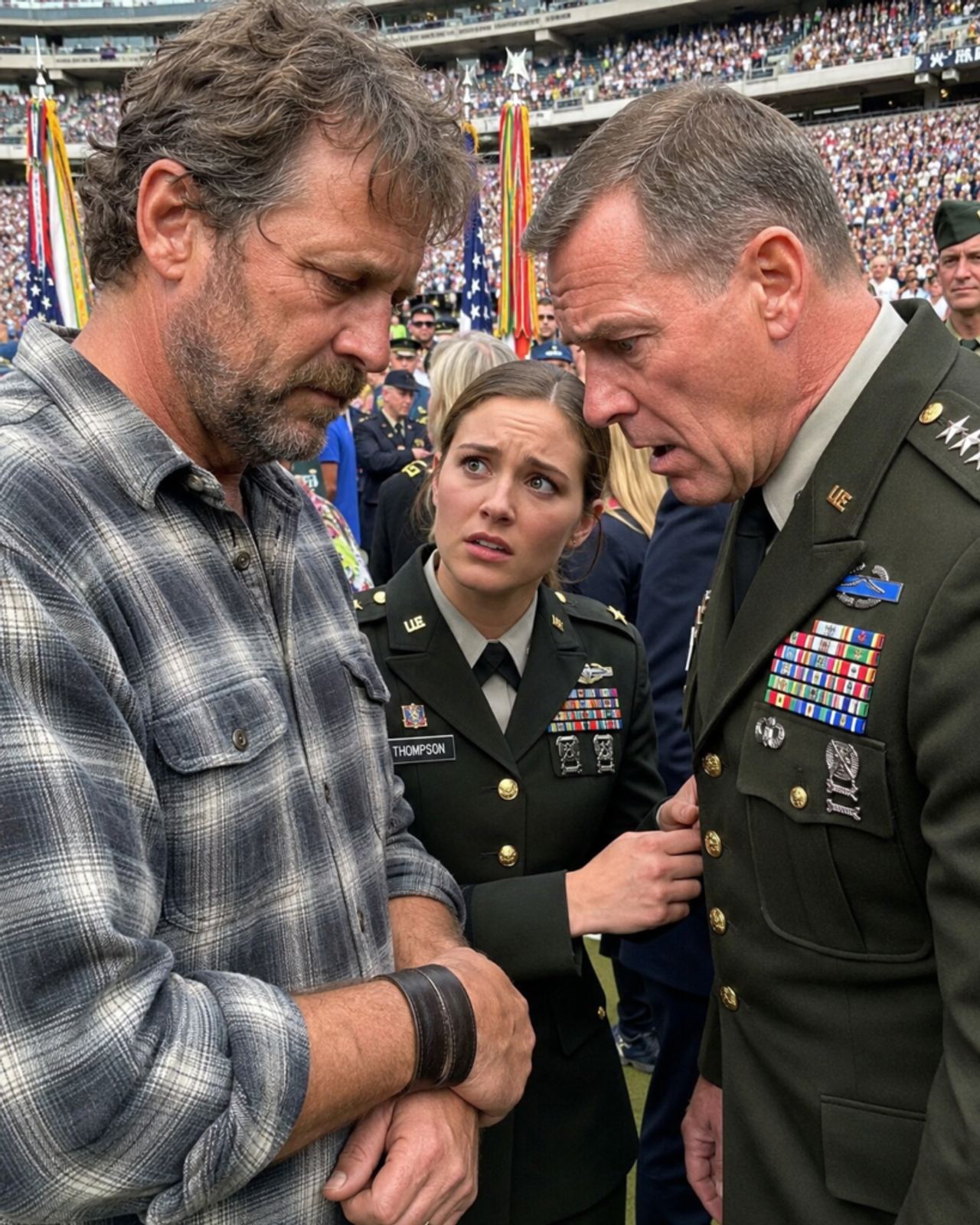
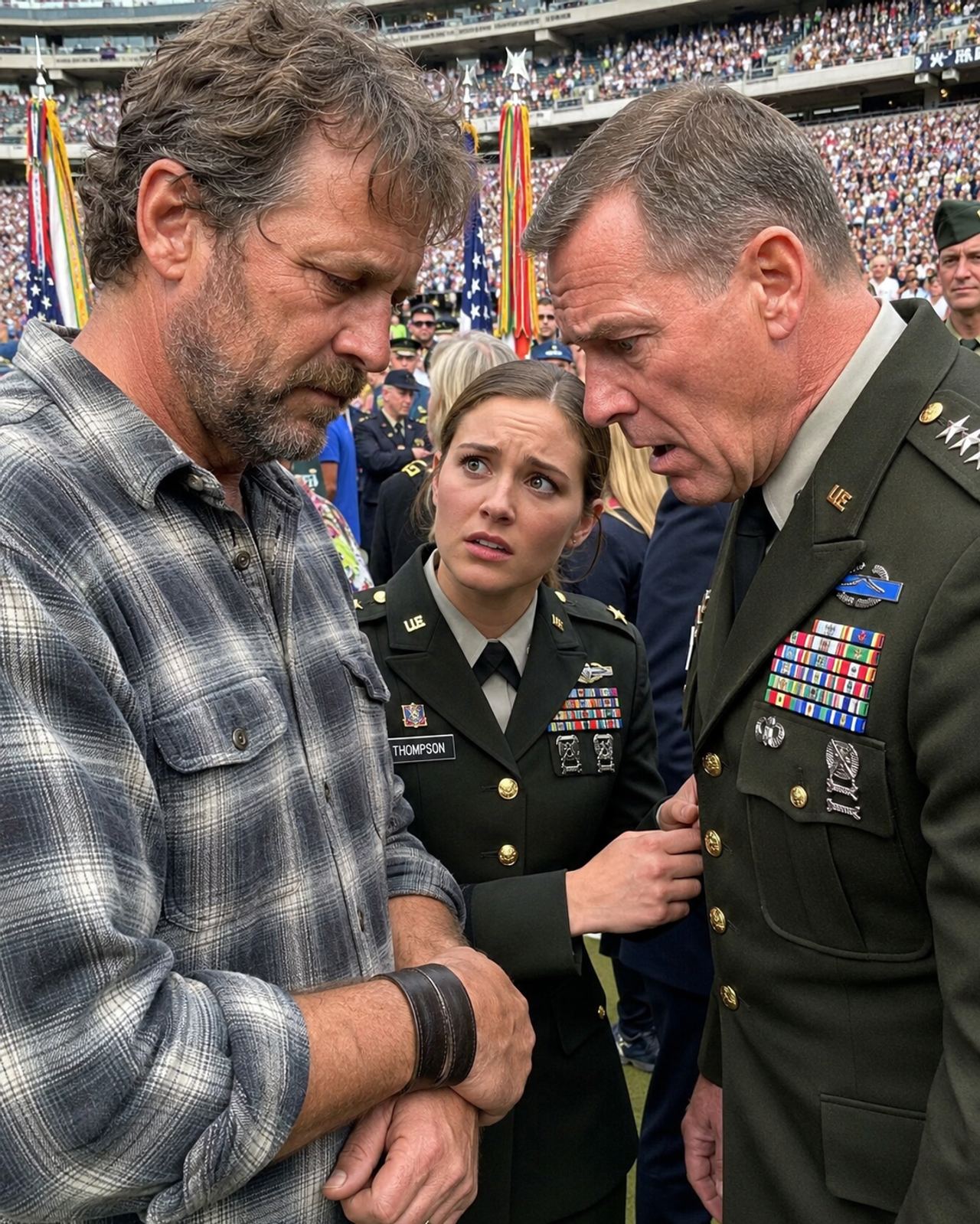
It thinned the moment Lieutenant General Daniel Mercer said my name like it belonged in a file he had locked away years ago. Emma’s hand stayed locked around my arm.
Not tight enough to hurt, but tight enough to remind me she could feel the shift in the air too.
The way thousands of people had gone from casual curiosity to silent attention in a matter of seconds. Mercer didn’t look at the crowd anymore.
He didn’t look at the cadets.
He looked at the wristband on my arm like it was a missing piece of something he had spent his life trying to finish understanding. The leather was old.
Cracked from heat and time.
The stitching uneven in one section where I had repaired it myself years ago with whatever thread I could find in a field kit.
Most people saw an outdated piece of junk. But Mercer’s expression said something else entirely. Recognition. And fear. “You’re not supposed to be here,” he repeated, softer now, like the words had less to do with me and more to do with his own memory failing him. I swallowed.
My throat felt like sandpaper.
“I’m here for my daughter’s commissioning.” Emma looked up at me at that exact moment, like she was trying to reconcile two versions of me she had never been forced to compare before.
The truck driver who missed birthdays because of deadlines.
And the man standing in front of a general who looked like he had seen a ghost. Mercer finally moved.
Not away.
Closer. His voice dropped so low I almost didn’t hear it over the distant wind moving across the stadium. “That band…” he said again.
“Where did you get it, Mr.
Carter?” A ripple went through the nearby seats.
Someone whispered something about intelligence.
Someone else said the word classified without knowing why. I looked down at the leather band.
I had stopped thinking of it as anything special years ago.
It had survived too much to be meaningful in any simple way.
Sandstorms.
Engine fires.
Nights where I didn’t know if the convoy behind me was still intact. It had been given to me in a place I never talked about unless I had to. But Mercer’s face told me he already knew part of the answer. His hand rose slightly, then stopped halfway as if he wasn’t sure whether he was still allowed to touch the past standing in front of him. “That pattern,” he said, voice breaking just enough for the nearest officers to hear.
“Only one logistics recovery unit used it in-theater… and they were marked as lost after the convoy incident outside Al-Qaim.” The stadium didn’t move.
Not a single flag.
Not a single camera flash. Emma’s breath caught beside me. Mercer finally looked up from my wrist and into my eyes. And what he said next made the entire front row go completely still.
PART 3
“That was my unit,” Mercer said softly, his voice trembling under thirty years of polished military discipline. “We were pinned down in the dry creek bed outside Al-Qaim. Command wrote us off. No air support. No heavy armor. They told us over the radio that logistics couldn’t reach us.”
The silence in the stadium was absolute. Thousands of families sat frozen, staring at a three-star general who had completely abandoned his podium to stand before a man in a grease-stained flannel shirt.
Mercer’s eyes brimmed with unshed tears. “Three fuel trucks pulled through the smoke in the middle of a mortar barrage. No escort. Just three rigs smashing through the barricades. The driver in the lead truck blew his tires, drove on the bare rims, and hauled us out one by one while taking small-arms fire. He gave us his extra supplies, his water, and his own leather rig strap to bind my sergeant’s shattered leg.”
Emma’s hand tightened around my arm until her knuckles turned white. She looked up at me, her mouth slightly open, trying to connect the father who struggled to pay for her textbooks with the phantom hero in the general’s story.
“We tried to find that driver after the evacuation,” Mercer continued, his voice echoing slightly against the concrete stands. “The file was sealed. Classified under a logistical burn order. No names. No medals. Just a line item that read ‘Equipment Lost in Transit.’ For twenty-five years, I thought that driver died in the desert.”
“I didn’t die,” I said softly, my voice raspy from thousands of miles of road dust and cheap cigarettes. “I just bought a rig and went back to work.”
Mercer stared at me, the years peeling away from his face. Then, slowly, deliberate as an iron beam settling into place, he stepped back.
He didn’t care about the news cameras rolling. He didn’t care about the brass sitting behind him or the protocol he was shattering into a thousand pieces.
Lieutenant General Daniel Mercer stood at rigid attention, threw his head back, and brought his right hand up to his brow in a crisp, razor-sharp salute.
“Sir,” Mercer said, his voice carrying across the silent field. “Permission to finally thank the man who gave me my life.”
PART 4
The sight of a three-star general saluting an old truck driver sent a shockwave through the crowd. Murmurs erupted like wind through dry grass. Cameras flashed in blinding white bursts.
Emma stood frozen beside me, staring at the high-ranking officer whose hand remained locked at his forehead. She slowly turned her head to look at me, her eyes filled with a mixture of awe, confusion, and a deep, aching heartbreak.
“Dad…” she whispered, her voice cracking. “Why didn’t you ever tell me?”
I looked down at her polished shoes, then at my own scuffed, steel-toed boots.
“Because that wasn’t a life I wanted you to carry, Emma,” I said softly, keeping my voice low so only she could hear. “When I came back from that war, the government didn’t offer a parade. They offered a signature on a non-disclosure agreement and a small check that barely covered two months of rent. They said the mission didn’t exist. If it didn’t exist, neither did my injuries, my nightmares, or my pension.”
A heavy drop of rain fell from the darkening gray sky, landing squarely on the cracked leather band around my wrist.
“I had a choice back then,” I continued, tears finally welling up in my eyes as the decades of hidden pain bubbled to the surface. “I could spend the rest of my life fighting a government that wanted me forgotten, or I could drive eighteen hours a day to make sure my little girl had food on her table and a fair shot at a life better than mine. I chose you, Emma. Every mile I drove in that old Freightliner… every broken radiator, every sleepless night on the shoulder of Interstate 80… it was all to keep you safe from the dark.”
Emma lowered her head, a silent sob catching in her throat. The proud young Army officer, who five minutes ago stood straight as a ramrod, leaned into my shoulder and squeezed my waist like she used to when she was eight years old.
General Mercer lowered his salute slowly, looking at the two of us. The anger and regret in his eyes were unmistakable—not toward me, but toward a system that used men like me and threw them into the shadows when the dust settled.
“Mr. Carter,” Mercer said, stepping closer and speaking with low, fierce determination. “They swept your sacrifice under the rug to cover up an intelligence failure. But I am the Deputy Chief of Staff now. And I swear on my rank, your story ends today.”
PART 5
The ceremony did not resume as planned. Protocol had been completely shattered, but no one moved to stop it.
General Mercer walked back up to the stage, took the microphone, and looked out over the sea of young officers and their families. His voice was no longer that of a stoic commander reading a scripted speech; it was the voice of a man clearing a debt twenty-five years overdue.
“Today, we honor the new leaders of our military,” Mercer spoke into the microphone, his voice reverberating through the stadium speakers. “But a leader who forgets the shoulders he stands on is no leader at all. Today, we are joined by a veteran who was erased from the history books. A man who drove through hell without a uniform, without a weapon, and without a guarantee of coming home, just so thirty seven soldiers—including myself—could draw breath today.”
Mercer pointed directly toward our section.
“Cadet Emma Carter,” Mercer commanded, his voice booming. “Bring your father to the platform.”
The crowd erupted into applause—a deafening, roaring thunder of stomping feet and cheering that shook the stadium walls. Emma took my hand, her grip strong and proud, and led me down the concrete steps toward the stage. My old flannel shirt felt completely out of place among the gold braid and polished brass, but as I walked, officers left and right stood up and snapped into salutes as I passed.
When we reached the stage, General Mercer unpinned a bronze star with a V-device for valor from his own dress uniform jacket—a medal he had kept in his pocket for decades, waiting for a ghost he never thought he’d see again.
He pinned it directly onto the faded flannel over my heart.
“It’s not official yet, John,” Mercer whispered to me, calling me by my first name for the first time. “But by tomorrow morning, the Secretary of the Army will have your corrected file on his desk. You will get your recognition, your pension, and your honor back.”
I looked at the heavy bronze metal resting on my chest, then turned to look at Emma. She was crying openly now, but her chin was held high, filled with an overwhelming pride that no military honor could ever match.
“I didn’t need the medal, General,” I said, my voice thick with emotion as I looked into my daughter’s eyes. “I just needed her to see that her dad did the best he could.”
Emma stepped forward, wrapped her arms around my neck, and whispered into my ear, “You were always my hero, Dad. Now the whole world knows it.”
As the afternoon rain began to fall steadily over the stadium, I didn’t feel the cold or the ache in my tired joints. For eighteen hours I had driven an old, clanking Freightliner down a long, dark road just to watch my daughter graduate.
I came as an invisible man. But as I stood under the stadium lights with my daughter’s arm locked in mine, I knew the long drive was finally over. I was finally coming home.