
Stories
She Found Her Son At The Door, Then The Paramedic Recognized Her Brother
A mother returns home from a year-end party to find her son injured on the floor, only to discover her brother and parents have been abusing him. As the truth unfolds, a paramedic’s reaction helps reveal a much deeper family secret involving a stolen child and a decades-old kidnapping.

AT THE END OF MY COMPANY’S YEAR-END PARTY, I came home to find my son collapsed at the door.
Then a paramedic looked at my brother and went pale.
The last song from the party was still thudding somewhere inside my ribs when I pulled into the driveway.
I remember the sound of my tires over the thin crust of frost near the curb.
I remember the porch light buzzing above the door.
I remember thinking I should have skipped the party, because my feet hurt and the cheap champagne had left a sour taste in my mouth.
My company badge was still hanging from my neck.
My lipstick had faded into a tired pink line.
The paper grocery bag I had forgotten in the SUV was slumped against the passenger seat, and the little American flag Eli had brought home from school was still tucked in the porch planter beside the front steps.
Everything looked ordinary.
That was the cruelest part.
The key slid into the lock, and the house opened into silence.
Not the good silence of a sleeping child.
A wrong silence.
The kind that seems to be holding its breath.
I stepped inside, shut the door behind me, and my heel landed on something soft.
I looked down.
My son was on the floor.
Eli was nine years old, all elbows and questions, the kind of boy who saved interesting rocks in his coat pockets and asked if clouds had shadows on the inside.
That night, he was crumpled near the front door like the house itself had rejected him.
His cheek was pressed against the tile.
One hand was curled near his throat.
His breathing was shallow.
There was a bruise spreading along his jaw that had not been there when I kissed him goodbye that morning.
My clutch hit the floor so hard the clasp snapped.
“Eli.”
The sound that came out of me did not feel like my voice.
It felt older.
Rougher.
I fell to my knees and touched his shoulder.
Warm.
Thank God, warm.
But limp.
Terribly limp.
“Baby, open your eyes. Eli, look at me.”
His lashes fluttered.
He made the smallest broken noise.
Then I felt it.
Someone was watching us.
I lifted my head.
My brother Ryan was leaning against the hallway wall with one ankle crossed over the other, arms loose at his sides, wearing the expression he had worn my whole life when other people became inconvenient.
Half bored.
Half amused.
Like my son was a spilled drink someone else should mop up.
“About time,” he said.
For a second, my brain refused to understand words.
Then my parents stepped out from the living room.
My mother still had a mug in her hand.
My father looked composed, almost formal, as if he were standing in a church hallway and not in my entryway while his grandson lay injured at my knees.
I looked at Ryan.
“What did you do?”
He shrugged.
It was lazy.
Practiced.
“Just disciplined him.”
My mother’s voice came cool and sharp behind him.
“He deserved it.”
Eli whimpered.
Something in me moved.
Not anger.
Worse than anger.
Clarity.
I had spent most of my life being trained to doubt myself before I doubted them.
When Ryan took something from me as a child, I was told I should have shared.
When he lied, I was asked what I had done to upset him.
When he hurt people, my parents called it strength.
When I cried, they called it weakness.
A family can teach you to apologize for bleeding on the floor.
Motherhood untaught me in one breath.
I reached into my purse and dialed 911.
My mother’s eyebrows lifted.
“Who are you calling?”
“Help,” I said.
Ryan pushed himself off the wall.
“Don’t be ridiculous. He’s fine.”
I did not look at him.
“No, he’s not.”
The operator answered.
I gave my address.
I said my child was unconscious, bruised, and breathing shallowly.
I said it clearly.
I said it like I was already reading the first line of a police report, because I knew my family was listening for hesitation they could turn into a story later.
Behind me, Ryan softened his voice.
“Hannah, you’re overreacting. You don’t know how to raise a boy. Somebody has to be firm.”
That old line landed exactly where he meant it to land.
He had been dressed up as necessary my entire life.
Necessary correction.
Necessary honesty.
Necessary cruelty.
Men like Ryan love the word firm because it sounds cleaner than what they really mean.
For one ugly heartbeat, I wanted to turn and put my hands on him.
I pictured it.
I pictured him on the floor instead of my son.
Then Eli’s breath hitched under my palm, and I stayed where I was.
I counted.
One breath.
Then another.
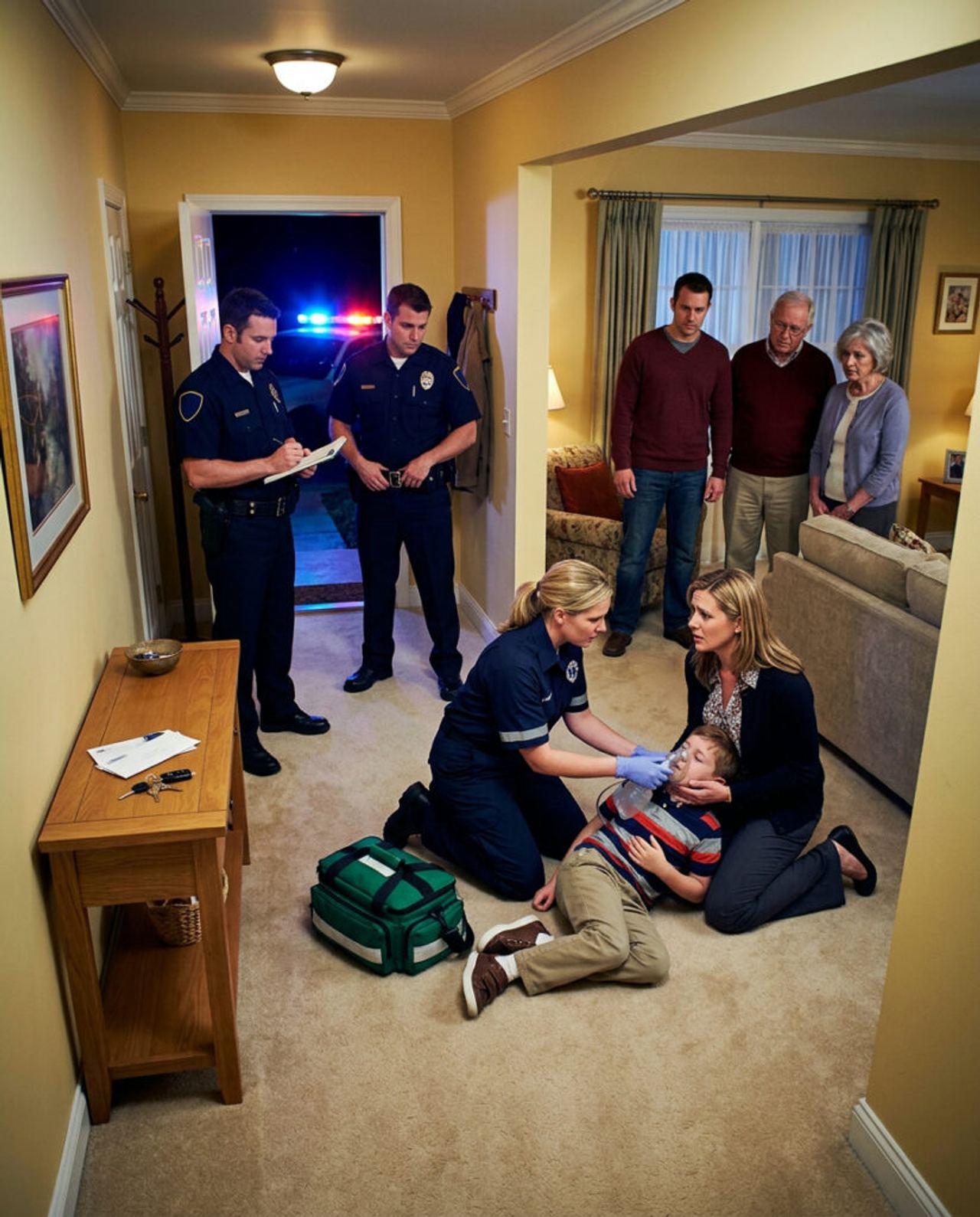
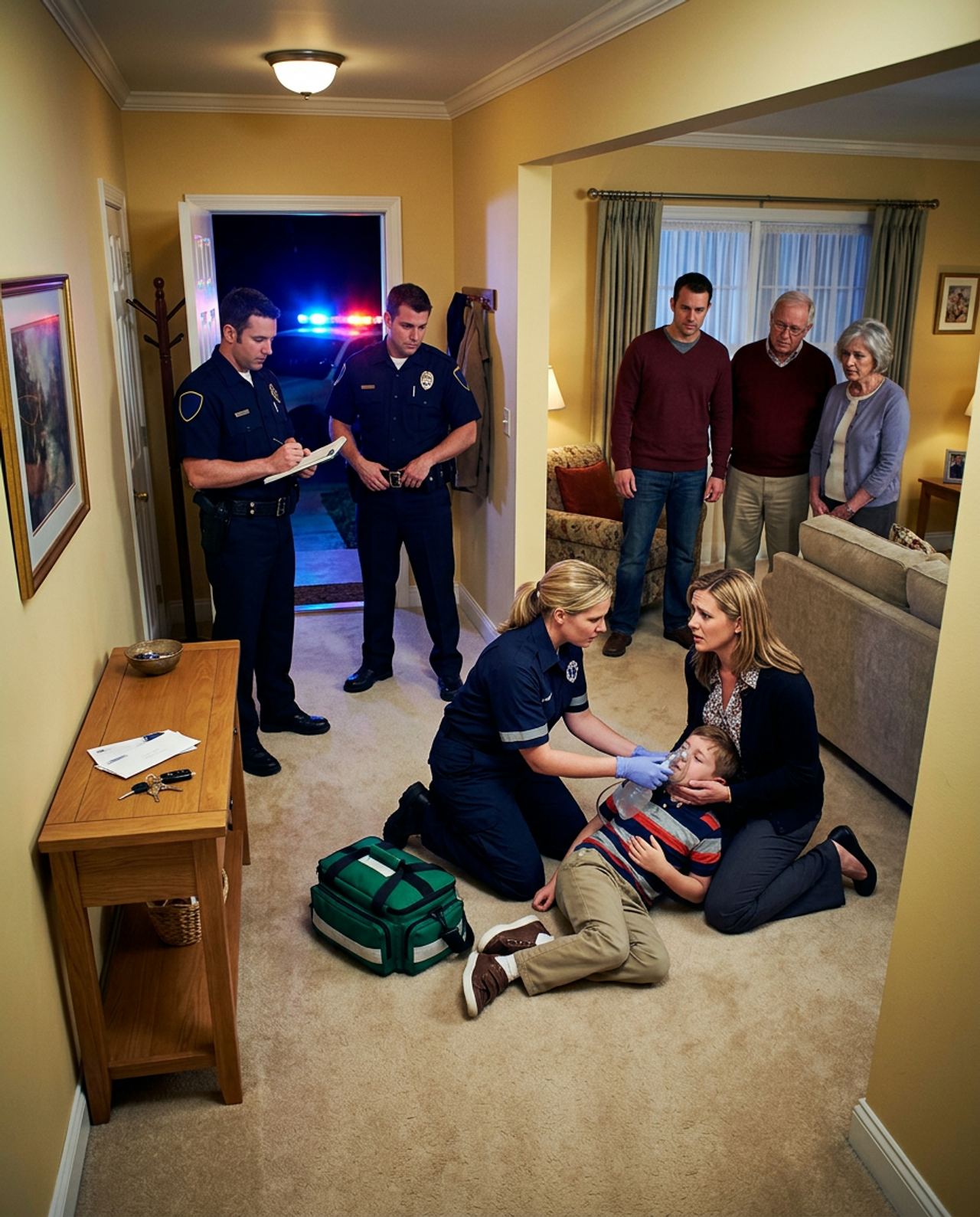
The sirens came too fast and too slow.
Red and blue light washed across the front windows.
Two paramedics came in with a police officer behind them.
One paramedic was a woman with calm hands and a low voice.
She dropped beside Eli immediately.
The other was a man with tired eyes, a trimmed beard, and the kind of focus that made everyone in the room feel suddenly less important than the child on the floor.
He checked Eli’s pulse.
He lifted his eyelids.
He pressed carefully along his ribs.
Eli made a sound that tore through me.
Then the male paramedic looked up.
His eyes landed on Ryan.
He froze.
It lasted less than a second.
But I saw it.
Recognition.
Not curiosity.
Not uncertainty.
Recognition so sharp it drained the color out of his face.
Ryan went still too.
So did my father.
My mother’s hand tightened around her mug.
The female paramedic fitted oxygen over Eli’s mouth.
The male paramedic leaned closer to me.
“Ma’am,” he whispered, “is that really your brother?”
I stared at him.
“Yes.”
His throat moved.
He looked at Ryan again.
This time, there was something almost like fear in his eyes.
“Because actually…”
He stopped himself.
“No. Never mind. We need to move your son now.”
Ryan’s face changed.
For the first time all night, the bored amusement left him.
At the hospital, the words became official.
Concussion.
Bruising.
Fractured rib cartilage.
A nurse used the phrase non-accidental trauma in a careful voice, the kind adults use when they know the truth is too heavy for a hallway.
The hospital intake desk took my statement at 12:31 a.m.
A police officer took another at 1:08 a.m.
A social worker wrote down Ryan’s name, my parents’ names, and the sentence my mother had said like she was reciting a recipe.
He deserved it.
I sat beside Eli’s bed and watched the monitor count his heartbeat back to me one beep at a time.
Around three in the morning, I remembered the cameras.
Months earlier, after Eli started flinching whenever Ryan’s car pulled into my driveway, I had installed two small cameras in the hallway and living room.
I told myself it was for peace of mind.
That was not the truth.
The truth was that some part of me had started suspecting what the rest of me was too frightened to name.
I opened my laptop in the hospital room.
The Wi-Fi was weak.
My hands were shaking.
The hallway footage loaded one frozen square at a time.
There was Ryan letting himself into my house with the spare key my mother had insisted family should have.
There was Eli coming around the corner.
There was Ryan saying something I could not hear.
Then his hand moved.
The first slap was calm.
That was the part that made me sick.
Not rage.
Not chaos.
Cruelty wearing patience like a clean shirt.
Eli’s head snapped sideways.
Ryan hit him again.
Then shoved him.
Then grabbed him by the arm and dragged him toward the door while my son folded inward, small and terrified and already trying to survive.
I watched it once.
Then again.
Because my brain kept trying to reject what my eyes had already accepted.
Love did not die in me that night.
It drained out quietly.
Completely.
When Eli woke the next morning, his first glance was not at me.
It was at the door.
“Mom,” he whispered.
“I’m here.”
His lips trembled.
“Is Uncle Ryan coming?”
The relief that crossed his face when I said no made me feel sick in a new way.
I took his hand carefully because of the IV.
“Has he hurt you before?”
Tears slid into his hairline.
He nodded once.
“Sometimes,” he whispered.
My whole body went cold.
“When?”
“When you were at work. Grandma said it was for my own good. He said if I told you, you’d get mad at me. Like she does.”
That was the moment the lie I had been living inside lost all its air.
This had not started at the year-end party.
That night was only the first time I came home early enough to interrupt it.
The hospital social worker came back.
Then the police returned.
I gave statements.
I handed over the footage.
I repeated Ryan’s words.
I repeated my mother’s words.
I said everything out loud this time.
At 9:42 a.m., the footage was copied and logged.
At 10:16 a.m., I signed the release form for the hospital records.
At 11:03 a.m., the police report number was written on the back of a card and placed in my palm.
Paperwork sounds cold until it becomes the first wall between your child and the people who hurt him.
Then paperwork becomes mercy.
But I could not stop thinking about the paramedic.
His reaction had not been random.
He had looked at Ryan the way people look at a face from a missing poster that has somehow stepped into the room alive.
While Eli slept, I started pulling at old threads.
There had always been holes in my family story.
A missing year in old photo albums.
An aunt who once drank too much wine at Thanksgiving and asked whether I had ever noticed how little Ryan looked like the rest of us.
My mother’s rehearsed smile whenever someone joked that one child seemed to belong to another family.
My parents never told Ryan’s birth story.
They had lines instead.
He was perfect from the beginning.
He was meant for us.
God gave him to us when we needed him.
Lines are what people use when the truth has edges.
I called my Aunt Celia.
The minute I told her Ryan had put Eli in the hospital, she went quiet.
Then she said, “Oh God. So it finally reached a child.”
My fingers went numb around the phone.
“What do you mean finally?”
She breathed shakily.
“Your mother lost a baby before Ryan. Or said she did. The timeline never made sense. She disappeared for months. Your father bullied everyone into silence. Then suddenly there was a baby, and no one was allowed to ask questions.”
I could barely speak.
“Are you saying Ryan might not be…”
“I’m saying your parents built their lives around secrets,” she said. “And secrets don’t stay buried. They just wait for a child to get hurt.”
That afternoon, the paramedic found me at the hospital.
His name was Mark.
He stood in the doorway with his cap in his hands, looking like a man who had argued with himself for hours before walking in.
“I need to tell you why I reacted the way I did,” he said.
We stepped into a quiet consultation room.
There was a faded map of the United States on one wall and a coffee machine that smelled burnt and overworked.
Mark told me that years earlier he had worked as an EMT in the next county.
There had been a case everyone remembered.
A newborn boy taken from a hospital in the middle of the night.
A security failure.
A nurse investigated.
No conviction.
A mother who never stopped looking.
For years, the county circulated age-progressed images.
“When I saw your brother,” Mark said, “I thought I was looking at one of those images grown up.”
My mouth went dry.
“Do you remember the baby’s name?”
He nodded.
“Noah Turner.”
The room seemed to tilt.
A nurse.
Money.
A missing baby.
A mother who never stopped looking.
That night, while Eli slept, I searched old articles.
Noah Turner had been abducted in March from a hospital less than twenty miles from where my parents were living at the time.
Ryan’s birth certificate said May.
Two months.
Two months is nothing on a calendar.
It is everything in a lie.
The next morning, I brought everything to Detective Alvarez.
The footage.
Aunt Celia’s account.
Mark’s statement.
The old article.
The timeline.
The detective listened without interrupting.
The more I talked, the less impossible it sounded.
His expression sharpened with every detail.
“We can pursue the assault immediately,” he said. “And we will start digging into the identity question.”
I nodded.
“Do it.”
That night my mother came to my porch with my father waiting in the car.
She still expected me to open the door because she was my mother.
I did not.
She stood under the porch light in her wool coat, eyes red but spine perfectly straight.
“Hannah, we need to talk.”
“No,” I said through the locked door. “You need to leave.”
Her face tightened.
“Ryan was correcting him. Boys need discipline.”
“He fractured my son’s ribs.”
My father stepped out of the car as if his presence still had the power to change the temperature.
“You’re making a spectacle,” he said. “Dragging police into family matters.”
I laughed.
There was nothing warm in it.
“You made it a police matter when you let a grown man beat a child in my house.”
My mother lowered her voice.
“You can’t keep Eli from us.”
“Watch me.”
Then I said the thing I had never said aloud before.
“You don’t know what love is. You know possession.”
My father’s face changed.
The mask slipped.
“If you continue with this,” he said softly, “you’ll regret it.”
The old threat.
The old family language.
Only this time, it did not work.
I lifted my phone and told him I had cameras, copies, hospital records, a police report, and a protective order in progress.
He looked at me as if I had become a stranger.
He was right.
The arrest happened on a Tuesday.
Detective Alvarez called and said they were at my parents’ house with a warrant related to the assault and possible falsified records.
I drove there because I needed to see the beginning of the end with my own eyes.
My mother was in the doorway, pale with fury.
My father stood behind her like a man trying to hold up a collapsing wall by glaring at it.
Ryan was visible through the front window, arms crossed, smiling as if all of this were beneath him.
Then the officers led him out.
He saw me and mouthed one word through the glass before the door opened.
Traitor.
The officer read him his rights.
Ryan scoffed at first.
Then he saw Mark standing near one of the patrol cars, giving a formal statement.
Fear tightened around Ryan’s eyes for the first time in my life.
My mother lunged forward.
“He’s our son!”
Detective Alvarez did not raise his voice.
“That remains to be seen.”
Something in the air changed when he said that.
Even my father stopped moving.
Over the next week, the investigation widened.
A retired nurse’s name surfaced.
Old hospital logs were requested.
Neighbors were interviewed.
A sealed record led to another sealed record.
Then Detective Alvarez found Lydia Turner.
Noah’s mother.
She was alive.
She had spent decades carrying grief like a second skeleton.
She agreed to meet me before agreeing to the DNA testing.
We sat in a coffee shop halfway between our towns, two women connected by a theft neither of us had committed.
She was smaller than I expected.
Tougher too.
Her hands shook only once, when she wrapped them around her paper cup.
“You’re telling me the man who hurt your son may be the baby they stole from me,” she said.
“Yes.”
She closed her eyes.
When she opened them again, they were wet but steady.
“Then your boy saved the truth by surviving it.”
I did not know whether to cry or apologize.
Instead I told her everything.
About Eli.
About the footage.
About the way my family called violence discipline.
About Ryan growing up adored, defended, untouchable.
Lydia listened without interrupting.
When I finished, she asked one question.
“Was he ever kind?”
I thought about Ryan carrying me on his back when we were children.
I thought about him telling me family was the only safe place in the world.
I thought about how easily he had become my parents’ weapon.
“Sometimes,” I said. “But I don’t know anymore whether it was kindness or practice.”
The DNA samples were taken three days later.
While we waited, Eli came home from the hospital.
He slept in my bed.
He started therapy.
He asked careful questions in a careful voice, the kind children use when they are trying not to break their mother’s face open with honesty.
“Are Grandma and Grandpa mad?” he asked one night.
“Yes,” I told him. “But that’s not your problem anymore.”
He looked at me for a long time.
“You picked me.”
That nearly destroyed me.
“Always,” I said.
Three weeks later, Detective Alvarez came to my kitchen table with a folder and a face that told me my life was about to split open again.
He sat down slowly.
He placed the file between us.
Before he even spoke, I saw the name typed across the top page.
Not Ryan.
Noah Turner.
The DNA confirmed what my parents had buried for decades.
Ryan was Noah.
My brother was not my brother by blood.
He was a stolen child raised inside a house that had confused possession with love so completely that they taught him to confuse force with family.
The assault case moved first.
The identity investigation moved slower, because old crimes leave behind old paper and older fear.
My parents were questioned.
Records were pulled.
The retired nurse’s connection to them became harder for anyone to explain away.
I wish I could say one folder fixed everything.
It did not.
Lydia did not get her baby back in any simple way.
Ryan did not become gentle because the truth had a different name for him.
My parents did not suddenly understand what they had done.
But Eli slept with the door open again.
Then, months later, he slept with it closed.
That was the real victory.
Not dramatic.
Not public.
Just a child deciding that a door could mean privacy instead of danger.
I kept the little American flag in the porch planter long after the paper edges faded.
Eli had put it there after school because he said every house should have one thing outside that means somebody is supposed to be safe inside.
For a while, I could not look at it without crying.
Now I look at it when I need to remember what happened in that entryway.
A family can teach you to apologize for bleeding on the floor.
Motherhood untaught me in one breath.
And when my son whispered, “You picked me,” I knew the rest of my life would be built around proving him right.
Read more stories
- For six months, I cared for a man every doctor believed would never wake up.
- I smiled when my son told me I wouldn’t be joining them for Christmas, got
- A Boy Crawled Seven Blocks To Save His Sister From Their Stepmother
- MILLIONS KNEW ROY CLARK’S SMILE. BUT THE WOMAN WHO KNEW THE MAN BEHIND IT HAD BEEN BESIDE HIM FOR 61 YEARS.