
Human Stories
Seven Months in the Attic—And the Phone They Never Found
A pregnant woman is trapped for months in her attic by her husband and mother-in-law, who abuse and livestream her suffering to a private audience. She quietly gathers evidence, finds help, and sets in motion a confrontation that exposes their crimes.

The attic had one small window, one folding chair, and enough cardboard boxes to make the room look temporary.
Nothing about Elena’s life up there was temporary.
By the time she was twenty-nine weeks pregnant, she knew every nail head in the unfinished floor, every place the insulation sagged, and every hour the late-afternoon light crossed the rafters.
She also knew exactly how long it took her mother-in-law to climb the stairs.
Marlene’s right knee made her pause on the landing.
Darren’s steps were faster and heavier, especially when he was carrying the phone he used to film.
Elena learned those sounds because sound was sometimes the only warning she received.
For seven months of her pregnancy, Marlene controlled what went into her body through a feeding tube.
Some days the mixture smelled sour before it even reached Elena.
Other days Marlene crushed pills into it and refused to say what they were.
Once, when Elena vomited blood into a towel, Marlene laughed and Darren kept filming.
Darren recorded the sessions for a private online audience he called their “humiliation channel,” a name he used with the casual pride of someone showing off a new hobby.
He would carry his phone upstairs, prop it against a chipped jewelry box on an old dresser, and check the angle.
Then he would watch the screen until the first viewers arrived.
Tiny laughing icons floated up beside Elena’s face.
“Smile for them,” Marlene would say.
Elena stopped asking why they were doing it.
Questions gave them more material.
Fear gave them more material.
Crying gave them more material.
So she learned to make her expression flat and still, even when the tube hurt and even when her stomach turned.
She kept one hand near her belly whenever she could.
Her son kicked most often in the evenings, around the same time Darren began filming.
Sometimes that movement gave her strength.
Sometimes it terrified her because it reminded her that she was not the only person trapped in the room.
Before the attic, Elena had worked as a nurse’s aide.
Her job had taught her to notice what other people missed: a patient breathing faster than usual, a hand that suddenly felt cold, a voice that became too quiet.
She knew how to write down pain without making the person feel like pain was all they were.
That training became the only structure she had left.
After Darren took her wallet and Marlene took her car keys, Elena began charting her own days.
She used the back of a torn prenatal pamphlet she found beneath a box of newborn clothes.
She did not write down every act because she was afraid they would find it.
Instead, she made one short line for each day that passed.
Sometimes she added a single letter.
S for sour.
P for pills.
C for camera.
The marks were not enough to prove everything, but they proved that time was moving.
That mattered on the days when the attic seemed outside ordinary life.
Marlene called the room Elena’s “quiet suite.”
She said it in front of neighbors, church friends, and anyone who asked why Elena had stopped answering messages.
According to Marlene, pregnancy had made Elena fragile.
According to Darren, his wife needed rest and did not want visitors.
They told people Elena had become anxious, confused, and dramatic.
Every lie was chosen carefully because each lie made the next one easier to believe.
Darren had not always spoken to her that way.
When Elena first met him, he seemed attentive in small, practical ways.
He brought coffee to her during double shifts.
He remembered which brand of crackers settled her stomach.
He waited in the parking lot after work when the weather was bad.
Those memories became dangerous after the attic door started locking from the outside.
They tempted her to search his face for the man she thought she married.
He was never there.
The Darren who climbed the stairs each evening cared more about the number beside the viewer icon than the woman in the chair.
Marlene cared about the baby.
At least, that was what she called it.
She bought boxes of clothes months before Elena’s due date.
She folded tiny sleepers and arranged them by size.
She talked about feeding schedules, nursery colors, and which family traditions the child would follow.
She rarely asked Elena how she felt.
When she did, the question sounded like a test.
The grandchild was treated like a possession that happened to be growing inside someone Marlene had decided she could control.
The room reflected that belief.
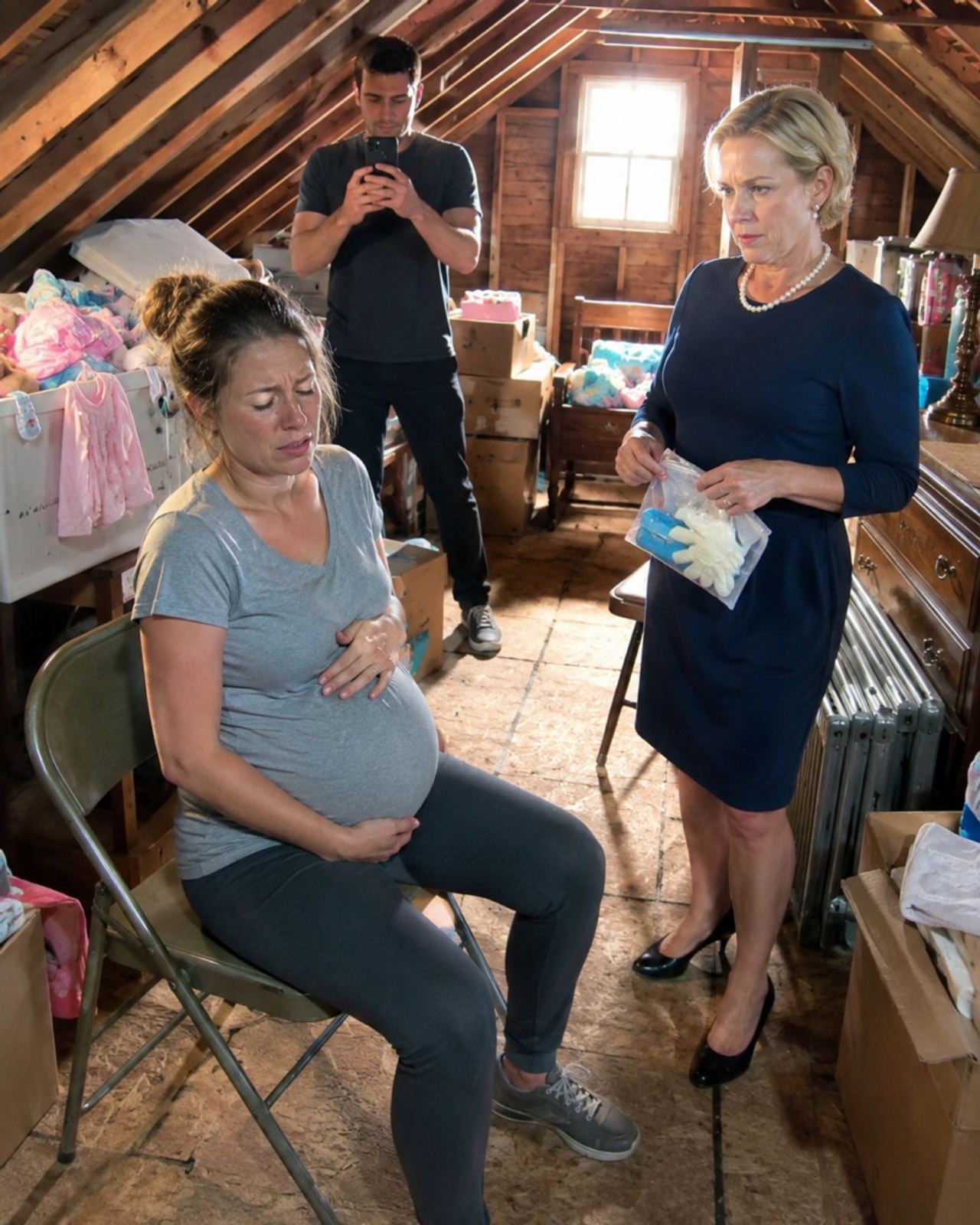
Baby clothes filled the boxes.
Elena had one thin blanket.
Marlene brought in a folding chair because she did not want Elena lying down during the recordings.
The old dresser held Darren’s phone, the baby monitor, and the supplies used for the tube.
The one small window looked down toward the driveway and the garage.
That window eventually gave Elena her first chance.
A grocery delivery arrived on a gray afternoon while Marlene was downstairs arguing on the phone.
Elena heard a car door close.
She heard paper bags being set on the porch.
Then she saw the driver walk back toward the driveway.
The woman’s name was Paula.
Elena knew because she had seen it on the delivery screen weeks earlier, before Darren took away her access to the household account.
Paula glanced up at the house.
Elena pressed both hands against the attic glass.
For one second, Paula kept walking.
Then she stopped.
Elena mouthed the only word she trusted herself to form clearly.
Help.
Paula’s face changed.
She looked toward the front door, then back toward the window.
Elena could not hear what she said.
Marlene appeared below a moment later and pulled one of the grocery bags inside.
Paula left.
For the rest of that day, Elena did not know whether the woman had understood or whether fear had made the exchange feel more meaningful than it was.
Two days later, another delivery arrived.
Marlene carried the bags upstairs because she wanted baby wipes stored near the boxes.
She complained that the package was heavier than usual.
Elena waited until the attic door locked again.
Inside the wipes was a cheap phone wrapped in a plastic grocery bag.
There was no note.
There did not need to be.
The battery was partly charged.
The sound was off.
A cloud upload page had already been opened.
Elena sat on the floor with the phone in both hands and felt something inside her shift.
The device was not a rescue.
The attic door was still locked.
Marlene was still downstairs.
Darren was still coming home.
But for the first time in months, Elena had control over one decision they did not know about.
She tested the attic carefully.
The strongest signal came from the far corner nearest the garage.
It was weak enough that a page could take minutes to load.
A video might fail several times before sending.
Elena began studying the room with new purpose.
The third floorboard near the dresser creaked.
The vent carried voices from the laundry room.
A loose section of insulation behind a support beam could hide the phone while leaving the camera exposed.
The baby monitor on the dresser was old and unreliable, but its speaker sometimes picked up sound from downstairs when Marlene forgot to unplug the other unit.
Every detail became part of Elena’s plan.
She did not try to call immediately.
A ringing phone would have ended everything.
Instead, she recorded short test clips at night and uploaded them when the Wi-Fi signal held.
The first successful file was only forty-three seconds long.
It showed the attic door opening.
It showed Darren’s phone being placed on the dresser.
It captured Marlene saying, “Do not make this difficult.”
The upload icon blinked.
Then it froze.
Elena thought the connection had failed.
A moment later, the icon turned solid green.
She stared at the screen until it dimmed.
That small green dot meant the file existed somewhere beyond the attic.
It meant the truth was no longer trapped entirely inside her memory.
After that, she recorded every session she could.
She wedged the phone into the insulation gap and angled it toward the folding chair.
The frame caught Marlene’s hands.
It caught the tube.
It caught Darren adjusting his camera.
It caught his jokes and the laughter in his voice.
It also caught the screen names that floated up the side of his livestream.
Elena kept the clips long enough to show patterns.
She wanted more than one terrible night.
She wanted the repetition.
The same chair.
The same commands.
The same private audience.
The same husband pretending that humiliation became harmless when strangers watched it through a screen.
Some recordings were difficult to upload.
The signal failed.
The battery dropped.
Once, Darren came back upstairs unexpectedly because he had forgotten his charger.
Elena had only enough time to slide the hidden phone beneath the torn prenatal pamphlet and cover both with her foot.
He looked at her for several seconds.
“What are you doing?”
“My leg cramped.”
He laughed and told his viewers she was always performing.
Then he left.
Elena waited until she could no longer hear his steps before she moved.
The phone had left a rectangular mark in the dust.
She erased it with her sleeve.
The cruelty worsened because Marlene and Darren believed there would be no consequence.
Marlene became less careful about what she said.
Darren began reading viewer comments aloud.
Some users suggested ways to embarrass Elena.
Others asked whether the baby moved during the sessions.
Elena kept her face still.
She saved every name she could see.
She saved the dates.
She saved the sound of the attic lock.
The evidence gave her hope, but it also created a new danger.
If they found the phone, they would not simply take it.
They would know she had resisted them.
They would know someone outside the house had helped.
They would know the story they had built about her could collapse.
Elena understood that timing mattered.
Her next prenatal appointment was approaching.
Marlene had already said Darren would answer most of the questions.
Elena suspected they planned to keep her from speaking privately with anyone.
She needed the files uploaded before that day.
She also needed one recording clear enough that nobody could dismiss the others as a misunderstanding.
That was why the final Friday mattered.
The afternoon passed slowly.
Marlene moved through the house with unusual energy.
Cabinet doors opened and closed downstairs.
The vacuum ran in the hallway.
Someone used the laundry room, and the baby monitor crackled twice on the dresser.
Elena sat in the folding chair and listened.
Her son kicked beneath her ribs.
She rubbed the spot and whispered that she was still there.
Near sunset, she checked the hidden phone.
The battery was low.
The latest upload had completed.
The icon was green.
She turned the screen dark and returned it to the insulation gap.
Then she heard Marlene on the stairs.

The pause came at the landing.
A moment later, the attic door opened.
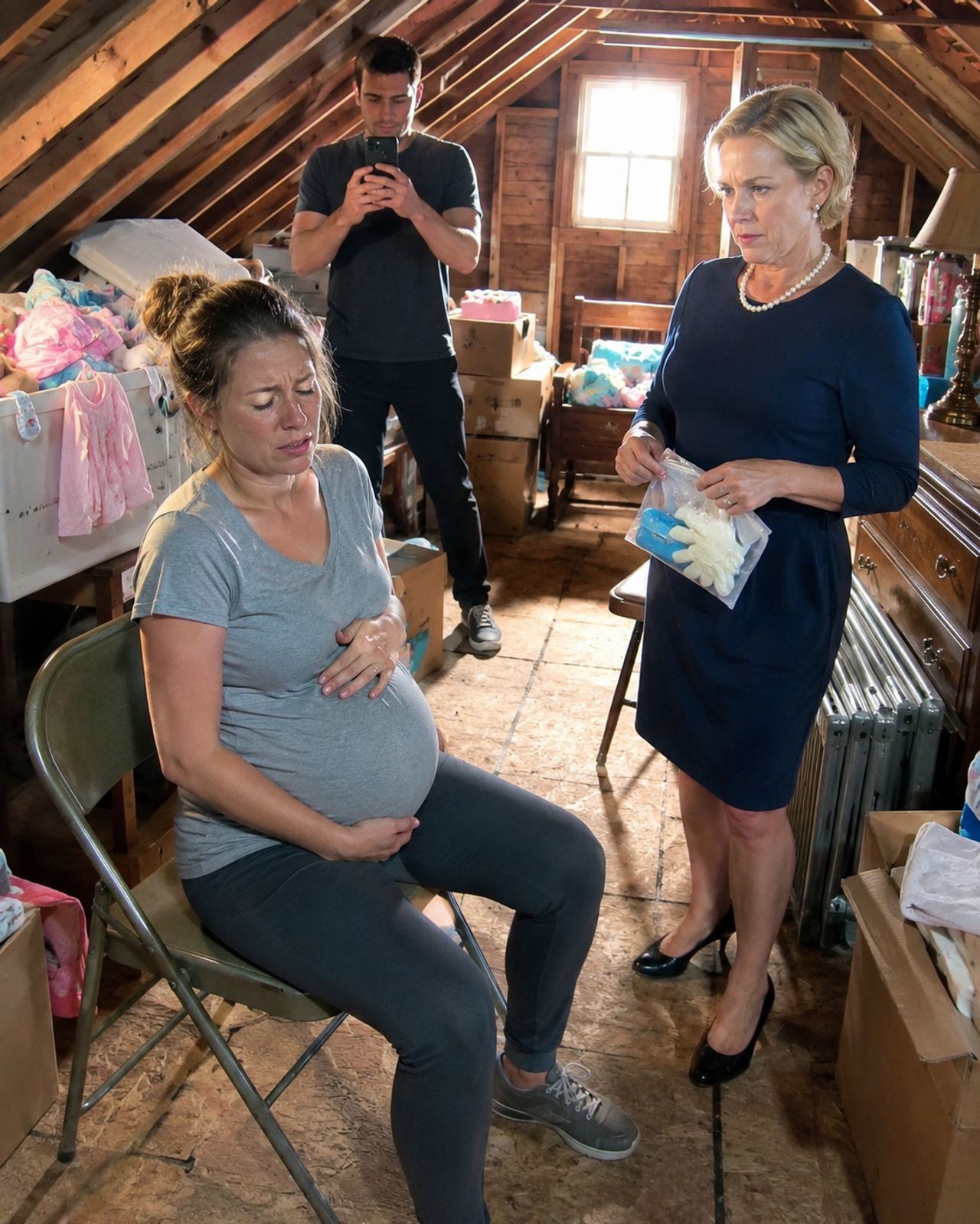
Marlene stepped inside wearing lipstick, church pearls, and a pressed navy dress.
The outfit made Elena’s stomach tighten.
Marlene dressed carefully when she expected to be seen.
Darren came in behind her with his phone already raised.
The livestream had started before he entered the room.
The screen glow lit his fingers.
Viewer icons appeared almost immediately.
“Tonight is the finale,” he said.
The word landed harder than anything else he had said.
Elena did not know exactly what Darren meant by it.
She knew only that his excitement was real.
Marlene placed the supplies on the dresser.
Her movements were deliberate.
She rolled the feeding syringe between her fingers and glanced toward Darren’s phone as though checking whether the audience had a clear view.
Elena felt her son kick hard.
She covered the movement with her palm.
For seven months, she had survived by giving Marlene and Darren as little reaction as possible.
She had lowered her eyes.
She had swallowed words.
She had kept her breathing even while their viewers laughed.
That night, survival required something different.
Marlene leaned close.
Her perfume filled the space between them.
“After this,” she whispered, “nobody will believe a word you say.”
The sentence was meant to break the last thing Elena still owned.
Instead, it clarified the choice in front of her.
The files were uploaded.
The hidden phone was recording.
The baby monitor was still plugged in.
Somewhere outside the attic, at least one person had believed the word Elena mouthed through the window.
She lifted her face.
For the first time in seven months, she looked directly at Darren’s camera.
“Then let them hear all of it.”
Darren laughed.
It was automatic at first, the same laugh he used whenever he thought she had made herself look foolish.
Marlene’s mouth curved into a small, satisfied smile.
Elena kept looking at the phone.
She wanted the viewers to see that she was not confused.
She wanted them to hear her voice before Darren could explain it for her.
The baby monitor crackled.
All three of them turned toward the dresser.
Static filled the attic for half a second.
Then a woman’s voice came through the speaker from downstairs.
“Elena? Keep him talking.”
Marlene froze with one hand near the tube.
Darren’s laugh stopped.
He looked toward the attic door, then back at the monitor.
“Who is that?” he asked.
The question was too quick and too sharp to be part of the performance.
Elena slid one hand behind her back.
Her fingers found the edge of the smuggled phone.
The case was warm.
The upload light glowed through a narrow crack near her palm.
Darren moved first.
He lunged toward the dresser and grabbed his own phone.
For a moment, the private viewers saw nothing but the ceiling as he turned it in his hand.
Then he lowered it and stared at the screen.
His eyes moved once from left to right.
The color left his face.
Marlene whispered his name, but he did not answer.
He looked at Elena as though the woman in the folding chair had become someone he had never met.
Then Darren lifted the phone, read whatever had appeared on the screen, and whispered her name.
Read more stories
- My son froze my cards so I couldn’t even buy groceries. He thinks he controls our $42 million empire—but one call from the bank made me realize he has no idea what I’m about to do. First my credit card declined. Then my debit.
- The Fishing Video That Exposed a Family’s Plot to Steal a Child
- A widowed father carrying his sleeping daughter was turned away from the very hotel he
- ROY CLARK HAD ALREADY PLAYED FOR PRESIDENTS, PACKED THEATERS AND MILLIONS OF TELEVISION VIEWERS. BUT AT 76, HE STILL FELT HUMBLED JUST TO SEE HIS NAME BESIDE HIS HEROES.