
Human Stories
My Son Took My $12 Million Palm Beach Villa And Gave It To His Wife’s Family. “This Is Theirs Now. Don’t Ever Show Your Face Here!” His Wife Laughed, “You Belong In A Nursing Home, Not A Palace!” I Smiled And Nodded. When Her Family Arrived With Three Moving Trucks, The Surprise Waiting Inside Made Her Drop The Keys – usnews
A widower in Palm Beach, left isolated after his wife’s death, allows his son and daughter-in-law to move into his mansion, only to discover they are planning to evict him and move in his in-laws. He legally transfers the villa to a charitable foundation, setting up a stunning confrontation when the family arrives with moving trucks.

From the first year, I could see her running it. Not cruelly, just constantly.
Every conversation with me had a purpose. Every visit had an ask in it somewhere, usually around the coffee.
And after Eleanor died, the arithmetic got faster. Because after Eleanor died, I made a mistake.
I was 65 years old and I had just lost my wife of 41 years and I was living alone in a $12 million house with 11 rooms I never went into and I was drowning. I don’t have a better word.
I’d wander that house at 3:00 in the morning. I ate standing up over the sink.
Maria, I’ll get to Maria. She matters.
Maria would come in on Mondays and find the same plate in the same place. And Daniel said, “Dad, why don’t we move in?
“Just for a while. You shouldn’t be alone in here.”
And I said, “Yes.” I want you to hear that because I think there are people who have said yes to something similar and I want you to know I don’t think we were stupid.
I think we were lonely. And being lonely makes you generous in ways that people who are doing arithmetic can use.
So, they moved in. And for about 6 months, it was genuinely good.
It was noise in the house. It was somebody else’s coffee cup in the sink.
I liked it. And then it turned so slowly that I couldn’t point to the day.
The first thing was the study. I had an office on the ground floor, and Brooke wanted to redo it as a nursery/guest room, and I said fine.
And my desk went into the garage. Then the art.
Eleanor had picked every piece in that house, and over about a year, most of it came down and went into storage and got replaced with things Brooke liked better. I said nothing.
It’s paint on canvas. She’s alive, and my wife isn’t.
There was one afternoon that I should have understood at the time and didn’t. I came into the kitchen and Brooke had a woman with her, a designer.
And they had swatches out on the island, and I said something friendly about it. And the designer turned to me and said, “Oh, are you the father-in-law?
“It’s so nice you’re able to stay with them.” Stay with them.
And Brooke did not correct her. She let it sit.
And then she said, “Walter, we’re almost done in here. Do you mind?”
Do you mind? In my kitchen.
And I said, “No, of course not.” And I took my coffee and I went out to the pool like a guest who’d been asked to give the family some privacy.
That’s how it goes. It is never one big theft.
It is 40 small ones. And every single time, saying something would make you the difficult one, so you don’t.
And then one day, you look up and you live in the back. Then it was the guest house.
They came to me together, which they always did when it was something significant. And they explained that with the baby coming, there was a baby coming, my granddaughter, who is two now.
It would make more sense for me to take the guest house at the back of the property. More privacy, quieter for me, better for everybody.
And the guest house is very nice. It’s nicer than any place I lived until I was 50.
That’s not the point. The point is that I moved out of the main house I had bought for my dying wife into the back at 66 years old, and I told myself it was my idea.
And once I was out there, I stopped being consulted about anything. Contractors would show up, and I’d walk over and ask what was happening and get told, pleasantly, that it was handled.
Daniel started referring to it as our place in front of me, and then to guests, and then eventually to me, without even the small courtesy of catching himself. And here’s the thing I want to be precise about because it’s the legal spine of this whole story.
That house was mine, solely, entirely. There was never a moment when it was not.
My name, and only my name, bought with a wire transfer from the sale of a company I built. No mortgage, no partnership, no trust, nothing.
I had never signed one document giving my son any interest in that property, not one. He simply began to behave as though it were his, and when nobody corrected him for two years, he stopped believing it was a question.
Now, let me tell you about the night I heard them. It was a Thursday in March.
I’d walked up to the main house around 9:00 to get a book out of the shelf in what used to be my study, and I came in through the kitchen door, which I always did. And they were in the dining room with a bottle of wine and Brooke’s parents on speakerphone.
And I stopped in the dark of that kitchen, and I listened to my son and my daughter-in-law plan my life. Robert and Susan Parker were selling their place up in Port Saint Lucie.
And the plan, already well along from the sound of it, they were talking about timing and which bedrooms Robert and Susan would use when they moved into the main house, into the front rooms, my rooms, Eleanor’s rooms. And Susan’s voice came out of that speaker asking, “And what about Walter?”
And I heard my daughter-in-law say, “Oh, he’s happy back there. And honestly, long term, there are some really beautiful places down here, like a Bonaventure or a Whitmore type of place.
“He’d have people his own age.” And I heard my son say, “Yeah, probably a year or two.
“Probably a year or two.” I stood in that dark kitchen at 68 years old and I did not make a sound.
I stood there and I listened to them discuss which facility to put me in, in the house I bought while my wife’s painting sat in a storage unit in Riviera Beach. And I’ll tell you the exact thing I felt and it surprised me.
It was not rage, it was clarity. It was the cleanest feeling I’ve had in my entire life.
It was like somebody turned a light on in a room I’d been feeling my way around for 3 years because in that moment I finally understood something I had been refusing to understand since Eleanor died. My son was not going to become a different person.
I had been waiting for that. 3 years and probably 20 before that, I had been waiting for Daniel to turn into the man I kept telling myself he was underneath.
And standing in that kitchen, I finally accepted that the man in the dining room was the finished product and that I had made him. And that no amount of additional money was going to fix a problem that money had caused.
I got my book. I went back to the guest house.
I did not say a word. And the next morning, I called a lawyer.
Now, let me tell you about Patricia Morgan because she is the reason this story has the ending it has. Patricia is in her late 50s and she does estate and elder law and she was recommended to me by the man who’d handled the sale of my company, importantly, by somebody with no connection to my son whatsoever.
That turned out to matter, and it’s the first piece of advice I’d give anybody. When you get a lawyer for something like this, do not use the one your family knows.
I sat in her office and I told her the whole thing, and when I finished, she asked me a question nobody had asked me in 3 years. She said, “Mr. Bennett, what do you actually want?”
And I sat there, and I could not answer her, because I had spent 3 years being managed, and the strange, terrible thing about being managed is that you stop generating wants of your own. You just react to other people’s plans for you.
And Patricia let that silence sit for a good long while. And then she said, “All right, different question.
“If the house were gone tomorrow, just gone, what would you miss?” And I said, “Nothing.”
And I heard myself say it, and I realized it was true. There was nothing in that building I wanted.
My wife wasn’t in it. Her art wasn’t even in it.
It was 11,000 square feet of somebody else’s idea of a life, and I hadn’t slept a night in it in 2 years. And Patricia said, “Then, let’s talk about what it could do instead.”
Now, I want to walk you through what I actually did carefully, because this is the part people get wrong when they tell this story back to me, and because it’s completely legal and completely boring, and that is exactly why it worked. Over the following 11 weeks, I made a charitable gift of that property.
That’s it. That’s the whole trick.
There was no revenge scheme. There was no trap.
A man who solely owns a piece of real property is allowed to give it away, and I gave mine away. I gave it to a foundation.
And here’s what the foundation does, and here’s why I chose it, and I want to take a second on this, because it’s the heart of the whole thing. There’s a real and quiet crisis in this country around old people who have money on paper and nobody in the world who actually wants them.
And there’s a second one, which is people who are caring for aging parents and are being destroyed by it financially, physically, and in their marriages because respite care is unaffordable and there’s essentially nothing between managing it alone and institutional care. The foundation I chose works in exactly that gap.
And what they wanted and could not afford anywhere in that county was a large residential property that could serve as a respite and transitional home. Somewhere an 82-year-old could live for a few months with dignity while the family figured things out.
Somewhere a daughter who’d been caring for her mother for 6 years could put her somewhere decent for 2 weeks and sleep. I went and looked at what they were working with before I decided.
Patricia drove me. It was a converted ranch house off a six-lane road with eight beds in it and a waiting list 91 names long.
And the director apologized three separate times for the air conditioning. And I stood in that hallway and thought about 11 bedrooms sitting empty in Palm Beach while a woman on the phone behind me told somebody there was nothing available until possibly November.
That was it. That was the whole decision.
It took about 4 seconds and I’ve never once looked back at it. So, I gave them a $12 million villa in Palm Beach with 11 bedrooms and a pool and a view of the water.
I put one condition on the gift and only one. It had to carry my wife’s name.
The Eleanor Bennett House. She wanted that house her whole life and she got 14 months in it, most of them in a bed.
Now her name is on the front of it and there are going to be people in those rooms for the next 50 years who get to sit by that pool and look at that water and not be alone at the end. That’s the closest thing to justice I could construct out of the situation, and I’ll take it.
Those 11 weeks were the strangest of my life, and I want to describe them because I think people imagine I was gleeful, and I was not. I ate dinner with those two people repeatedly.
I held my granddaughter on my lap in that living room while an architect I’d already hired was sitting in a parking lot outside a title company. I said good morning to my son in a driveway that had ceased to be mine 6 days earlier.
And every night I went back to the guest house, and I did not feel clever. I felt like a man watching a wave come in from a long way off, knowing exactly where it was going to break and on whom, and having decided not to shout.
I slept better in those 11 weeks than I had in 3 years. Make of that what you like.
I’ve stopped trying to make anything of it. The paperwork closed in the third week of June, and I did not tell a living soul in my family.
Now, I need to tell you about the certified letter because this is the detail that turned the whole thing into what it became. Patricia was extremely clear with me.
She said, “We are not ambushing anyone. We are going to give proper written notice well in advance with a clear date, delivered in a way we can prove.
“Not because we’re required to be kind about it, but because I will not have anybody able to say afterward that you were sneaky. Everything we do, we do on the record.”
So, in the first week of July, a certified letter went out to my son at that address. It stated that ownership of the property had transferred to the foundation as of the closing date.
It stated that the foundation had granted him and his household a courtesy occupancy period, and it gave a specific date by which the property needed to be vacated. It was polite.
It was extremely clear, and he signed for it, and we have his signature. And now, here is what Daniel Bennett did with that letter.
Nothing. He told no one.
He did not tell his wife. He did not tell her parents, who were at that moment under contract to sell their house in Port St. Lucie.
He read a certified letter informing him that the villa now belonged to a charitable foundation, and he decided and I have thought about this for a year, and I believe I understand it. He decided that it was a bluff.
That it was Dad being emotional. That he would drive over and talk to his father, and it would get sorted the way everything in his entire life had gotten sorted.
He never came. I want to say that again because it’s the saddest sentence in this whole story.
My son received a letter telling him he was losing a $12 million house, and he did not think it was worth a 20-minute conversation with his father. Instead, he waited.
And while he waited, his in-laws sold their house. Now, let me tell you about the afternoon in the foyer because that’s where this started.
It was the second week of August, and by then the foundation was moving. Surveys, contractors, an architect walking the property with a clipboard.
And I was up at the main house that afternoon because I was meeting the project manager. And Daniel came out into the front hall and asked me what all these people were doing on the property, and I said they were with the foundation.
And he said, and I could see he’d decided this was the moment to end the nonsense. He said, “Dad, we need to be straight with each other.
“This has gone far enough. Robert and Susan close on their house in 3 weeks.
“They’re moving in here. This is theirs now.
“And honestly, at this point, don’t ever show your face here again unless you’re invited.” And Brooke was on the stairs.
She’d come out to watch. And she laughed.
Not a big laugh, a light one. The kind you use when the outcome was never in doubt.
And she said, “Walter, come on. You belong in a nursing home, not a palace.”
And I looked at the two of them. And I want to be very honest about what I felt because I don’t think it’s what people expect.
I did not feel triumphant. I knew exactly what was coming and I did not enjoy it.
What I felt was tired and enormously sad and something almost like pity because I was the only person in that hallway who knew what was about to happen to all of us. And I understood in that moment that I could still stop it.
I could have opened my mouth right there and said the four sentences that would have prevented the entire thing. And I didn’t.
I have examined that decision more than any other in my life and I’ll tell you where I’ve landed. I didn’t stay quiet to punish them.
I stayed quiet because I had finally, at 68 years old, stopped trying to manage my son’s life for him. He got a certified letter.
He made a choice about it. For the first time in 39 years, I let my son find out what happens when you don’t handle something.
That is either the most loving thing I have ever done for that boy or the coldest and some days I still don’t know which. So, I smiled and I nodded and I said, “All right.”
And I picked up my hat and I walked out. 11 days later, three moving trucks came up the drive.
Now, I want to explain why I was there because this is the one thing I did that I’ll cop to as deliberate and I’ve made my peace with it. I was there because the foundation asked me to be.
That was the day the signage went up and the project team was doing their formal walk-through and they’d asked me to come for the small ceremonial part of it, the naming plate essentially. It had been on the calendar for weeks.
Did I know Robert and Susan were closing around then? Yes.
Did I know it was the exact same morning? No, I did not and that is the honest truth.
But I’d be lying if I said I was sorry when the trucks came up that drive. I’m not that good a man.
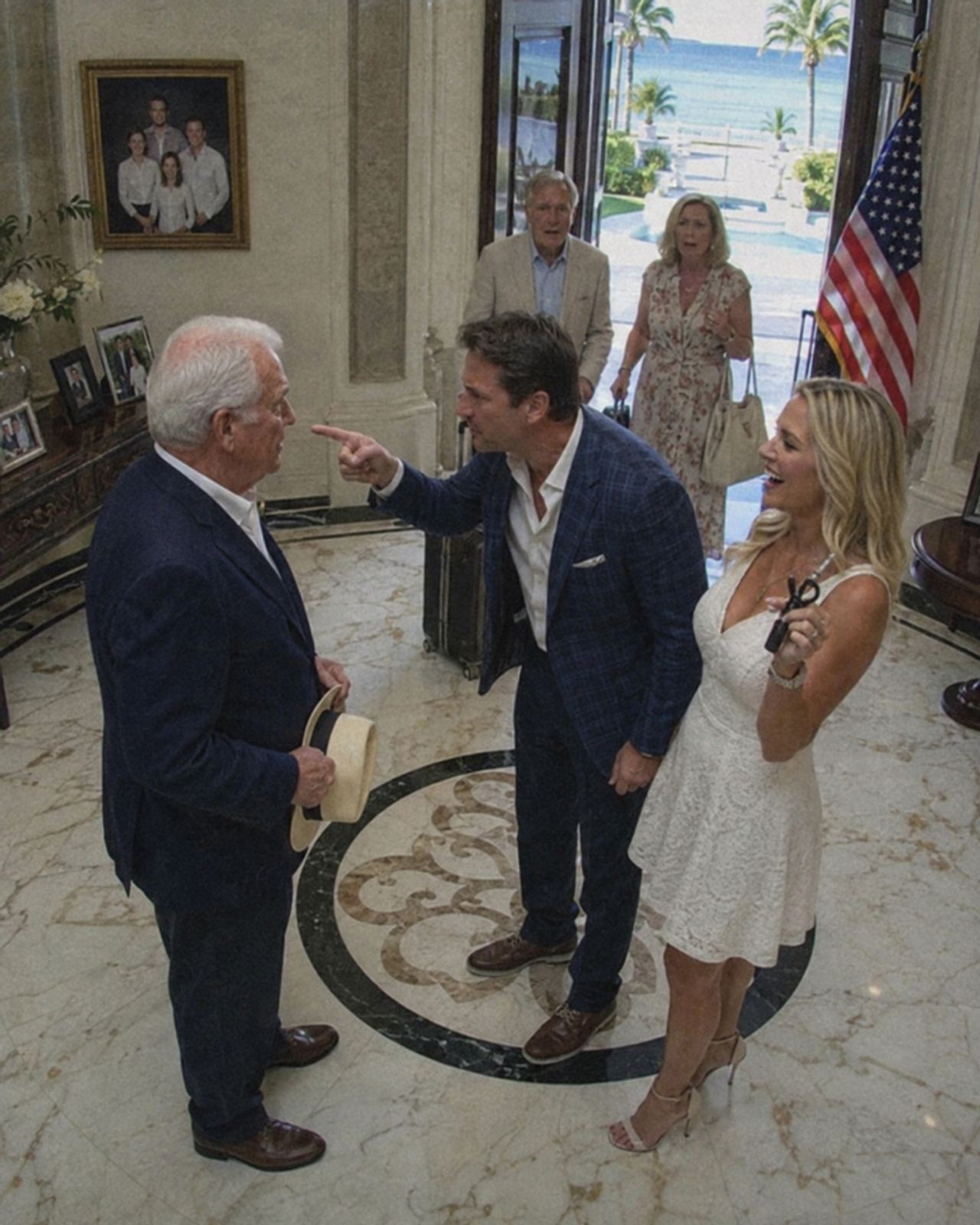
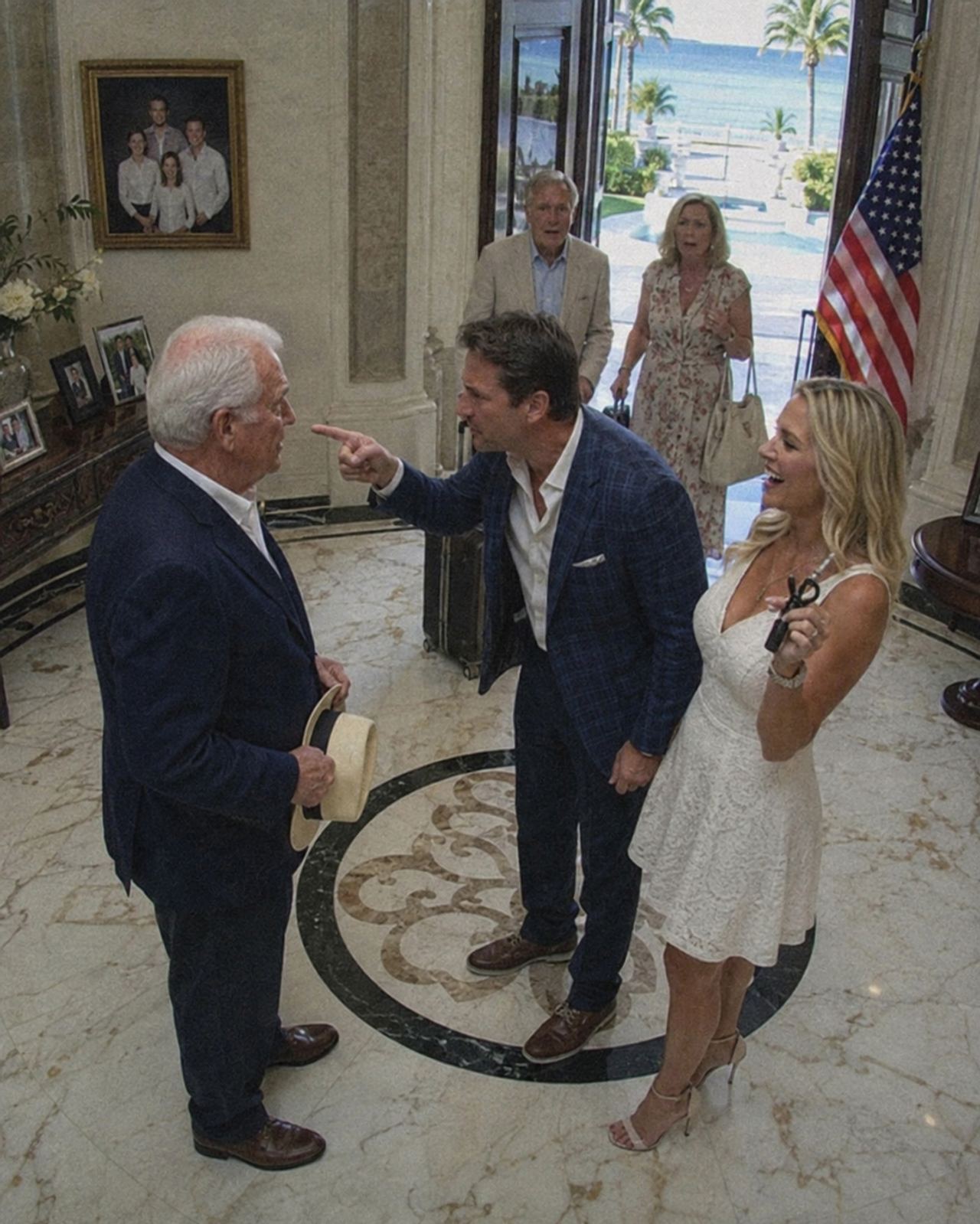
Here’s what was in that house that morning. Six people from the foundation, including their executive director, an architect and two contractors with the drawings spread all over the dining room table, a project manager with a hard hat on, my attorney, Patricia Morgan, in a suit with a folder, because she does not miss things, and a deputy from the sheriff’s office.
Not because anybody expected trouble, but because Patricia had made a formal request for a civil standby, an ordinary measure when a property transfer involves people who might not have gotten the message. On the wall of the entry hall was a brushed bronze plate, hung about 2 hours earlier, that read, “The Eleanor Bennett House, Respite and Transitional Residence.”
And I was sitting in a chair by the window in that front hall in my hat, because I’d just come in from outside. The front doors were standing wide open because the contractors were carrying equipment through.
So, the Parkers didn’t even have to knock. They just walked in.
Robert first, then Susan, then Brooke with the coffee in one hand and the keys in the other. And they came into that entry hall talking, mid-conversation the way you do when you’re arriving somewhere you own.
And they stopped. I want to describe this accurately because it happened in stages, and it took maybe 8 seconds total.
First, they saw people, a dozen strangers, hard hats, drawings on the table, a man in a sheriff’s uniform standing by the dining room door. And Susan said, “Oh, sorry.
“Are we—” the way you do when you think you’ve walked into the wrong event. Then, Brooke saw me sitting in a chair by the window.
And I watched her face do something complicated, because I was not supposed to ever show my face there again. And there I was in a chair like I’d been waiting 11 days, which, in a sense, I had.
And then she saw the plate on the wall. I was watching her eyes when she read it.
I saw them go across it, and then go back to the beginning and read it again, the way you do when the words don’t assemble the first time. The Eleanor Bennett House.
Eleanor—my wife, her husband’s late mother—on a bronze plate on the wall of a house her parents were moving into in 3 hours. And I want to be precise about the order of it because it’s the order that did the damage.
She did not read that plate and think we’ve been cheated. That would have been survivable.
What she read standing in a doorway with her parents behind her and their house already sold was proof that the entire thing had been settled and finished and hung on a wall in bronze. And that the finishing had taken months.
Bronze doesn’t happen overnight. Bronze is a lead time.
And if it had taken months, then somebody had known for months. I watched her get all the way to the end of that thought while she was still standing on the mat.
And that’s when she dropped the keys. They hit the marble and they were loud.
You know how a set of keys sounds on a hard floor in a big room. And nobody moved to pick them up.
And they just lay there on the floor for what felt like a very long time. And Robert Parker, who I’ve never had a bad word for and still don’t, said, “Brooke, what is this?”
And that is the exact moment my son came through the front door behind them. I’ll never forget his face because Daniel understood everything instantly.
He didn’t have to read the plate. He’d had the letter in his hand for 5 weeks.
And I watched my son walk into a room and see all at once that the thing he’d decided to ignore had happened anyway on schedule exactly as it said it would in writing and that his wife and his in-laws were standing in the middle of it. Patricia Morgan stepped forward and introduced herself and said very calmly that she was counsel for Mr. Bennett, that the property had transferred to the foundation in June, that written notice had been provided and signed for on a specific date, and that she had copies of everything with her if anyone would like to see them.
She’d brought copies. Of course she had.
And Brooke turned and looked at her husband and said, “Signed for? What is she talking about signed for?”
And Daniel didn’t answer her. And that silence answered her.
I got up out of my chair then and I picked up her keys off the floor and I handed them back to her because she was shaking and it seemed like the decent thing to do. And I said the only thing I said that entire morning.
I said, “There’s a good facility in Wellington that takes new residents. Your mother’s welcome to apply.
“We keep a waiting list.” And then I put my hat on and I walked out past the trucks.
All right, the honest rest of it because these stories always want to stop at the good part. Robert and Susan Parker had already closed on their house.
That was real and it was bad and I want to be clear that I have never for one second felt good about that part. Those are two people in their 70s who sold their home because their daughter and son-in-law told them a villa was waiting and it was not because my son sat on a letter.
They stayed in a rental for 4 months. It was Susan, of all people, who called me about 6 weeks after on a Sunday and she was not angry and I have thought about that phone call a hundred times.
She said, “Walter, I want you to know I don’t blame you. I’d have done the same thing.
“I just wish somebody had told us.” And I told her that was the truest sentence anybody had said about this whole business and I meant it.
We’re friendly now in a strange way. She sends a card at Christmas.
Daniel and Brooke’s marriage did not survive it. They separated within about 5 months and the divorce was final this spring.
And I want to be careful here because I know how this sounds and I’m not going to dress it up. That was not my doing and it also was not-not my doing and I’ve stopped pretending those are different things.
What ended that marriage was not the house. It was that she found out in front of her parents that her husband had known for 5 weeks and said nothing.
Everything after that was just the paperwork. Daniel and I did not speak for 7 months.
Then in March, a year after the night in the kitchen, which I noticed and I suspect he did, too, he called me and we met at a coffee place in West Palm, and I want to tell you honestly that it was not a reconciliation. It was very hard and it was not warm.
He was still angry. He told me I’d humiliated him, and I said, “Yes, that’s fair, and I’m sorry it happened in front of your in-laws, and I would do it again.”
And then he said the thing that I think about most. He said, “You could have just told me.”
And I said, “Daniel, I sent you a certified letter.” And he sat there.
And I watched him understand it, really understand it for the first time, that it had never once occurred to him to take his father seriously. That the letter had arrived and he had filed it under things Dad will get over.
He’s 39 years old. That was the first consequence he ever experienced that I didn’t buy him out of.
We’re… I don’t have a good word for what we are. We talk.
It’s careful. He works now, an actual job for somebody else, and he’s not good at it yet, and he hates it, and I have not offered him $1, and I’m not going to.
That’s the most fathering I’ve ever done, and I started at 68. And my granddaughter’s two and a half.
I see her every other weekend. Brooke has been decent about it, considerably more decent than I expected, and I’ve told her so.
That little girl is going to grow up knowing her grandfather, and that is worth more than that house was. The house took most of a year to convert, and it opened this past summer.
12 residents at a time, plus four respite beds that turn over constantly. I go on Thursdays.
I don’t do anything useful. I’m not a nurse and I’d be a menace.
I sit out by the water with whoever wants company and mostly what I do is listen to people in their 80s tell me about their lives, which it turns out is the single best way I have ever found to spend a morning. There’s a man there named Samuel Alvarez, 91, who was a merchant marine and has been everywhere on this earth twice and who has no living family whatsoever.
Not one person. And every Thursday he asks me the same question when I sit down, whi…
Read more stories
- A Whitney Houston song? On the stage of Americas Got Talent? Yeah, right, The crowd chuckled as the unassuming man grabbed the mic, But the moment he started singing, everything changed, The entire city square went silent, You could hear a pin drop, Phones flew up, jaws hit the floor, No one saw this coming, his voice left the crowd in shock!
- My Sister Mocked My Engagement Party From the Maldives, Then My Mother Casually Admitted They Had Used My $20,000 Deposit for Their Vacation, So I Said Only Two Words and Quietly Took Back Everything My Paycheck Had Been Holding Together.
- Escaping on a midnight flight, a stranger whispered, “Pretend to sleep on my shoulder. A P.I. is photographing you.” As we landed, his security detail swarmed the tarmac. He checked his phone and growled, “Your ex-husband is waiting at the gate.” My abusive ex assumed he had cornered a defenseless mother. Instead, he had just blindly walked into an inescapable, billionaire-funded hell.
- My sister threw my fiancée’s wedding dress into the pool just days before the ceremony