
Human Stories
My Parents Let My Brother Move Into My $825K House…
Mara Winslow’s family tries to move her brother and his pregnant wife into her legally owned house by force, only for Mara to fight back with property records, law enforcement, and an attorney. What begins as a shocking family betrayal escalates into evidence of forged documents and possible fraud.

My name is Mara Winslow, and for most of my life, my family treated me like a reliable appliance.
Useful. Quiet. Expected to work. Not something anyone praised unless it stopped doing what they wanted.
I was thirty-one, worked as a housing compliance officer for the State Housing Finance Agency, and owned a little blue bungalow on Oakmont Drive with white trim, a crooked brick path, and a lemon tree that refused to die no matter how badly winter treated it. The house was only 1,200 square feet when I bought it, but it had solid bones, old oak floors, and sunlight that poured through the kitchen windows every morning like warm milk.
I bought it when I was twenty-two.
No family money. No gift. No secret loan from my parents. Just a conventional mortgage, my savings from three jobs, and a stubborn belief that if I owned one small corner of the world, nobody could move me again.
My father, Grant Winslow, called my job “glorified paperwork.”
My mother, Celia, told her church friends I “could have done more” if I had taken the money Dad offered when I graduated college.
He never offered money. He offered control, wrapped in a lecture.
My younger brother, Kellan, was twenty-eight and still lived in their 4,500-square-foot house rent-free. He called himself an entrepreneur, though his business ideas usually involved other people’s savings and phrases like “market disruption.” My parents called him creative.
When I put 11% into my retirement account, they called me scared.
When Kellan lost money selling imported phone cases from my parents’ garage, Dad called it “a learning curve.”
That was how the family worked. Kellan was always becoming something. I was always supposed to already be something for everyone else.
The text came on a Wednesday afternoon while I was reviewing a complaint from a woman whose landlord had changed the locks after she missed one rent payment.
I still remember the time: 2:47 p.m.
Mom: Your brother and Lacey are moving into your house tomorrow. Clear out anything private tonight. Leave the back door key under the frog planter.
I stared at the screen so long the fluorescent lights above my cubicle started to hum louder than usual. Outside my office window, traffic crawled under a gray spring sky. Someone’s burnt coffee smell drifted from the break room.
I read the message again.
Then again.
My first emotion wasn’t anger. It was a strange, floating disbelief, like I had stepped off a curb that wasn’t there.
I called her.
“Hi, honey,” Mom said brightly. “Did you get my message?”
“The message where you told me my brother is moving into my house?”
She laughed softly, the way she did when she thought I was being childish. “Mara, don’t start. Kellan and Lacey need room for the baby. This is a family decision.”
“It’s my house.”
“Technically, yes.”
“No, Mom. Not technically. Legally. Financially. Actually. My name is the only name on the title.”
“You always get so rigid about words.”
“Title is not just a word.”
There was a pause. I heard dishes clinking on her end, the faint rush of water from her kitchen sink. She was probably standing under the pendant lights in her huge white kitchen, wearing the floral apron she put on whenever she wanted to look like the heart of the family.
“Your father and I discussed it,” she said. “Kellan needs stability right now.”
“Then let him stay with you.”
“We can’t have a newborn disrupting our routine. Your father uses the north bedroom as his office, my craft room is finally organized, and the guest suite is for actual guests.”
“So your routine matters, but my home doesn’t?”
“Mara, you are one person in a three-bedroom house. You work all day. You barely use the space.”
I looked at the framed photo on my desk of my front porch in October, pumpkins lined on the steps, my old porch swing painted green. I had sanded that swing myself until my fingers blistered.
“I use every inch of it,” I said.
“You can move back here for a while,” Mom said. “Kellan’s old room is empty. It would be good for you. You’ve been alone too long.”
“I am not moving into my brother’s childhood bedroom so he can take the house I bought.”
Her voice cooled. “You’re making this ugly.”
“You made it illegal.”
That was the first time she stopped sounding sure.
Then she said, “Don’t embarrass this family, Mara. Kellan already rented the truck.”
The line went dead.
For a full minute, I sat perfectly still.
Then I opened my laptop, pulled up the county property records, and typed my address.
There it was.
Mara Elise Winslow. Sole owner. Purchased April 2013. Current assessed value: $782,400. Last private offer on record: $825,000.
No liens except the small remaining mortgage.
No co-owner.
No family trust.
No “technically.”
Just my name.
And for the first time all afternoon, my hands stopped shaking.
Because my family had mistaken my quietness for weakness. They forgot what I did for a living.
I knew exactly what happened when someone tried to force a person out of a home they had no legal right to touch.
I also knew that if I let them cross the threshold once, they would call it permission forever.
So I printed the deed. I printed my mortgage statement. I printed a notice denying entry and occupancy, written on plain paper, with my signature at the bottom.
Then I called the sheriff’s non-emergency line and said, “I need a civil standby at my property. My family is attempting to enter and remove belongings from my home without permission.”
The dispatcher asked, “Are they there now?”
I looked at my phone.
A new message from my neighbor, Mrs. Bell, had just appeared.
Mara, are you moving? There’s a rental truck in your driveway, and your mother is carrying boxes out.
My stomach turned cold.
They hadn’t waited until tomorrow.
They were already inside.
Part 2
The drive home took seventeen minutes. It felt like seventeen years.
The sky had gone white and heavy, the kind of late afternoon light that makes every windshield glare. My fingers gripped the steering wheel so tightly my knuckles ached. At each red light, I could feel my pulse in my throat.
I did not call my mother again.
I did not call Kellan.
That was the old Mara’s reflex: explain, plead, make it easier for people who had already decided I was inconvenient.
Instead, I kept driving.
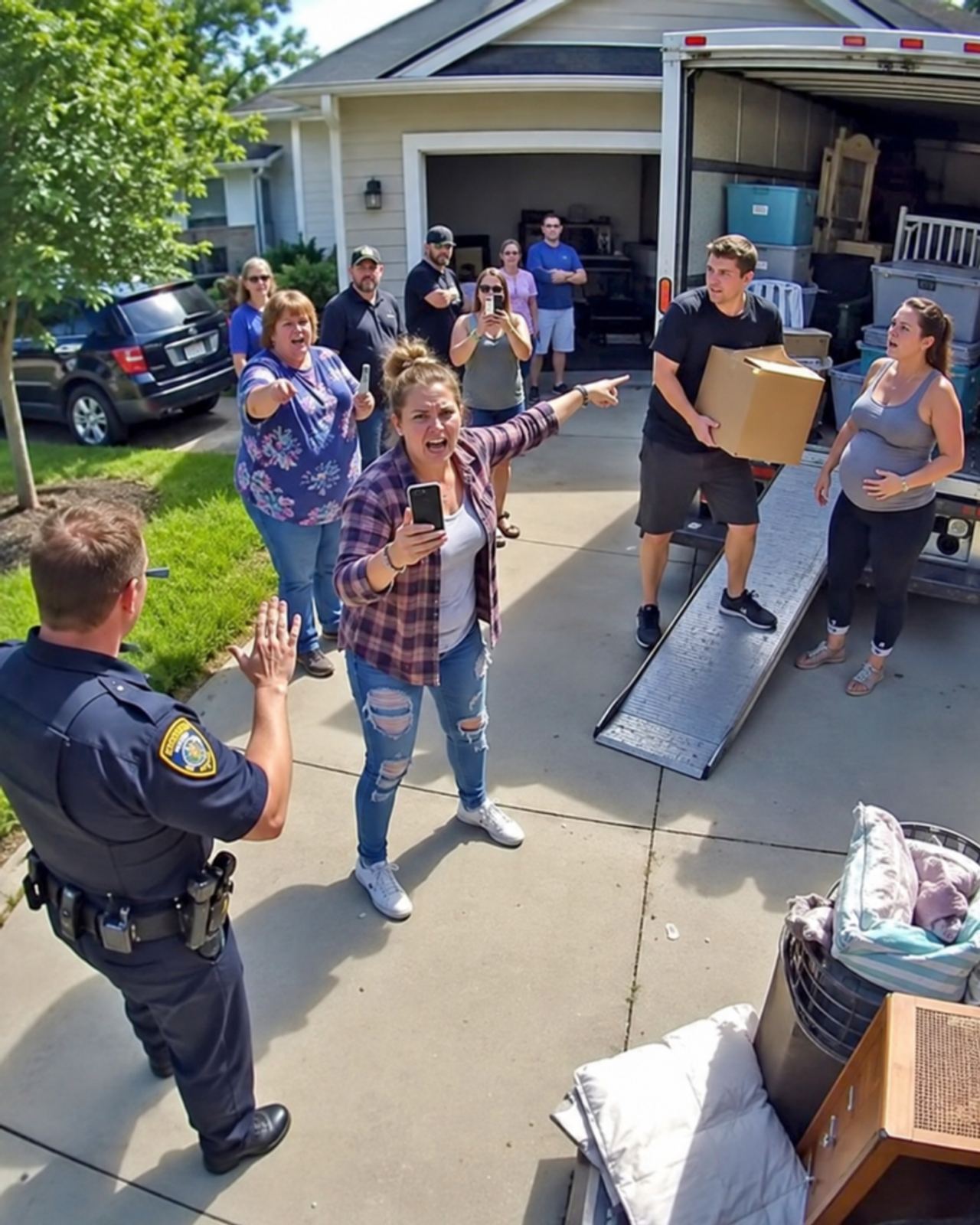
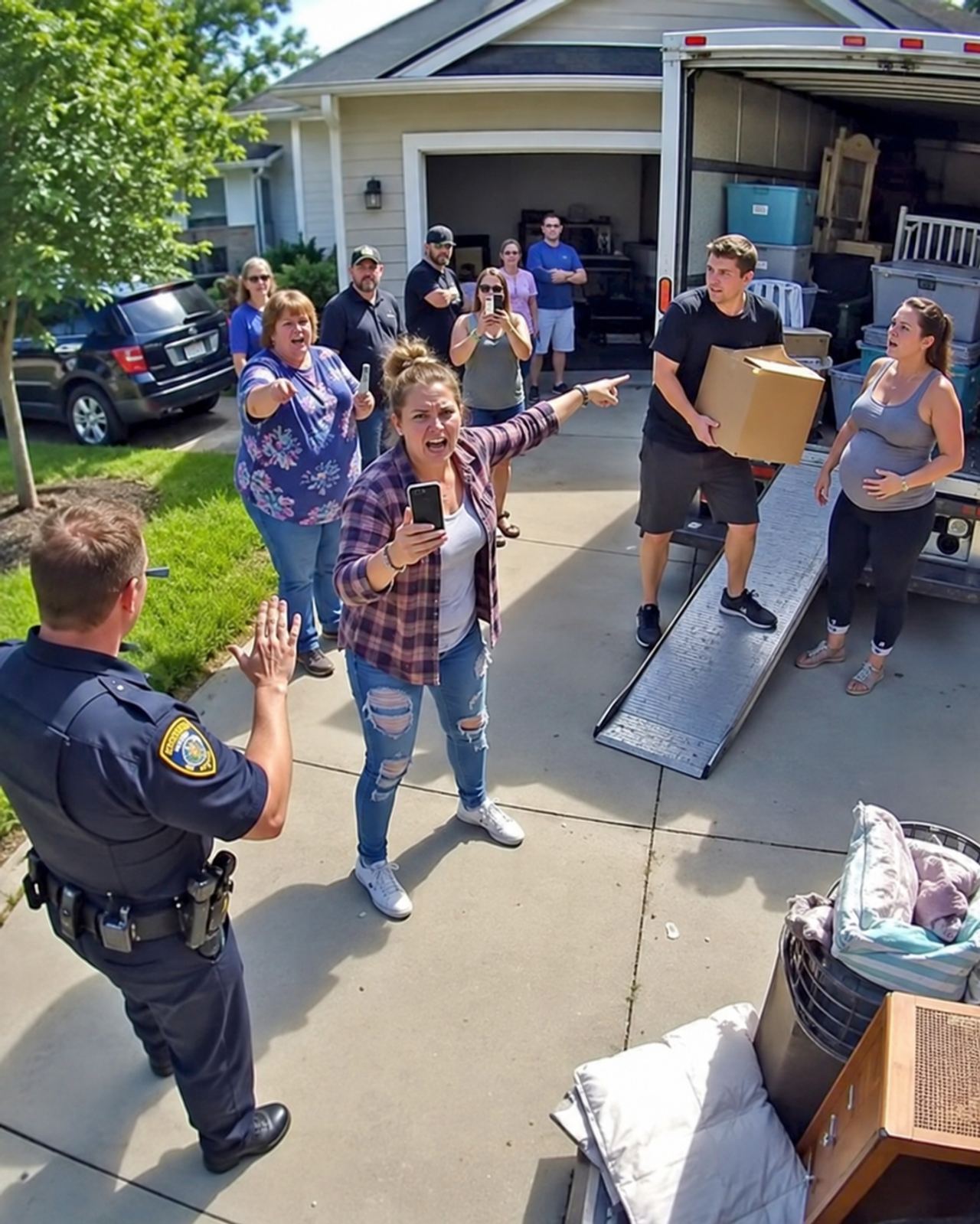
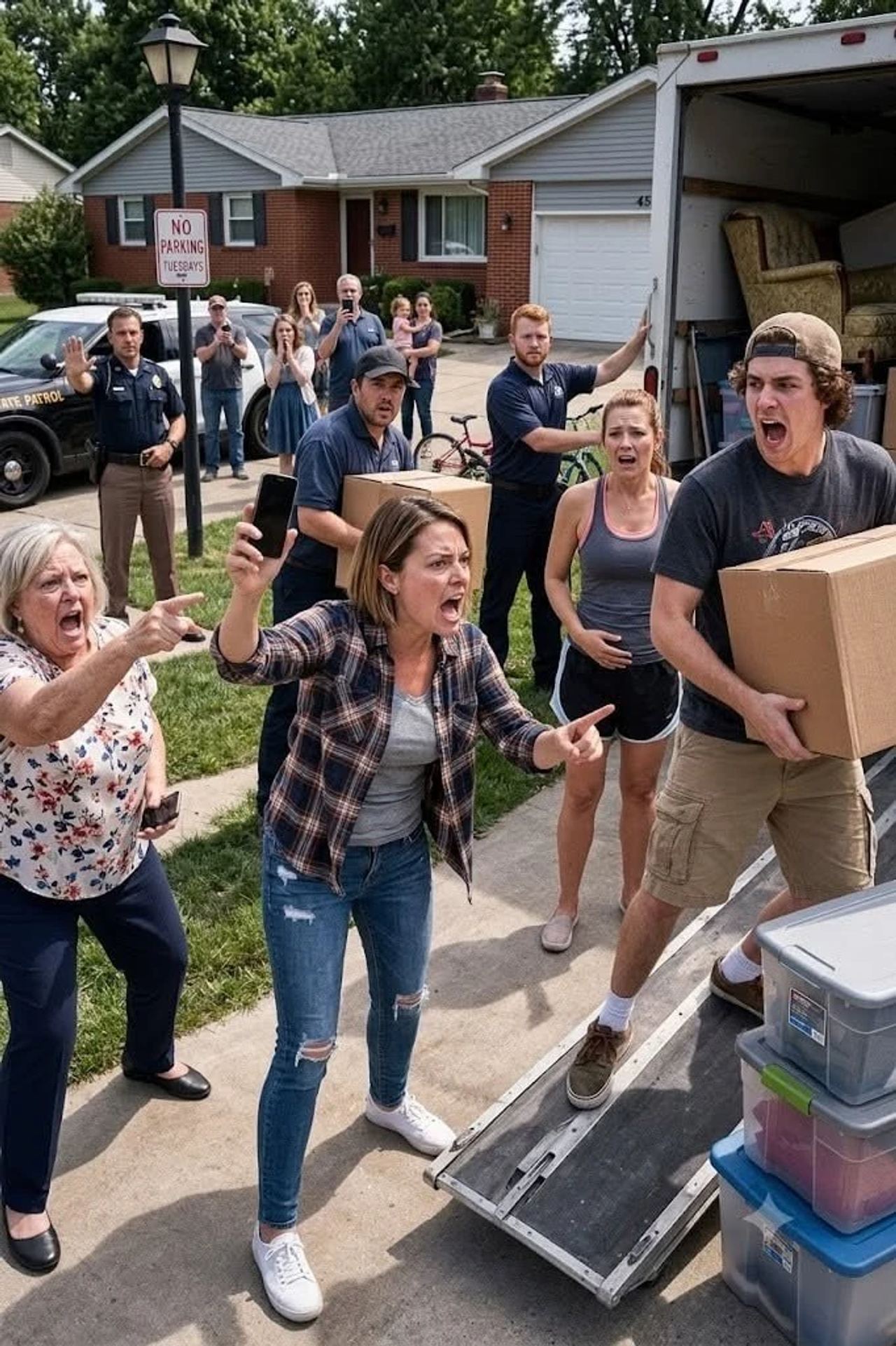
When I turned onto Oakmont Drive, I saw the orange-and-white rental truck before I saw my house. It was backed into my driveway, one rear wheel crushing the edge of the lavender bed I had planted last summer.
My mother stood on my porch holding a roll of packing tape.
Kellan was carrying my grandmother’s dresser out of my bedroom.
The dresser had curved brass handles and scratches on the left side from when Grandma had moved it across three states after her divorce. Nobody in the family wanted it when she died because the veneer was peeling. I spent six weekends stripping, sanding, staining, and sealing it until it glowed warm as honey.
And there was my brother, hauling it toward the truck like it was trash from a storage unit.
Lacey sat in the passenger seat of Kellan’s car, one hand on her stomach, the other scrolling through her phone. She looked bored. Not guilty. Not confused. Bored.
I parked across the street and stayed in my car, just like the dispatcher had told me.
My phone buzzed.
Mom: You don’t need to come make a scene. We’re handling the heavy things first.
I almost laughed. The sound caught somewhere in my chest and hurt.
Mrs. Bell, my seventy-two-year-old neighbor, stepped onto her porch wearing a purple cardigan and gardening gloves. She saw my car and raised both hands like a question.
I shook my head once.
She understood. She stayed outside.
Kellan came back out with a cardboard box labeled Mara kitchen.
My kitchen.
The blue ceramic bowls I bought from a potter in Asheville. The cast iron skillet I seasoned for years. The chipped mug from my first promotion, the one that said “She Handles It” in gold letters.
My mother saw me then.
Her face tightened. She walked down the porch steps fast, her sandals slapping the brick path.
“Mara,” she hissed through the passenger window. “Do not start.”
I rolled the window down halfway. “Put everything back.”
“We are not doing this in front of neighbors.”
“You started this in front of neighbors.”
“Kellan has already told Lacey’s parents they’re moving in. Do you understand how humiliating it would be to back out now?”
A bitter little puzzle piece slid into place.
This wasn’t just about space.
It was about the story they had already sold.
“What did you tell them?” I asked.
Mom’s eyes flicked toward the truck. “That the family had arranged housing.”
“The family did not arrange anything.”
“We raised you. We helped make you who you are. Don’t act like everything you have appeared out of nowhere.”
“You did not buy this house.”
Her lips pressed together.
Behind her, Kellan came out again, this time carrying my framed diploma under one arm and a box under the other.
Something in me snapped cleanly into place.
“Put that down,” I called.
Kellan froze.
Mom turned sharply. “Mara, lower your voice.”
“That is my degree. Put it down.”
Kellan rolled his eyes. “Relax. I was going to put your office stuff in the garage.”
“My office stuff is staying in my office.”
He looked at Mom. “I told you she’d do this.”
That sentence landed hard.
Not “I didn’t know.” Not “Mom said you agreed.” Not “Sorry.”
I told you she’d do this.
He knew.
A sheriff’s cruiser turned onto Oakmont Drive at 4:23 p.m., slow and deliberate. The red and blue lights weren’t flashing, but the sight of the car changed the whole temperature of the street.
My mother straightened like someone had pulled a wire through her spine.
Sheriff Nolan Mercer got out. He was in his early fifties, broad-shouldered, with silver at his temples and a calm expression that didn’t waste movement. I recognized him from a housing fraud training seminar our agency had held the year before.
“Ms. Winslow?” he asked.
I got out of the car with my folder. “Yes, sir.”
My mother smiled before I could speak. It was her public smile, soft and wounded. “Officer, thank goodness. This is just a family misunderstanding.”
“Sheriff,” he corrected gently. “And I’ll need to understand who owns the property.”
“I do,” I said.
Mom spoke over me. “It’s our daughter’s house, but we’re family. Her brother and his wife are expecting, and Mara agreed—”
“No,” I said.
The word was quiet.
Everyone heard it.
Sheriff Mercer looked at me. “You did not give permission?”
“I did not. I explicitly denied permission after my mother informed me they intended to move in. They entered anyway and began removing my property.”
I handed him the deed, my driver’s license, the mortgage statement, and the written denial of entry.
He reviewed each page slowly.
Kellan shifted his weight. “This is ridiculous. She’s not using half the house.”
The sheriff looked up. “That isn’t relevant.”
“It’s a family issue,” Mom said quickly. “We don’t need all this legal nonsense.”
“Ma’am,” Sheriff Mercer said, “property ownership is not nonsense.”
For the first time that day, my mother had no immediate answer.
Then Lacey got out of the car.
She was wearing a cream sweater, black leggings, and oversized sunglasses pushed into her hair. Her face was pale, but her voice was sharp.
“Kellan, what is happening?”
Kellan stared at the ground.
Lacey looked at me. “Your mom said the house was available.”
“It is not.”
“She said it was being transferred.”
My mother’s head whipped toward her. “Lacey.”
The sheriff’s eyes moved from Lacey to my mother.
My skin prickled.
“Transferred?” I asked.
Mom’s mouth opened, then closed.
Kellan muttered, “Can we not do this here?”
But it was too late.
Because the first real clue had slipped out in front of a sheriff, my neighbor, and half of Oakmont Drive.
My family hadn’t just planned to move into my house.
They had told people I was giving it away.
Part 3
Sheriff Mercer’s tone stayed even, but the air sharpened around us.
“Ms. Winslow,” he said to my mother, “do you have documentation showing a transfer, lease, purchase agreement, or permission to occupy?”
Mom’s face flushed. “Not with me.”
That was not the same as no.
My heart gave one hard thud.
Kellan dragged a hand through his hair. “Mom.”
The sheriff looked at him. “Do you have any documentation?”
Kellan’s jaw worked. “No.”
Lacey stared at him. “You told me your parents handled it.”
“They did,” he snapped.
“No,” I said, “they didn’t.”
My mother turned on me. “You are enjoying this.”
I looked at the truck. At my dresser. At my flattened lavender. At my diploma resting sideways in my brother’s arms like a piece of junk.
“No,” I said. “I am surviving it.”
Sheriff Mercer folded the documents and handed them back to me. “Based on what I have here, Ms. Mara Winslow is the sole legal owner. No one else has permission to enter or remove belongings. Anything already removed needs to be returned immediately. Then everyone who does not have permission to be here needs to leave the property.”
My mother let out a small laugh. “You can’t be serious.”
“I am.”
“She’s putting a pregnant woman on the street.”
Lacey flinched. Maybe because she was pregnant. Maybe because she knew she was being used as a shield.
“She lives with you,” I said. “In a house with four extra bedrooms.”
Mom’s eyes narrowed. “That is not appropriate.”
“For who?”
“For a young family. They need independence.”
“Then Kellan can get a job and rent an apartment.”
Kellan finally turned on me. His face was red, sweaty at the hairline. “You always do this.”
“Do what?”
“Act like you’re better than me because you have paperwork.”
I looked at the folder in my hand. “This paperwork is the reason you don’t own my house.”
He took a step toward me. Sheriff Mercer moved half a step between us without touching anyone. It was enough.
Kellan stopped.
For the next twenty minutes, my family carried my life back inside.
My dresser returned to my bedroom, though Kellan bumped it against the doorframe and chipped the fresh stain. My kitchen boxes went back under the breakfast bar. My diploma returned to the office wall, crooked, with a fingerprint smudge across the glass. My mother refused to help. She stood on the driveway with her arms crossed, whispering furiously into her phone.
I heard pieces.
“She called law enforcement.”
“No, I’m not exaggerating.”
“After everything we’ve done.”
Lacey sat on my porch steps and cried quietly. At first, I felt the old reflex rise in me: comfort her, explain, make sure nobody felt too bad.
Then I remembered she had watched them carry my belongings out of my home for at least twenty minutes before I arrived.
So I said nothing.
Mrs. Bell came down her front walk holding a paper cup with a plastic lid.
“For you,” she said, passing it to me. “Peppermint tea. You looked like you could use something warm.”
That tiny kindness almost undid me.
“Thank you,” I whispered.
My mother saw and scoffed. “Very theatrical.”
Mrs. Bell looked at her over the top of her reading glasses. “Celia, I watched your son carry Mara’s dresser out of her bedroom. Don’t confuse witness with theater.”
For one bright second, I loved Mrs. Bell more than half my blood relatives.
At 4:58 p.m., the truck was empty again.
Sheriff Mercer wrote notes on a small pad. “Ms. Winslow, do you want to file formal trespass charges today?”
My mother’s face changed. The anger cracked, and fear showed underneath.
“Mara,” she said quickly. “Don’t you dare.”
I had never heard my mother sound afraid of me before.
It didn’t feel as good as I thought it would.
It felt sad.
“I won’t file today,” I said. “But I want this documented.”
The sheriff nodded. “It will be.”
Kellan exhaled hard, like I had inconvenienced him by not ruining his record.
Mom stepped closer, lowering her voice. “Your father is going to be furious.”
I looked at her. “Good. Maybe he’ll finally pay attention.”
She recoiled as if I had slapped her.
Then Lacey stood up. “Kellan, did your parents actually own any part of this house?”
Kellan looked at Mom.
Mom looked away.
That silence was loud enough to shake the street.
Lacey’s mouth opened slightly. “You told my parents this was a family property.”
“No,” Kellan said quickly. “I said it was handled.”
“You said your sister was signing it over because she didn’t need it.”
I felt all the blood drain from my face.
Signing it over.
Not renting. Not staying temporarily. Signing it over.
The story was bigger than a truck in my driveway.
My brother had promised his pregnant wife a future built on my title.
And my parents had let him.
Maybe even helped him.
Part 4
After they left, my house felt violated.
Not messy. Not damaged beyond repair. Violated.
The air smelled like cardboard, sweat, and my mother’s perfume, a powdery rose scent that lingered in the hallway like an accusation. The rug in the living room was curled at one corner. A drawer in my bedroom hung open. One of my framed photos had fallen behind the nightstand.
I walked room to room with my phone, recording everything.
The chip in the dresser.
The crushed lavender.
The muddy shoe print near my bed.
The scrape on the hallway wall.
Every little mark said the same thing: they thought this place was already theirs.
By 6:15 p.m., a locksmith was changing every lock. He was a quiet man named Dale who smelled faintly of metal shavings and wintergreen gum. He replaced the front deadbolt, back door lock, garage entry, and side gate latch.
“Family situation?” he asked, not looking up.
“How did you know?”
He gave a tired half-smile. “Strangers break windows. Family asks where the spare key is.”
By 8:00 p.m., I had installed a doorbell camera, two side cameras, and a floodlight above the garage. Mrs. Bell’s grandson helped me connect the app because my hands were still shaking too badly to type the Wi-Fi password correctly.
At 9:12 p.m., my father called.
I let it ring until the last second.
“What the hell did you do?” he barked.
I sat at my kitchen table, still wearing my work blouse, a cold cup of peppermint tea beside me. The light above the sink buzzed faintly.
“I stopped people from illegally entering my home.”
“Don’t use your agency language on me.”
“Then don’t commit housing violations in my driveway.”
“You humiliated your mother.”
“She humiliated herself.”
“She was trying to help your brother.”
“With my house.”
“It’s a house, Mara. You act like it’s a child.”
“No. You act like it’s yours.”
A heavy silence.
Then Dad said, “You didn’t build that life alone.”
There it was.
The old hook under the bait.
“I paid the down payment,” I said. “I paid the mortgage. I paid the taxes. I paid for every repair from the roof to the water heater.”
“We raised you.”
“You don’t get equity for parenting.”
His breathing grew rough. “Kellan needs a stable home.”
“Then give him one of yours.”
“This is different.”
“Because your space matters and mine doesn’t?”
He snapped, “Because you don’t have a family.”
The words hit the room and seemed to stay there.
For a moment, I only heard the refrigerator humming.
I looked toward the hallway where the afternoon sun usually painted gold on the floorboards. At night, the house was darker, but it was still mine. The walls I patched. The floors I refinished. The place that had held me when nobody else did.
“I am a family,” I said.
Dad laughed once, cruelly. “You know what I mean.”
“Yes,” I said. “That’s the problem.”
He lowered his voice. “Your mother told Lacey’s parents this was settled. Kellan signed paperwork based on that understanding.”
My body went still.
“What paperwork?”
Another silence.
“Mara.”
“What paperwork?”
“It’s nothing binding.”
“Then send it to me.”
“No.”
“Dad.”
“You are not turning this into one of your little investigations.”
I stood up so fast the chair scraped the floor. “What did Kellan sign?”
Dad’s voice hardened. “You should have cooperated.”
The call ended.
For a long second, I stared at my phone.
Then I opened my laptop again.
I checked county records. No transfer filed. No lien. No deed change. Nothing.
Then I checked my email. Nothing from any title company. Nothing from a realtor. Nothing from a closing attorney.
At 10:03 p.m., a new message arrived from an unknown number.
This is Lacey. I need to know what is going on. My parents gave us money for renovations because Kellan said the house would be ours before the baby came. Did you agree to that?
I read it twice.
Renovations.
Money.
Before the baby came.
My anger shifted into something colder and more focused.
I typed back: I agreed to nothing. I am the sole owner. No transfer, sale, lease, or occupancy was ever authorized by me. Please send me anything Kellan gave you or your parents.
Three dots appeared. Disappeared. Appeared again.
Then she sent a photo.
It was a one-page “family occupancy and transfer agreement.”
My name was typed at the bottom.
And beneath it was a signature that was supposed to be mine.
But it wasn’t.
Part 5
I did not sleep that night.
I sat at my kitchen table with every light on, the forged document open on my laptop, the doorbell camera feed running beside it. Outside, wind pushed dry leaves across the porch. Each scrape made me glance toward the front door.
The fake agreement was clumsy in some places and dangerous in others.
It claimed I had agreed to “transfer beneficial family use” of my house to Kellan and Lacey within ninety days. It said they could begin occupancy immediately. It said I would vacate by the move-in date and remove “personal clutter” from the property.
Personal clutter.
That was my furniture. My books. My grandmother’s dresser. My life.
The signature at the bottom looked like mine if someone had seen it once on a birthday card and tried to copy it from memory. The M looped too high. The W in Winslow had an extra sharp point. Whoever forged it didn’t know that after signing thousands of compliance forms at work, my signature had become fast, flat, and almost ugly.
This one was pretty.
That alone told me my mother had probably done it.
At 7:30 a.m., I called my supervisor, Naomi Pike.
She listened without interrupting.
When I finished, she said, “Do not communicate by phone anymore. Everything in writing. Save the original files. Screenshot metadata if possible. And Mara?”
“Yes?”
“This is not a misunderstanding. This is fraud.”
The word settled over me like ash.
Fraud.
At work, fraud belonged in case files. It belonged to people who changed dates, forged notices, lied to tenants, hid income, threatened families who didn’t know their rights.
It did not belong to my mother’s floral apron or my father’s golf shirts.
Except it did.
By 9:00 a.m., I had an appointment with a real estate attorney named Odette Harrow, recommended by my cousin Linnea, the only attorney in our extended family and one of the few people who had never treated me like a disappointment.
Odette’s office smelled like cedar, printer toner, and expensive coffee. She was in her forties, with silver hoops, sharp eyes, and the kind of calm that made panic feel wasteful.
She reviewed the deed, the sheriff’s report, the texts, the forged agreement, and Lacey’s messages.
Then she leaned back.
“You have several options.”
“I don’t want drama,” I said automatically.
Odette raised one eyebrow. “Mara, they brought a moving truck to your house and forged your signature. The drama has already arrived. We’re discussing containment.”
I almost smiled. Almost.
She drafted three letters.
One to my parents.
One to Kellan and Lacey.
One to Lacey’s parents, who, according to the fake agreement, had contributed $38,000 toward “renovations and nursery preparation.”
Each letter stated that I was the sole owner, had authorized no transfer, lease, occupancy, or renovations, and considered any further attempt to enter, alter, occupy, sell, encumber, or claim the property unlawful.
The letter to Kellan included one sentence that made my hands tingle.
Any document bearing Ms. Winslow’s alleged signature purporting to transfer or grant property rights is fraudulent and has been preserved for potential civil and criminal action.
Odette slid the letters across the desk. “Do you want to give them a chance to correct the record privately?”
I thought of Mom telling everyone I had thrown out a pregnant woman.
I thought of Dad saying I didn’t have a family.
I thought of Kellan carrying my diploma like clutter.
“No,” I said. “Send them.”
The first explosion came at 11:42 a.m.
Mom: You hired a lawyer against your own family?
I didn’t answer.
Dad: Call me immediately.
I didn’t answer.
Kellan: You’re insane. Lacey is crying because of you.
I d…
Read more stories
- GEORGE JONES THOUGHT CONWAY TWITTY WAS THE BIG SURPRISE AT THE OPENING OF HIS MUSIC PARK. TAMMY WYNETTE HAD SECRETLY BROUGHT IN ONE MORE MAN — HIS OLD FRIEND CHARLEY PRIDE.
- At the family dinner, My Sister Threw Food In My Toddler’s Face And Dragged Her Across The Floor: “Here, eat it like a dog now.” She made her eat from the ground while she burst into tears. But before I could reach her, my sister grabbed her hair, lifted her off the ground, and slammed her to the floor. Her scream shook me to the core. But right there, in front of everyone, I revealed a secret that left my sister shaken with shock…
- EVERYONE KNEW HIM AS COUNTRY MUSIC’S $500 MILLION MAN — BUT HIS REAL LEGACY WAS BUILT ON A 1984 PROMISE MADE LONG BEFORE THE FAME.
- “Dad… my arms hurt so much, mom said I shouldn’t tell you.” Returning from a 48-hour paramedic shift, I found my 8-year-old curled in a tight ball inside her closet. My wife’s hundreds of thousands of online fans think she’s the perfect mother. But when my daughter confessed what happened over a spilled juice box, my heart stopped. I gently rolled up her sleeves, and the injuries I saw broke me into pieces…