
Human Stories
My Mother-in-Law Pushed Me Downstairs—Then the X-Rays Told the Truth
After suffering serious injuries from a fall down the stairs, the narrator learns from X-rays and medical documentation that the incident was not an accident but an assault by her mother-in-law. The story follows the fallout as her husband admits the truth, the family’s silence unravels, and she ultimately chooses divorce and a life built around honesty and safety.

Dr. Mercer waited until the door closed behind Graham.
“You have three fractured ribs on the left side,” he said. “One is displaced, and the CT shows bruising around the lung. You need to stay for observation.”
I stopped breathing for a second, not because of the pain, but because he had finally named what Graham kept trying to shrink.
Then the doctor pointed to the long pressure mark across my upper back.
“I cannot tell you who caused this,” he said carefully. “But your injuries and your account need to be documented exactly as you gave them.”
The nurse asked whether I wanted Graham kept outside.
I heard his shoes scrape in the hallway, then his low voice telling someone on the phone that I was “upset and confused.”
“Yes,” I said. “Keep him out.”
That was the first decision I made that night without looking at my husband for permission.
The nurse brought me my purse. My phone had seven missed calls from Judith and a stream of messages in the family group chat.
Graham had written one sentence while I was inside the scanner:
Mom didn’t mean to push Nora. Please don’t make this bigger than it is.
He had admitted the truth to the entire family while asking the hospital to believe a lie.
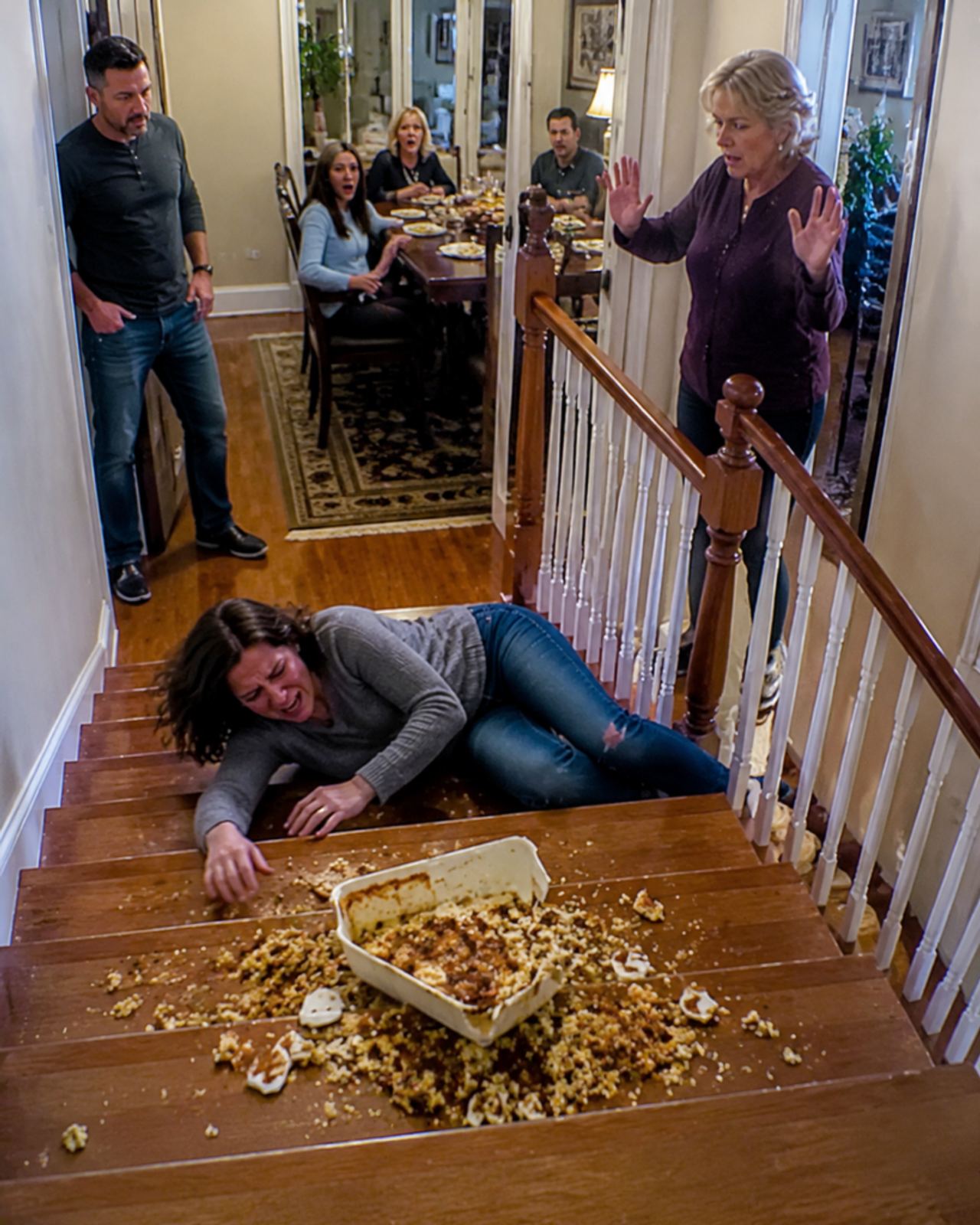
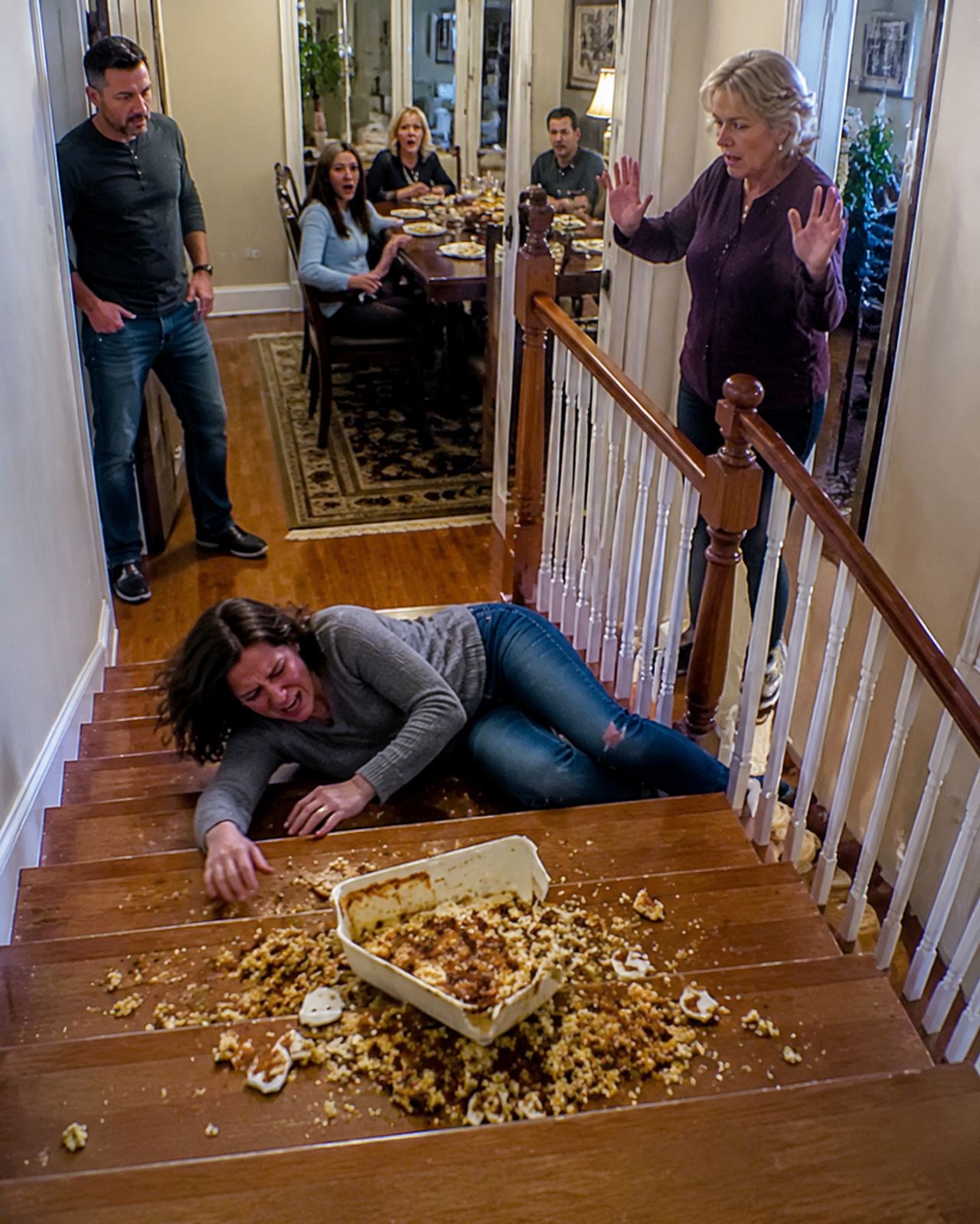
Before I could show the nurse, voices rose outside. Judith had arrived in the same cream cardigan she wore at dinner, a dark casserole stain drying near the hem.
She pushed past Graham and stopped when she saw me, the cut sweater, and Dr. Mercer’s chart.
Her face turned pale.
Then she pointed at me and said, “Tell them I never touched you.”
I lifted my phone so Graham could see his own message glowing on the screen.
He looked at his mother.
Then he looked at me.
And for the first time in our marriage, he had to decide which woman he was willing to tell the truth about.
Graham’s mouth opened, but nothing came out at first.
Judith stepped closer to him, her eyes sharp now that fear had replaced performance.
“Graham,” she warned.
He looked at the message on my screen again.
Then he said, “She pushed you.”
The words were quiet, but they changed the room.
Judith’s face twisted. “You were upstairs.”
“I was at the doorway,” he said. “I saw your hand on her back.”
My husband had known from the beginning.
He had watched his mother push me, heard my body hit the stairs, and still spent the drive to the hospital building an accident around her.
Dr. Mercer did not celebrate the admission or turn it into a speech.
He simply asked both of them to leave so the nurse could finish documenting my condition.
Judith refused at first.
She said I was trying to destroy her family.
She said I had always been dramatic.
She said the pressure mark on my back could have come from anything.
The nurse moved between the bed and the doorway and told her she needed to step out.
Graham reached for his mother’s elbow, but Judith jerked away from him as though he had become the traitor.
Before the door closed, she looked directly at me.
“You will regret this,” she said.
I believed her.
That was the frightening part.
I also knew I would regret myself more if I lied.
The nurse photographed the visible bruising for my medical chart with my permission, then wrote down my words exactly.
She asked whether I wanted to speak with someone about making a report.
My first instinct was to ask Graham what he thought.
The habit was so deep that I actually turned my head toward the door.
Then pain caught under my ribs, sharp enough to remind me where that habit had brought me.
“Yes,” I said.
The process was not dramatic.
There were questions, pauses, and long stretches where the only sound was the soft hiss of the blood-pressure cuff.
I gave the same account again: the basement door, Judith’s whisper, the pressure between my shoulders, the missing step, and the concrete floor.
I showed the message Graham had sent.
I did not exaggerate anything.
I did not need to.
Near midnight, Graham was allowed back into the room after Judith had left the hospital.
He stood beside the wall instead of approaching the bed.
For years, that had been his position whenever his mother hurt someone.
Close enough to witness.
Far enough to claim helplessness.
“I panicked,” he said.
“So you lied.”
“I was trying to keep everyone calm.”
“I was at the bottom of a staircase.”
His eyes dropped to the cut edge of my sweater.
“She is still my mother.”
“And I am still your wife.”
He flinched, but I was past protecting him from sentences he had earned.
Graham sat in the chair by the window and pressed his palms together.
He told me his mother had always been difficult.
That was the word he used.
Difficult.
As if Judith had forgotten birthdays, criticized recipes, or arrived late to dinner.
He talked about how she could freeze him out for weeks when he challenged her and how his father had taught him to apologize before anyone had even decided what he had done wrong.
I knew some of that history.
I had watched Judith punish him with silence, tears, and sudden illnesses whenever he set a boundary.
But knowing where his fear came from did not make it safe for me to live inside it.
“You saw her push me,” I said. “Then you told the nurse I slipped.”
He started crying.
I did not.
The pain medication had softened the edges of my ribs, but it had not softened the fact between us.
“Are you going to tell the truth if they ask you again?” I said.
He stared at the floor for a long time.
“Yes.”
“Even if she cuts you off?”
His face tightened.
“Yes.”
I wanted to believe him.
Trust had once come easily with Graham because he showed up in ordinary ways.
He packed my lunch when I worked late.
He kept jumper cables in my trunk.
He remembered how I took my coffee and always checked the weather before long drives.
Those small things had convinced me he was steady.
But steadiness only counts when the ground moves.
When his mother pushed me, Graham had chosen the version of peace that required my silence.
At two in the morning, my oxygen level dipped and the nurse adjusted my position.
Every movement hurt.
Graham stood to help, but I asked him not to touch me.
He sat down again.
That was the first boundary he respected without argument.
By morning, the bruising had spread across my side in dark bands.
Dr. Mercer explained that the lung bruising appeared stable, but I needed another night of observation and strict follow-up after discharge.
He also told me that rib injuries could worsen if I tried to rush recovery.
Graham asked whether he could take me home.
“No,” I said.
I called a coworker I trusted and asked whether I could stay in her spare room after discharge.
She did not ask for the polished version.
She only said, “I’ll be there.”
Graham heard the call.
He looked like he wanted to object, but he did not.
Later that morning, two relatives from Sunday dinner sent messages to the family group.
One wrote that she had seen Judith follow me toward the basement.
Another admitted the entire table heard Judith accuse me of turning Graham against her before the fall.
Neither had moved when I was lying on the concrete.
Now they were typing apologies from the safety of their own kitchens.
I was angry, but their messages mattered because they broke the agreement that Judith’s version would be the only version allowed to survive.
Graham added one more message.
I saw my mother put her hand on Nora’s back. Nora did not slip.
Judith responded within seconds.
She called him ungrateful.
She accused me of controlling him.
Then she left the group chat.
The family had spent years organizing itself around her reactions.
For once, the truth stayed in the room after she left it.
I remained in the hospital for another night.
Graham slept in a chair in the hallway because I would not let him back into my room.
He later told me he had nowhere else to go.
I told him that was not my problem to solve while breathing hurt.
When I was discharged, my coworker arrived with a paper coffee cup, a clean sweatshirt, and a pillow for the seat belt.
Graham stood near the exit holding my overnight bag.
He handed it to her instead of trying to carry it to his car.
“I am sorry,” he said.
“I know.”
It was not forgiveness.
It was only an acknowledgment that I had heard him.
For the next six weeks, my life became a schedule of medication, shallow walks, follow-up appointments, and sleeping upright because lying flat felt like being folded around broken glass.
My coworker left groceries outside the spare room and never made me explain why I cried when I heard footsteps behind me on the stairs.
Graham moved into a short-term rental.
He sent messages, but I answered only the practical ones.
He paid the medical bills that insurance did not cover.
He also gave a formal statement consistent with what he had finally said in the hospital.
Judith tried to contact me through relatives.
She called the fall an accident, then a misunderstanding, then a private family matter.

Each version asked me to carry the same burden: protect her from what she had done.
I stopped responding.
The case moved slowly through interviews and records rather than one dramatic confrontation.
My medical chart documented the fractures, lung bruising, pressure mark, and the account I gave before anyone could coordinate a story.
Graham’s message established that he knew I had been pushed while he was still telling hospital staff I slipped.
His later statement confirmed what he saw.
The relatives’ accounts supported the argument that preceded the fall.
Judith’s attorney eventually advised her not to keep insisting nobody had touched me.
Months later, she accepted a resolution that included probation, counseling, restitution toward my medical costs, and an order not to contact me.
She never apologized directly.
Her written statement said she regretted that “a family disagreement became physical.”
Even then, she tried to make the staircase share the blame.
Graham and I separated permanently.
He asked me to attend counseling with him.
I told him he needed counseling whether I returned or not.
For once, he did not turn his growth into a condition I had to satisfy.
He began speaking honestly about the way he had spent his life managing Judith’s emotions at everyone else’s expense.
He also admitted that he had seen smaller moments before the staircase.
A hand gripping my wrist too long at Thanksgiving.
A door blocked during an argument.
A joke about how accidents happen to women who do not respect their elders.
He had treated each moment as separate because seeing the pattern would have required him to choose.
That admission hurt almost as much as the lie in the ER.
It also made my decision clear.
I filed for divorce.
Graham did not fight it.
The final paperwork arrived on a rainy afternoon almost a year after the fall.
My ribs had healed, though one spot still ached when the weather changed.
I was living in a small second-floor apartment by then.
The stairs had frightened me at first.
I used to grip the railing so hard my fingers went numb, especially when someone walked behind me.
Then, little by little, the staircase became ordinary again.
One Sunday, the coworker who had picked me up from the hospital came over with two friends and a casserole in a cheap glass dish.
We ate at my kitchen table.
No one monitored what I said.
No one corrected my memory.
No one asked me to trade truth for comfort.
When it was time to put the leftovers away, my friend reached for the dish and asked where I wanted it.
I looked toward the refrigerator.
“Right there,” I said.
She set it on the middle shelf.
Such a small thing.
A dish carried safely from one room to another.
A Sunday dinner that ended without anyone being afraid.
For a long time, Graham’s words had followed me: Let’s keep it in the family.
I understand them differently now.
Silence kept Judith comfortable.
The truth kept me alive, gave Graham one chance to become honest, and showed every person at that dinner what their stillness had cost.
Family is not the place where harm gets hidden.
It is the place where someone tells the truth before you have to beg.
Read more stories
- My Mother Asked for the Name of My Commanding Officer. I Should Have Known Then.
- One week before his 18thbirthday, my grandsonsaid: “The best giftwould be your deathso we can… For five years I paid my daughter’s mortgage, car notes, and Axel’s school bills.
- Because my ex-wife’s lawyer held up my pay stubs in family court, pointed at my
- Her Family Ignored Her Crash. Then Their Secret Debt Collapsed