
Human Stories
My Brother Called Me a Navy Dropout—Then the General Recognized Me
At a Navy ceremony, Samantha’s family assumes she failed after leaving the Naval Academy—until a general reveals she is actually a senior director in a highly classified national security program. The story follows the fallout, long-held family resentments, and a tentative step toward reconciliation.

General Thomas Carter placed the sealed black folder in my hands, but he did not look at me when he spoke.
He looked at my father.
“She did leave the Naval Academy,” he said.
“What you apparently never asked was where she went next.”
For several seconds, nobody moved.
The auditorium had been loud only moments earlier.
Families had been laughing, cameras flashing, new graduates accepting congratulations beneath banners and polished brass fixtures.
Now the space around us felt unnaturally still.
My brother Daniel gave a small, nervous laugh.
“Sir, Samantha works in insurance.”
General Carter turned his head toward him.
“Is that what she told you?”
Daniel’s smile disappeared.
My father gripped the back of the nearest chair.
I could see him trying to rearrange twelve years of certainty in his mind.
He knew I had left the Academy.
He knew I had moved to Virginia.
He knew I traveled often.
He knew my answers about work were vague.
Risk assessment.
Government contracts.
International clients.
Whenever he pushed, I changed the subject.
He had decided that meant I was embarrassed.
The truth was simpler.
I was forbidden to tell him more.
General Carter lowered his voice.
“The extraction completed this morning required authorization from someone standing in this room.”
Daniel looked automatically toward the senior officers nearby.
Carter shook his head.
“It wasn’t me.”
My father looked at the folder in my hands.
“Samantha,” he said, “what is this?”
It was the first time all day he had spoken my name without disappointment attached to it.
I slid one finger under the seal.
The black folder opened with a soft tear.
Inside was a single cover page.
Most of the text meant nothing to anyone without the proper access, but the classification markings were unmistakable.
So was the title beneath my name.
Daniel saw it.
His lips parted.
“No,” he whispered.
I looked at him.
“What?” my father demanded.
Daniel did not answer.
He had spent enough time around special operations to recognize the name of the joint intelligence task force listed beneath the security header.
More importantly, he understood what level of authority was required to appear on that page.
His eyes moved from the folder to me.
“That’s impossible.”
The auditorium doors opened behind us.
Three uniformed officials entered.
They did not look at General Carter.
They came directly to me.
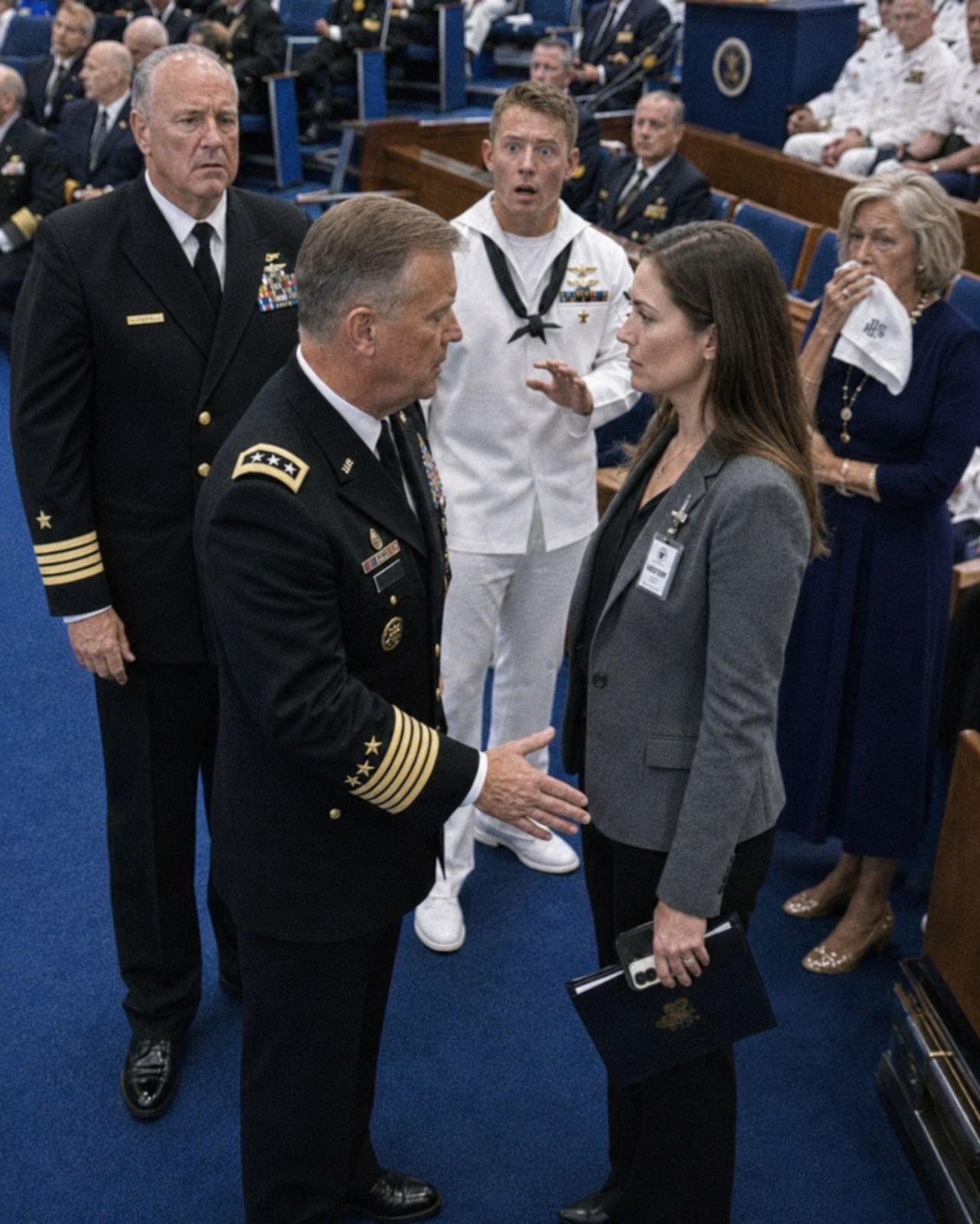
The first was Rear Admiral Susan Keller, a woman I had known for almost eight years.
The second was an intelligence liaison from Washington.
The third was a Navy commander carrying a locked communications case.
Keller stopped beside me.
“Director Hayes,” she said.
My father flinched as if the title itself had struck him.
Daniel actually turned around, searching for someone else with my last name.
There was no one.
I closed the folder.
My mother finally lowered her handkerchief.
“Director of what?” she asked.
Nobody answered immediately.
The intelligence liaison glanced at the crowd gathering around us.
“This is not the appropriate setting.”
That sentence should have ended the conversation.
It almost did.
Then my father found his voice.
“With respect,” he said, using the formal tone he had once used with superior officers, “I believe my family deserves some explanation.”
General Carter studied him.
“Your daughter has spent more than a decade protecting information you were never entitled to receive.”
My father’s face tightened.
“I’m her father.”
“And that,” Carter said, “does not constitute a security clearance.”
A few officers nearby looked away.
My father did not.
He was too stunned.
For twelve years, he had believed my silence proved his judgment correct.
Every unanswered question had become evidence against me.
Now he was discovering that my silence had not been shame.
It had been discipline.
The commander carrying the communications case stepped closer.
“Ma’am, Washington is requesting confirmation before the follow-on briefing.”
I nodded.
“Tell them I’ll join in fifteen minutes.”
Daniel stared at me.
“You can tell Washington to wait?”
The question escaped before he could stop it.
Admiral Keller gave him a look that contained more answer than any speech could have.
I slipped the secure phone back into my pocket.
“Daniel,” I said quietly, “this is your ceremony.
Go be with your team.”
It was not sarcasm.
I meant it.
He had earned the trident on his chest.
Whatever existed between us, his achievement was real.
But humiliation has a strange effect on people who are accustomed to giving it rather than receiving it.
Daniel did not walk away.
Instead, he stepped closer.
“So that’s it?” he said.
“You show up here dressed like a civilian, let everyone think you’re nothing, and suddenly a general calls you Director?”
His voice was rising.
People were listening.
My father whispered, “Daniel.”
But my brother had already lost control of the moment he thought belonged to him.
“You could have told us.”
I looked at him.
“You never asked without already knowing the answer you wanted.”
His jaw tightened.
“That’s not true.”
I remembered the Christmas dinner three years earlier when he had introduced me to his fiancée’s parents.
“My sister used to be Navy,” he had said.
Used to be.
Then he had smiled at me across the table.
“Didn’t quite work out.”
Everyone had laughed politely.
I had changed the subject.
I remembered my father’s retirement dinner, when a former colleague asked what I did for a living.
Before I could answer, Dad had said, “Private-sector paperwork.
She was never built for operational life.”
I had been forty-eight hours removed from an intelligence coordination center in Europe.
I said nothing then too.
Now Daniel was demanding explanations in front of several hundred people.
General Carter intervened.
“Lieutenant Hayes.”
Daniel straightened automatically.
Carter’s tone was calm.
“Your sister owes you no classified briefing.”
Daniel’s face turned red.
“No, sir.”
My father looked between us.
“What exactly is her position?”
Carter glanced at me.
I gave a small nod.
He chose his words carefully.
“Your daughter is a senior civilian director attached to a joint national security program supporting special operations and intelligence coordination.
Beyond that, I suggest you stop asking questions in public.”
My mother sat down suddenly.
My father remained standing.
Daniel looked at the trident on his chest.
Then at me.
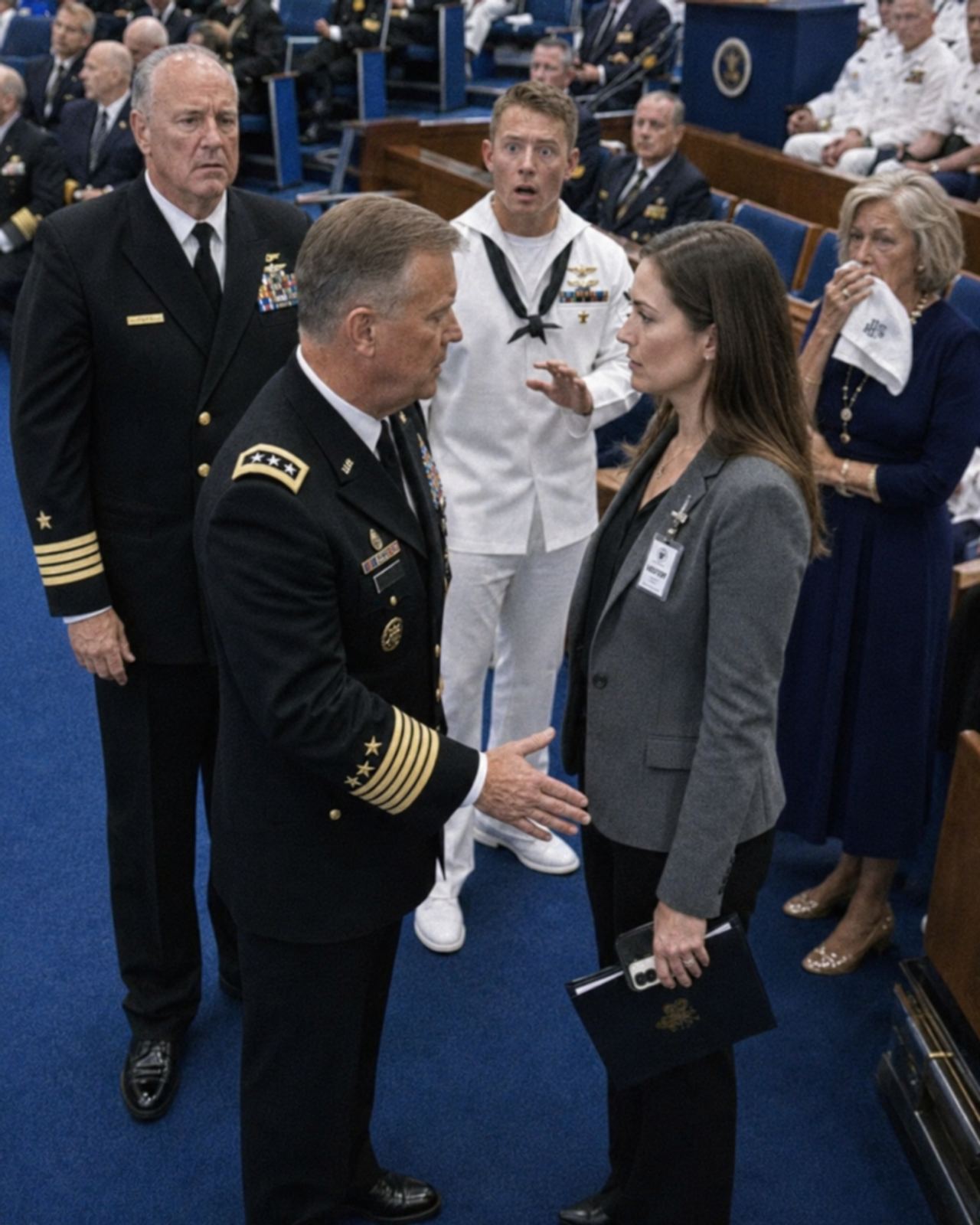
I knew what he was realizing.
The community he had just fought his way to enter was connected, in ways he had never imagined, to the world I had inhabited quietly for years.
The irony would have been funny if it had not hurt so much.
My brother had spent half his life trying to surpass the sister he believed had quit.
I had spent the same years trying not to let his contempt matter.
Admiral Keller touched my arm.
“We need to brief.”
I nodded.
Before I could leave, my father stepped in front of me.
His movement was not aggressive, but it stopped me.
“Samantha.”
I waited.
His voice dropped.
“Why didn’t you tell me?”
The question was almost gentle.
That made it harder.
I could have given him the easy answer.
“Samantha.”
I waited.
His voice dropped.
“Why didn’t you tell me?”
The question was almost gentle.
That made it harder.
I could have given him the easy answer.
I continued.
“You told everyone I failed.”
“I thought you had.”
“You never asked.”
“You wouldn’t explain.”
“I was nineteen, Dad.
I told you I had been recruited into another program.
You said it was an excuse.”
His face changed.
He remembered.
I could see it.
That night at the dining table had never left me.
I had come home with withdrawal paperwork and instructions I barely understood myself.
A federal recruiter had identified me through a language and analytical program connected to the Academy.
My departure was legal, authorized, and tied to a path so sensitive that even my explanation to my family had been deliberately incomplete.
My father had heard only one thing.
She left.
To him, leaving meant failing.
“You said you were going into some government analysis program,” he murmured.
“Yes.”
“I thought you were saving face.”
“I know.”
He looked down.
Behind him, Daniel said nothing.
General Carter checked his watch but did not interrupt.
For once, nobody rescued my father from the consequences of his assumptions.
My mother stood again.
Her eyes were wet.
“We were proud of Daniel,” she said softly.
“I know.”
“We thought you didn’t want us involved in your life.”
I looked at her.
“You stopped calling after I left the Academy.”
She opened her mouth.
Then closed it.
That was the problem with old family stories.
They become comfortable because everyone agrees not to inspect them too closely.
Mine had been simple.
Samantha quit.
Samantha pulled away.
Samantha was bitter about Daniel’s success.
Nobody had noticed how much effort it took for me to keep showing up anyway.
Birthdays.
Weddings.
Funerals.
Promotions.
And now Daniel’s SEAL ceremony.
I had stood at the back because no one saved me a seat.
I had still come.
Daniel finally spoke.
“Was this whole thing some kind of test?”
I frowned.
“What?”
“You standing back there.
Saying nothing.
Waiting for someone important to recognize you.”
His voice carried bitterness now.
As if my existence had become an attack on him.
“No,” I said.
“Then why come?”
That question silenced me for a moment.
Because beneath the arrogance, beneath the cruel jokes and years of competition, he was still my little brother.
I remembered him at six years old, running behind me on the beach with a plastic submarine in his hand.
I remembered helping him study for exams.
I remembered the first time he told our father he wanted to serve.
I had been proud of him then.
I was proud of him now.
“I came because you earned something difficult,” I said.
“And because I wanted to see it.”
His anger faltered.
“You never said that.”
“You never gave me the chance.”
He looked away.
General Carter’s expression softened slightly.
Then the secure phone inside my blazer vibrated again.
The moment ended.
Duty had a way of doing that.
I checked the screen.
The follow-on situation had changed.
Admiral Keller saw my face.
“What happened?”
“New intelligence.”
The commander immediately unlocked the communications case.
Carter stepped toward me.
“Do you need the secure room?”
“Yes.”
Within seconds, the emotional drama of my family became secondary to something larger.
That was another truth they had never understood about my life.
There was rarely time to feel things when they happened.
You stored them somewhere quiet and dealt with them later.
I started walking with Keller and Carter toward a restricted office behind the auditorium.
Then Daniel called after me.
“Samantha.”
I turned.
He stood beneath the bright lights in his white uniform, surrounded by family, teammates, officers, and strangers who had watched his certainty collapse.
For the first time that day, he did not look smug.
He looked young.
“Are those people from this morning okay?” he asked.
The question surprised me.
I thought of the message on my phone.
ALL PERSONNEL ACCOUNTED FOR.
“Yes,” I said.
“They made it home.”
Daniel nodded once.
Something changed in his face.
Not understanding.
Not yet.
But perhaps the beginning of respect.
I entered the secure room and spent the next forty minutes on an encrypted conference call.
By the time I emerged, most of the ceremony crowd had moved to the reception hall.
My father was waiting outside.
Alone.
He held two cups of coffee.
For a man who had commanded sailors through storms and crises, he looked strangely uncertain.
He offered me one.
I accepted it.
We stood in silence.
Finally he said, “I owe you an apology.”
I took a sip.
“Yes.”
He blinked.
I think he expected me to make it easier for him.
I had done that too often.
He stared into his coffee.
“I was cruel to you.”
“Yes.”
“I thought I was teaching you accountability.”
“You were punishing me for embarrassing you.”
His jaw tightened, but he did not argue.
That was new.
“I told people you failed.”
“You did.”
“I let Daniel believe it too.”
“You encouraged him.”
He closed his eyes briefly.
“I did.”
The hallway was quiet.
When he looked at me again, the retired captain was gone.
He was simply my father.
“I don’t know how to fix twelve years.”
“You don’t.”
He looked stricken.
I continued before he misunderstood.
“You don’t fix twelve years in one hallway because a general embarrassed you.”
He nodded slowly.
“You fix tomorrow.
Then the day after that.”
For the first time, his eyes filled.
“I’d like to try.”
I looked through the glass doors toward the reception.
Daniel was standing with several teammates.
My mother was beside him.
No one was posing for photographs anymore.
No one was performing.
“Then start by being proud of Daniel without using me as the failure standing next to him,” I said.
My father followed my gaze.
“I can do that.”
“And stop telling my story when you don’t know it.”
He nodded.
“I can do that too.”
We walked into the reception together.
People noticed.
Of course they did.
But this time my father did not rush ahead to explain me.
He did not announce my title.
He did not turn my career into a new trophy for the Hayes name.
He simply walked beside me.
Daniel saw us approach.
For one awkward second, nobody knew what to say.
Then he looked at me.
“I was an ass.”
My mother gasped.
I almost laughed.
“Yes,” I said.
Daniel rubbed the back of his neck.
“I kept thinking you left because you couldn’t do it.”
“I know.”
“And every time I achieved something, I compared it to you.”
“I know that too.”
He glanced down at his trident.
“I think I needed you to fail.”
That was the first completely honest thing he had said to me in years.
I nodded.
“Maybe.”
He looked at me again.
“Are you proud of me?”
I let the question sit for a moment.
Not to punish him.
Because he deserved a real answer.
“Yes, Daniel.
I am.”
His eyes reddened.
“But being proud of you does not mean I will let you humiliate me anymore.”
He nodded immediately.
“Fair.”
“No more dropout jokes.”
“Never again.”
“No more explaining my life to strangers.”
“Done.”
“And if I tell you I cannot discuss my work?”
He gave a faint smile.
“I’m going to assume it’s more interesting than insurance.”
That finally made me laugh.
The tension broke.
Not completely.
Twelve years of damage does not disappear because a family shares one honest conversation beside a reception table.
But something important had ended.
The lie had ended.
Not the classified parts of my life.
Those remained mine to protect.
The deeper lie was the one my family had repeated so often that even I had once begun to wonder whether they were right about me.
That leaving one path meant I had failed.
That silence meant weakness.
That being underestimated meant being small.
Later that afternoon, General Carter found me near the exit.
He glanced toward my family.
“Interesting ceremony.”
“That’s one word for it.”
He smiled.
“Your father all right?”
“He has some recalibrating to do.”
Carter nodded.
“And your brother?”
I watched Daniel across the room, laughing with his teammates.
This time, when someone pointed toward me and asked a question, Daniel did not smirk.
He simply said something quietly.
The man beside him looked at me with surprise, then respect.
Daniel caught my eye.
He gave me a small nod.
Not a performance.
Not an apology designed for an audience.
Just acknowledgment.
“He’ll be fine,” I said.
Carter started to leave, then stopped.
“For what it’s worth, Director, you could have corrected them years ago.”
I looked at him.
“Not without saying things I wasn’t supposed to say.”
“You could have given them something.”
“Maybe.”
He waited.
I thought about it.
“But eventually,” I said, “I realized I shouldn’t need a classified title to deserve basic respect from my own family.”
Carter nodded once.
“That,” he said, “is also true.”
He walked away.
My secure phone vibrated again.
Another message.
Another responsibility.
I slipped it back into my pocket without checking it yet.
For once, I gave myself five more minutes.
I crossed the reception hall and stood beside my brother while our mother insisted on taking a family photograph.
My father moved to put
Daniel in the center.
Then he stopped.
He looked at me.
“Here,” he said, making room beside him.
It was such a small thing.
A place in a photograph.
A space that should have existed all along.
I stepped forward.
The camera flashed.
Daniel’s trident gleamed beneath the lights.
My gray blazer looked almost plain beside the uniforms.
And for the first time in twelve years, nobody needed me to be less so someone else could feel like more.
Read more stories
- OMG, I tried this last night and my taste buds are still celebrating! Never thought someth
- Her Husband Gave Away Her Car. Her Father’s Quiet Call Changed Everything
- His Vasectomy Became A Weapon Until The Ultrasound Spoke
- “911, what’s happening there, sweetheart?” she asked, lowering her voice until it was almost a whisper.