
News
Inside Kenny Rogers’ Family World With Son Christopher Cody Rogers
At the peak of his 1980s fame, Kenny Rogers tried to build a private, grounded childhood for his son Christopher Cody Rogers—balancing arena tours, deep parental longing, and the pull of home at Beaver Dam Farms.


A long-awaited child arrived at the busiest moment
In 1982, Kenny Rogers and his fourth wife, Marianne Gordon, welcomed Christopher Cody Rogers after years of hoping to become parents together. By then, Rogers was not simply successful—he was in the thick of one of the most demanding stretches of his career, a period defined by relentless travel, sold-out performances, and a schedule that could keep him away from home for long stretches at a time.
That timing gave Christopher’s arrival a special emotional weight. He was not just another chapter in a celebrity life already moving at full speed; he became a reason to rethink what success was supposed to mean. For Rogers, who had spent years chasing the next concert, the next recording, the next professional obligation, fatherhood introduced a more intimate clock—the missed firsts, the fleeting milestones, the moments that do not wait for a tour to end.
Beaver Dam Farms was designed as a refuge from fame
Rather than raising their son in the center of the entertainment world, Rogers and Gordon built family life around Beaver Dam Farms, their large estate near Athens, Georgia. The property offered distance from Hollywood’s noise and a chance to create a childhood that felt more sheltered, spacious, and ordinary than the public might have expected from one of the era’s biggest stars.
That setting mattered. The image of Rogers in the public imagination was inseparable from the stage lights and the road, but home was something else entirely. Beaver Dam Farms became the place where celebrity receded and routine took over, where the focus was not on an audience but on one little boy’s daily life. It was a private answer to a very public career.
Marianne Gordon became the anchor of the household
A crucial part of that stability came from Marianne Gordon herself. She stepped away from a successful television acting career to stay home full-time with Christopher, shaping the family’s domestic world while Rogers was often away performing. Her choice gave the household consistency and gave Rogers confidence that, even when work pulled him elsewhere, his son’s life had steadiness at its center.
The arrangement also revealed the invisible labor behind many celebrity family stories. While Rogers’ fame was visible to millions, the structure that allowed their son to grow up with continuity was built largely at home. Gordon’s presence created the calm that made the rest of the family’s balancing act possible, especially during the years when Rogers’ schedule was at its most punishing.
A tour bus became an attempt to keep family together
Rogers knew that ordinary solutions would not solve an extraordinary problem: how do you remain present as a father when your job keeps you moving from city to city? His answer was both practical and revealing. He had a custom tour bus outfitted like a rolling family home so Gordon and young Christopher could join him during especially busy stretches on the road.
It was an effort to shrink the distance that touring creates. Instead of accepting a sharp divide between stage life and family life, Rogers tried to merge them where he could. The bus was not just a convenience; it was a statement of priority. If he could not always come home, he would try to bring home with him. For a child, that meant seeing a father not only as a figure who disappeared for work, but as someone trying, however imperfectly, to stay close.
In his memoir, Luck or Something Like It, Rogers later reflected on his deepest regret from the 1980s: that work claimed time that should have belonged to Christopher.
At home, every free hour was built around a child’s world
Back at the Georgia estate, Rogers shaped the property with his son in mind. Play areas, a swimming pool, and even a miniature golf course turned Beaver Dam Farms into a landscape of family recreation. These details say something important about his approach to fatherhood: when he was home, he wanted home to feel fully inhabited by childhood.
There is a tenderness in that impulse. For a performer used to commanding giant rooms, the real emotional center of life had shifted to smaller scenes—time in the yard, games, swimming, simple hours without an audience. The estate’s amenities were not just luxuries; they were tools for togetherness, ways to make rare days off feel complete and entirely devoted to Christopher.
Christopher became the emotional center of a 16-year marriage
For more than a decade, Christopher was, by every indication, the shared center of Kenny Rogers and Marianne Gordon’s marriage. Their family life was organized around him, and his presence gave shape to decisions about where they lived, how they traveled, and what kind of atmosphere they wanted to create away from public view.
Yet even the most intentional arrangements could not erase the strain of a life built around constant work. Rogers would later speak with unusual candor about the cost of those years, acknowledging that ambition and obligation had consumed hours he wished he had spent with his son instead. It is that note of regret, as much as the image of the custom bus or the Georgia estate, that makes this family story linger. Behind the star’s extraordinary success was a very ordinary ache: the fear of missing your child grow up.

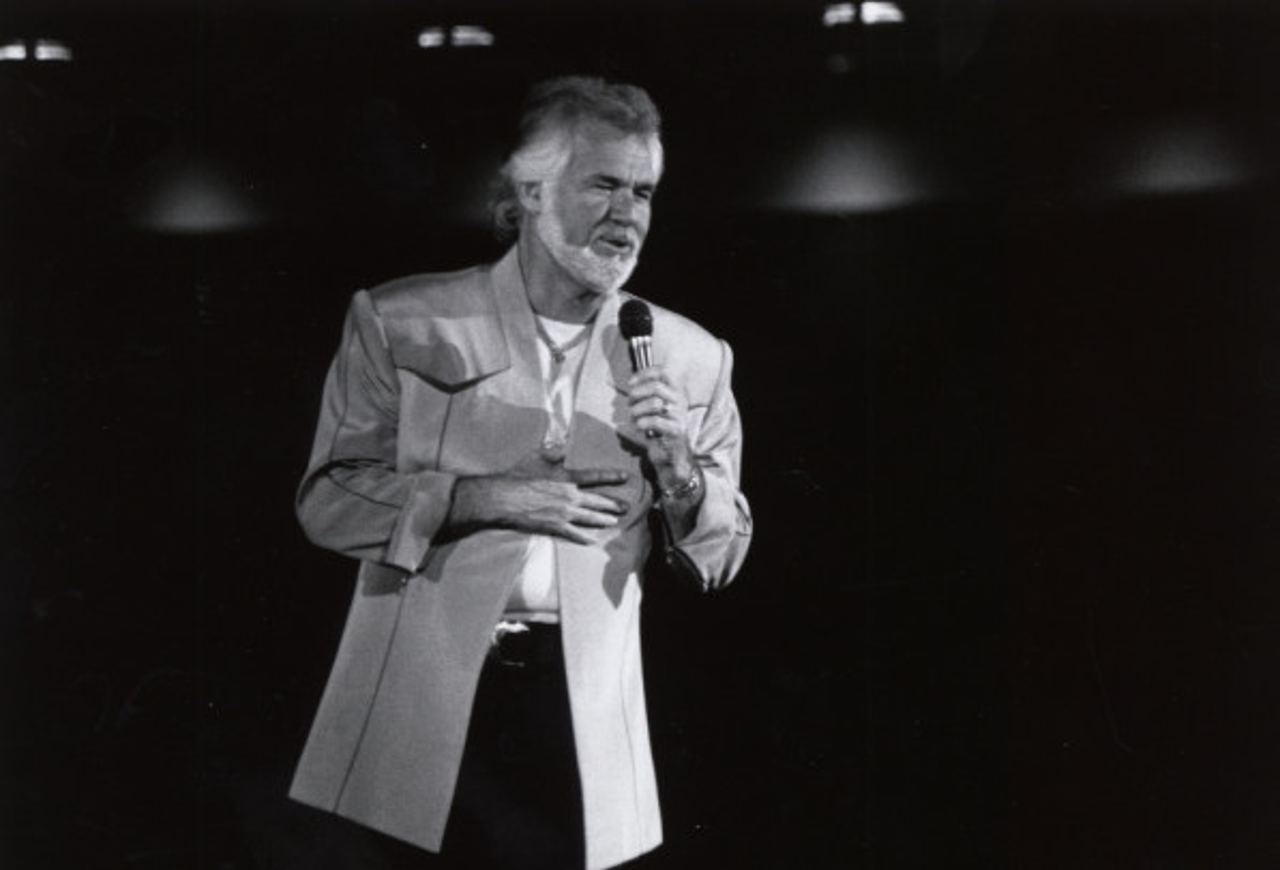
Quick Facts
- Child: Christopher Cody Rogers
- Parents: Kenny Rogers and Marianne Gordon
- Born: 1982
- Family home: Beaver Dam Farms near Athens, Georgia
- Marianne Gordon’s role: Left acting to stay home full-time with Christopher
- Kenny Rogers’ concern: Missing early milestones because of heavy touring
Image credits: Philpottm / Wikimedia Commons / CC BY-SA 3.0; User kw111786 on Flickr (Original version) User UCinternational (Crop) / Wikimedia Commons / CC BY-SA 2.0; University of Houston Digital Library / Wikimedia Commons / CC BY-SA 2.0.