
Human Stories
I Came Home Early and Found My Wife and Newborn Abandoned—But the Security Footage Revealed Who Had Really Been Paying for My Family’s Life
A man returns home early to find his wife and newborn in dangerous conditions, only to discover through hospital care, bank records, and security footage that his mother and sister had been using money meant for his family. As the confrontation deepens, hidden secrets from both spouses begin to surface, revealing years of manipulation and financial deception.

PART 2
By the time the cab pulled beneath the bright red letters of the emergency entrance, Maya was barely conscious.
The driver jumped out before I could ask for help. He opened the rear door, took one look at Maya’s gray face and the bundle tucked against my chest, then shouted toward the hospital doors.
“Somebody get a wheelchair!”
A nurse came running with an orderly behind her. The next few minutes dissolved into fragments—questions, fluorescent light, the squeak of rubber wheels, Liam’s thin cry, Maya’s fingers slipping from mine.
“She had a C-section eleven days ago,” I said as they lifted her onto a bed. “She’s bleeding. She has a fever. She hasn’t been eating.”
“How long has the bleeding been going on?”
“I don’t know.”
The answer tasted like failure.
I had spoken to Maya every day while I was in Germany. Sometimes twice a day. She had told me she was tired but fine. She had smiled at the camera while holding Liam against her shoulder. My mother had appeared behind her with a tray of tea and said, “Don’t worry about a thing, David. We have everything under control.”
And I had believed her.
A pediatric nurse gently took Liam from me. I resisted without meaning to.
“I need to check his temperature,” she said softly. “You can stay right here.”
The thermometer registered low. Not dangerously low, she assured me, but low enough that they wrapped him in heated blankets and brought warm formula. When the nurse asked what brand he had been taking, I told her the name of the prescription formula his pediatrician had recommended.
She frowned.
“This isn’t what’s in his diaper bag.”
I looked down. Inside the canvas bag was a half-empty tin of the cheapest powdered formula sold at a neighborhood discount store.
“That’s not his,” I said.
Maya turned her head toward us. Her eyes opened only halfway.
“Eleanor said the other one was wasteful,” she whispered. “She said babies don’t know the difference.”
The nurse’s expression changed, but she asked no further questions. She simply wrote something on the chart.
A doctor examined Maya behind a curtain while I sat outside with Liam against my chest. He had stopped crying and was making small, exhausted sounds in his sleep. His face was red from the cold. One tiny fist had escaped the blanket and rested against my shirt.
I had imagined meeting my son a hundred times during the flight home.
I had pictured Maya standing at the door, smiling despite her exhaustion. I had pictured taking Liam in my arms while my mother cried and Chloe took pictures. I had imagined warmth, food, laughter, and the city counting down to midnight outside our windows.
Instead, the first time I held my child, his body was chilled because the heat had been turned down in my own apartment.
A security officer passed the waiting area just as fireworks began exploding somewhere beyond the hospital walls. Through a narrow window, I could see flashes of red and gold reflected in the glass towers across the river.
Midnight.
The city celebrated.
I bent my head and kissed Liam’s soft hair.
“Happy New Year, son,” I whispered. “I’m sorry I’m late.”
The doctor came out twenty minutes later. She introduced herself as Dr. Patel and spoke in the calm, careful tone of someone accustomed to delivering frightening news without causing panic.
“Maya has a post-operative infection, dehydration, and significant anemia,” she said. “The incision has partially reopened. We’re admitting her for intravenous antibiotics and observation.”
“Is she going to be all right?”
“We caught it before it became more serious.”
Before it became more serious.
The phrase should have comforted me. It didn’t.
Dr. Patel glanced at Liam, who was sleeping against my chest.
“Your son should also remain here for monitoring tonight. His temperature is improving, and he’s feeding well. That’s encouraging.”
“Thank you.”
The doctor hesitated.
“Mr. Bennett, I need to ask you a difficult question. Was your wife being prevented from accessing food, medication, heat, or medical care?”
I looked through the curtain at Maya.
“I don’t know,” I said.
For the second time that night, the truth sounded unbearable.
Maya answered the question herself after they moved us into a private room.
“No one locked me in,” she said.
She lay propped against white pillows, an IV line in her arm. Some color had returned to her face, though she still looked painfully small beneath the hospital blanket.
“I could have called someone,” she continued. “I could have called an ambulance.”
“Why didn’t you?”
Her eyes shifted toward the bassinet beside my chair.
“Because your mother said if I embarrassed the family, she would tell you I wasn’t capable of taking care of Liam.”
I stared at her.
“She said what?”
Maya’s voice grew quieter.
“She said you were already under pressure at work, and that if I called you home, you might lose the German contract. She told me you had warned her I could be emotional after the surgery.”
“I never said that.”
“I know that now.”
“Maya, I never said anything remotely like that.”
“I know.”
The pain in her voice stopped me. I sat beside the bed and took her hand.
Her wedding ring hung loosely around her finger.
“I should have told you,” she said. “But every time I tried, she was nearby. Or Chloe was. They kept saying you had enough to worry about.”
“Why did you believe them?”
Maya looked at me then, and for the first time since I had found her, I saw something sharper than fear in her eyes.
“Because you always believed them first.”
The words landed without force, but they struck deeper than any accusation shouted in anger.
I opened my mouth.
Nothing came out.
Maya looked away.
“When we chose the apartment, your mother said I pushed you into spending too much. When I wanted Liam’s nursery painted green instead of blue, she said I was controlling. When I asked Chloe not to post pictures from my baby shower before I had shared them myself, Chloe cried, and you asked me to apologize.”
“I was trying to keep the peace.”
“You were keeping their peace.”
Outside the room, a cart rattled down the corridor. A nurse laughed softly at something a colleague said. Life continued at an ordinary pace while my understanding of my marriage quietly rearranged itself.
“I didn’t know it was this bad,” I said.
“No,” Maya replied. “You didn’t.”
She closed her eyes, exhausted.
I wanted to defend myself. I wanted to explain that I had spent years supporting everyone because my father died young and my mother had struggled. I wanted to say that Chloe had always been impulsive and Mark had been between jobs more often than he had been employed. I wanted to say that helping family was not the same as choosing them over my wife.
But as I watched Maya lie in a hospital bed because she had been afraid to call me, every explanation sounded like another excuse.
“I’m sorry,” I said.
Her eyes opened again.
“I don’t need you to be sorry tonight, David. I need to know Liam and I are safe.”
“You are.”
“From them?”
The answer should have been immediate.
It wasn’t.
Not because I wanted my mother or sister near Maya again, but because I suddenly understood that canceling their cards was the easiest part. The harder part would be accepting what they had done without softening it, explaining it away, or turning Maya’s suffering into another family disagreement everyone would be expected to move past.
“Yes,” I said at last. “From them too.”
Maya watched me for several seconds, as though measuring whether the promise could bear weight.
Then she nodded.
At 2:17 in the morning, my mother called.
I let the phone ring until it stopped.
A minute later, Chloe called.
Then Mark.
Then my mother again.
Messages began arriving.
There must be a problem with the hotel card.
Call me immediately.
David, this is humiliating.
The resort says the payment was declined.
We have Ethan’s family here. What are we supposed to do?
Ethan was Chloe’s ten-year-old son from her first marriage. His presence was the only reason I felt even a flicker of concern.
I texted Chloe.
Make sure Ethan has a safe place to sleep. Use your own funds. We will speak tomorrow.
Her reply came instantly.
My own funds? Are you serious?
I turned the phone facedown.
Maya had fallen asleep. Liam rested in the hospital bassinet, his small chest rising steadily beneath the blanket.
For the first time all night, there was silence.
I used it to think.
Fourteen thousand dollars.
That was the amount I had transferred before leaving for Germany. The money was meant to cover groceries, a night nurse, transportation to medical appointments, household help, and anything Maya or Liam needed while I was away.
I opened my bank account.
The transfer had gone into a secondary checking account that my mother managed with my permission. I had set it up years earlier after my father’s death. At first, it paid her rent and utilities. Over time, it became the account she used for family expenses.
I reviewed the transactions.
There was a charge for airfare to Miami.
Five tickets.
A resort deposit.
Designer clothing.
Two spa appointments.
A seafood restaurant.
A car service from the airport.
A jewelry store in Bal Harbour.
My thumb stopped over the screen.
The jewelry purchase was dated four days before Christmas.
Three thousand eight hundred dollars.
The account balance was forty-two dollars and sixteen cents.
I scrolled backward.
There was no payment to a night nurse.
No grocery delivery.
No pharmacy charge.
No payment to the cleaning service I had arranged.
Then I noticed something else.
A series of transfers, all for the same amount.
Nine hundred dollars.
One in August.
One in September.
Two in October.
One in November.
All sent to a company called Hudson Family Consulting.
I had never heard of it.
The next morning, while Maya slept and Liam underwent a routine examination, I called my attorney.
Daniel Ross had handled my business contracts for nearly a decade. He was also one of the few people I trusted to tell me when I was being foolish.
He answered on the fourth ring.
“David? It’s eight in the morning on New Year’s Day.”
“I need help.”
My voice must have told him the rest.
He stopped sounding sleepy.
“What happened?”
I stepped into the hallway and told him everything.
Not dramatically. Not angrily.
I gave him the facts: the empty apartment, the food, the note, Maya’s condition, Liam’s low temperature, the fourteen thousand dollars, and the charges in Miami.
Daniel was silent for several seconds.
“Have you spoken to your family?”
“No.”
“Good. Don’t yet.”
“I canceled the cards.”
“That was reasonable. Take screenshots of every transaction before anything changes. Download full statements. Save the note. Save all messages.”
“I already took pictures.”
“What about the apartment cameras?”
I leaned against the wall.
The security cameras.
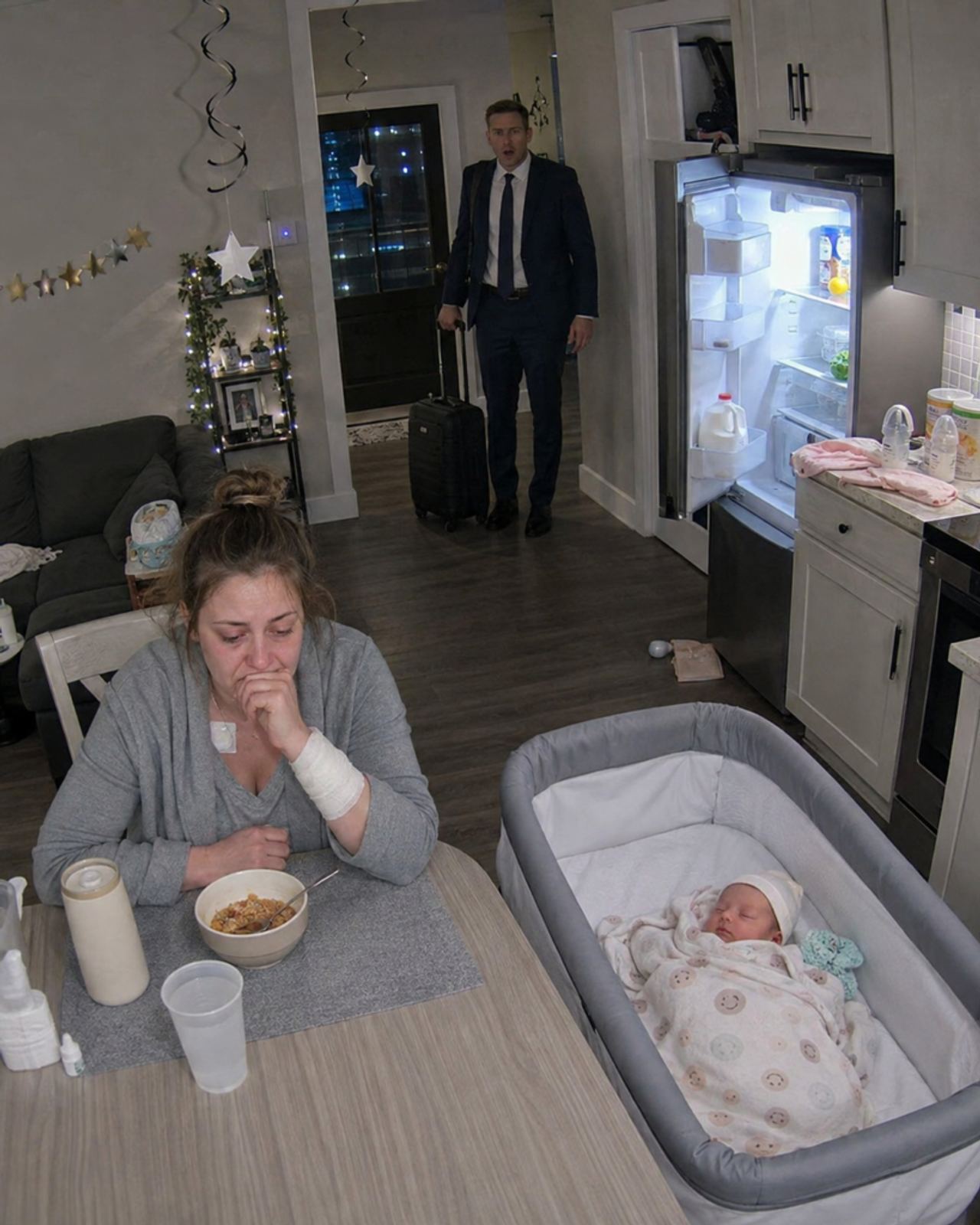
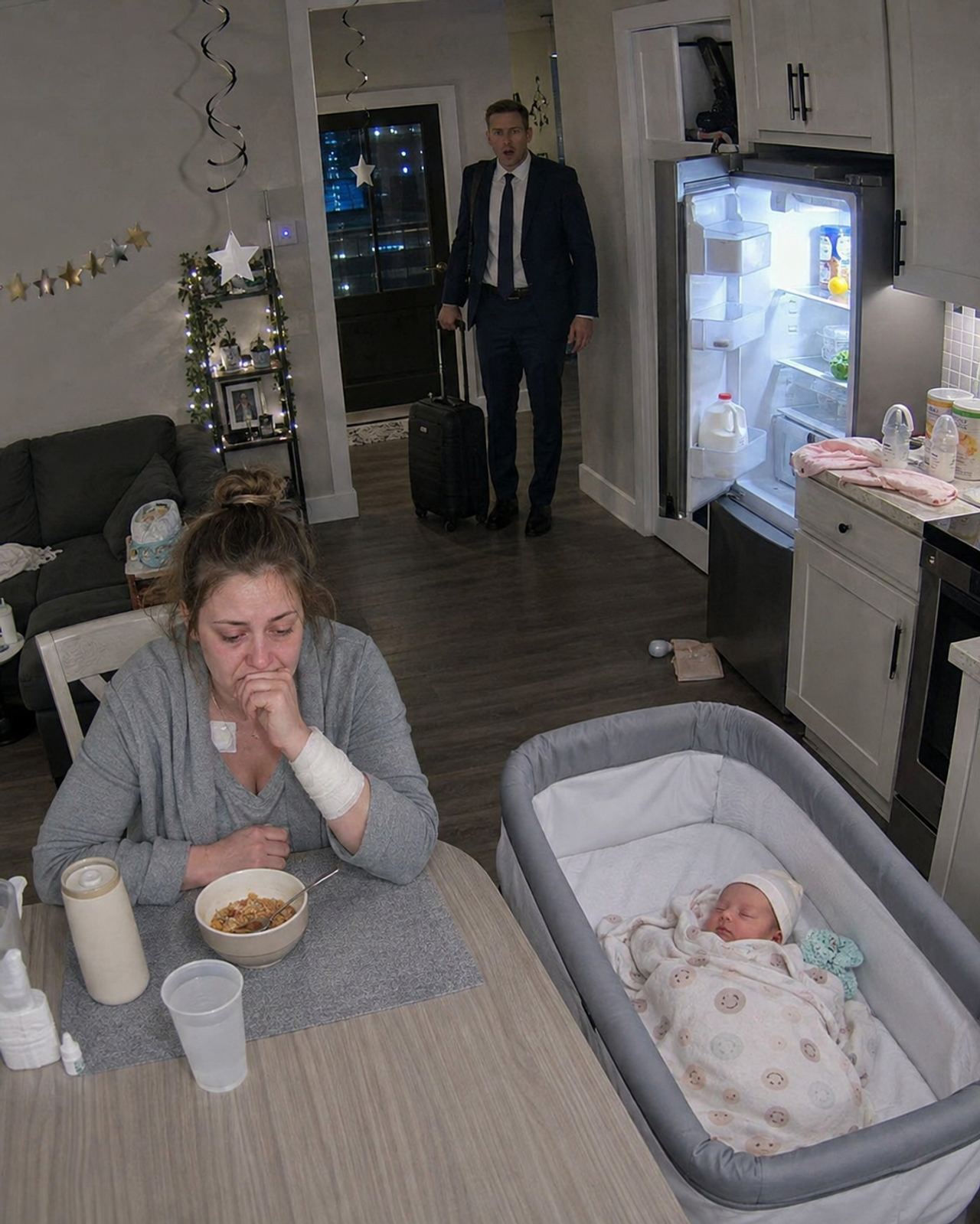
I had installed three of them after a package theft the previous year—one at the front door, one in the living room, and one overlooking the kitchen entrance. Maya had initially disliked the idea, so we had agreed never to place cameras in bedrooms or private areas.
The footage uploaded automatically to cloud storage.
“I haven’t checked,” I said.
“Check before you contact anyone.”
I returned to the room and opened the security application.
The first thing I noticed was that the kitchen camera had gone offline six days earlier.
The second was that it had not malfunctioned.
It had been manually disconnected.
The living room camera remained active.
I began with the previous morning.
At 8:12 a.m., my mother entered the frame wearing a linen travel suit and sunglasses. Chloe followed, carrying a suitcase. Mark came behind her with two more bags.
Maya stood near the sofa holding Liam.
Even through the small screen, I could see how carefully she moved.
My mother said something. The camera had audio, but the television was on, and the words were difficult to hear.
I increased the volume.
“You have food in the pantry,” Eleanor said.
“There are two packets of noodles,” Maya replied. “And crackers.”
“You said you didn’t have an appetite.”
“I said I felt nauseated.”
“Then noodles are perfect.”
Chloe walked through the room holding a white garment bag.
“Mom, we’re going to miss the car.”
Maya shifted Liam to her other arm.
“At least leave the formula Dr. Stein prescribed.”
Mark stopped beside the open suitcase.
“That stuff cost almost eighty dollars a tin.”
“It’s what his doctor recommended.”
My mother took the baby bag from the sofa, opened it, and removed two sealed tins of formula.
“We can return these on the way to the airport.”
Maya stared at her.
“You can’t return his food.”
“I bought replacement formula.”
“With David’s money,” Maya said.
My mother’s face changed.
It was not a dramatic change. She did not shout or raise a hand. She simply stepped closer until only a few inches separated them.
“Everything in this family is bought with David’s money,” she said quietly. “Including the roof over your head.”
I felt something cold move through me.
On the video, Maya tightened her hold on Liam.
“This is my home.”
My mother smiled.
“For now.”
The recording continued.
At 8:26, Chloe took several containers from the refrigerator and placed them into insulated travel bags.
At 8:31, Mark carried out the electric space heater I had ordered for the nursery.
At 8:34, my mother turned the thermostat down to fifty-eight degrees.
At 8:37, all three of them left.
Maya stood in the middle of the living room after the door closed.
For nearly a minute, she did not move.
Then she sat on the sofa and cried without making a sound.
I shut off the video.
My hands were shaking.
Daniel was still on the phone.
“David?”
“I saw enough.”
“Save the footage.”
“I will.”
“And listen carefully. This is no longer only a financial dispute. The hospital may be required to make a report because a recovering patient and newborn were left without proper care. Don’t interfere with that process.”
“I wouldn’t.”
“Also, do not threaten anyone. Do not post anything online. Do not make decisions about housing or access to the apartment until we understand who legally resides there.”
“My mother doesn’t live with us.”
“Does she receive mail there?”
“Sometimes.”
“Does she have a key?”
“Yes.”
“Then change the locks, but coordinate with building management. Do it properly.”
I looked through the glass panel in the door. Maya was awake, watching Liam sleep.
“Daniel, what is Hudson Family Consulting?”
“I don’t know.”
“There are repeated transfers from the account.”
“To a person or a company?”
“It says company.”
“Send me the details. I’ll look into it.”
When I returned to the room, Maya noticed my expression.
“You watched the cameras.”
It was not a question.
“Yes.”
She folded her hands over the blanket.
“How much did you see?”
“Enough to understand that you tried to stop them.”
“I should have tried harder.”
“No.”
“I let her take the formula.”
“You had just had surgery.”
“I still let her.”
I sat beside her.
“Maya, listen to me. I am not going to make you responsible for what they did.”
Tears filled her eyes, but she blinked them away.
“They kept saying I was selfish,” she whispered. “Every time I asked for anything, your mother reminded me that she raised two children after your father died. She said she went back to work three weeks after Chloe was born. She said women today expect to be treated like patients instead of mothers.”
“My father was alive when Chloe was born.”
Maya looked at me.
“What?”
“My father died when Chloe was nine.”
“She told me she raised both of you alone from infancy.”
“That isn’t true.”
The room seemed to become even quieter.
It was a small lie compared with what had happened, yet it unsettled me in a way I could not immediately explain.
My mother had told the story of her sacrifice for years. She had described exhausted nights, unpaid bills, and lonely holidays after my father’s death. I had built much of my adult life around repaying a debt I believed I owed her.
But if she had changed one part of the story, what else had she changed?
Maya studied my face.
“You didn’t know?”
“No.”
Before she could respond, a social worker entered the room.
Her name was Lena Morales. She had a composed face, kind eyes, and a folder tucked under one arm.
She asked to speak with us together.
Lena explained that the hospital’s concern was not merely Maya’s infection. It was the combination of her condition, the lack of food, the low temperature in the apartment, and the absence of the people who had agreed to care for her.
“No one is accusing either of you of neglecting your child,” she said. “But we need a clear plan before discharge.”
Maya stiffened.
“Are you going to take Liam?”
“No,” Lena said gently. “That is not what I said.”
Maya reached for my hand.
Lena waited until her breathing settled.
“Your son is healthy,” she continued. “Your husband sought care promptly when he found you. What we need to establish is that the home is safe, warm, supplied, and free from interference.”
“I can arrange that today,” I said.
“Who has access to the apartment?”
“My mother, my sister, and my brother-in-law.”
“Will they continue to have access?”
“No.”
Maya looked at me.
This time, my answer had come without hesitation.
Lena made a note.
“Because there may have been financial exploitation and deliberate deprivation of care, a report will be made. The police may contact you. This does not automatically mean anyone will be charged. It means the circumstances will be documented and reviewed.”
Maya’s fingers tightened around mine.
My first instinct was still the old one: protect the family name, prevent embarrassment, keep private matters private.
Then I remembered the footage.
The thermostat.
The formula tins.
My mother’s voice saying, For now.
“We’ll cooperate,” I said.
After Lena left, Maya stared at the closed door.
“You’re angry.”
“I am.”
“At me?”
I turned toward her.
“No.”
“You look like you want to break something.”
“I want to understand how I missed this.”
Maya gave a tired, humorless smile.
“You missed it because they were kind when you were watching.”
That sentence stayed with me all day.
By late afternoon, building management had changed the locks. Daniel arranged for a private home-care nurse to begin the morning Maya was discharged. I ordered groceries, formula, medications, and a second space heater.
I also booked a small furnished apartment two floors above ours for two weeks.
Maya was surprised.
“Why do we need another apartment?”
“So the locks can be changed, the cameras checked, and the apartment cleaned before you go back.”
“You think they’ll come home.”
“I know they will.”
At 5:40 p.m., my mother sent a voice message.
Her tone was controlled, but I could hear strain beneath it.
“David, I don’t know what game Maya is playing, but you have created a serious situation. The hotel is demanding payment, Ethan is frightened, and Chloe is in tears. Call me before this becomes something you cannot undo.”
I played it twice.
Then I handed the phone to Maya.
She listened without expression.
“What do you think I should do?” I asked.
Maya returned the phone.
“I think you should stop asking me to decide what kind of son you are.”
“That’s not what I’m asking.”
“It is, a little.”
She looked toward Liam.
“You want me to tell you it’s all right to confront her. Or that it’s all right to forgive her. Either answer would make me responsible for what happens next.”
I absorbed that.
“You’re right.”
“I don’t want revenge, David. I don’t want them humiliated. I don’t want Ethan dragged into this.”
“What do you want?”
“I want the truth to be allowed into the room.”
The phrase was so simple that it hurt.
At six o’clock, I called my mother.
She answered immediately.
“Finally.”
“Where is Ethan?”
“With Chloe.”
“Is he safe?”
“Of course he is safe. What kind of question is that?”
“Put Chloe on.”
“David—”
“Put Chloe on.”
There was movement, then my sister’s breathless voice.
“Are you out of your mind? The hotel froze the room charges. Mark had to call three friends.”
“Is Ethan safe?”
“Yes, he’s safe.”
“Do you have enough money to feed him and get him home?”
A pause.
“Yes.”
“Then come home tomorrow.”
Chloe’s voice sharpened.
“Why? So Maya can sit there looking fragile while you accuse us of things?”
“She’s in the hospital.”
Silence.
“What?”
“She has an infection. Her incision reopened.”
“That’s not our fault.”
I closed my eyes.
I had hoped for surprise. Concern. Regret.
Anything.
“What happened to the money I sent?”
“Ask Mom.”
“I’m asking you.”
“We thought the trip would be good for everyone.”
“Everyone?”
“For the family.”
“My wife and son are my family.”
“You know what I mean.”
“No,” I said. “I don’t think I do anymore.”
My mother took the phone back.
“This is exactly what Maya wanted.”
“Maya wanted to be left alone after surgery with no food?”
“She had food.”
“She had two packets of noodles.”
“She is exaggerating.”
“I watched the security footage.”
For the first time, my mother had no answer.
The silence stretched between us.
Then she said, very quietly, “You had no right to record private conversations.”
“It’s my apartment.”
“That camera was supposed to be for burglars.”
“It was.”
Her breath caught.
“David, you are upset. I understand that. We made a mistake leaving earlier than planned.”
“You took the baby’s formula.”
“We replaced it.”
“You turned down the heat.”
“The apartment gets stuffy.”
“You took the food.”
“It would have spoiled.”
“And you spent the fourteen thousand dollars.”
“That money was for family expenses.”
“It was for Maya and Liam.”
“You said it was to take care of the family.”
Her voice had changed. She was no longer denying what happened. She was rearranging the meaning of it.
“I need you to come home,” I said.
“We are not getting on a plane just so you can perform some dramatic interrogation.”
“The hospital filed a report.”
I heard Chloe speaking in the background.
Then Mark.
My mother covered the phone, but I could still hear fragments.
Police.
Report.
Cameras.
When she returned, her voice was colder.
“What exactly did you tell them?”
“The truth.”
“You don’t know the truth.”
“I know what I saw.”
“No,” she said. “You saw one morning.”
Something in her tone made me pause.
“What does that mean?”
“It means Maya has not told you everything.”
I looked at my wife. She was watching me from the hospital bed.
“What hasn’t she told me?”
My mother exhaled slowly.
“You should ask her why she refused to let us call the doctor three days ago.”
I turned toward Maya.
Her face had gone still.
“Why would she refuse?” I asked.
“Because she was afraid the doctor would ask questions.”
“What questions?”
My mother’s answer came carefully.
“About the money she has been sending out of the country.”
I stared at Maya.
She looked away.
My mother continued.
“She has her own secrets, David. Before you destroy this family, perhaps you should find out who your wife has been paying every month.”
Then the call ended.
For several seconds, neither Maya nor I spoke.
The machines beside her bed continued their soft electronic rhythm.
Finally, I asked, “Is that true?”
Maya’s eyes remained fixed on the blanket.
“Yes.”
The single word altered the air between us.
“Who have you been sending money to?”
“My mother.”
I knew almost nothing about Maya’s mother.
They had been estranged for years. Maya had told me that she grew up moving between relatives in the Philippines after her father disappeared. She rarely spoke of those years. When I had asked whether her mother would attend our wedding, Maya said only that it was better if she didn’t.
“How much?”
“Usually five hundred dollars. Sometimes more.”
“From where?”
“My personal savings.”
“Why didn’t you tell me?”
“Because I knew how it would look.”
I struggled to keep my voice level.
“How would it look?”
“Like I was doing the same thing you were doing.”
The answer stopped me.
Maya swallowed.
“My mother contacted me when I was four months pregnant. She said she was ill. I didn’t believe her at first. Then she sent medical records.”
“What kind of illness?”
“Kidney disease.”
“Have you spoken to her doctor?”
“No.”
“Have you seen her?”
“No.”
“Maya.”
“I know.”
There was shame in her voice, but also something else—fear.
“She asked me not to tell anyone,” Maya said. “She said the people caring for her would stop helping if they thought I had a wealthy husband.”
“Wh…
Read more stories
- My Mother-in-Law Threw Scalding Oil Over Me Because Dinner Wasn’t Ready When Her Son Walked Through the Door.
- I caught my husband lying to me in real time. He told me he was
- A NETWORK DEMANDED HE CHANGE ONE CONTROVERSIAL WORD—BUT ON LIVE TELEVISION, JOHNNY CASH LOOKED DIRECTLY INTO THE CAMERA AND PROTECTED A SONGWRITER’S TRUTH INSTEAD.
- My Niece Called Me “Family Trash,” So I Removed My Name From Everything Keeping Them Afloat