
Human Stories
His Son Came Home in Pain. Then One 911 Call Changed Everything-hihehu
A father notices his son returning from his mother’s house in severe pain and, after months of documenting concerning behavior, calls 911 to get help. In the hospital, the boy’s statement and the father’s evidence finally force others to see the truth.

Eli was supposed to be tired on Sunday evenings.
That was always the explanation Vanessa sent home with him.
Too much screen time.
Image
Too much sugar.
Too much attitude.
Too much of me letting him feel safe for forty-eight hours, though she never said that last part out loud.
I had learned to read the spaces between Vanessa’s words a long time ago.
During our marriage, she never yelled when other people were in the room.
She folded anger into calm sentences.
She could make a threat sound like a concern.
By the time we divorced, she had mastered the kind of softness that made everyone else lean toward her and away from me.
So when her gray SUV rolled to the curb in front of my house that Sunday evening, I already expected a little tension.
I expected a backpack tossed too hard onto my porch.
I expected one of her tight smiles.
I expected Eli to be quiet for an hour before he became himself again.
I did not expect him to walk toward me like every step hurt.
The summer air smelled like cut grass and hot pavement.
Somewhere down the block, a lawn mower coughed once and died.
The sudden silence made the scrape of Eli’s sneakers across my driveway sound too loud.
He moved slowly, one hand gripping his backpack strap so tightly his knuckles had gone white.
His cheeks were blotchy.
His eyes looked swollen.
His jaw was locked like he was holding a scream behind his teeth.
Vanessa did not get out of the car.
She rolled the window down halfway and called across the front yard, “He’s being dramatic again, Michael. Don’t feed into it.”
Then she looked through the windshield at our son.
It was not the look of a mother checking whether her child was okay.
It was the look of someone warning a witness not to speak.
My stomach turned before Eli reached the porch.
He used to run to me on Sundays.
He used to crash into my legs, drop his backpack in the entryway, and start talking so fast I had to laugh and tell him to breathe.
He would tell me what cereal he ate, what cartoon he watched, what dinosaur fact he remembered, what song got stuck in his head.
That was my boy.
He filled rooms.
For the last few months, he had been shrinking inside them.
First he stopped singing in the car.
Then his teacher sent home a note saying he had been chewing the skin around his fingers until they bled.
Then bedtime on Sunday turned into a negotiation no child should ever have to make.
“Please don’t make me go back tomorrow,” he would whisper.
When I asked why, his answer was always the same.
“Mom gets mad when I talk.”
I did what people tell fathers to do when they are scared and trying not to sound bitter.
I emailed his teacher.
I spoke with the school counselor.
I scheduled a child psychologist appointment.
I saved text messages.
I wrote down dates, pickup times, drop-off times, and the exact sentences Eli repeated more than once.
The first counselor note was clipped inside a folder by my desk.
A teacher’s email sat printed beneath it.
My phone held screenshots from three Sunday exchanges where Vanessa wrote that Eli was “attention seeking” or “confused after time with you.”
I had been documenting because I had learned a hard truth.
Fear sounds emotional.
Proof sounds useful.
People believe calm voices before they believe shaking hands, and that is how too many children learn to whisper.
Vanessa knew it.
She never raised her voice in meetings.
She wore soft sweaters.
She posted matching-pajama pictures online and wrote captions about gratitude.
She knew exactly how to make my concern sound like a divorced dad’s resentment.
Once, in the school office, she had tilted her head and said, “Michael is having trouble accepting boundaries.”
The counselor looked at me like I was the unstable one.
Vanessa kept going.
“Eli knows if he complains, Michael reacts. He likes the attention.”
I remember looking at my son through the small office window that day.
He was sitting on a plastic chair with his hands tucked under his thighs.
He looked like he was trying to take up less space than his own body needed.
I did not explode.
I did not accuse her in that office.
I wrote down the date when I got home.
That Sunday, standing in my entryway, Eli looked at the couch and swallowed hard.
“Dad,” he whispered, “can I go to sleep without sitting down first?”
Something inside me dropped so fast I felt dizzy.
I crouched in front of him.
“Buddy, what happened?”
His mouth opened.
Then it closed.
“Nothing.”
That word scared me more than a scream.
I reached slowly toward his shoulder, trying to make sure he saw my hand coming.
He flinched anyway.
For one ugly heartbeat, I saw Vanessa’s SUV still in my mind.
I pictured myself running into the street.
I pictured yanking open her door.
I pictured demanding answers while every neighbor on the block watched from behind curtains.
My hands curled before I forced them open again.
Rage would have made a mess.
Documentation could save him.
So I stood, walked to the kitchen counter, picked up my phone, and dialed.
“911, what is your emergency?”
My own voice sounded far away.
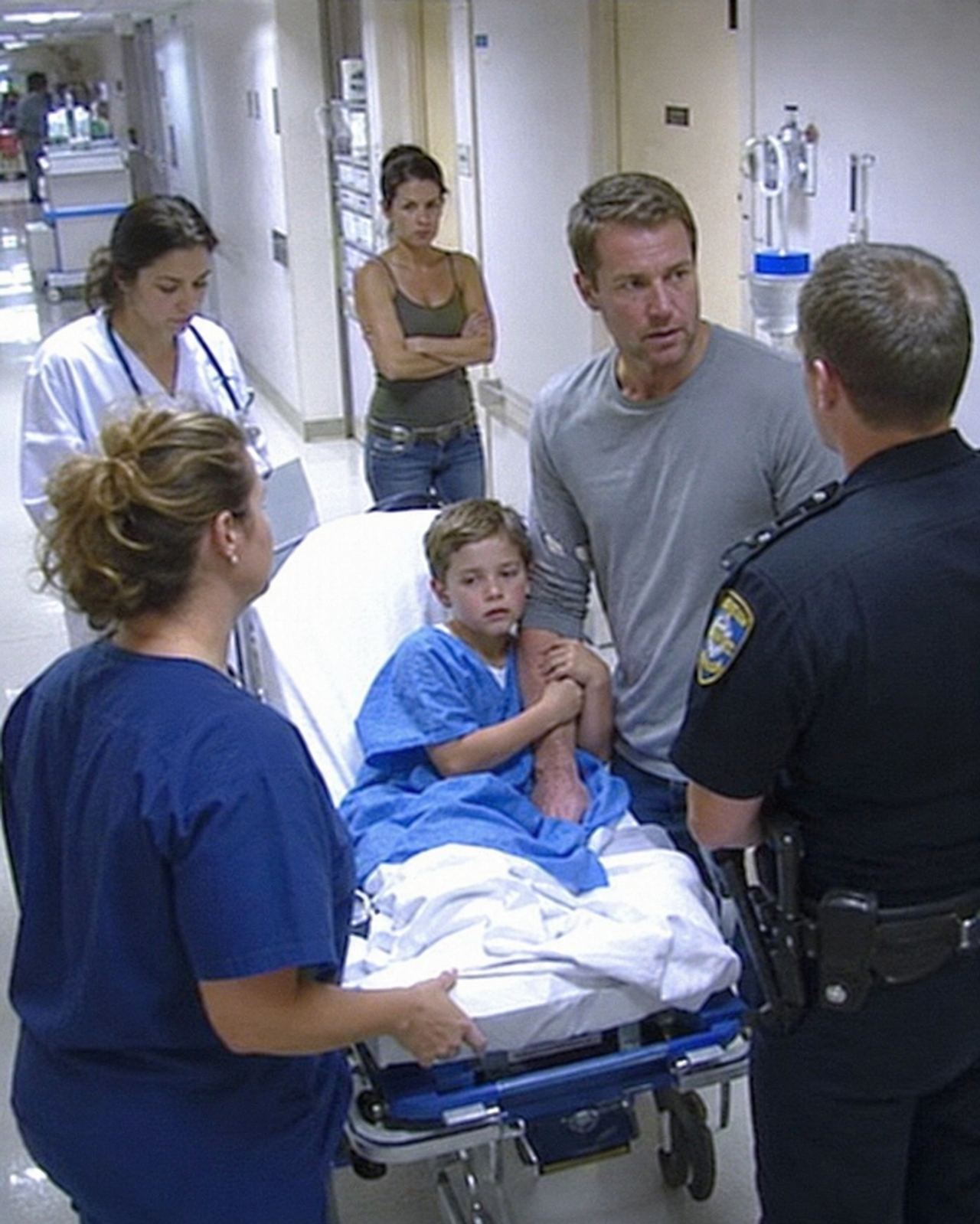
“My eight-year-old son was just dropped off by his mother,” I said. “He is in severe pain. He can barely move. I need an ambulance and a police officer at my address immediately.”
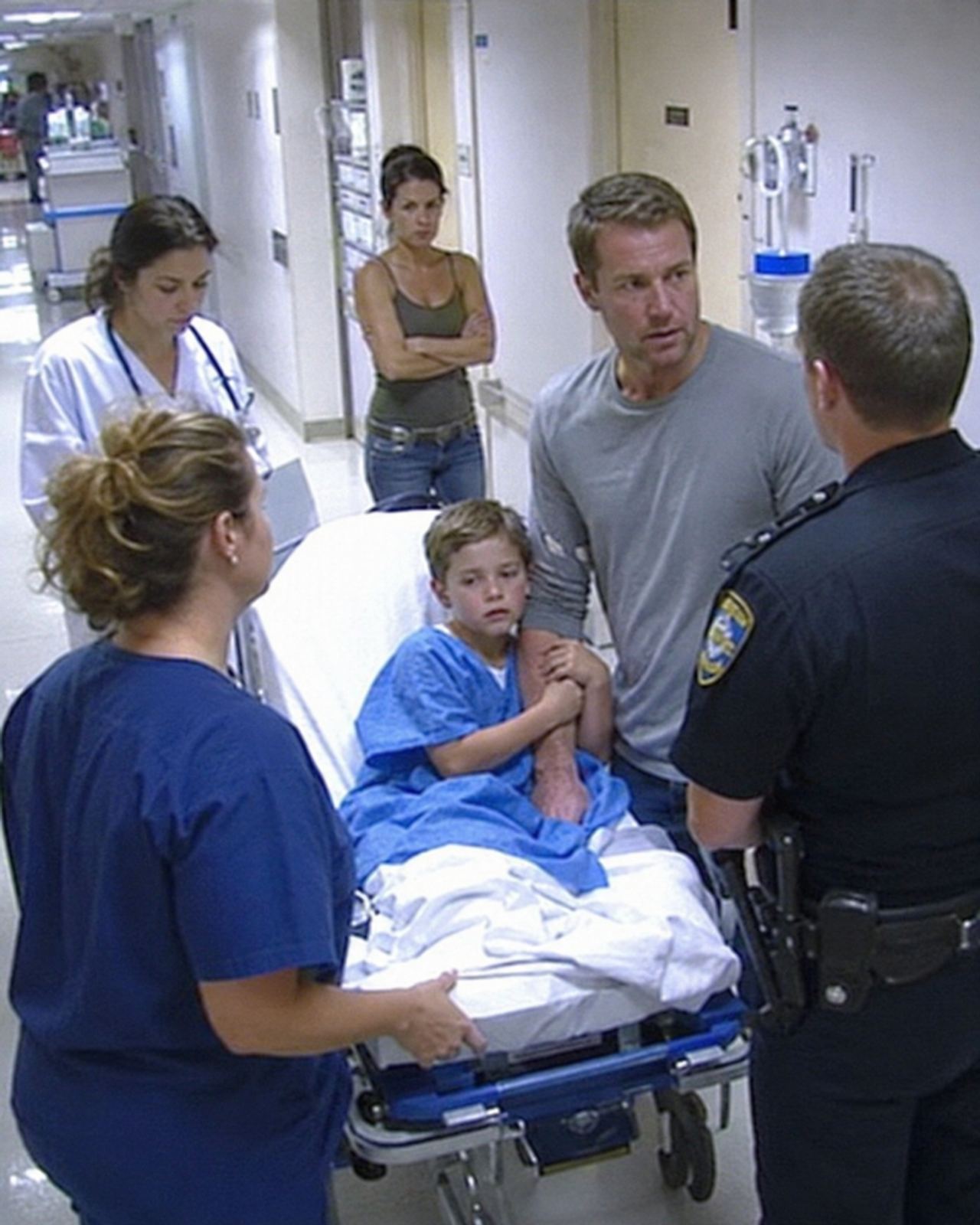
Eli’s face changed.
Not confusion.
Panic.
“No, Dad,” he said. “Please. Mom said if police came, they would take me away and put you in jail.”
That was the moment I understood the damage was not only in his body.
It had been planted deep in his mind.
I knelt again and held his cold hands between mine.
“Listen to me,” I said. “You are not in trouble. You did nothing wrong. Nothing.”
He began to cry without sound.
Even crying had rules now.
The ambulance came first.
The police cruiser pulled in less than a minute later, tires hissing against the curb.
Curtains shifted in two houses across the street.
A dog barked once behind a fence.
For the first time all evening, I stopped caring who saw.
An EMT stepped inside with a medical bag in one hand.
She knelt in front of Eli.
Her expression changed before she said a word.
“Who brought him here like this?”
“His mother,” I said. “Fifteen minutes ago.”
“Did she stay?”
“No.”
The EMT took one slow breath.
“We need to move now.”
A second EMT rolled the stretcher to the porch.
The police officer asked for the basic facts while I kept my eyes on Eli.
Time of drop-off.
Vehicle.
Whether Vanessa had said anything.
Whether Eli had named what happened.
I gave him everything I could without filling in what I did not know.
At 6:12 p.m., the officer wrote in his notebook.
At 6:14 p.m., I showed him the most recent text exchange.
At 6:17 p.m., the EMTs lifted Eli carefully onto the stretcher.
He grabbed my shirt with both fists.
“Dad, don’t let go.”
I bent until my forehead touched his.
“I’m not going anywhere.”
At the hospital, the intake desk moved faster than I expected.
A nurse took one look at Eli and called for someone behind the double doors.
A doctor read the intake notes and led us straight back.
I tried to follow, but a social worker stopped me with one gentle hand.
“We have to document this correctly,” she said.
Correctly.
That word hit me harder than I expected.
For months, I had been trying to document the shadow.
Now the thing itself was standing under bright hospital lights.
A nurse placed a hospital wristband around Eli’s wrist.
The EMT gave the timeline.
The officer stood near the intake desk.
The social worker wrote down Eli’s words exactly as he gave them, without smoothing them, without improving them, without making them easier for adults to hear.
I sat in the ER hallway with my hands locked together.
Low voices moved behind the exam room door.
The fluorescent lights buzzed above me.
A paper coffee cup sat on a side table, untouched and cooling.
My phone kept lighting up in my hand.
Three missed calls from Vanessa.
Then a text.
“You are making a huge mistake.”
Then another.
“He lies when he is scared.”
Then another.
“Do not let them question him without me.”
I screenshotted every message.
Not because I was calm.
Because my hands needed something useful to do.
At 6:41 p.m., the nurse stepped out with a clipboard held close to her chest.
The social worker followed.
The officer moved closer to the desk.
No one said much.
They did not have to.
Every adult face in that hallway had shifted from concern to recognition.
Then the automatic doors opened.
Vanessa stepped into the ER with perfect lipstick.
She did not look at the nurse first.
She looked at me.
“Michael,” she said, soft enough for strangers to trust, “you need to stop this.”
The officer turned toward her.
The social worker did not move, but her fingers tightened around the clipboard.
Behind the half-open exam room door, I heard Eli crying again.
This time, it was not silent.
“Ma’am,” the officer said, “are you the child’s mother?”
Vanessa gave him a small, exhausted smile.
“Yes. And my ex-husband has been coaching him. This is exactly what I warned the school about.”
Then the nurse stepped forward with the intake form.
That was the thing Vanessa had not counted on.
A form does not care how polished your voice sounds.
It does not care what sweater you wore.
It does not care who looked calmer in the school office.
It asks for time, condition, statement, witness, signature.
It leaves less room to perform.
There was a timestamp at the top.
6:41 p.m.
There was a line for who brought the child in.
There was another line for the child’s statement before treatment.
And beneath that, written in block letters, were words Eli had been too scared to say in my living room.
Vanessa saw the page before I did.
Her mouth opened.
Nothing came out.
The social worker’s face changed first.
The officer looked down once, then back at Vanessa.
His expression went from polite to cold.
Even the nurse pressed one hand against the clipboard like she needed it to stay standing.
Then Eli’s small voice came from behind the exam room door.
“Dad? Is she here?”
Vanessa’s smile cracked.
The officer took one step toward her.
“Mrs. Carter,” he said, “before you say another word, you need to understand that your son has made a statement.”
Vanessa blinked quickly.
“He’s confused.”
The social worker answered before I could.
“He was very clear.”
Something in that sentence changed the air.
Vanessa looked at me again, but the old power was gone from her face.
For years, she had relied on being the calmest person in the room.
Now she was in a room full of people trained to watch what calmness tries to hide.
The officer asked her to step aside.
She tried to refuse.
She asked whether she was being accused.
She asked whether I had put them up to this.
She asked to see Eli.
The doctor came out then and said, firmly, “Not yet.”
Those two words almost folded her in half.
I had thought I would feel satisfaction when someone finally saw what I had been trying to show them.
I did not.
I felt sick.
I felt furious.
I felt like I had been standing outside a burning house for months, begging people to smell smoke, and now that flames were showing through the windows, all I could think was that my son had been inside the whole time.
The officer took my folder when I offered it.
Teacher email.
Counselor note.
Screenshots.
Exchange times.
The text Vanessa had sent minutes earlier.
He did not read every page in the hallway.
He looked at the first two, then at the social worker, and nodded once.
That nod did not fix anything.
But it opened a door I had been pushing against alone for too long.
Eli was treated that night.
The medical team documented everything they were required to document.
The social worker stayed until the initial report was completed.
The officer took my statement and told me what would happen next.
There would be a report.
There would be follow-up.
There would be people asking hard questions in rooms where Vanessa could not control the story with a soft sweater and a tired smile.
When I was finally allowed back beside Eli, he looked smaller than eight.
The hospital blanket covered him up to his chest.
His backpack sat on a chair in the corner.
His wristband looked too big on his arm.
He turned his face toward me and whispered, “Are you going to jail?”
I sat beside the bed and took his hand.
“No,” I said. “And neither are you.”
His fingers tightened around mine.
“Mom said you would.”
“Mom was wrong.”
He stared at the ceiling for a long time.
Then he asked, “Can I tell the truth now?”
The question nearly broke me.
Not because of what it meant for Vanessa.
Because of what it meant he had been carrying.
I leaned close enough that he did not have to raise his voice.
“Yes,” I said. “You can tell the truth now. And I will stay right here while you do.”
He cried then.
Real crying.
Messy, scared, exhausted crying.
No rules.
No holding it behind his teeth.
No checking the doorway first.
I stayed with him until his breathing evened out.
In the chair beside his bed, with the fluorescent lights dimmed and the hallway finally quieter, I thought about every person who had told me to be careful not to overreact.
I thought about every time I had swallowed my anger because I knew Vanessa would use it against me.
I thought about the folder by my desk and the screenshots in my phone and the teacher who had written one note because she saw something adults at home kept trying to explain away.
People believe calm voices before they believe shaking hands.
But that night, calm finally met paper.
Paper met witnesses.
Witnesses met a little boy brave enough to speak once someone made the room safe.
By morning, I was not the father making accusations anymore.
I was the father who had called for help before anyone could clean up the truth.
And Eli was not the dramatic child Vanessa had tried to describe.
He was an eight-year-old boy who had walked into my house like every step hurt and still found enough courage to say the first honest words that saved him.
When the sun came through the hospital blinds, he was asleep with one hand still wrapped around my sleeve.
I did not move.
I had promised him I would not let go.
This time, everyone heard me.
Read more stories
- Three hours before my grandmother’s will was read, my mother gripped my wrist in the lawyer’s office and whispered, “If you get even a dollar, I will make your life unbearable.” She had already locked me out while Grandma was dying and twisted my silence into proof I didn’t care—so when the lawyer reached for a second stack of papers marked with a red clip, everything in that room shifted.
- MY HUSBAND BURNED MY ONLY NICE DRESS SO I COULDN’T ATTEND HIS PROMOTION GALA—HE CALLED
- My Son Walked Into Graduation Wearing a Red Dress — The Reason Silenced the Entire Room
- The Seekers’ “Georgy Girl” Bridges Folk and Pop Worlds to Achieve Global Acclaim in 1966