
Human Stories
Her Husband Called Their Sick Daughter a Faker. The Scan Proved Otherwise
A mother finally takes her daughter’s ongoing pain seriously after her husband dismisses the girl as faking it, and an ultrasound reveals a dangerous ovarian mass. The diagnosis forces the family to confront denial, control, and the cost of not believing a child’s symptoms.

Maya Thorne had always been the kind of child who made noise without trying.
She hummed while brushing her teeth.
She kicked a soccer ball against the garage door until the whole house thudded in rhythm.
She laughed on the phone with her friends so loudly that I used to knock on her bedroom door and remind her we had neighbors.
For fifteen years, that noise had been the proof of her presence.
Then, slowly, our house got quiet.
It did not happen all at once.
That is the cruel part about watching someone you love get sick. The first signs are small enough for other people to dismiss and big enough to keep a mother awake.
At first Maya said her stomach hurt after dinner.
Then she said she felt nauseated before school.
Then she stopped finishing breakfast.
Then she started coming home and falling asleep with her sneakers still on, one arm over her stomach as if her body was guarding a secret from itself.
I noticed everything.
Robert noticed enough to be annoyed.
My husband was not a man who liked mess, uncertainty, or bills he had not approved in advance.
When we first married, I thought that made him steady.
He kept receipts in labeled envelopes.
He knew when the car insurance renewed.
He could tell you what the electric bill had been in March two years earlier, and he said things like “planning is love” with such confidence that I believed him.
For a long time, I trusted him with the practical parts of our life.
I gave him access to every folder, every account, every password, every decision I was too tired to fight about.
That was my trust signal.
I thought I was sharing the weight of a family.
He treated it like ownership.
By the time Maya got sick, Robert had spent years training our home to orbit around his approval.
Doctor visits needed his approval.
Unexpected expenses needed his approval.
Even fear, somehow, needed his approval before it counted.
The first night Maya pushed away her dinner, he said she was being dramatic.
The second week, he said she was avoiding school.
By the third week, he was saying the same sentence almost every evening.
“She’s faking it.”
He said it at the kitchen table with his phone in one hand and a fork in the other, like our daughter’s pain was an inconvenience that had shown up without an appointment.
Maya sat across from him in an oversized hoodie, pale under the kitchen light.
The room smelled like reheated chicken, dish soap, and the lemon candle I lit when I was trying to make our house feel kinder than it was.
The small American flag on our porch tapped against the post whenever the wind moved through the neighborhood.
Robert never looked up.
“Don’t throw money away on hospitals,” he said.
Maya’s eyes dropped to her plate.
That was the moment I should have stood up and told him the conversation was over.
I did not.
I wish I could make myself braver in the retelling, but the truth is quieter and harder.
Fear can become a habit inside a marriage.
You learn when to speak, when to soften your tone, when to wait until someone is in a better mood.
You tell yourself you are keeping peace.
Sometimes you are only teaching your children what silence costs.
After that night, I stopped trying to convince Robert and started documenting Maya.
I wrote down when she ate and when she could not.
I saved the school nurse’s email from Tuesday morning saying Maya had come in dizzy after second period.
I took a photo of the untouched bowl of soup she left on Wednesday night, not because soup mattered, but because proof had become the language my husband could not pretend not to understand.
On Thursday, Maya bent down to tie her shoes and froze with one hand pressed to the wall.
“Sweetheart?” I asked.
“I’m fine,” she said.
She was not fine.
Her face had gone the color of wet paper.
On Saturday, she slept fourteen hours.
On Sunday, she cried in the bathroom with the faucet running because she thought the sound would hide her.
At 2:13 a.m. on Monday, the sound that woke me was not loud.
It was a thin, broken breath.
I got out of bed before I was fully awake.
The hallway carpet felt cold under my feet.
Robert slept on his side of the bed, turned away from the door.
When I opened Maya’s room, the desk lamp was still on.
She was curled tightly on her side, both arms wrapped around her stomach, gray hoodie twisted around her wrists.
Her knuckles were white.
Her face was shiny with tears.
There was a dark crescent soaked into the edge of her pillow.
“Mom,” she whispered, and the word barely survived leaving her mouth.
I crossed the room and sat beside her.
“Please,” she said. “Make it stop hurting.”
Something in me hardened then.
Not anger.
Older than anger.
A mother’s body recognizing that the time for permission was over.
The next afternoon, I signed Maya out through the school office at 1:42 p.m.
The secretary looked at Maya’s pale face and did not ask many questions.
I wrote my name on the checkout sheet, put my hand between Maya’s shoulder blades, and guided her through the glass doors into the parking lot.
She moved slowly.
Every step looked negotiated.
I buckled her into the family SUV and drove straight to Riverside Medical Center.
I did not tell Robert.
On the way, Maya stared through the passenger window at strip malls, gas stations, and yellow school buses moving through the afternoon traffic.
She did not ask where we were going.
I think she knew.
At the hospital intake counter, a woman with tired eyes slid a clipboard toward me.
The forms were ordinary in the way terrifying things often are.
Patient name.
Date of birth.
Insurance information.
Consent to treat.
A bright orange insurance sticker was placed crookedly in the upper corner.
I signed everything.
At 2:27 p.m., a nurse printed a plastic wristband with Maya Thorne on it and fastened it around my daughter’s thin wrist.
At 2:46 p.m., they took blood.
At 3:08 p.m., the ultrasound order appeared in the chart.
Robert texted while Maya was sitting beside me in the waiting area.
Where are you?
I turned the phone facedown in my lap.
That small act felt enormous.
For years, I had answered him quickly because it was easier than explaining later.
But motherhood has a different spine.
It stands up even when the rest of you is shaking.
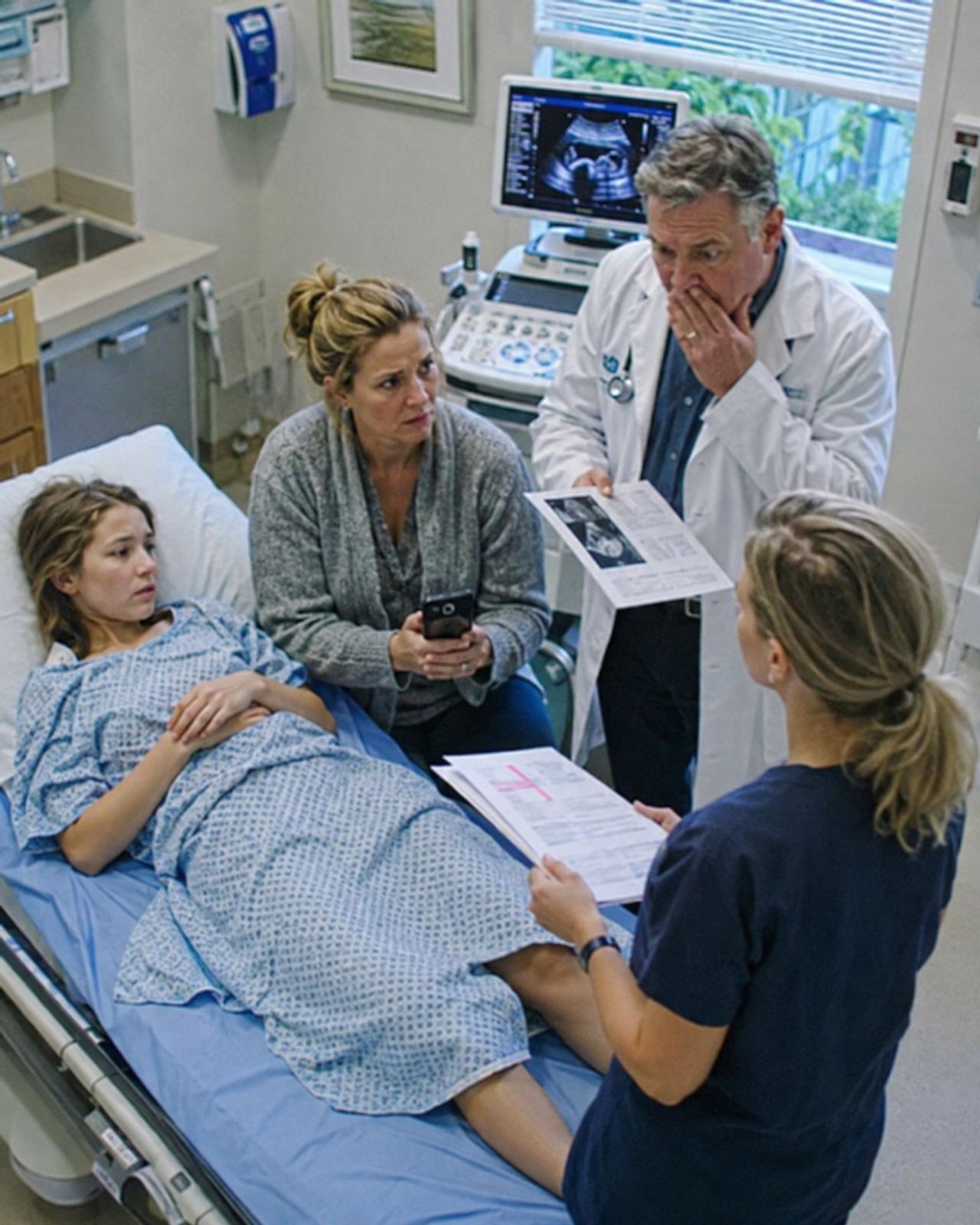
The ultrasound room was clean, pale, and too bright.
It smelled like antiseptic and warm plastic.
Maya lay on the exam table under a thin paper sheet while the technician warmed gel between her gloved hands.
“This may feel a little cold,” the technician said.
Maya nodded.
Her fingers found the edge of the mattress and gripped it.
At first, the technician made gentle conversation.
She asked Maya about school.
She asked whether she played sports.
Maya said soccer, but not lately.
The technician smiled at that.
Then the wand moved lower across Maya’s abdomen.
The technician stopped talking.
The silence was not empty.
It was active.
It had weight.
She adjusted the angle, pressed a button, took an image, adjusted again, took another.
Her eyes flicked over the screen.
Her mouth flattened.
I watched her hands instead of the monitor because I was afraid of what my own face might do if I looked too soon.
“Is something wrong?” I asked.
The technician’s voice became professional.
“The doctor will review everything with you.”
That was not an answer.
It was a door closing.
She saved the images and left the room.
Maya turned her head toward me.
“Mom?”
I touched her ankle through the sheet.
“I’m right here.”
Seven minutes later, Dr. Lawson came in holding a clipboard.
He had kind eyes, which somehow made it worse.
Doctors who are about to say nothing serious move differently from doctors who are choosing every word.
Dr. Lawson was choosing every word.
“Mrs. Thorne,” he said, “we need to talk.”
Maya pushed herself up on one elbow.
The paper beneath her crinkled.
“Am I in trouble?” she asked.
The question broke my heart because it told me exactly what Robert’s voice had taught her.
Pain had become something she thought she had to defend.
“No, sweetheart,” I said. “You are not in trouble.”
Dr. Lawson looked at the ultrasound screen.
Then at the bloodwork.
Then at me.
“The scan shows there is something inside her,” he said.
For one second, the room stopped being a room.
The lights were too bright.
The monitor hummed too loudly.
The gel bottle on the counter, the folded hoodie on the chair, the orange sticker on the intake form, every ordinary object became painfully sharp.
“Inside her?” I repeated. “What does that mean?”
He turned the monitor slightly.
A pale shape filled part of the screen.
I did not understand what I was seeing, but I understood his face.
Maya’s fingers tightened around my sleeve.
My phone buzzed again.
Robert.
You better not be at a hospital.
I stared at the words.
Not Are you okay.
Not Is Maya okay.
A warning.
Dr. Lawson saw my face change.
“Is there someone coming here?” he asked.
“My husband,” I said.
The doctor’s expression shifted again, not dramatically, but enough.
He asked whether Maya had recent trauma.
He asked whether she had fallen.
He asked whether she took any medication not listed on the intake form.
I said no to all of it.
Then the nurse returned with one more sheet marked URGENT REVIEW.
Dr. Lawson read it and went still.
The nurse said quietly, “Should I call pediatric surgery?”
That was the moment the scream came out of me.
Not because I understood.
Because I did not.
Because every terrible possibility arrived at once and none of them had a name yet.
Dr. Lawson moved closer and lowered his voice.
He explained that the ultrasound showed a large mass in Maya’s abdomen.
He did not call it cancer.
He did not call it benign.
He said they needed additional imaging immediately and that pediatric surgery needed to evaluate her because the mass appeared to be pressing against surrounding tissue.
He said her bloodwork showed inflammation and anemia.
He said her pain was real.
Those five words hit me harder than the medical language.
Her pain was real.
Maya heard them too.
Her face crumpled.
“I told Dad,” she whispered.
“I know,” I said.
“I told him so many times.”
“I know, baby.”
Robert arrived twenty-six minutes later.
He came into the room angry, not frightened.
That is a detail I will never forgive.
He opened the door with his jaw set and his work badge still clipped to his belt.
“What is this?” he demanded.
Maya flinched.
Dr. Lawson turned toward him.
“Mr. Thorne, I’m Dr. Lawson. Your daughter requires urgent further evaluation.”
Robert looked at the monitor, then at the clipboard, then at me.
“You went behind my back?”
I expected to shake.
I did not.
“Yes,” I said.
His eyes narrowed.
“You had no right.”
That was when Dr. Lawson stepped in.
“Sir,” he said, “your daughter is ill. This is not a disciplinary conversation.”
Robert’s face changed at the word ill.
Not softened.
Calculated.
He looked at Maya and said, “You should have told me it was this bad.”
Maya stared at him.
The room went quiet in a way I recognized from our dinner table.
But this time, the silence did not belong to him.
“I did,” Maya said.
It came out weak, but it came out.
Robert opened his mouth.
I stood between him and the bed.
The movement was small.
It changed everything.
Within the hour, Maya was admitted for more imaging.
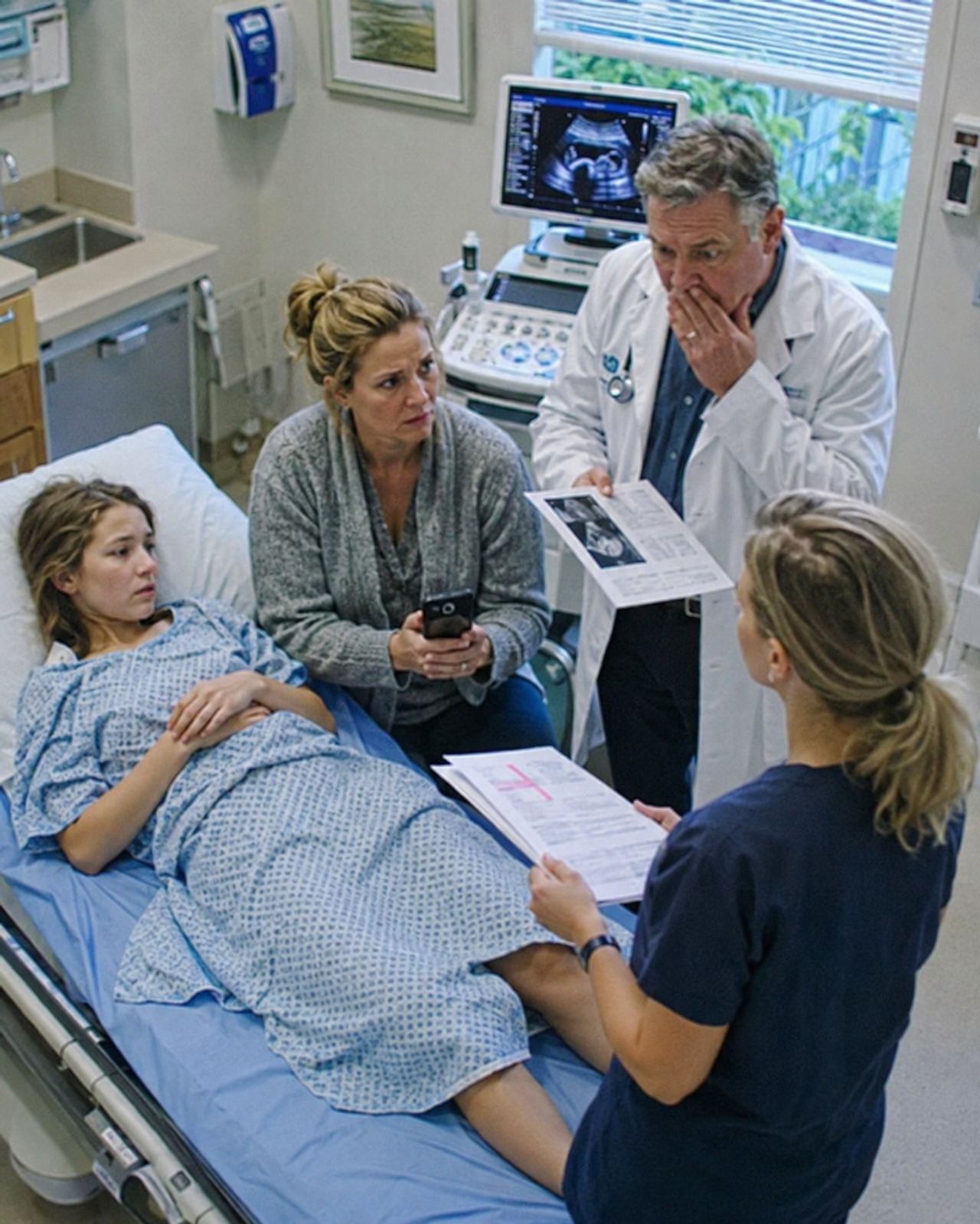
A CT scan confirmed what the ultrasound had suggested.
There was a large ovarian cystic mass, twisted enough to threaten blood flow and inflamed enough to explain the weeks of pain, nausea, dizziness, and exhaustion.
The pediatric surgeon explained it carefully.
It might be benign, but it could not be ignored.
It had to be removed.
Soon.
Maya listened with both hands wrapped around the hospital blanket.
I asked every question I could think of.
Robert stood near the wall, silent for once.
When the surgeon left, he tried to speak to me in the hallway.
“We need to discuss the cost,” he said.
I looked at him for a long time.
Behind me, through the glass, Maya lay in a hospital bed wearing a wristband with her name on it.
She looked small.
She looked exhausted.
She looked like a child who had spent weeks begging adults to believe her.
“No,” I said.
Robert blinked.
“No?”
“No,” I repeated. “We are not discussing the cost before we discuss the fact that our daughter could have lost an ovary because you called her a liar.”
His face flushed.
“That’s not fair.”
“Neither was making her prove pain to you.”
He looked away first.
It was the first honest thing he had done all day.
Maya had surgery the next morning.
The mass was removed.
The surgeon was able to preserve the ovary.
The pathology later came back benign.
I cried so hard in the hospital bathroom that a nurse knocked to ask if I needed help.
I did need help.
Just not the kind she meant.
Over the next few days, Maya slept, healed, and slowly returned to herself in fragments.
She asked for ice chips.
Then she asked for her phone.
Then she asked whether her soccer coach knew she would be out for a while.
That question made me cry again because it was the first time in weeks she had spoken about a future like she expected to be in it.
Robert tried to behave like a corrected man.
He brought flowers.
He said the words I’m sorry in the stiff voice of someone who wanted forgiveness to be efficient.
Maya accepted the flowers and set them on the windowsill.
She did not tell him it was okay.
I did not tell him either.
Some apologies are not keys.
They do not unlock the room they damaged just because someone finally says them.
When we came home, I changed things.
I called the insurance company myself.
I requested copies of every medical record from Riverside Medical Center.
I opened a separate folder with the intake form, the ultrasound report, the CT summary, the surgical discharge papers, and the pathology result.
I also scheduled Maya with a counselor.
Then I scheduled one for myself.
Robert said I was overreacting.
That word used to work on me.
It did not anymore.
The first counseling session was quiet.
Maya sat with her knees pulled close and said very little.
Near the end, the counselor asked what had been the scariest part.
I expected Maya to say surgery.
I expected her to say the scan.
Instead, she looked at the carpet and said, “I thought maybe I really was making it up.”
That sentence did more damage to my marriage than any argument could have.
Because there it was.
An entire house had taught my daughter to doubt the evidence of her own body.
An entire house had taught her to wonder if she deserved to be believed.
I could not unhear that.
Robert and I separated three months later.
There was no screaming scene.
No broken dishes.
No dramatic suitcase on the lawn.
I packed my documents, Maya’s medical folder, our essentials, and the photo she had taken years earlier of the sunset over the mailbox.
We moved into a smaller rental with thin walls, a stubborn heater, and a kitchen that smelled like old wood no matter how much I cleaned it.
Maya said she liked it.
“It feels quieter,” she told me.
I knew what she meant.
Quiet can be fear.
But quiet can also be peace.
She returned to school slowly.
She missed soccer for the season, but she went to games and sat with her team.
Her friends brought snacks.
Her coach saved her jersey.
By spring, she was taking pictures again.
Not every day.
Not like before.
But enough.
One evening, I found her on the front steps photographing the sky with her phone angled toward a pink streak of cloud.
The air smelled like cut grass and someone’s barbecue down the block.
She turned when she heard me.
“Mom?”
“Yeah?”
“Thank you for taking me.”
I sat beside her.
The porch step was cold through my jeans.
“I should have taken you sooner,” I said.
She leaned her shoulder against mine.
“But you took me.”
That was the mercy she gave me.
I am still learning how to accept it.
The medical file stays in a cabinet now.
The orange insurance sticker has faded a little.
The ultrasound image is still there too, printed in grainy black and white, a picture of the thing that nearly took more from my daughter than anyone in that house wanted to admit.
Sometimes I think about that night at the dinner table.
Robert scrolling.
Maya shrinking.
Me swallowing words because I thought fear was the same thing as keeping peace.
Then I think about the hospital room, the monitor glow, Dr. Lawson’s face, and my daughter’s fingers digging into my sleeve.
The truth is simple now.
Children should not have to win a courtroom trial inside their own home before someone takes their pain seriously.
Maya told us her stomach hurt.
She told us she felt sick all the time.
One parent called it attention.
One parent finally called a doctor.
That difference changed everything.
Read more stories
- My stepson smashed my son’s handmade airplane, stared directly at me, and said, “YOU’RE NOT
- My daughter collapsed on my porch at 1 AM. Her lip was split, her face covered in bruises. “Don’t make me go back,” she begged. Her wealthy husband had brutally beaten her. He thought he was untouchable. He completely forgot that his mother-in-law is a seasoned Homicide Detective. My blood ran cold, but my mind stayed razor-sharp. I knew exactly how to destroy him—and my daughter had just handed me the weapon—something out of her pocket that she stole from his safe
- FOUR LEGENDS SHARED ONE STAGE IN THE EARLY NINETIES—BUT THEIR BIGGEST REBELLION WAS NOT ABOUT MUSIC.
- THEY WAITED 20 YEARS TO SING TOGETHER AGAIN. THEY HAD 19 DAYS LEFT.