
Stories
Her Family Mocked Her Service Until One Call Sign Changed Thanksgiving
At a Thanksgiving dinner, a mother publicly humiliates her daughter while praising her son in uniform, only to have a classified call sign reveal the daughter’s true service and force the family to confront years of neglect. The night becomes a painful reckoning about respect, visibility, and the difference between serving and being served.

The turkey smelled like rosemary, butter, and everything my mother wanted people to believe about our family.
Warm.
Grateful.Whole.
The dining room looked the same as it had every Thanksgiving since my father died nineteen years earlier.
Polished mahogany table.
White china with the blue rim she only used when people were watching.
Silver forks set with military precision, though my mother had never served a day in anything except her own bitterness.
There were fifteen relatives in that room, and every one of them knew where they were supposed to look.
At Nathan.
My younger brother sat at the head of the table in his dress blues, shoulders straight, hair perfect, face tired in the careful way decorated men learn to hide.
My mother had placed him there like a medal she had earned herself.
Every aunt had hugged him first.
Every uncle had clapped his shoulder.
Every cousin wanted a picture.
They asked about deployments, about the teams, about whether he had ever jumped from a plane at night, about whether the movies got anything right.
Nathan answered politely, the way he always did.
He left out almost everything.
Men like my brother know the difference between pride and performance.
My mother did not.
To her, Nathan’s uniform was not cloth.
It was proof.
Proof that she had raised a hero.
Proof that my father would have approved of her favorite child.
Proof that I, sitting near the sliding glass door with cold air crawling down my back, had somehow failed by comparison.
I wore a gray suit because I had come straight from work.
Not office work, exactly.
But that was what she called it because it made me smaller.
At 4:12 a.m. that morning, I had signed out of a windowless operations room after thirty-six hours awake.
At 3:08 a.m., the last confirmation had come through.
Six Americans were alive.
At 3:41 a.m., the recovery channel closed.
At 3:57 a.m., I had placed my initials on the after-action log, zipped my badge into the inside pocket of my suit jacket, and stood in a restroom under fluorescent lights until my hands stopped shaking.
By noon, I was in my mother’s driveway, looking at the little American flag by the mailbox and wondering why the hardest rooms to walk into were sometimes the ones where people knew your childhood nickname.
My mother opened the door and looked past me first.
That was habit.
She always checked to see if I had brought someone.
A husband.
A fiancé.
A child.
Any evidence that I had arranged my life in a way she could explain at church, at the grocery store, or to Aunt Linda over coffee.
I had brought grocery-store flowers and a store-bought pie.
She took both like accepting a late apology.
“Nathan is already here,” she said.
I knew what that meant.
It meant the show had started.
Inside, the house was loud with relatives and football from the living room television.
The kitchen windows had fogged from steam.
The hallway smelled like turkey skin, hot rolls, and the pine candle my mother lit every year because tradition mattered more to her than tenderness.
Nathan found me by the laundry room.
For one second, he dropped the public face.
“You look awful,” he said.
“Good to see you too.”
His mouth twitched.
Then he looked at my eyes, really looked, and the humor left him.
“Long shift?”
“Something like that.”
He knew better than to ask more in a hallway full of relatives.
We had grown up in a house where silence was not always secrecy.
Sometimes it was survival.
When our father was alive, silence meant fishing before sunrise, his thermos between us, the old pickup ticking as it cooled near the lake.
After he died, silence meant my mother staring at bills, Nathan polishing shoes he had outgrown, and me learning how to fix things before anyone could say we needed a man in the house.
My father had taught us both discipline.
My mother had taught us hierarchy.
She loved Nathan loudly and corrected me quietly until both became facts nobody questioned.
By the time dinner was ready, she had arranged the table like a map of her affections.
Nathan at the head.
My mother’s seat within reach of the serving platter.
Her sisters close enough to admire her work.
Me near the sliding door, half-blocked by a decorative vase that had never done anything useful in its life.
I sat down and felt the cold coming through the glass against my shoulder.
The scar under my jacket tightened.
She did not know about that scar.
She knew about my apartment lease, my lack of children, and the fact that I sometimes missed family calls.
She did not know about Aleppo.
She did not know about the field hospital intake form with my name spelled wrong.
She did not know about the medic who had cut my sleeve open while I stared at a ceiling fan turning too slowly above me.
She did not know because she had never asked a question that was not designed to become ammunition.
Dinner began with prayer.
My mother thanked God for Nathan’s service.
She thanked God for bringing her son home safe.
She thanked God for sacrifice, courage, and the men who stand between America and danger.
Nobody said my name.
Nathan’s jaw shifted.
I saw it.
He said nothing.
I did not blame him for that yet.
Families teach you your role early, and sometimes even brave men obey the old seating chart.
The carving knife moved through the turkey with soft wet sounds.
Steam rose from the breast meat.
My mother made sure Nathan got the first plate.
Thick slices.
Dark meat because he liked it.
A generous pour of gravy.
Two warm rolls.
Sweet potatoes with browned marshmallows.
She set the plate in front of him like presenting an offering.
“My hero,” she said.
Nathan looked embarrassed.
“Mom.”
“What? A mother can be proud.”
Then she served the others.
Aunt Linda.
Uncle Mark.
Rachel.
The cousins.
My plate came last among the first round, though I was sitting close enough for her sleeve to brush my chair.
Her hand paused over the platter.
Everyone saw it.
Everyone pretended not to.
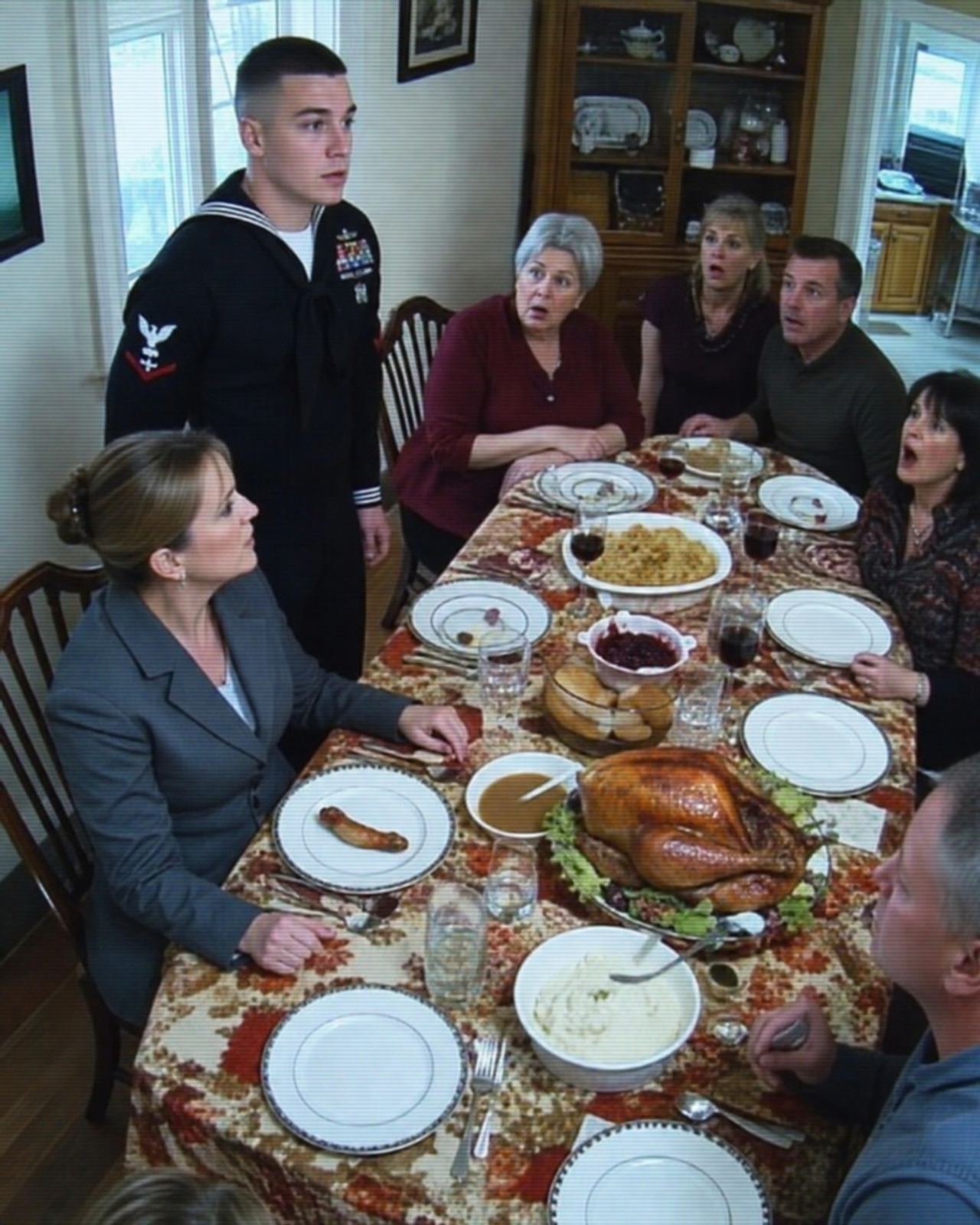
She selected the driest wing, the one tucked near the edge, and laid it on my plate with cold green beans.
The porcelain clacked.
It was not loud.
It did not have to be.
Humiliation does not need volume when the room has already agreed to listen.
“Office life catches up with a woman,” she said sweetly.
Aunt Linda looked down.
Uncle Mark took a drink of water.
Nathan stopped buttering his roll.
“We can’t all have your brother’s discipline,” my mother added.
I aligned my knife and fork beside my plate.
My hands were steady.
That seemed to disappoint her.
“I’m fine, Mom,” I said.
“Of course you are. You’re always fine.”
There was laughter around the table, the polite kind that asks permission to stop.
She did not give it.
“Your father used to say service shows in how a person carries themselves,” she continued.
There it was.
My father’s name.
She reached for him the way some people reach for a weapon in a drawer.
“Dad said a lot of things,” I said.
My voice was flat.
Nathan looked up.
He knew that tone.
He had heard it when we were teenagers and a man at a gas station grabbed my wrist because he thought I had cut the line.
He had heard it again when I came home at twenty-two and found my mother had packed my room into plastic bins to make space for Nathan’s gear.
He knew quiet did not always mean surrender.
My mother did not.
She took silence as proof that the blade had landed.
“Maybe Nathan can help you find something closer to real military,” she said.
She reached over and patted my shoulder.
Her nails pressed directly over the old scar.
Pain flashed white and brief beneath my jacket.
I did not move.
For one ugly second, I saw the room differently.
Not table.
Not relatives.
Exits.
Angles.
Hands.
Glass.
I breathed in through my nose and counted three heartbeats.
That restraint did not make me noble.
It made me trained.
Nathan set his roll down.
“Mom,” he said. “Drop it.”
The room shifted around that one sentence.
My mother blinked because Nathan correcting her in public was not part of the tradition.
“I’m only talking to your sister.”
“I said drop it.”
The chandelier hummed faintly above us.
Aunt Linda’s fork hovered over the cranberry dish.
Rachel’s phone, which she had been using to record little family clips, rested face-up near her glass.
A football announcer shouted from the living room, muffled and absurd.
The candle flame nearest my plate leaned toward the sliding door.
Nobody moved.
My mother smiled wider.
That was how I knew she was angry.
“Your father understood sacrifice,” she said, turning her eyes toward his portrait on the sideboard.
The portrait was in uniform.
The flag in the display case beneath it had been folded tight, edges sharp, blue field visible through glass.
My mother dusted that case every Saturday.
She had built a shrine to a man whose gentleness she refused to remember.
“He would have been proud of Nathan,” she said.
Nathan’s face went still.
I looked at my plate.
Cold wing.
Green beans.
A smear of gravy that had reached me by accident.
“And you,” she said, each word wrapped in sugar, “are a useless pog. You shame his memory.”
That word hit the room harder than she understood.
Pog.
A service insult she had no right to use and no understanding of how she was using it.
She had heard it somewhere, probably from a man at a Veterans Day luncheon or a television show, and saved it for the moment she wanted to make me sound small in front of a decorated son.
Every face turned away except Nathan’s.
My right hand closed around the steak knife.
Not to use it.
Not even close.
But my body moved before the polite daughter in me could stop it.
Nathan saw.
His fork hit his plate.
The crack of metal against china cut through the room.
He stood so fast his chair scraped back across the hardwood.
“Mom,” he said, voice low and hard, “shut your mouth.”
My mother looked genuinely stunned.
“Excuse me?”
Nathan did not answer her.
He was looking at me.
At my hand.
At the knife.
At the chair angle.
At the way I had chosen the seat facing the kitchen entrance with the hallway reflected in the sliding glass door.
He looked at the gray suit.
At the badge shape pressing faintly beneath the inside pocket.
At the folded napkin I had placed over the cold wing as if covering evidence.
And then something in his face changed.
Recognition is not always sudden.
Sometimes it arrives one detail at a time until there is nowhere left for denial to stand.
“You don’t do admin, do you?” he asked.
My mother scoffed.
“Nathan, don’t be ridiculous.”
He ignored her.
“What is your call sign?”
The room did not understand the question.
I did.
So did he.
Because at 7:03 a.m., while my mother was probably arranging place cards, a secure operations summary had crossed his command channel.
A recovery operation.
Six Americans.
A route nobody would discuss at Thanksgiving.
A call sign attached to the woman who had coordinated the final extraction window.
Only three commanders had heard it spoken aloud.
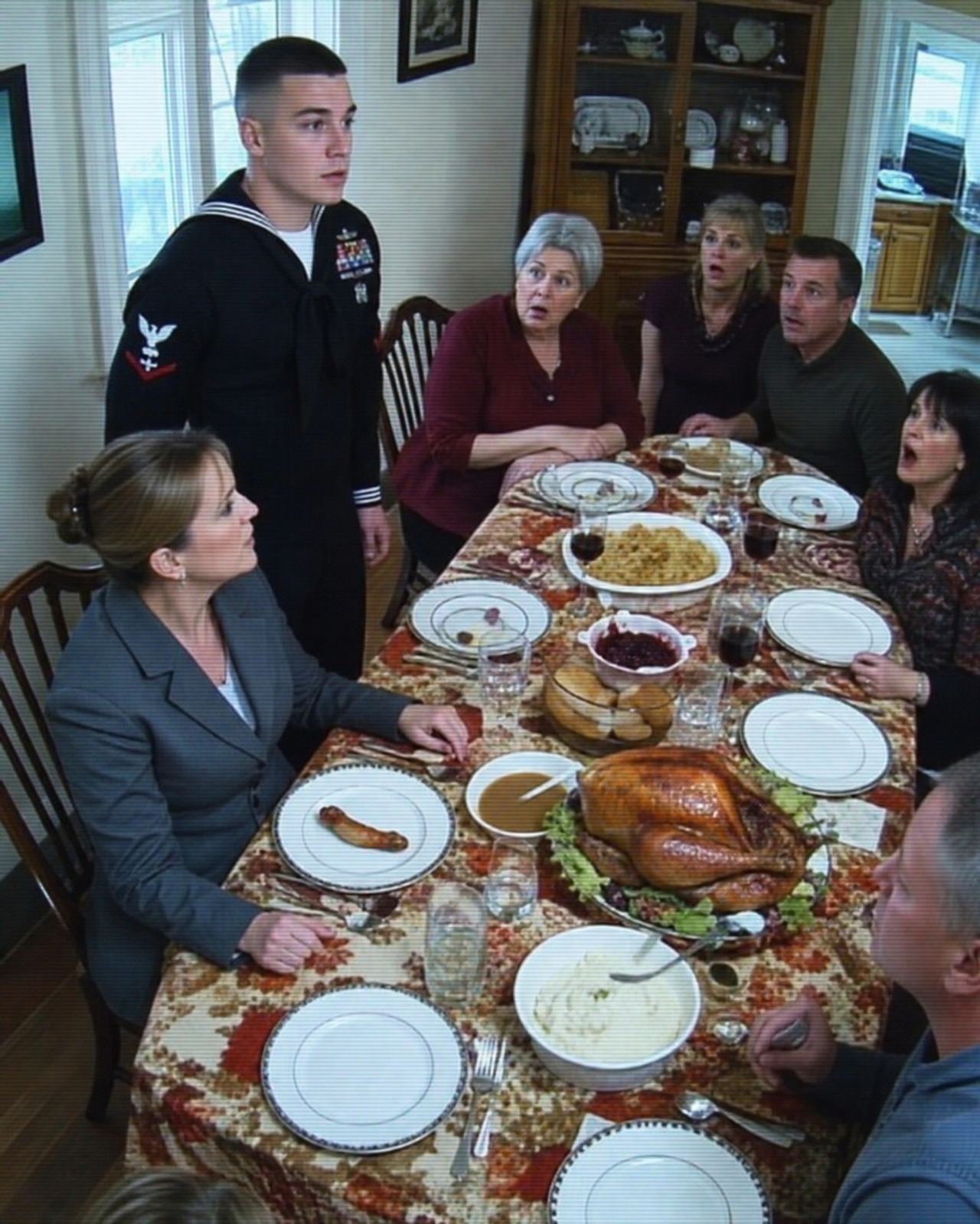
Nathan had not known that woman was me.
Until now.
“Nathan,” my mother snapped, “sit down.”
He did not.
His shoulders squared.
His chin lifted.
His hands flattened against the seams of his dress blues.
He stood at attention in our mother’s dining room.
It was the most terrifying apology I had ever seen.
“Say it,” he whispered.
I looked at my father’s portrait.
I thought of his hands teaching me how to tie a fishing knot.
I thought of the folded flag in the garage when we were kids, the one he said meant nothing if you could not be decent at your own table.
Then I looked at my mother.
She was still smiling.
She thought the room belonged to her.
“Valkyrie,” I said.
The word barely crossed the table.
It did not need to be loud.
Nathan’s face drained.
His eyes dropped for half a second, not from shame exactly, but from the reflex of a man realizing he should have shown respect before he understood why.
My mother laughed.
It was thin and wrong.
“Anyone can make up a name,” she said.
Nathan turned on her slowly.
“No,” he said. “She didn’t make that one up.”
Rachel’s phone buzzed against the table.
Then Nathan’s did.
He looked down.
I saw the sender before he angled the screen away.
Command Duty Officer.
He read the message once.
Then again.
His jaw tightened.
My mother reached for the phone.
“Give me that.”
Nathan stepped back before she could touch it.
That tiny motion did what every word before it had not.
It told the room the hierarchy had changed.
Uncle Mark put both hands flat on the table.
Aunt Linda covered her mouth.
Rachel stopped recording and then seemed to realize she already had been.
My mother’s smile slipped.
Nathan turned the phone so she could see.
I did not need to read the whole message.
I knew what it said because I had already lived the hours behind it.
It confirmed the recovery.
It confirmed the call sign.
It confirmed that the woman my mother had just mocked in front of fifteen relatives had been the link between six families and an empty chair that did not have to stay empty.
My mother grabbed the table edge.
Her knuckles went pale against the linen.
“I didn’t know,” she whispered.
There it was.
The defense of people who never ask because not knowing lets them stay cruel longer.
Nathan looked at me.
For the first time all night, he looked younger than me.
“Why didn’t you tell me?” he asked.
I could have told him the truth.
That I had tried, once, when he came home from selection and everyone was cheering so loudly there was no room for my sentence.
That I had started to explain after my first overseas injury, but my mother interrupted to ask whether the scar would show in a sleeveless dress.
That I had learned secrecy at work and invisibility at home, and the two had fit together too easily.
Instead, I said, “You never asked.”
The words landed harder than I expected.
Nathan flinched.
My mother found her voice.
“This is still my house,” she said.
That was when the room finally understood she was not sorry.
She was cornered.
There is a difference.
Nathan’s expression closed.
“Dad’s house,” he said.
My mother went still.
That was the first true crack.
Because after my father’s death, paperwork had passed through this family like weather.
Most of it had been handled by my mother.
Some of it had been handled by me because I was the oldest and the one who understood forms.
The mortgage modification.
The insurance claim.
The property tax notices.
The county clerk copy of the survivorship deed.
Documents my mother had called boring until she needed them to prove ownership, authority, or moral superiority.
Nathan did not know the details.
I did.
I had scanned them years earlier.
Not because I planned revenge.
Because I had learned never to leave the only copy of anything important in a house where love came with conditions.
Rachel’s phone buzzed again, but no one looked.
Nathan lowered his voice.
“Mom,” he said, “do you understand who you’ve been humiliating all these years?”
My mother looked from him to me.
Her mouth opened.
No words came.
The woman who could turn a cold wing into a public sentence suddenly had nothing ready.
I stood.
My chair did not scrape.
I made sure of that.
I picked up my coat from the back of it and pulled my badge from the inside pocket just enough for Nathan to see the edge.
Not the room.
Not my mother.
Just him.
His eyes closed briefly.
When they opened, they were wet.
“I’m sorry,” he said.
It was not enough.
It was also the first honest thing anyone at that table had offered me in years.
My mother tried one last time.
“I fed you,” she said.
I looked down at the plate.
Cold wing.
Folded napkin.
Knife beside it.
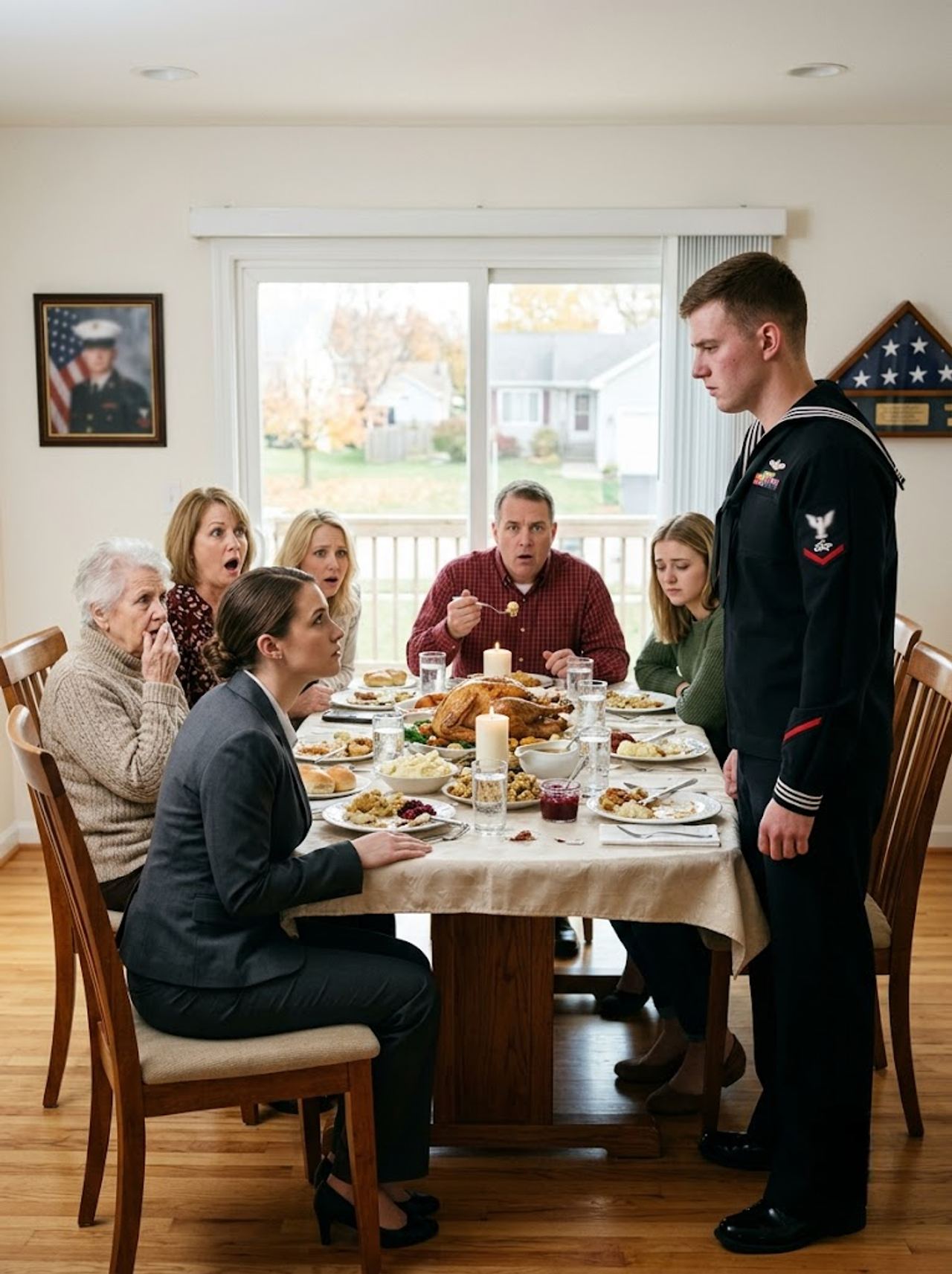
Fifteen witnesses.
“No,” I said. “You served me. There’s a difference.”
Nobody laughed.
Aunt Linda began to cry quietly, which irritated me more than it moved me.
Tears from bystanders often arrive after the damage, when the cost of silence becomes visible enough to embarrass them.
Nathan stepped away from the head of the table.
Then he did something I never expected.
He picked up his full plate, the thick turkey slices and warm rolls and everything my mother had piled there, and set it down in front of me.
Then he took my cold plate and put it at his seat.
My mother made a sound like he had slapped her.
He had not.
He had done something worse to her performance.
He had corrected the stage picture.
“Nathan,” she whispered.
“No,” he said.
His voice shook once.
Only once.
“You don’t get to use Dad for this. You don’t get to use my uniform for this. And you don’t get to call her useless because she didn’t hand you a version of service you could brag about.”
The room stayed frozen.
Then Uncle Mark pushed back his chair.
For a moment, I thought he was leaving.
Instead, he looked at me and said, “Your father would have been proud.”
My mother’s head snapped toward him.
He did not take it back.
That was the second crack.
Small, but real.
One by one, the room began to move again.
Not comfortably.
Not cleanly.
But honestly, for the first time that night.
Rachel placed her phone face down.
Aunt Linda whispered my name like an apology she had not earned.
Nathan remained standing beside me.
My mother sat down slowly at the head of the table she no longer controlled.
I did not make a speech.
People expect the humiliated person to explain the moral of the story because it makes everyone else feel forgiven for arriving late.
I had no interest in making them comfortable.
I took my coat.
Nathan followed me to the front door.
The hallway was colder than the dining room.
Through the glass pane beside the door, I could see the driveway, the mailbox, and the small flag moving in the dark.
He stopped with one hand on the wall.
“I should have known,” he said.
“Maybe.”
“No. I should have.”
I looked at him then.
Really looked.
He was still my brother.
The boy who had fallen asleep on my bedroom floor after our father’s funeral because he did not want to be alone.
The teenager who mailed me half his first paycheck from boot camp because he thought I needed help with rent.
The man who had let our mother build a throne out of his uniform because it was easier than tearing the house apart.
“Knowing isn’t the same as asking,” I said.
He nodded.
That sentence hurt him.
It should have.
Behind us, my mother said my name.
I turned.
She stood in the doorway to the dining room, smaller without the table between us.
For once, she did not look angry.
She looked afraid.
“Are you leaving?” she asked.
I almost said yes.
Then I looked past her.
At the portrait.
At the folded flag.
At the plate Nathan had moved to my seat.
At the table full of people who had spent years learning how not to see me.
“No,” I said.
Her face changed with relief too quickly.
So I finished.
“I’m going back in. I’m going to eat the hot dinner Nathan gave me. Then I’m going to leave without pretending this was fine.”
The relief died.
Good.
I walked back to the table.
No one spoke when I sat down.
The food was still warm.
That detail nearly broke me.
Not the insult.
Not the call sign.
Not even Nathan standing at attention in our mother’s dining room.
It was the simple fact that for the first time in that house, someone had noticed my plate.
I picked up my fork.
My hand trembled once.
Nathan sat beside me instead of returning to the head of the table.
He ate the cold wing without complaint.
My mother watched him do it.
She had wanted Thanksgiving to prove which child mattered.
By the end of dinner, it had proved something else.
An entire table had learned how easy it was to overlook a person when the story they preferred was already polished, framed, and hanging on the wall.
And I learned something too.
Respect does not always arrive as applause.
Sometimes it arrives as a chair scraping back, a brother finally seeing the room clearly, and a cold plate being carried to the seat where it belonged all along.
I left after dessert.
Nathan walked me to my car.
The night air smelled like wet leaves and chimney smoke.
He stood in the driveway with his hands in his pockets, no longer at attention, no longer performing for anyone.
“Can I call you tomorrow?” he asked.
“You can call,” I said.
He nodded.
Then he looked toward the dining room window, where our mother was a still shape behind the glass.
“It’s going to change,” he said.
I opened my car door.
“It already did.”
When I drove away, the house shrank in the rearview mirror.
The little flag by the mailbox flashed once in my headlights.
For years, my mother had used my father’s memory like a weapon.
That night, the truth did not bring him back.
It did not erase the cold meals, the small jokes, the years of being treated like a footnote in my own family.
But it did one thing I had stopped expecting.
It made everyone at that table look directly at what they had helped her do.
And for once, nobody had the courage to look away.
Read more stories
- Twenty-Four Hours After the Divorce, They Came Knocking
- TWO COUNTRY NETWORKS PULLED HIS VIDEO. ONE OFFERED TO PUT IT BACK IF GARTH BROOKS ADDED A DISCLAIMER. HE REFUSED — AND MONTHS LATER, THE CMA NAMED IT VIDEO OF THE YEAR.
- “She Was Never in the Army.” My Own Mother Smiled Under Oath as She Called My Combat Scars Fake and My Medals Bought Online—But Thirteen Minutes Later the Courtroom Doors Opened, a Two-Star General Walked In, Saluted Me, and My Family’s Lies Turned Into Federal Felonies.
- Five days after my C-section, my husband loaded his mother into our luxury SUV and handed me bus fare instead. “Don’t make this difficult,” he said, pressing a few bills into my hand while I stood outside the hospital holding our newborn son. I said nothing. I looked down at the money… then called the one person he never should have underestimated.