
Human Stories
He Came Home Early And Found His Newborn Freezing In His House-myhoa
A man returns home early on New Year’s Eve to find his wife recovering from a C-section in a freezing house, with their newborn kept warm only by her coat. He discovers his mother has been secretly entering their home, lowering the heat, and trying to force his wife out, leading him to expose the abuse and protect his family.

I flew home a day early on New Year’s Eve because the job wrapped faster than expected.
It was supposed to be a surprise.
A good one.
I pictured walking into the house with takeout, kissing my wife’s forehead, and holding our daughter while Lena finally slept more than forty minutes at a time.
Our baby was eleven days old.
Lena was eleven days out from a C-section.
The world outside the plane window looked like ice and gray clouds, but I felt almost light for the first time since the delivery.
Tired.
Worried about bills.
Worried about work.
But light.
I thought I was going home to warmth.
Instead, when I opened the front door, the house felt like a garage.
Cold air sat inside the rooms like it had weight.
Not chilly.
Not a little drafty.
Cold enough that my breath caught.
Cold enough that the windows had frost along the lower edges.
Cold enough that the first thing I heard was not the television or the baby crying.
It was the furnace clicking uselessly after I turned it back on.
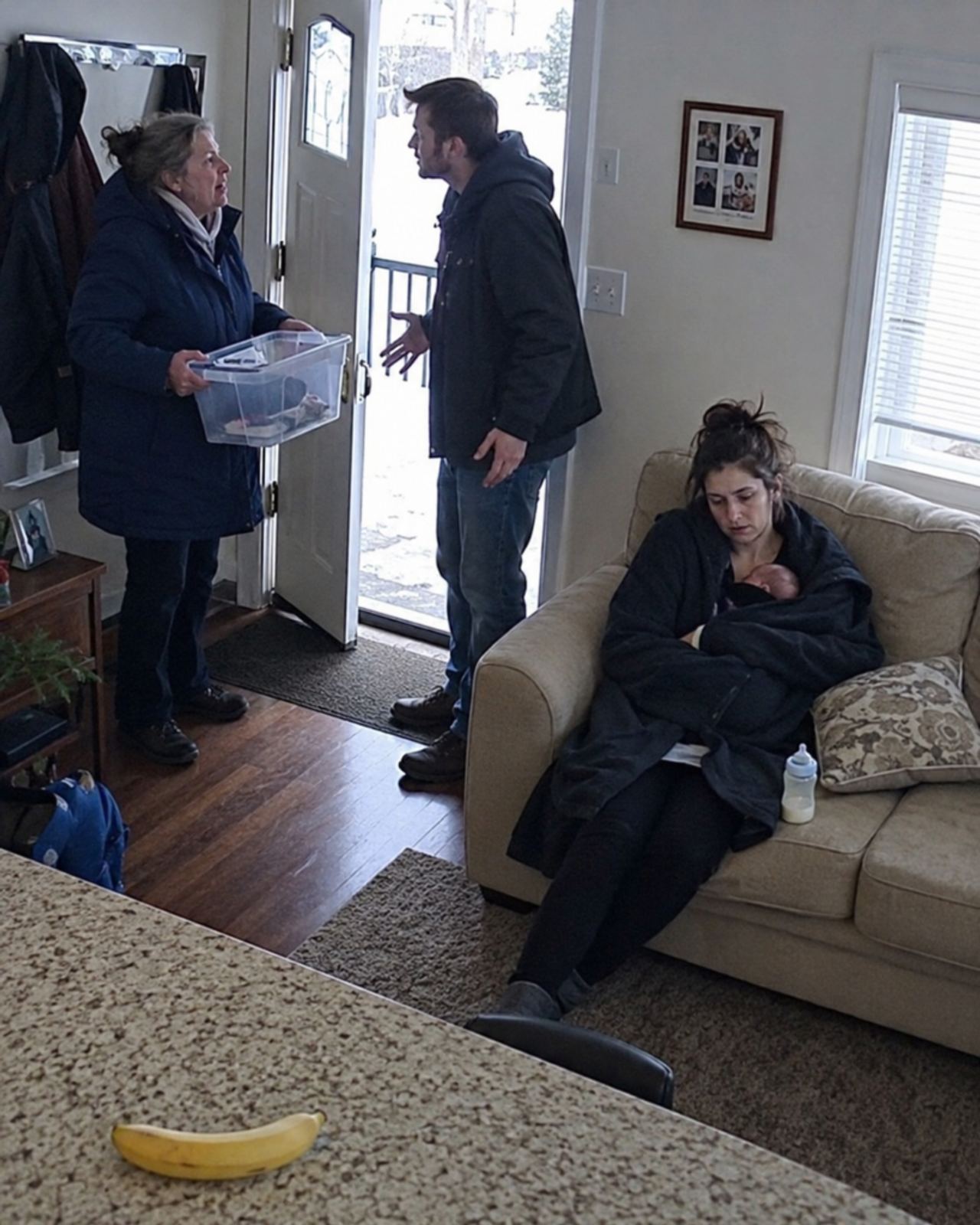
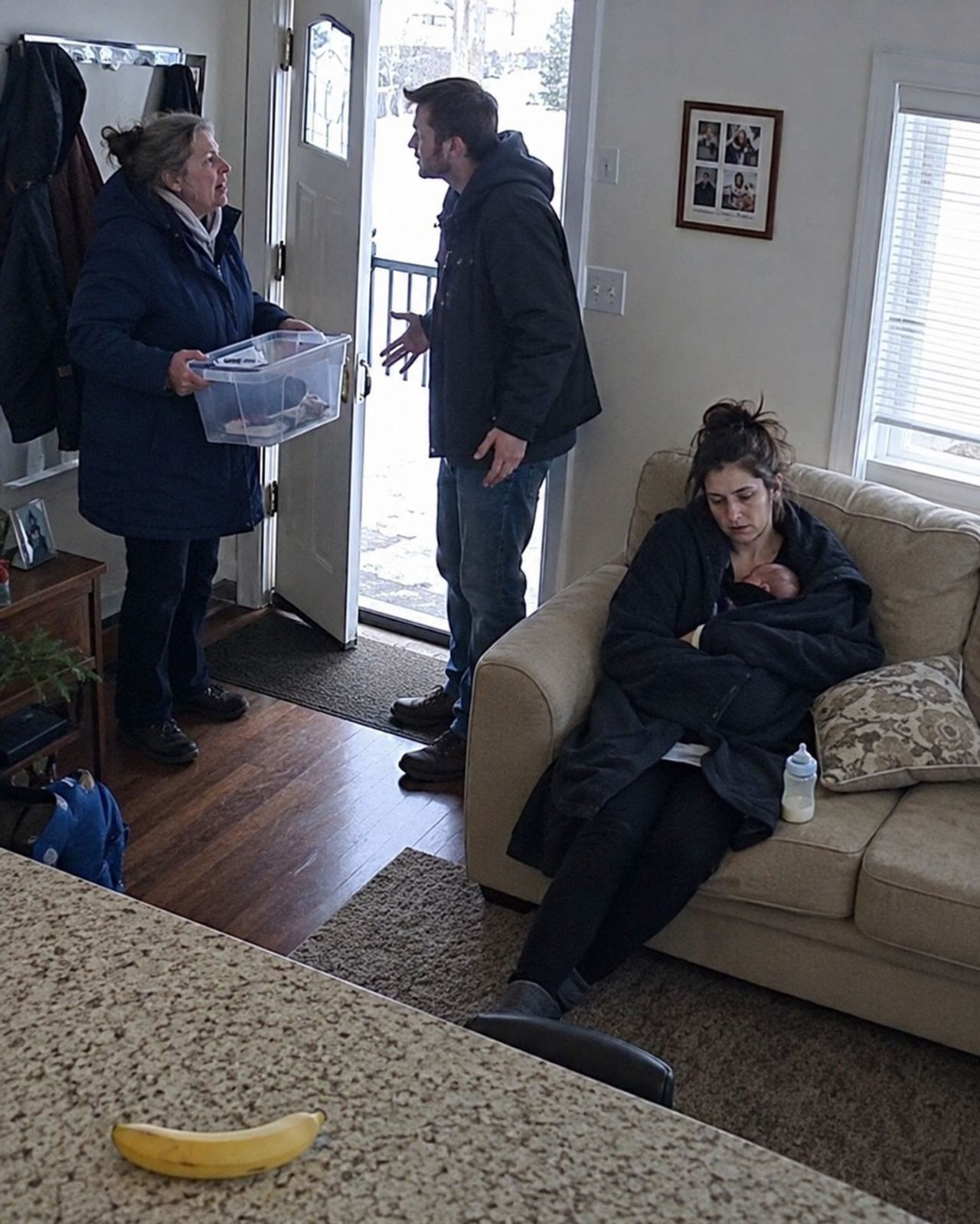
Lena was on the couch.
She wore the oversized gray sweatshirt she had been living in since the surgery.
There was a formula stain near one shoulder.
Her hair was pulled back badly, like she had tried once and then run out of strength.
She held our daughter under her coat, pressed against her chest.
Only the baby’s tiny cap and one curled hand showed beneath the fabric.
My wife looked up at me like she did not trust the sight of me yet.
Like maybe I was another dream that would make waking worse.
“Lena?”
Her lips trembled.
“You’re home.”
I dropped my bag by the door.
The cold hit harder when I crossed the living room.
Her hands were icy.
Our daughter’s cheek was warm only because Lena had been using her own body like a furnace.
I turned toward the thermostat.
It was set so low I thought the screen had glitched.
I raised it immediately.
Heat clicked through the vents, slow and mechanical, like the house itself was waking from neglect.
Then I saw the kitchen counter.
One banana.
That was all.
One banana sitting beside an empty mug, a bottle that needed washing, and a stack of unopened mail.
Not a pot of soup.
Not groceries.
Not the meals my mother had promised she would bring while I was away.
One banana.
“What happened?” I asked.
Lena looked down at our daughter.
“She said the thermostat is her call, and I wasn’t allowed to ask you for money.”
My body went still.
“Who said that?”
She did not answer.
She did not need to.
My mother had a way of filling rooms even when she was not in them.
I had flown out for a three-day contract job because the hospital bills were coming, because paternity leave was not long enough, and because I thought Lena had help.
My mother had offered.
Insisted, actually.
“You go handle work,” she told me. “I’ll check on the girls.”
The girls.
She said it so lovingly.
She made soup the day we came home from the hospital.
She folded one load of laundry.
She called the baby “my little New Year’s miracle.”
I gave her a spare key.
For emergencies.
I thought I had done the responsible thing.
I thought I was making sure Lena was not alone.
Instead, I had handed a key to someone who believed my absence made her in charge.
“Why didn’t you call me?” I asked.
The question came out wrong.
Too sharp.
Lena flinched.
I hated myself instantly.
“I’m not blaming you,” I said. “I swear I’m not.”
She swallowed.
“Your mother said you were already angry about how much the delivery cost. She said bothering you again would prove I couldn’t handle being a mom.”
I felt the floor tilt.
I had never said anything like that.
Not in anger.
Not joking.
Not even silently.
The delivery had been expensive.
The surgery.
The extra night.
The lactation consult our insurance barely covered.
The prescriptions.
The follow-ups.
I was worried, yes.
But not about Lena.
Never about Lena.
Never about our daughter needing food, heat, care, or comfort.
I had been working because I loved them.
My mother had translated that into a weapon.
I sat beside Lena carefully.
She adjusted the baby under her coat.
The movement made her wince.
C-section pain is not small pain.
I knew that.
But I had not understood the cruelty of being cold while healing from it.
“Tell me everything,” I said.
Lena shook her head.
“I don’t know where to start.”
So I opened the camera app.
We had installed two indoor cameras before the baby came.
One facing the entryway.
One angled toward the kitchen and living room.
Not because we expected danger.
Because we thought it would be cute to catch the dog meeting the baby.
The dog was staying with my sister during recovery.
The cameras had recorded something else.
I scrolled back.
Nine days.
My mother had let herself in every one of them.
On the first recording, she entered with the spare key.
She stayed forty-three minutes.
She opened cabinets.
Adjusted the thermostat.
Moved bottles from the drying rack.
Stood over Lena while Lena sat on the couch holding the baby.
The audio was low, but I heard my mother say:
“You need to stop acting fragile. Women have had babies forever.”
On the second day, she walked in carrying two grocery bags.
For one second, relief flickered through me.
Then I watched her leave twenty minutes later with both bags still full.
Lena explained in a flat voice that my mother had looked through the receipt, called half the food unnecessary, and said she would return it.
Chicken soup.
Oatmeal.
Yogurt.
Ready-made meals.
Electrolyte drinks.
Snacks Lena could eat one-handed while feeding the baby.
My mother called them indulgences.
The banana was the only thing left within reach after Lena fed the baby through the night.
I kept scrolling.
My jaw hurt from holding still.
On the fourth day, Lena stood in the entryway wrapped in a blanket.
Her shoulders were hunched.
The baby cried softly against her.
She asked my mother to turn the heat up because the baby felt cold.
My mother did not lower her voice.
“Babies survived winter before people started wasting money on seventy-degree houses. And don’t call him. He needs to see whether you can manage without being rescued.”
The room around me blurred.
I paused the video.
Then unpaused it.
Because rage wanted to stop.
Proof needed me to continue.
Every visit followed the same pattern.
My mother arrived shortly after noon.
She changed something inside the house.
She left before dark.
Once, she carried out a bag of clean baby clothes because she claimed Lena was running the washer too often.
Another time, she stood on the porch and warned Lena that I would come home to an empty bank account if she kept buying “comfort items.”
Blankets.
Food.
Heat.
That was what she meant by comfort.
Cruel people rarely begin by taking everything.
They begin by redefining what you are allowed to need.
My wife had been recovering from major surgery while caring for a newborn in a house my mother made colder on purpose.
And I had been sending texts from another city saying, “How are my girls?” while Lena wrote back, “We’re okay.”
We were not okay.
I called my mother.
Put the phone on speaker.
She answered cheerfully.
She thought I was still away.
“Hi, honey. How is the trip?”
“How are things at my house?” I asked.
There was a pause so slight I might have missed it any other day.
“Under control,” she said. “Your wife is emotional, but that’s normal after childbirth. I’ve been keeping her from making bad decisions.”
“You shut off our heat.”
The silence lasted only a second.
Then she recovered.
“I lowered it. There’s a difference. You work too hard for her to burn through your paycheck because she’s uncomfortable.”
Lena flinched at the word.
Uncomfortable.
Not cold.
Not recovering.
Not eleven days after surgery.
Uncomfortable.
I looked at my wife.
At our daughter tucked beneath her coat.
At the banana on the counter.
“The money belongs to both of us,” I said. “The house belongs to Lena and me. And you were never given permission to control either one.”
My mother laughed.
Not nervously.
As if I were a child trying to sound like an adult.
“You’ll understand when you see what she becomes without me fixing everything.”
Fixing.
That word made my skin crawl.
I ended the call.
I walked to the keypad and started changing the code.
Lena caught my wrist.
Her fingers were cold.
“Not yet,” she whispered.
I turned.
She pointed to the camera timeline.
My mother had arrived within the same fifteen-minute window every day.
12:12.
12:17.
12:14.
12:19.
She was due in six minutes.
Lena’s face was pale, but her eyes were clear.
“I want you to hear it,” she said.
“I believe you.”
“I know. But she changes her story when people walk in. She’s done it for years.”
That was true.
My mother could insult someone in a kitchen, then become soft-voiced the moment another person entered.
She could make a cruelty sound like concern.
She could make control sound like experience.
She could make anyone who challenged her seem dramatic.
Lena knew that better than I did.
So I moved into the dark hallway.
The heat had begun clicking through the vents, but the room was still bitterly cold.
Lena lowered herself back onto the couch with our daughter beneath her coat.
She pressed one hand near her incision.
Her mouth tightened, but she made no sound.
That restraint nearly broke me.
At 12:17, a key turned in the lock.
My mother stepped inside carrying an empty plastic storage bin.
Not food.
Not diapers.
Not wipes.
Not medicine.
An empty bin.
She closed the door behind her and looked at Lena.
Her face hardened.
“You’re still here. I told you to pack before he came home.”
Lena kept her voice steady.
“Why?”
“Because once he sees you can’t take care of yourself, he’ll stop pretending this arrangement works. You can go stay somewhere else, and I’ll help him with the baby until he gets his life back.”
The hallway went silent around me.
His life.
Not our life.
Not our family.
Mine.
As if Lena and the baby were clutter my mother intended to reorganize.
That was when I stepped out.
My mother’s fingers tightened around the empty bin.
She stared at me.
Then at the warm air beginning to move the curtain above the vent.
“You’re not supposed to be home until tomorrow,” she said.
I looked at the bin.
“What is that for?”
She set it on the floor.
“I was going to start moving her things out.”
For a moment, no one spoke.
The baby stirred against Lena’s chest.
My mother tried to smile.
I lifted my phone.
It was already recording.
“Say that again.”
Her face changed.
Not guilt.
Calculation.
“I was trying to help.”
“No,” I said. “You were trying to replace her.”
She looked offended.
That was almost impressive.
“You are emotional,” she said. “You’ve been working too much. You don’t see how she manipulates situations.”
I opened the thermostat app.
The access history refreshed.
Nine manual changes.
All from my mother’s temporary guest code.
The lowest setting had been made at 1:08 p.m. the day after I left.
Another log showed keypad unlocks every day between 12:12 and 12:19.
I read the entries out loud.
My mother went pale.
“That doesn’t prove intent,” she snapped.
Lena looked up from the couch.
“She told me if I complained, she would tell you I was neglecting the baby.”
My mother laughed too quickly.
“She’s postpartum. She’s confused.”
That was her last mistake.
The front door opened again.
My sister Mara stepped inside holding two grocery bags and a folder from the pediatrician’s office.
I had texted her from the airport when my earlier flight landed.
I had only said:
“Something is wrong at home. Can you come by at 12:20 and bring food?”
Mara looked at Lena.
At the cold room.
At our mother.
At the plastic bin.
Her face collapsed.
“Mom,” she said, “I warned you not to do this again.”
Again.
The word hit the floor harder than anything else.
My mother turned on her.
“Mara, stay out of this.”
But Mara did not move.
She set the groceries on the counter beside the banana.
Then she opened the folder.
Inside were old emails from three years earlier, when her own son was born.
Screenshots.
Messages.
A thermostat complaint.
A note from her husband describing how my mother had told him Mara was “failing at motherhood” and needed to be removed from stress.
Same accusations.
Same language.
Same line about helping until he got his life back.
I stared at my sister.
“How long have you known?”
Her eyes filled.
“Long enough to be ashamed.”
My mother’s voice sharpened.
“Mara had postpartum depression. I was protecting the baby.”
Mara flinched.
Then she straightened.
“No. You used my fear against me. And when I got better, you told everyone you saved us.”
The room became very quiet.
Lena began to cry silently.
Not because she was weak.
Because the pattern had finally been named.
That is what abusers fear most.
Not anger.
Pattern.
One incident can be explained away.
A pattern asks who benefits.
I changed the keypad code while my mother stood there.
Then I removed her guest access from the thermostat.
Then I opened the camera settings and exported the clips.
My mother watched each step.
“You’re overreacting,” she said.
“No.”
“You’ll regret this.”
“No.”
“She’ll turn you against your family.”
I turned to her.
“My wife is my family. My daughter is my family. You are the person who left them cold.”
That sentence struck her harder than I expected.
Maybe because it was simple enough to be understood.
Mara moved to the couch and placed one grocery bag near Lena.
Soup.
Bread.
Fruit.
Protein drinks.
Diapers.
Wipes.
Actual help.
Lena looked at the bags like she was afraid they would be taken away.
I hated that.
My mother picked up the empty storage bin.
“Fine,” she said. “If you want to ruin your life, I won’t stop you.”
“You already tried,” I said.
She left without saying goodbye to the baby.
That told me more than anything else.
A woman who truly came for her granddaughter would have looked at her before walking out.
My mother looked only at the locked keypad.
After she left, the house warmed slowly.
Not dramatically.
Not all at once.
But steadily.
The baby slept.
Lena ate half a bowl of soup and cried because it was hot.
Mara cried too.
I stood in the kitchen, staring at the banana on the counter.
It looked obscene now.
A little yellow exhibit of what my mother thought my wife deserved.
I photographed it before throwing it away.
Not because a banana mattered legally.
Because someday, if I began softening the memory, I wanted to remember how small cruelty can look while it is starving someone.
That evening, we called Lena’s OB and the pediatrician.
The pediatrician told us to bring the baby in for a check.
The baby was okay.
Cold, but okay.
Lena needed rest, nutrition, warmth, and help that did not come with threats.
The doctor said that plainly.
I needed to hear it from someone outside the family, because my mother’s voice had been installed in me longer than I wanted to admit.
We filed a police report the next day.
Not because we expected handcuffs.
Because documentation matters.
Unauthorized entry after access was revoked would matter.
Tampering with household conditions where a newborn lived would matter.
Threats to remove my wife’s belongings would matter.
The camera clips mattered.
The thermostat logs mattered.
The keypad logs mattered.
Mara’s old emails mattered.
My mother called thirty-one times that day.
Then she called relatives.
By evening, my aunt texted:
“Your mother says Lena is unstable and you’re punishing her for helping.”
I sent one clip.
Just one.
The storage bin.
My mother saying:
“You can go stay somewhere else, and I’ll help him with the baby until he gets his life back.”
My aunt did not reply for three hours.
Then she wrote:
“I’m sorry.”
Other relatives got the same clip when they asked.
I did not argue.
I did not defend.
I sent evidence.
My mother hated that more than yelling.
Yelling she could call disrespect.
Evidence just sat there.
For the next two weeks, Mara came every other day.
Sometimes she cooked.
Sometimes she held the baby while Lena showered.
Sometimes she sat at the table with me and admitted things about our childhood I had spent years explaining away.
How Mom controlled the thermostat when Dad traveled.
How she decided who was “dramatic.”
How help always came with humiliation.
How praise was given only to the child who made her look needed.
I apologized to Mara.
Not because I had caused what happened to her.
Because I had believed the family version of it.
She accepted without making me suffer for it.
That was grace.
Lena healed slowly.
Her incision closed.
Her color improved.
She stopped flinching when the keypad beeped.
The baby gained weight.
The house became full of normal newborn chaos.
Bottles.
Laundry.
Half-finished coffee.
Tiny socks in impossible places.
Warm rooms.
So many warm rooms.
On New Year’s Day, I threw away the spare key my mother had returned by mail.
Then I changed the locks anyway.
A month later, she showed up at the porch.
No bin.
No groceries.
A gift bag with a baby blanket.
She rang the bell because she had to.
I answered through the camera first.
“What do you want?”
“To see my granddaughter.”
Lena was in the living room feeding the baby.
She heard.
Her shoulders tensed.
I looked at my mother on the screen.
“You don’t get access to the child you tried to separate from her mother.”
She cried.
Maybe real tears.
Maybe not.
“I made mistakes.”
“Yes.”
“I was worried.”
“No. You were controlling.”
She looked away.
That was the first honest thing she did.
“I thought you needed me.”
“I needed you to love us.”
She had no answer.
I did not open the door.
Maybe someday there would be a supervised visit.
Maybe therapy would help.
Maybe accountability would become more than a word she tried on when locked out.
But not that day.
That day, my wife was warm.
My daughter was fed.
My house was quiet.
That was enough.
I flew home a day early on New Year’s Eve and found my wife on the couch eleven days after her C-section, holding our daughter under her coat because the heat was off.
There was one banana on the counter.
My mother had let herself in for nine days and called cruelty help.
She thought being my mother gave her authority over my home.
She forgot that marriage is not a vacancy waiting for a parent to reclaim.
It is a family.
And the day I saw that empty storage bin in her hands, I understood exactly what she had come to remove.
Not clothes.
Not clutter.
My wife.
So I locked the door.
Turned up the heat.
And chose the family shivering right in front of me.
Read more stories
- My parents sold their fully paid-off house to save my sister from debt, then showed
- The Silent Emergency That Turned A Peanut Allergy Call Into Terror-aurelia
- At my husband’s funeral, my children inherited property, and a fortune I never even knew existed
- The HOA Board Blew Up My 1924 Dam — Then Watched 47 McMansions Disappear Under Spring Floodwater