
Human Stories
Dad Heard His Daughter Scream, Then Found Grandma’s Purse
A father hears his daughter scream and discovers his mother-in-law restraining her and threatening the family, leading him to find incriminating papers in her purse. The story follows the aftermath as he protects his wife and daughter and uncovers a disturbing pattern of manipulation and possible medication tampering.

The scream cut through the sound of my lawn mower so sharply that, for one stupid second, I thought the blade had hit something alive.
Then I recognized my daughter’s voice.
Lily.
I let go of the handle in the middle of the front yard.
The mower coughed once, rattled, and died, leaving the kind of silence that makes every ordinary sound feel wrong.
The June heat sat heavy on the back of my neck.
Fresh-cut grass clung to my boots.
Somewhere down the block, a dog barked twice, and the neighbor’s sprinkler kept ticking over the lawn with the blind patience of a thing that did not know my house had just changed.
Then Lily screamed again.
“Dad!”
I ran.
The front door was open because I had been going in and out for water.
I hit the porch steps too fast, caught the railing with one hand, and nearly slipped on the damp grass I had tracked across the entryway.
“Lily?”
The living room looked normal in the way a room can look normal right before you never trust normal again.
Cartoons were still playing on the television.
A cereal bowl sat on the coffee table, the milk turning gray around the floating loops.
One pink sock lay near the stairs.
The little American flag Lily had stuck in the porch planter for Memorial Day kept tapping softly against the window in the warm breeze.
Then I heard a muffled sob from the hallway.
Her bedroom door was half closed.
I shoved it open.
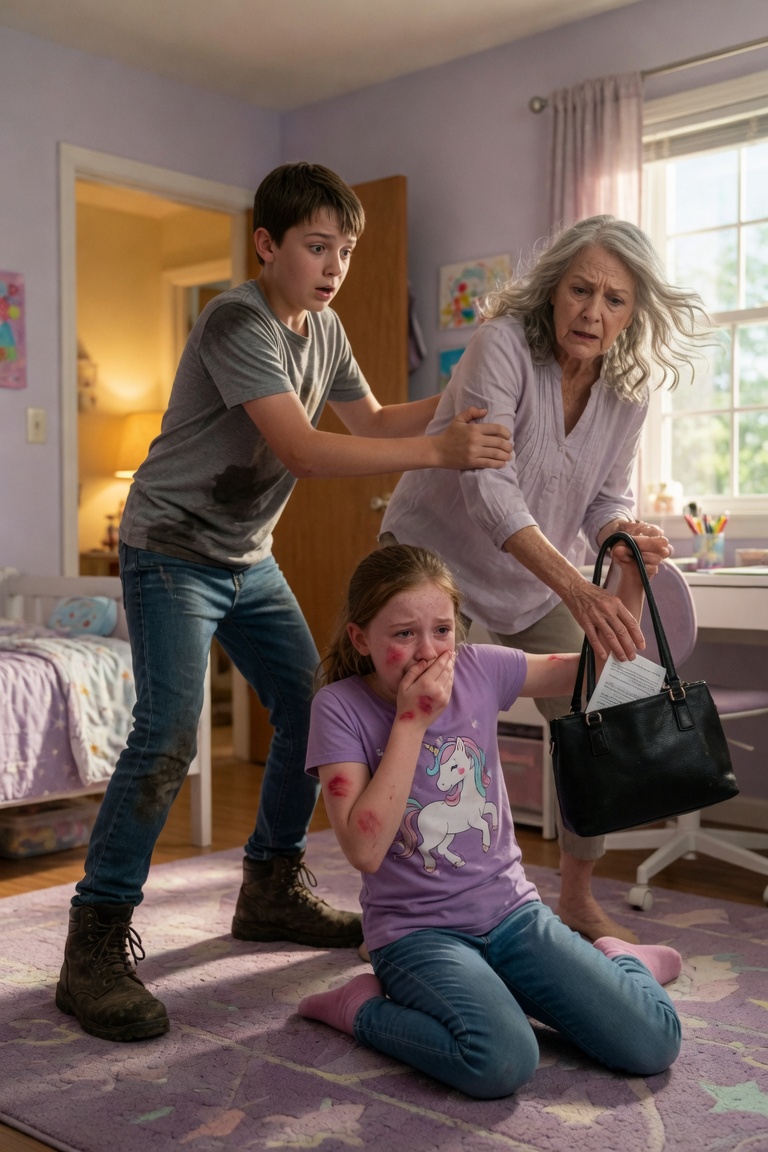
My mother-in-law, Marlene Whitaker, was kneeling on the rug with one hand clamped over my nine-year-old daughter’s mouth.
Her other hand gripped Lily’s shoulder so hard that the skin around her fingers had gone white.
Lily was pinned beneath her, kicking and twisting with the small desperate strength of a child trying to breathe.
Marlene’s carefully sprayed silver hair had fallen loose across her forehead.
Her blouse was wrinkled at the waist.
Her face looked nothing like the composed woman who corrected my table manners, inspected our baseboards, and called herself “the only adult in this family.”
It looked wild.
Desperate.
“If you tell Daddy,” she hissed close to Lily’s face, “your mother won’t wake up next time.”
I crossed the room before I knew I had moved.
I grabbed Marlene under both arms and pulled her off my daughter.
She weighed almost nothing, but she fought me for half a second, twisting back toward Lily like there was still one more sentence she needed to force into my child’s mouth.
“What the hell are you doing?”
Her expression changed so quickly it made my stomach tighten.
The fury vanished.
Her shoulders relaxed.
Her mouth tightened into offended dignity, like I had embarrassed her at a church potluck instead of finding her on top of my child.
“Ethan, let go of me.”
I released her, but I stayed between her and Lily.
Behind me, my daughter scrambled backward until her spine hit the wall.
She pulled her knees to her chest.
Her purple unicorn shirt was stretched at the collar, and red marks were already rising on her shoulder where Marlene’s fingers had been.
I had known Marlene for eleven years.
She had been at our wedding in a cream dress that looked a little too close to white.
She had stayed in our house for two weeks after Lily was born and rearranged our kitchen without asking.
She brought casseroles when my wife got sick, sat straight-backed in hospital waiting rooms, and told everyone she was the only reason this family still functioned.
For a long time, I let her believe that.
Not because it was true.
Because when someone is helping you carry fear, you do not always notice when they start using that fear like a leash.
My wife had been in and out of doctors’ offices for months.
Some mornings she woke up pale and shaking.
Some afternoons she would sit at the kitchen table with a paper coffee cup between her hands and stare at Lily’s school drawings on the refrigerator like she was memorizing them.
Marlene stepped in during that time.
She drove her to appointments when I could not leave work.
She picked up prescriptions.
She kept copies of paperwork “just in case.”
That was the trust signal.
We gave her access.
Keys, schedules, pharmacy bags, intake forms, the soft underbelly of a house already scared enough to be grateful.
Marlene smoothed her blouse like she could press the scene back into shape.
“You’re overreacting,” she said. “Lily threw a tantrum. I was trying to calm her.”
“You had your hand over her mouth.”
“She was screaming.”
“Because you were on top of her.”
Marlene gave a brittle little laugh.
“You know how dramatic children can be.”
That was the first moment I understood this was not panic.
Panic stumbles.
Panic explains too much.
Marlene was already building a story.
I turned slightly, keeping my body between them.
“Sweetheart, what happened?”
Marlene answered before Lily could.
“Nothing happened.”
“I asked Lily.”
“She misunderstood a private conversation.”
My daughter’s face was so pale that the freckles across her nose stood out like brown paint.
She looked smaller than nine.
She looked like every word had to crawl past fear before it could leave her mouth.
“Dad,” she whispered.
“I’m right here.”
“Check her purse.”
The room went still.
Outside, the mower sat dead in the yard.
The sprinkler clicked.
The cartoon voices kept laughing from the living room, thin and wrong.
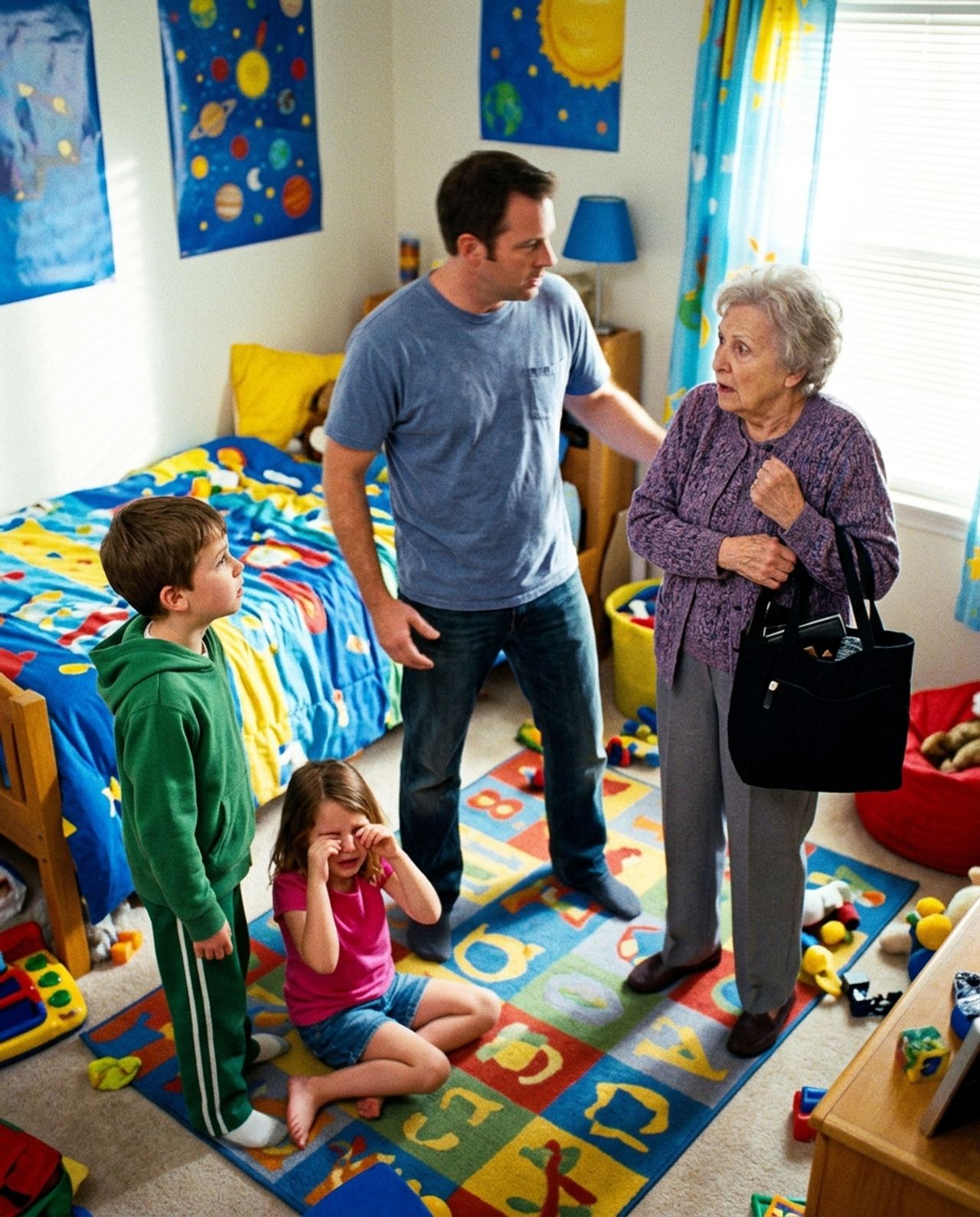
Marlene’s hand moved toward the black leather purse hanging from Lily’s desk chair.
I saw it.
So did Lily.
“Don’t,” my daughter said, and her voice broke.
I picked up the purse before Marlene could touch it.
“Ethan,” Marlene said softly, “this is humiliating.”
“Then it should feel familiar.”
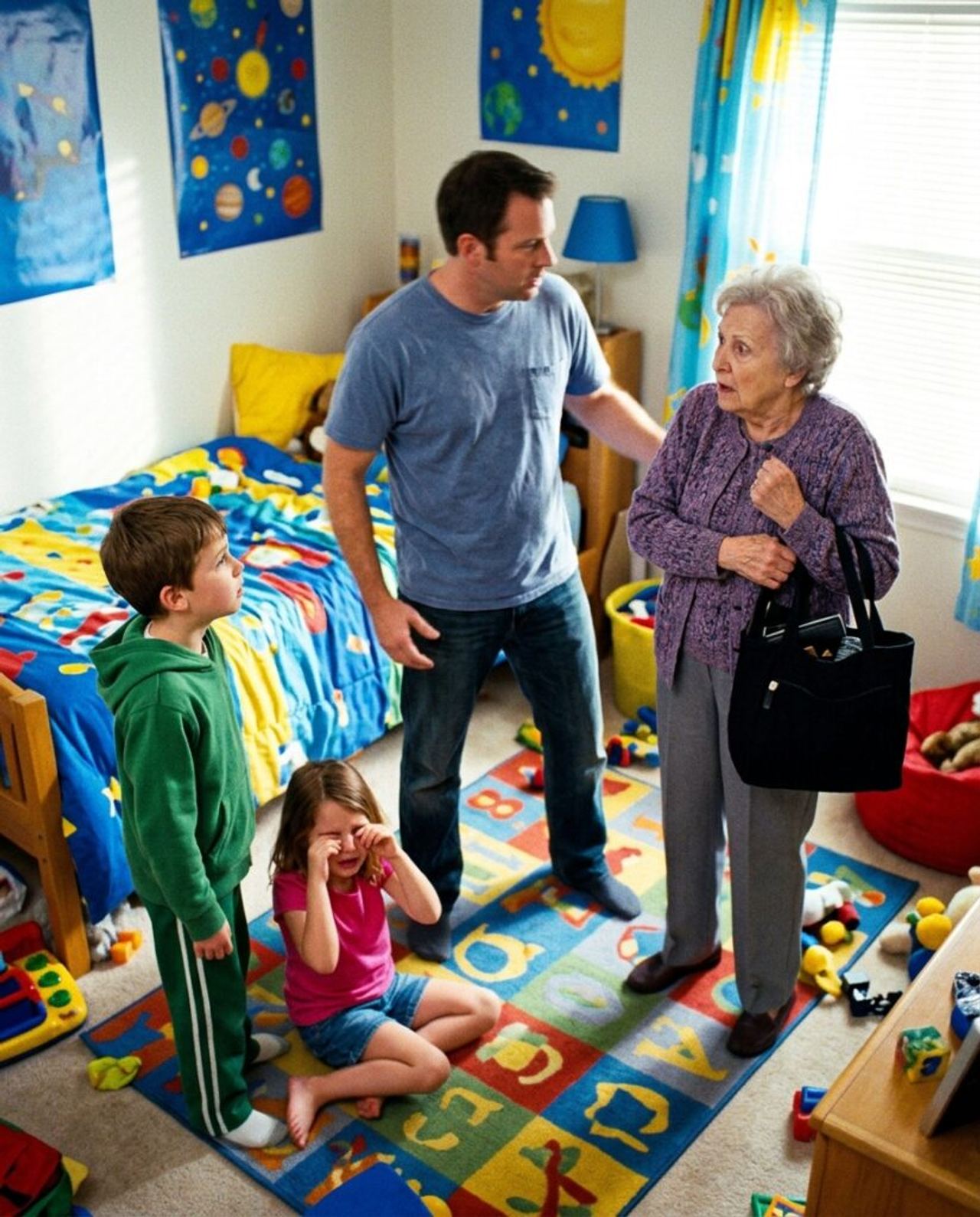
Her eyes sharpened.
For one ugly heartbeat, I wanted to throw the purse across the room.
I wanted to shake the truth out of her.
I wanted to be loud enough to frighten whatever had frightened my daughter.
Instead, I unzipped it.
Rage makes noise.
A father protecting his child sometimes has to get very quiet.
Inside were normal things first.
A wallet.
Breath mints.
A folded tissue.
Reading glasses.
A small bottle of hand lotion.
Then my fingers touched paper.
Not a receipt.
Not a grocery list.
Something folded twice and tucked flat against the lining.
I pulled it out.
Marlene’s face went pale.
At the top was my wife’s name.
Below it was a hospital intake desk stamp from 10:14 a.m. that morning.
There was a medication schedule written in blue ink.
Beside it was a note in Marlene’s handwriting.
My stomach went cold as I read it once, then again, because the first time my mind refused to accept the words in front of me.
The note was not written like a reminder.
It was written like instructions.
Lily started sobbing harder.
Marlene whispered, “She had no right to see that.”
Not “that is not mine.”
Not “you are misunderstanding.”
Not “let me explain.”
She had no right to see that.
That sentence told me Marlene knew exactly what the paper was.
It told me Lily had seen enough to become dangerous.
It told me my wife’s sickness had a witness I had almost failed to protect.
I looked from the paper to my daughter, then back to the woman who had just held her hand over Lily’s mouth.
Then my fingers found something else in the purse lining.
A second folded page.
Marlene reached for the doorway like she already knew she had run out of lies.
I unfolded it.
It had Lily’s name on it.
For a second, I could not make myself read past the first line.
Lily was pressed against the bedroom wall, both hands over her mouth now, not because anyone was holding her down anymore, but because fear had taught her to do it herself.
Marlene took one careful step backward.
“Ethan,” she said, and this time her voice had no polish left in it. “You don’t understand what you’re looking at.”
The paper shook in my hand.
Across the top, someone had written Lily’s full name in blue ink.
Under it was another time stamp.
Another hospital desk notation.
A line copied from a form nobody in my house had ever shown me.
Then Lily whispered, “Grandma said Mommy would stop breathing if I told.”
That did it.
Marlene’s purse slipped off the chair and hit the rug.
Her wallet, mints, and reading glasses spilled out.
So did a small pharmacy bag.
Marlene saw me look at it.
Her whole face collapsed.
Not anger.
Not offense.
Fear.
She grabbed the doorframe with one hand.
“I was only trying to fix what your wife ruined,” she whispered.
Lily made a sound I will never forget.
It was not a cry exactly.
It was more like all the air leaving a child at once.
I picked up the pharmacy bag, turned it over, and saw the label folded under the receipt.
Then I looked at Marlene and asked the only question left in that room.
“What did you give my wife this morning?”
Marlene did not answer.
That silence was the answer that made me move.
I took out my phone with one hand and kept the papers in the other.
Marlene reached toward me.
“Do not call anyone,” she said.
I stepped back.
“You don’t get to tell me what to do in my house.”
“You’ll ruin everything.”
“No,” I said. “You already did.”
I called my wife first.
She did not pick up.
I called again.
Still nothing.
That was when my hands started shaking for real.
I called the hospital number from the intake sheet.
A woman at the desk answered, and I made myself speak slowly, because panic was trying to climb out of my throat.
I gave my wife’s name.
I gave the 10:14 a.m. intake time.
I told her there were medication papers in my mother-in-law’s purse and that my daughter had just said something had been given to her mother.
The woman on the other end stopped sounding routine.
She asked me to stay on the line.
She asked if my wife was home.
I said no.
She asked who had last been with her.
I looked at Marlene.
Marlene looked at the floor.
“Her mother,” I said.
The hospital told me to bring the papers and pharmacy bag in immediately if I could do so safely.
Then the woman said something that turned my bones hollow.
“Sir, if you believe a medication error or tampering may have occurred, do not let anyone destroy those documents.”
Documents.
That word steadied me.
It made the room smaller.
It gave my fear edges.
I took photos of everything on the floor.
The first folded note.
The second page with Lily’s name.
The pharmacy bag.
The receipt.
The red marks on Lily’s shoulder, without touching her, without making her lift her shirt, without turning her pain into evidence before I had even held her.
Then I called 911.
Marlene finally moved.
She lunged for the pharmacy bag.
I shifted my body between her and the floor.
“Back up.”
“That belongs to me.”
“Then you can explain that to them.”
She stared at me with a look I had seen a hundred times at holiday dinners.
The look that said she expected me to cave first.
I used to cave because I wanted peace.
I used to let her win because my wife was tired and Lily was young and some days survival looked like swallowing the argument.
But an entire house can teach a child to wonder if telling the truth will make everything worse.
That afternoon, I decided my daughter would never learn that lesson from me.
Lily crawled toward me then.
Not all the way.
Just close enough to grab the back of my T-shirt with two fingers.
I crouched without taking my eyes off Marlene.
“You’re safe,” I told her.
She shook her head.
“Mommy isn’t.”
Those two words cut deeper than the scream had.
The police arrived before the ambulance did.
I remember the sound of tires at the curb.
The porch flag tapping the window.
Marlene standing in the hallway with her hands folded like a woman waiting for a choir to begin.
She tried to speak first when the officer entered.
Of course she did.
“There’s been a misunderstanding,” she said.
The officer looked at Lily behind me, then at the papers in my hand.
“Sir, start from the beginning.”
So I did.
I told him about the scream.
I told him about Marlene’s hand over Lily’s mouth.
I told him exactly what she said about my wife not waking up next time.
I handed over the hospital intake paper, the medication schedule, the handwritten note, the second page with Lily’s name, and the pharmacy bag.
Marlene kept interrupting.
“He’s emotional.”
“The child is confused.”
“My daughter has medical issues he doesn’t understand.”
The officer finally turned to her.
“Ma’am, you need to stop talking for a moment.”
That was the first time I saw Marlene realize charm was not a legal strategy.
At the hospital, my wife was awake but weak.
She looked at me from the bed with an oxygen tube under her nose and tried to smile before she saw Lily.
Then her face changed.
A mother knows when her child has been hurt.
She reached out with a trembling hand.
Lily climbed onto the edge of the bed and folded herself carefully against her mother’s side.
“I told Dad,” Lily whispered.
My wife closed her eyes.
“Good,” she said.
That one word broke something in me.
Later, a nurse took the papers.
A hospital administrator made copies.
An officer photographed the pharmacy bag.
Words started appearing that made the whole thing feel both less real and more real at the same time.
Incident report.
Medication review.
Witness statement.
Possible tampering.
Chain of custody.
The process verbs mattered.
Copied.
Logged.
Bagged.
Cataloged.
Because Marlene had spent years turning feelings into fog.
Now everything had edges.
Now everything had labels.
My wife told me later that Marlene had insisted on handling one of her morning medications that day.
She had said my wife looked too tired to keep track.
She had said a good mother accepts help.
She had said, in that soft cutting voice of hers, that Lily needed stability and that maybe a grandmother could provide what a sick mother could not.
That was what the page with Lily’s name had been about.
Not a custody order.
Not anything official yet.
But notes.
Dates.
Observations.
A private little file Marlene had been building about my daughter’s home life.
Missed school pickup when my wife was hospitalized.
Dishes in sink.
Child upset.
Mother sleeping during afternoon.
Father works outside home.
Every hard day we had survived had been written down by the one person we thought was helping us survive it.
Marlene had not been helping.
She had been collecting.
When Lily saw the papers in the purse, Marlene panicked.
When Lily understood her own name was in there, she asked what it meant.
That was when Marlene grabbed her.
That was when the threat came.
Your mother won’t wake up next time.
There are sentences you cannot put back into the air after a child hears them.
The investigation did not turn into one clean dramatic moment the way people imagine.
Real life is slower than that.
There were interviews.
There were forms.
There were hospital calls.
There was a police report number written on a card that sat on our kitchen counter for weeks.
There were family members who called me cruel for “overreacting” before they knew half the facts.
There were others who went very quiet when they heard Lily repeat Marlene’s exact words.
Marlene was told not to contact us.
That did not stop her from trying through relatives.
Her first message said she forgave me.
Her second said my wife had poisoned me against her.
Her third said Lily had always been dramatic.
I saved every message.
Screenshots.
Dates.
Times.
No more fog.
My wife recovered enough to come home three days later.
The house felt different when she walked in.
Not safer yet.
Just honest.
The cereal bowl was gone.
The mower had been pushed back into the garage by my neighbor.
The porch flag still tapped against the window when the wind shifted.
Lily slept in our room for almost two weeks.
She asked the same question in different ways.
Would Grandma come back?
Would Mommy wake up?
Was she bad for looking in the purse?
Every time, I answered the same way.
No.
Yes.
No, sweetheart.
Never.
We found a counselor through the school office.
We changed the locks.
We moved medical paperwork into a locked file box.
My wife changed the pharmacy pickup permissions and removed Marlene’s name from every contact form we could find.
At the hospital follow-up, my wife cried when the nurse asked who was allowed to receive information about her care.
Not because the question was hard.
Because for the first time in months, the answer was simple.
“Only my husband,” she said.
Then she looked at Lily.
“And when she’s older, only if she wants to know.”
Lily sat beside her in a hoodie two sizes too big, swinging her feet above the floor.
She did not smile.
Not yet.
But she leaned her shoulder against her mother’s arm.
Sometimes healing starts that small.
Not a speech.
Not forgiveness.
Just a child choosing where to lean.
Weeks later, I finally mowed the lawn again.
The sound of the engine made Lily flinch from the porch.
I shut it off right away.
I walked over and asked if she wanted me to wait.
She looked at the mower, then at the window, then at me.
“Can I sit outside while you do it?”
So she sat on the porch steps with a juice box and watched me mow one careful strip at a time.
The little American flag tapped against the planter beside her.
The sprinkler clicked across the neighbor’s lawn.
The world sounded almost the same as it had that day.
But this time, when Lily called out, I heard her right away.
“Dad?”
I let go of the mower handle.
The engine died.
She pointed to the strip I had missed near the mailbox.
“You forgot that part.”
For the first time in a long time, she looked proud of noticing something.
Not scared.
Not guilty.
Just proud.
I smiled and pushed the mower back over the uneven grass.
Marlene had tried to teach my daughter that truth was dangerous.
She had tried to teach her that adults with power could press a hand over her mouth and rewrite what happened.
But that afternoon, in the heat, with grass on my boots and my daughter on the porch, I understood something simple.
A house does not become safe because nothing bad ever happens there.
It becomes safe when a child knows what happens next.
When she screams, someone runs.
When she tells the truth, someone believes her.
When she says, “Dad, check her purse,” someone opens it.
And when the truth is ugly enough to make a grown woman run for the doorway, someone still unfolds the page.
Read more stories
- She Texted A Billionaire By Mistake To Borrow $50 For Baby Formula—He Showed Up At
- Father Calls 911 After Son Returns Home, Then The Timeline Changes
- My father-in-law came to see the house my parents bought for me, but when my husband started giving rooms to his family and demanded the keys, one sentence made his dad go pale…
- After Her Family Skipped Graduation, One Dollar Changed Everything.