
Celebrities & Music
BEFORE ALAN JACKSON BECAME A COUNTRY MUSIC LEGEND, ONE CHANCE ENCOUNTER WITH GLEN CAMPBELL HELPED OPEN THE DOOR THAT CHANGED HIS LIFE FOREVER.
The article recounts how a chance encounter between Denise Jackson and Glen Campbell at an airport led to Alan Jackson receiving a pivotal songwriting deal that changed his life and career in country music.

Long before the awards, the sold-out arenas, and the songs that would become part of America’s heart, Alan Jackson was still a young man chasing a dream that felt almost too far away. He had the voice. He had the songs. He had the heart of a country storyteller. But like so many dreamers who come to Nashville, he still needed a door to open. And sometimes, destiny does not arrive with thunder. Sometimes, it arrives through one unexpected meeting.
Alan’s wife, Denise Jackson, was working as a flight attendant when she met Glen Campbell — already a beloved star, already a name that carried weight in country music. That meeting became more than a passing moment. It became a connection that helped Alan take one of the first real steps toward Nashville. By 1986, Alan Jackson had signed a songwriting deal with Glen Campbell’s publishing company. It was not fame yet. It was not the Grand Ole Opry yet. It was not “Remember When,” “Chattahoochee,” or “Where Were You” yet. But it was a beginning. And sometimes, a beginning is everything.
Glen Campbell was not simply another famous name in Alan Jackson’s story. He became part of the bridge between a working man’s dream and a country music legacy that would touch millions. This was not the loud kind of showbiz friendship built for headlines. It was something quieter — and maybe even more powerful. A helping hand. A opened door. A moment of belief before the world knew Alan Jackson’s name. Years later, fans would see Alan Jackson as one of the greatest traditional country artists of his generation. But before the world heard him, someone had to give that dream a chance. And Glen Campbell helped open that door. Sometimes, legends are not only remembered for the songs they sang. They are remembered for the lives they helped lift along the way.
80 MILLION RECORDS. 35 NUMBER ONE HITS. BUT BEFORE THE STADIUMS KNEW HIS NAME, ONE QUIET ENCOUNTER IN AN AIRPORT SAVED ALAN JACKSON’S DREAM.
Today, we know him as the towering pillar of traditional country music. He is the man in the white Stetson who still stands tall, carrying the torch for the honky-tonk heroes of the past. He is the voice that held a broken nation together with “Where Were You (When the World Stopped Turning).” When we hear Alan Jackson, we hear our own hometowns, our own fathers, and our own memories echoing back to us.
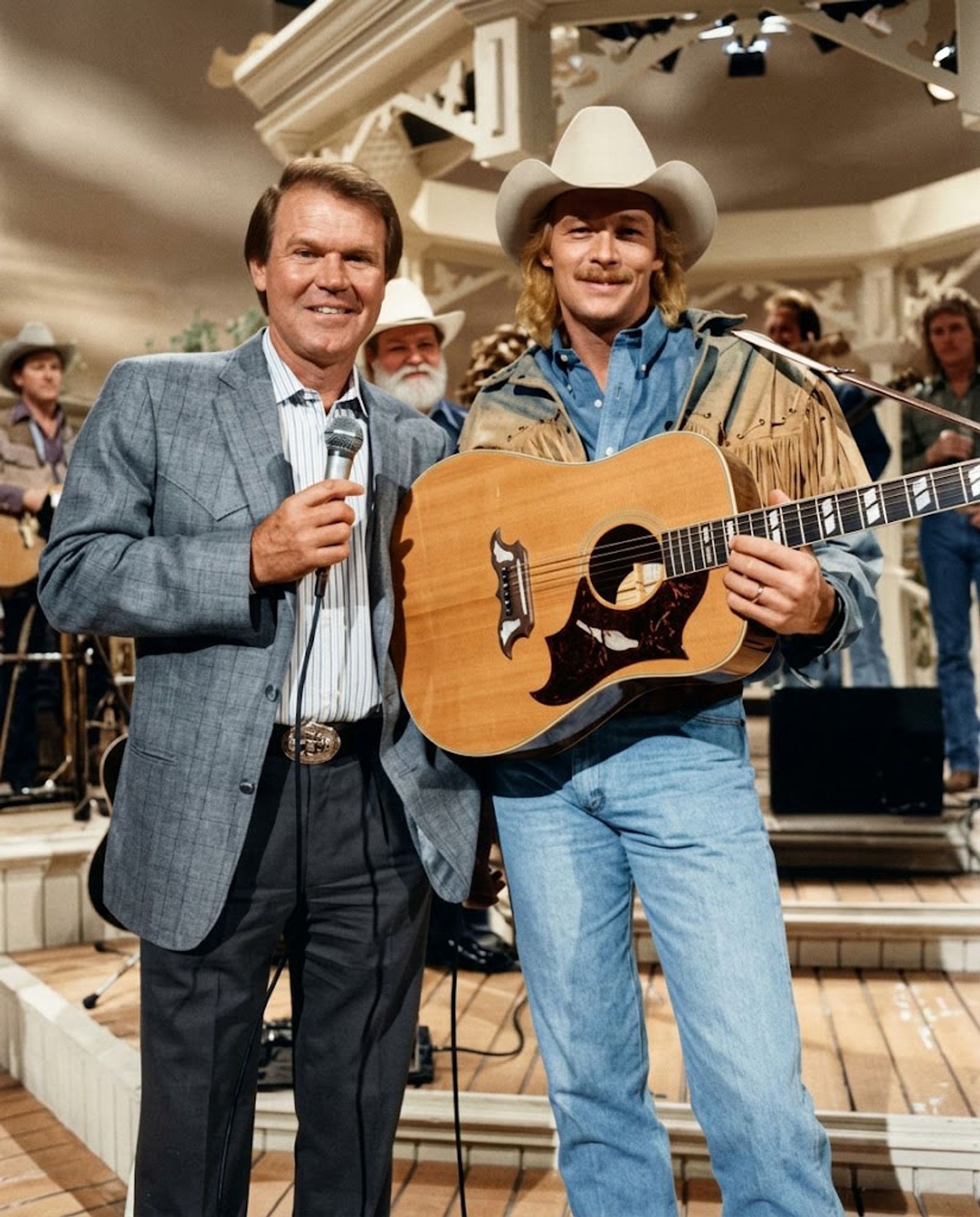
But we rarely think about the days when that voice was almost silenced before it ever had the chance to be heard. In the mid-1980s, Nashville was a tough town for a quiet kid from Newnan, Georgia. Alan wasn’t chasing the pop-country trends of the era. He was stubborn about his sound, gripping tightly to the fiddles and steel guitars that the industry was slowly trying to leave behind. The doors on Music Row were heavy, and they were firmly shut.
He was a forklift driver. He was playing in dark, smoky bars where the clinking of beer bottles was louder than the sparse applause. The dream of making a living with a guitar was slowly turning into the quiet ache of a fading hope. But behind every man refusing to quit, there is often someone else holding the pieces together. For Alan, that was Denise.
His high school sweetheart was working as a flight attendant, walking up and down the aisles of airplanes just to keep the lights on in their small apartment. She believed in the songs he was writing in the dark. She just needed someone else to hear them.
Then came a random, unremarkable afternoon at the Atlanta airport. Denise was in uniform, walking through the terminal, when she spotted a familiar face in the crowd. It was Glen Campbell. The Rhinestone Cowboy. A global icon whose voice had already immortalized “Wichita Lineman” and “Galveston.” He was a man who lived at the absolute summit of the music world.
Denise could have simply walked by. She could have asked for a quick autograph. Instead, she took a desperate leap of faith for the man she loved. She approached the legend and handed him her husband’s demo tape.
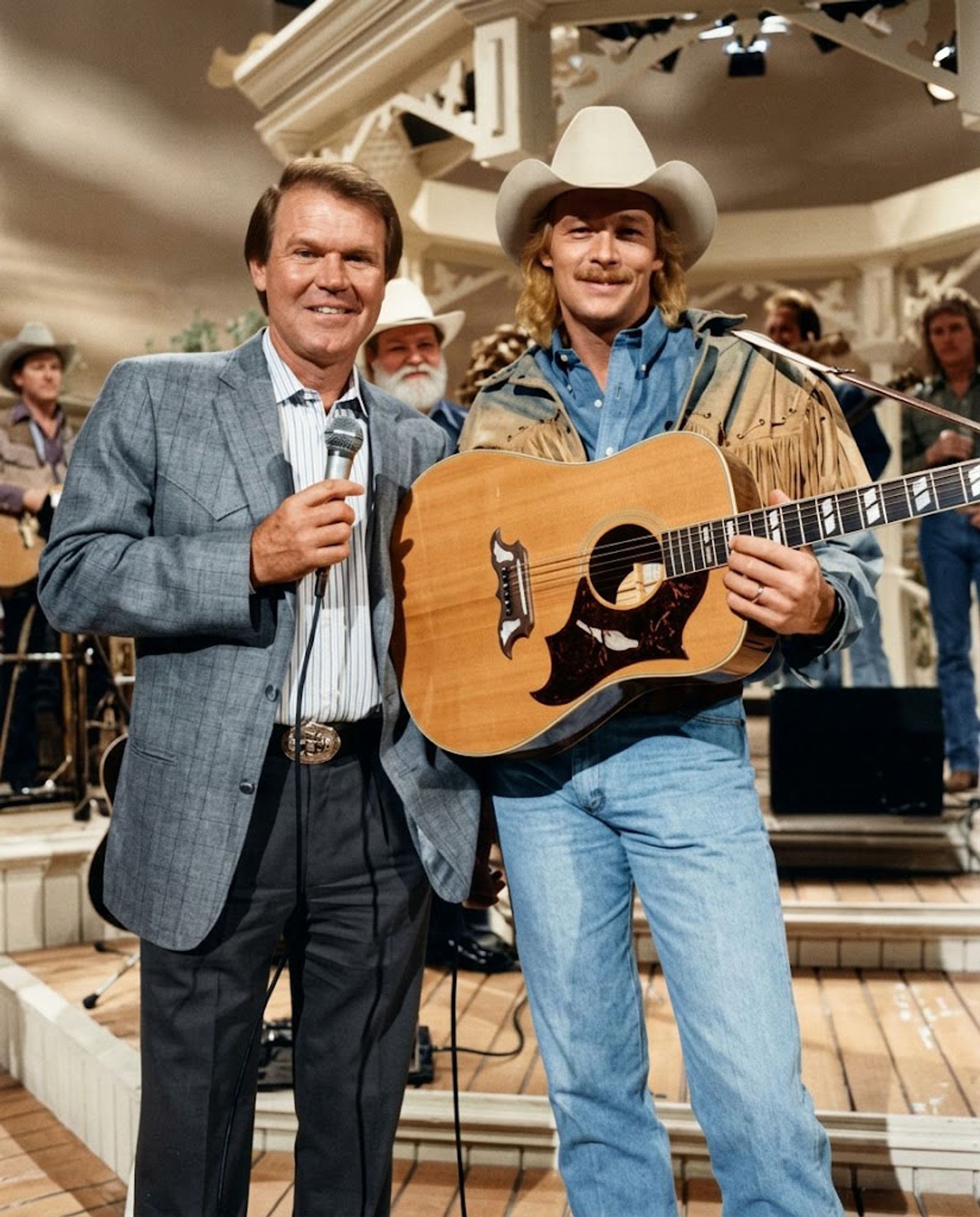
In the music business, moments like this happen every day. Tapes are handed over, polite smiles are given, and the cassettes are usually thrown into the nearest trash can before the flight even takes off. But Glen Campbell was different. He didn’t just pocket the tape to be polite. He took it with him. And he actually listened.
He didn’t hear a pop star. He didn’t hear a fleeting gimmick. He heard the undeniable, unpolished truth of the American South pouring through the speakers. He heard a kid who was singing simply to survive. Glen didn’t just pass along a polite compliment. He reached down and opened a door that had been welded shut.
He gave Alan Jackson a publishing deal with his own company, offering him a financial lifeline when his pockets were entirely empty and his resolve was wearing thin. Campbell had absolutely nothing to gain from a forklift driver with a heavy drawl. He was already a superstar. But true legends do not hoard the light—they know how to pass it on.
Glen Campbell has since left this earth, taking with him a voice that defined a generation. But his quiet act of grace remains alive every single time Alan Jackson steps up to a microphone today. Alan is still here. He is still singing. He keeps proving that pure, traditional country music never really dies, and we are incredibly lucky that we still get to witness him carry that torch.
Every time he strums that acoustic guitar and the arena lights up, a piece of that airport encounter lives on in the music. Sometimes, a legacy isn’t just built on the awards you leave behind. Sometimes, it is built on the hand you reach out in the dark. And the music you help save along the way.
Read more stories
- He Was Rejected By His Own Mom And Raised To Think ‘Women Are Evil’ But He Became A Legendary Rockstar
- TOBY KEITH RECORDED SOME OF THE BIGGEST PATRIOTIC ANTHEMS IN COUNTRY MUSIC HISTORY—BUT HIS REAL LEGACY WAS BUILT ON MILITARY BASES WHERE NO CAMERAS WERE ROLLING.
- [Video]: The One-Take Hit That Took Over Rock Radio
- The Box Tops’ “The Letter” Captures Lightning in a Bottle and Redefines Blue-Eyed Soul in 1967-2