
News
How a Neonatal Crisis Reordered Kenny Rogers’ Life at the Height of Fame
At the very moment Kenny Rogers seemed to have everything country stardom could offer, his newborn son’s fight to breathe forced him to step away from the spotlight and rethink what success meant.


A superstar brought to a standstill
By the early 1980s, Kenny Rogers was one of the most recognizable men in American music. His voice was everywhere, his concerts were major events, and his solo career had reached a level of mainstream visibility few country artists of the era could match. He was, in every practical sense, operating at full speed.
Then family life intervened with a force that fame could not soften. In late 1981, Rogers and his fourth wife, Marianne Gordon, welcomed their son, Christopher Cody. But the birth was premature, and the celebration turned almost instantly into a medical emergency. Instead of settling into the rituals of new parenthood, the couple found themselves facing the terrifying uncertainty of intensive neonatal care.
Inside the NICU, celebrity meant nothing
Christopher was diagnosed with hyaline membrane disease, a severe respiratory distress syndrome that endangered premature infants whose lungs were not yet ready to function on their own. In that moment, the machinery of success that had sustained Rogers’ public life became irrelevant. What mattered now was respiratory support, close monitoring, and whether a fragile newborn could make it through the next hour, then the next day.
The contrast was stark. A performer used to bright lights, tight itineraries, and the roar of audiences was suddenly spending long stretches in the muted tension of a neonatal intensive care unit. The soundscape changed completely: no applause, no band, no backstage chatter—only the controlled quiet of a hospital, broken by the steady beeping of monitors and the low hum of life-support equipment.
The applause of a crowd could always come again; a moment beside a struggling child could not.
Why Kenny Rogers put work on hold
Rogers responded in the most direct way possible: he stopped. Commercial obligations, appearances, and the relentless forward motion that normally governs a major entertainer’s life were pushed aside. The decision was less a public statement than a private reckoning. His son was in crisis, and there was nowhere else he needed to be.
That pause mattered because it cut across the assumptions of celebrity culture. Stars are often expected to keep moving, to fulfill dates, to absorb personal turmoil without disrupting the business around them. But in the NICU, those priorities collapsed. Rogers was not a brand or a box-office draw there. He was simply a father waiting outside a glass incubator, watching and hoping.
A lesson in fragility
Christopher eventually stabilized, but the experience left a deeper mark than a temporary interruption to a tour schedule. Medical crises involving premature babies have a way of compressing life into immediate, essential terms. For a parent, time is no longer measured by release cycles, bookings, or career milestones. It is measured by oxygen levels, doctor updates, and whether a child is getting stronger.
For Rogers, those days appear to have sharpened the difference between what is urgent and what only seems urgent. Stardom thrives on momentum and repetition: another show, another city, another ovation. A newborn’s struggle for survival exposes how little of that glamour can protect what matters most. The hospital vigil stripped fame down to its smallest human truth—love, fear, helplessness, presence.
How the experience changed his view of success
The crisis did not erase Rogers’ career, nor did it make him any less ambitious. But it seems to have changed the way he valued his time. There is a permanent shift that can happen when a parent sees how quickly life can turn, especially at a moment when everything else appears to be going right. Success stops looking like an endless ascent and starts looking more like a series of choices about where you are willing to be present.
That is what makes this episode so revealing in the arc of his life. At a commercial peak, when stepping away would have carried obvious professional costs, he discovered that certain moments cannot be rescheduled. Tours can be rebooked. Applause can return. But a child’s first fight for life happens once, and missing it would have carried a different kind of consequence—one no career triumph could undo.
The private turning point behind the public image
Kenny Rogers’ public persona was often built around steadiness: the seasoned storyteller, the confident headliner, the man who seemed at ease in the machinery of entertainment. The prolonged hospital vigil with Christopher revealed another side of that image, one that many parents instantly recognize. Beneath the polish was a father confronting the limits of control.
That is why the episode still resonates. It is not only a footnote in the life of a famous singer; it is a reminder that even at the highest levels of fame, family emergencies can reorder everything. In 1981, one of country music’s biggest stars was forced to measure life not by ticket sales or headlines, but by the rise and fall of a newborn’s breathing. By the time the crisis passed, the scale he used to judge what mattered had changed for good.

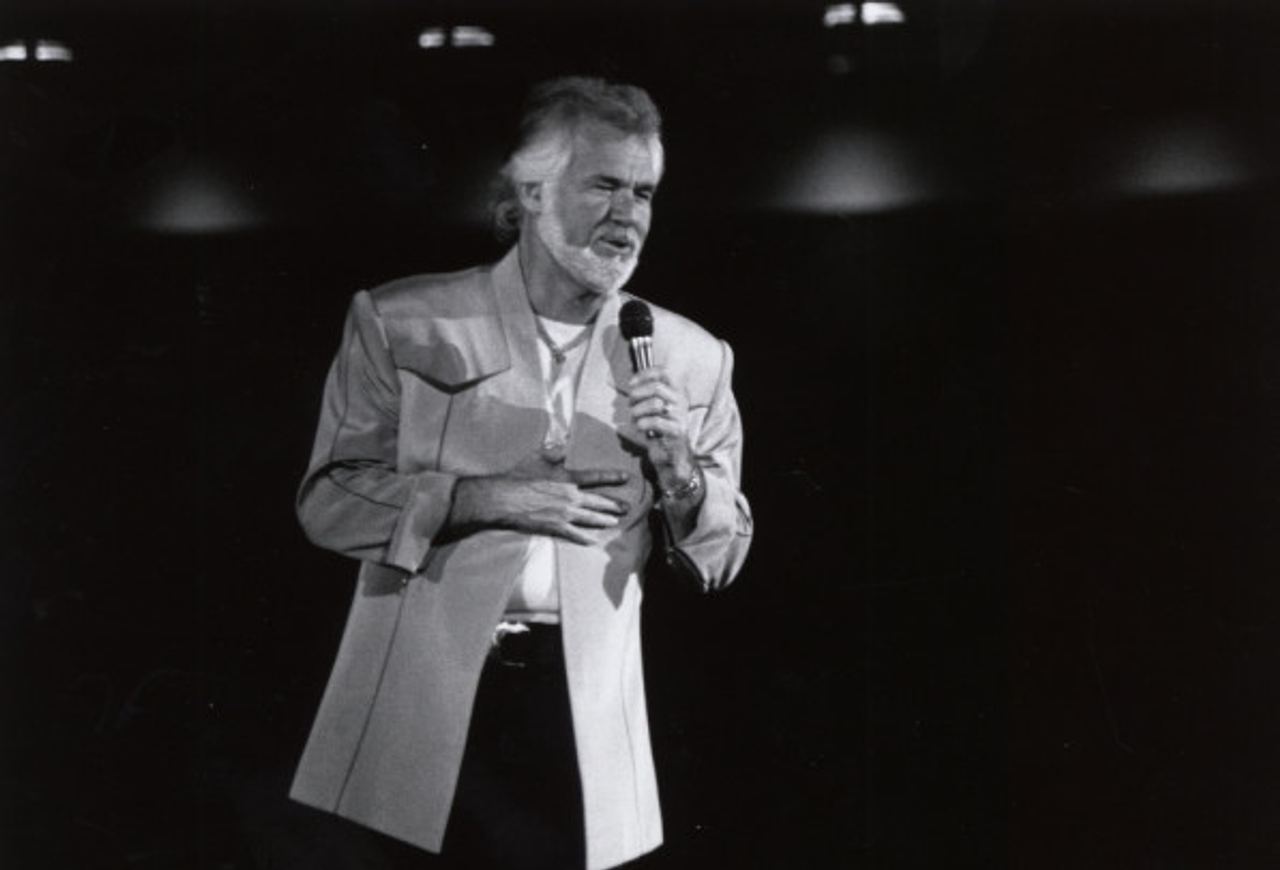
Quick Facts
- Subject: Kenny Rogers
- Spouse at the time: Marianne Gordon
- Son: Christopher Cody Rogers
- Medical crisis: Premature birth followed by hyaline membrane disease
- Immediate impact: Rogers put commercial obligations on hold to remain at the hospital
Image credits: Philpottm / Wikimedia Commons / CC BY-SA 3.0; User kw111786 on Flickr (Original version) User UCinternational (Crop) / Wikimedia Commons / CC BY-SA 2.0; University of Houston Digital Library / Wikimedia Commons / CC BY-SA 2.0.

