
Human Stories
A Woman in a Coma for Five Years Was Suddenly Found Pregnant
A woman who has been in a coma for five years is discovered to be pregnant, triggering an investigation into how it happened and who is responsible. As secrets inside the care facility unravel, her husband, medical staff, and access records come under scrutiny.

Chapter One
The Second Heartbeat
My sister had not spoken, moved, or opened her eyes on command in five years.
Then a nurse placed an ultrasound probe against her stomach—and found a second heartbeat.
I was halfway through a meeting when Teresa Hall called me from the Briarwood Neurological Care Center.
“Lauren, you need to come immediately.”
“Is Natalie dying?”
There was a pause.
“No. But I can’t explain this over the phone.”
I reached Briarwood twenty-three minutes later. Teresa was waiting inside the entrance instead of at the nurses’ station. She had cared for Natalie for almost three years, and I had never seen her look afraid.
“What happened?”
“Her abdomen has been getting larger.”
“You said it was bloating.”
“That’s what Dr. Voss believed.”
“And now?”
Teresa glanced toward the security camera above us.
“I ordered another examination.”
She led me to Room 307.
Natalie lay exactly as I had seen her two days earlier. Her dark hair had been brushed away from her face. A pale blanket covered her body. A feeding tube disappeared beneath the collar of her gown, while a monitor recorded the slow rhythm of her heart.
Five years earlier, a truck had crossed the center line and struck Natalie’s car. The doctors repaired her broken bones, stopped the bleeding, and saved her life.
But they could not bring her back to us.
Dr. Raymond Voss stood beside her bed with an unfamiliar female physician. A portable ultrasound machine had been positioned near the window.
“What’s happening?” I demanded.
Dr. Voss closed the door.
“Lauren, this is Dr. Mira Feldman from maternal-fetal medicine.”
For several seconds, the words meant nothing.
Then I looked at the machine.
“No.”
Dr. Feldman approached me carefully. “We need your permission to perform an ultrasound.”
“Why would my sister need an obstetrician?”
No one answered.
I looked at Teresa. Her eyes were shining.
“Tell me.”
She pulled the blanket lower.
Natalie’s stomach rose beneath her hospital gown. I had noticed the change during my previous visit, but Dr. Voss had blamed constipation, medication, and reduced muscle tone.
Now I could see that he had been wrong.
“No,” I repeated.
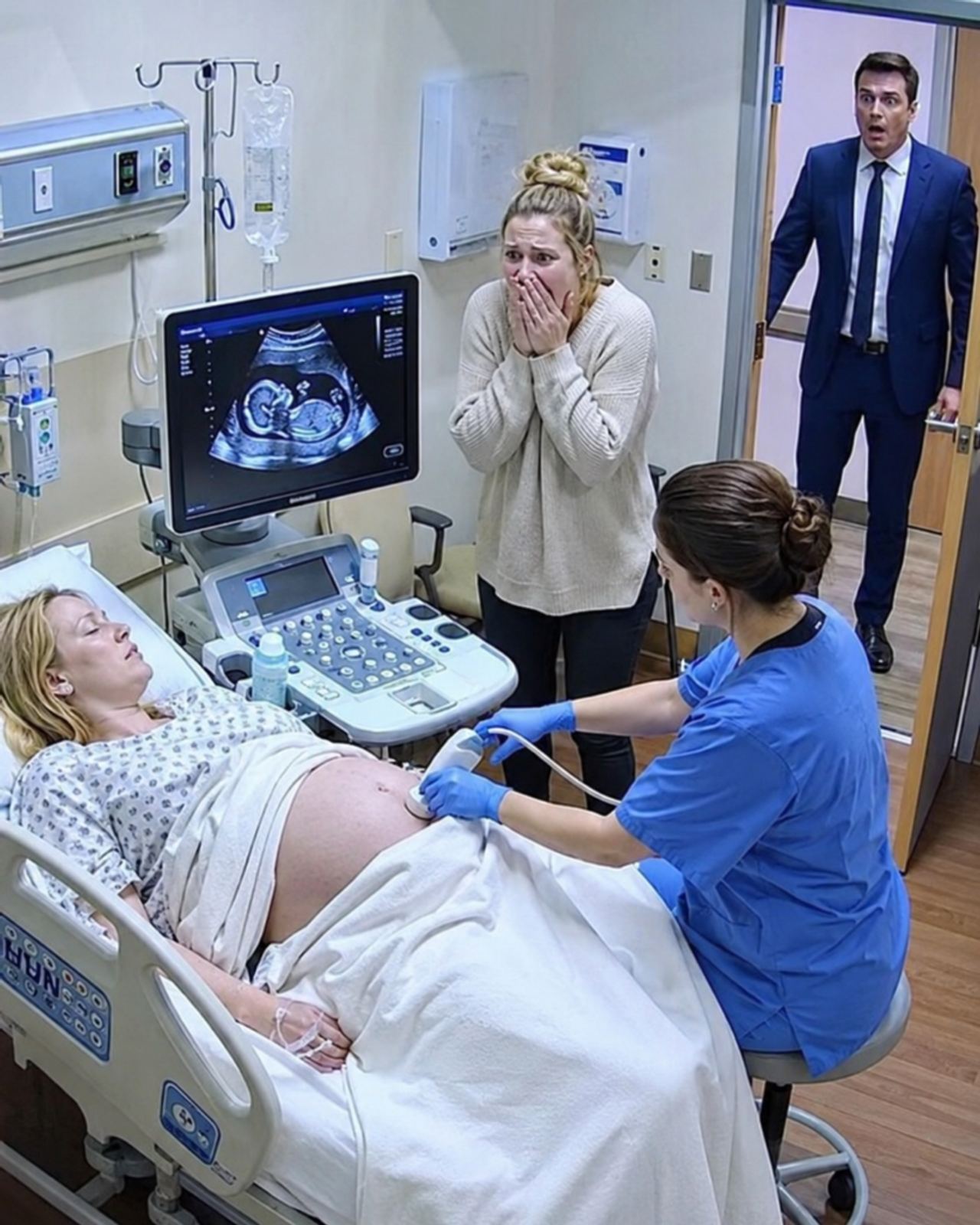
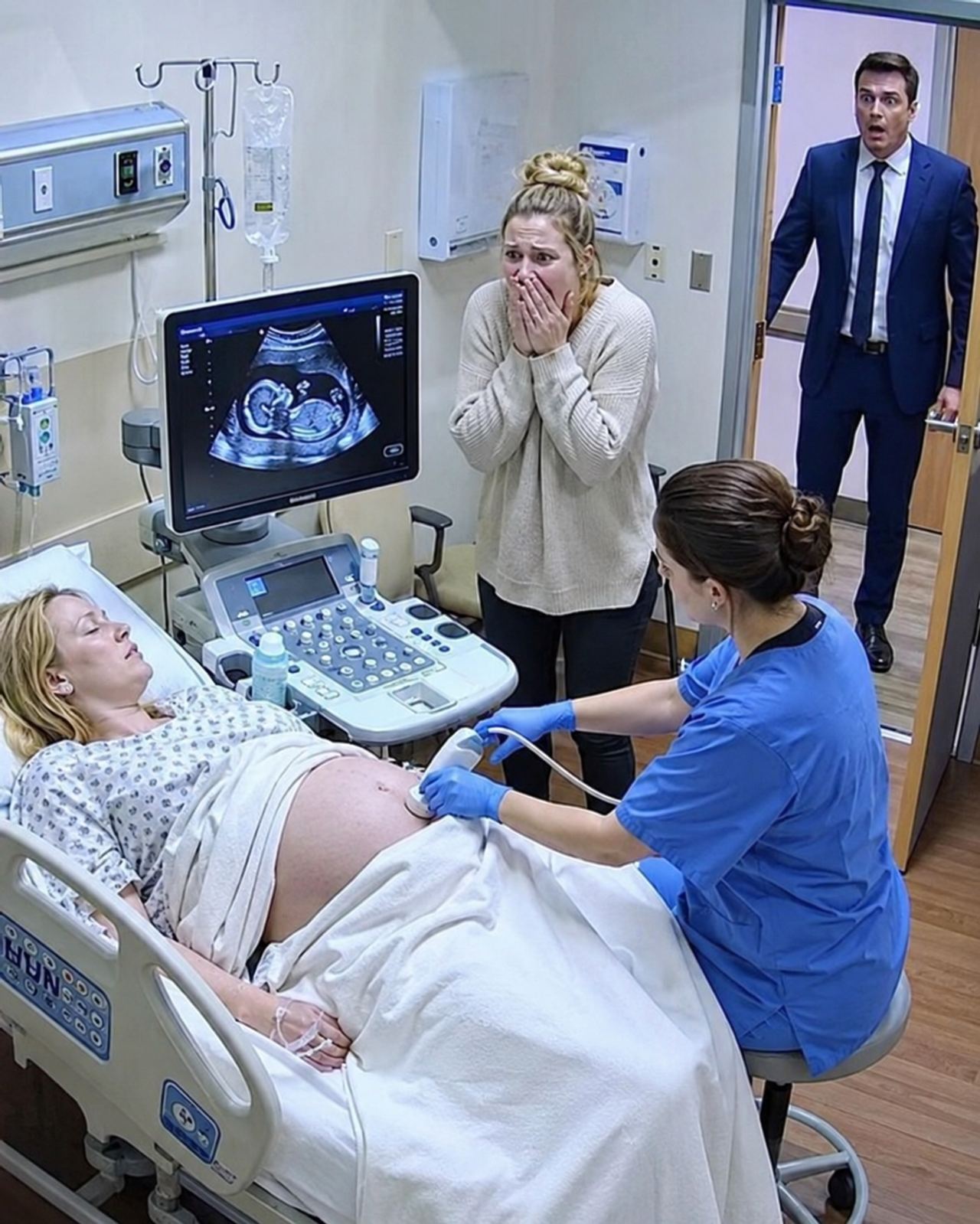
Dr. Feldman switched on the machine. I wanted to stop her, but my legs would not move.
She spread clear gel across Natalie’s abdomen and pressed down with the probe.
The screen filled with gray shadows.
Then something moved.
A curved spine. A tiny head. One hand floating near a face.
A rapid heartbeat filled the room.
I gripped the bed railing.
“What is that?”
Dr. Feldman looked directly at me.
“Your sister is pregnant.”
The room tilted.
“That isn’t possible.”
“The fetus measures approximately twenty-four weeks.”
“Twenty-four weeks?” My voice broke. “She has been in this room for five years.”
Dr. Voss stepped forward. “We have already contacted law enforcement.”
I turned on him.
“You told me she was bloated.”
“Her condition makes pregnancy difficult to detect.”
“You examined her.”
“Our staff followed standard procedures.”
“Standard procedures?” I pointed toward Natalie. “She cannot speak. She cannot move. She cannot consent to anyone touching her.”
No one denied it.
Teresa covered her mouth.
I looked at my sister’s peaceful face and felt something inside me split open. Someone had entered this room believing Natalie could never accuse him.
“Who had access to her?”
Dr. Voss hesitated. “Medical staff, aides, therapists, approved visitors—”
“Give me their names.”
“The police will review the records.”
“I want every name.”
A knock interrupted us.
Before anyone could respond, the door opened and Natalie’s husband walked in.
Blake stopped when he saw the ultrasound machine.
He looked at Dr. Voss, then at Natalie’s stomach.
I waited for him to ask whether she was safe.
I waited for him to demand to know who had done this.
Instead, he stared at the moving image on the screen and whispered, “Is the baby going to survive?”
The room became completely silent.
I turned toward him.
“The baby?” I said. “How did you know there was a baby?”
Blake’s face changed.
Only for a second.
But Teresa saw it too.
Chapter Two
The Door That Never Locked
Blake looked from me to the ultrasound screen.
“There’s a fetus on the monitor,” he said. “What else was I supposed to think?”
“You asked if the baby would survive before you asked what happened to your wife.”
His expression hardened.
“I just walked into a room full of terrified people. I didn’t know what was happening.”
“Neither did I. But I asked about Natalie.”
Blake moved toward the bed.
Teresa stepped between them.
It was such a small movement that Dr. Voss might not have noticed it. I did.
“What are you doing?” Blake asked.
“Until law enforcement arrives, no one touches her unless medically necessary,” Teresa said.
“I’m her husband.”
“And she is now the victim of a suspected crime.”
The words seemed to hit everyone at once.
Blake stopped walking.
Dr. Voss ordered the room sealed. Security guards blocked both ends of the hallway while staff transferred Natalie to a private medical unit where she could be monitored by female nurses.
Detective Monica Shaw arrived less than an hour later.
She was a compact woman in her forties with tired eyes and a voice that never rose. She spoke to each of us separately before gathering Dr. Voss, Teresa, Blake, and me in a conference room.
“Who had unsupervised access to Natalie Pierce during the last seven months?” she asked.
Dr. Voss placed a printed list on the table.
“Twenty-six medical employees, nine therapists, four maintenance workers, three housekeeping employees, and approved family visitors.”
“Male employees?”
“Seventeen.”
“Visitors?”
Dr. Voss looked at Blake. “Her husband and sister.”
Blake leaned forward. “Lauren isn’t a suspect.”
“Neither are you at this moment,” Detective Shaw said. “We are establishing access.”
“At this moment?”
“You were alone with your wife during some visits.”
“She’s my wife.”
Detective Shaw did not blink.
“Marriage does not create consent where consent is impossible.”
Blake pushed back from the table, but he said nothing else.
The detective requested voluntary DNA samples from every male employee and visitor. She also demanded security footage, electronic badge records, medication logs, shift schedules, and Natalie’s complete medical chart.
Dr. Voss left to retrieve them.
He returned twenty minutes later without the footage.
“There appears to be a storage problem,” he said.
“What kind of problem?” Detective Shaw asked.
“The camera outside Room 307 was replaced four months ago. Some archived files may not have transferred correctly.”
“Some?”
“All footage recorded before the replacement is currently unavailable.”
My fingers tightened around the edge of the table.
Natalie was approximately twenty-four weeks pregnant.
The missing footage covered the exact period when she would have conceived.
Detective Shaw stared at Dr. Voss for several seconds.
“Secure every server in this building. No one from your staff touches them again.”
By evening, investigators had identified one person whose badge appeared repeatedly in Natalie’s electronic access history.
Colin Briggs.
He was a thirty-two-year-old patient care aide who worked overnight shifts. His badge had opened Room 307 eleven times between midnight and four in the morning during the suspected conception window.
Colin claimed he entered only to reposition Natalie, check her feeding tube, or change bedding.
Then a forensic technician found a used medical glove beneath Natalie’s bed.
The glove carried Colin’s DNA.
Police brought him into an unused office while Teresa and I watched from the hallway. Colin’s face had gone pale, but he did not look surprised when Detective Shaw showed him the evidence bag.
“That isn’t mine,” he said.
“Your DNA says otherwise.”
“I use hundreds of those gloves.”
“One of them was found under her bed.”
Colin looked through the glass panel and saw me.
“I never hurt your sister.”
“Then explain your badge records,” I said.
His eyes shifted toward Dr. Voss.
“I can’t.”
Detective Shaw stepped closer. “Can’t—or won’t?”
Colin lowered his voice.
“Someone used my badge.”
“Who?”
“I don’t know. It disappeared twice, and both times it came back before I reported it.”
“That’s convenient.”
“No.” Colin looked at me again. “It was planned.”
Detective Shaw placed the evidence bag on the desk.
“Why would anyone frame you?”
Colin stared past her at Dr. Voss.
Then he said, “Because six months ago, I found a man inside Natalie’s room after visiting hours.”
I stopped breathing.
“Who was he?” Detective Shaw asked.
Colin opened his mouth.
Before he could answer, every computer screen in the hallway went black.
Chapter Three
The Devoted Husband
The computers went dark before Colin could identify the man he had seen in Natalie’s room.
Detective Shaw immediately locked the office door.
“No one leaves.”
Only the computer system had failed. The lights remained on, and Natalie’s medical monitors continued functioning.
Dr. Voss pulled out his phone.
“I need to contact our IT department.”
“You need to put that phone on the desk,” Detective Shaw replied.
Two officers hurried toward the server room while Teresa ran to check on Natalie.
Colin remained in his chair, staring at the dead monitor.
“Tell me what you saw,” Detective Shaw ordered.
“It was after two in the morning,” he said. “I opened Natalie’s door because her feeding-pump alarm had been silenced.”
“Was that normal?”
“No. The alarm could only be muted from inside the room.”
“Who was there?”
“A man stood beside her bed. He wasn’t wearing scrubs.”
“Did you see his face?”
“Not clearly. The room was dark.”
Colin said the man wore a visitor badge and a dark coat. One hand rested on Natalie’s abdomen. When Colin demanded an explanation, the stranger claimed to be family.
“He said he was allowed to be there,” Colin continued. “Then Dr. Voss came upstairs and told me to return to my patients.”
Every face turned toward the director.
“That never happened,” Dr. Voss said.
Colin rose from his chair.
“You threatened to fire me if I reported it.”
“That is a lie.”
Detective Shaw stepped between them.
“When was this?”
“Six months ago.”
Six months.
Around the time Natalie’s baby had been conceived.
Investigators discovered that the computer shutdown had originated from an administrator’s terminal. The login credentials belonged to Dr. Voss, although he insisted someone had stolen his password.
The missing files could not immediately be recovered.
By morning, reporters had surrounded Briarwood.
Someone had leaked Natalie’s pregnancy.
Blake walked outside before Detective Shaw could stop him. Cameras turned toward him as he stood on the front steps and described himself as a husband whose “entire world had been violated.”
He cried at exactly the right moment.
“I have visited Natalie faithfully for five years,” he told them. “I will protect my wife and our unborn child from anyone who tries to exploit this tragedy.”
Our unborn child.
I heard it from inside the lobby.
So did Detective Shaw.
Blake had not taken a DNA test. No one had established who the father was. Yet he had already placed himself between Natalie and the baby.
Within hours, strangers online were calling him courageous. They posted old wedding photographs and praised him for refusing to abandon his disabled wife.
They did not know that Blake had tried to prevent Natalie from being transferred three times.
I had once believed he wanted her to remain near the doctors who knew her. Now Detective Shaw showed me copies of his legal objections.
The first transfer would have moved Natalie to a facility with cameras inside every patient room.
The second required biometric access for all visitors.
The third prohibited unsupervised overnight visits.
Blake had fought all three.
“When did you become Natalie’s sole guardian?” Detective Shaw asked.
“Seven months ago. Before that, Blake and I shared medical authority.”
“And why did you request the change?”
“Money was disappearing from her settlement account.”
“How much?”
“Almost two hundred thousand dollars.”
Blake claimed the payments covered Natalie’s care. My attorney discovered that some had gone to a private investment company Blake controlled.
I had planned to file for divorce on Natalie’s behalf.
Blake learned about it seven months ago.
Natalie became pregnant shortly afterward.
Detective Shaw’s phone rang.
She listened without speaking, then looked at me.
“What is it?”
“Blake has filed an emergency petition with the court.”
“For what?”
“To remove you as Natalie’s guardian.”
I stared through the glass doors at him as he continued speaking to the cameras.
“On what grounds?”
Detective Shaw’s expression tightened.
“He says your demand for fetal DNA testing endangers his wife—and his child.”
Chapter Four
The Woman Who Could Still Hear
Blake insisted Natalie could not understand what had happened to her.
Teresa believed otherwise.
“Natalie sometimes reacts to voices,” she told Detective Shaw the following morning. “Her heart rate changes. Her breathing changes. Occasionally, she cries.”
Dr. Voss dismissed those reactions as involuntary.
Teresa waited until he left before opening a private nursing log she had kept for two years.
“I started writing these down because the official chart kept being changed.”
The notebook contained dates, times, and small observations.
11:42 p.m.—heart rate increased during visitor entry.
1:16 a.m.—tear observed after male voice in room.
2:08 a.m.—feeding alarm muted; visitor not listed.
Several entries occurred on nights Blake claimed he had not visited.
“Why didn’t you tell me?” I asked.
“I reported them to Dr. Voss. He said I was assigning meaning to reflexes.”
“Were you?”
“I don’t know. But somebody kept deleting my notes.”
Detective Shaw arranged a controlled observation.
Natalie lay in her new room with sensors monitoring her pulse, breathing, and brain activity. Dr. Feldman remained beside the bed while Colin stood in the doorway under police supervision.
He spoke Natalie’s name.
Nothing changed.
He approached the foot of the bed.
Natalie’s heartbeat remained steady.
Then Colin left, and Blake entered.
He had been granted a supervised visit while the guardianship dispute was reviewed. The moment he spoke, Natalie’s pulse climbed.
“Natalie,” he said softly. “It’s me.”
Her breathing became faster.
Blake looked at the monitor and almost smiled.
“She recognizes her husband.”
“Or she recognizes someone she fears,” I said.
“You want it to be me.”
“I want the truth.”
Blake moved closer to the bed. Detective Shaw warned him not to touch Natalie.
He stopped beside her shoulder.
“You always wanted a baby,” he whispered. “Now we finally have one.”
A tear slipped from the corner of Natalie’s closed eye.
Dr. Feldman wiped it away and examined her carefully.
“It may be an automatic response,” she cautioned.
Then Blake leaned nearer.
Natalie’s pulse jumped again.
Teresa looked at me.
“She hears him.”
Blake stepped back.
“That proves nothing.”
“No,” Detective Shaw said. “DNA will.”
The court denied Blake’s request to remove me as guardian. That afternoon, Dr. Feldman performed an amniocentesis under ultrasound guidance. The procedure would determine whether the fetus had inherited any medical conditions—and provide a DNA profile of the father.
Blake refused to submit his own sample.
He claimed the investigation had become a public spectacle. His attorney argued that testing him without probable cause would violate his rights.
Detective Shaw collected voluntary samples from the seventeen male employees instead.
Colin was the first to comply.
Before the fetal sample was sent to the laboratory, Teresa sealed it inside a tamper-evident container. Detective Shaw photographed the seal and personally handed it to a hospital courier.
For the first time, I felt we were close to an answer.
That evening, I sat beside Natalie and held her hand.
“If you can hear me,” I whispered, “I’m sorry I didn’t protect you.”
Her fingers remained motionless.
“But I promise he will never be alone with you again.”
The door opened behind me.
Blake stood there with a security officer.
Natalie’s heart monitor accelerated before he said a word.
Blake looked at the screen.
Then he looked at me.
At that exact moment, Detective Shaw called.
“Lauren,” she said, “the fetal DNA sample never reached the laboratory.”
Chapter Five
The Missing Sample
“The fetal DNA sample never reached the laboratory.”
I looked at Blake standing in Natalie’s doorway.
He had arrived less than five minutes before Detective Shaw called.
That could not be a coincidence.
“Get him away from her,” I said.
The security officer stepped between Blake and the bed.
“What happened?” Blake demanded.
“The sample is missing.”
His eyes flickered toward Natalie’s abdomen.
Then he forced himself to look surprised.
“That proves this investigation is out of control.”
“It proves someone is terrified of the result.”
Detective Shaw arrived twenty minutes later and sealed the maternity wing.
The courier who collected Natalie’s sample was stopped in the Briarwood lobby by a woman wearing a laboratory coat. She showed him an electronic message stating that the tube had been mislabeled and needed to be returned.
The message came from Dr. Voss’s hospital account.
The woman signed for the package and disappeared through a staff-only exit.
“Who was she?” Detective Shaw asked him.
“I assumed she worked here.”
“Did you check her badge?”
“She had one.”
Security footage showed the woman keeping her face turned away from the cameras. The badge she used to open the exit belonged to a laboratory technician who had called in sick that morning.
Dr. Voss was brought into the conference room.
“I did not send that message,” he insisted.
“It came from your account,” Detective Shaw said.
“My password was stolen.”
“Just like someone supposedly used your computer to shut down the medical system?”
“Yes.”
“And deleted four months of surveillance footage?”
Dr. Voss looked toward his attorney.
“I’m not answering further questions.”
A laboratory supervisor contacted Detective Shaw that evening. Someone using Dr. Voss’s credentials had ordered the missing sample destroyed as “contaminated biological material.”
But no disposal record existed.
The tube had vanished.
Blake’s attorney immediately filed another motion to stop all fetal testing. He argued that repeated procedures could endanger Natalie and the baby.
“Repeated procedures?” I said when Detective Shaw showed me the filing. “The first sample was stolen.”
“That is exactly his argument. He knows you may refuse another amniocentesis because of the medical risk.”
I went to Natalie’s room and found Dr. Feldman examining the fetal monitor.
“Can you safely take another sample?”
“Not immediately,” she said. “Every invasive procedure carries some risk.”
My eyes filled with tears.
“So whoever stole it wins?”
Dr. Feldman closed the door.
Then she lowered her voice.
“No.”
From her medical bag, she removed a sealed envelope.
“I divided the fluid into two tubes.”
I stared at her.
“The courier took the official sample,” she explained. “Teresa warned me that records were disappearing, so I personally transported the second tube to the state forensic laboratory.”
“Does anyone else know?”
“Only Teresa, Detective Shaw, and now you.”
“What about Dr. Voss?”
“No.”
“Blake?”
“Absolutely not.”
The state laboratory needed forty-eight hours to develop a paternal DNA profile. Until then, we had to behave as if the stolen tube were our only sample.
That night, Dr. Voss asked to speak with me privately.
He looked twenty years older than he had that morning.
“You should move Natalie,” he said.
“You fought every attempt to move her.”
“I was wrong.”
“Why are you telling me this now?”
His eyes moved toward the hallway camera.
“Because whoever did this knows the police are close.”
“Who entered her room?”
“I can’t tell you.”
“Can’t—or won’t?”
Dr. Voss gripped the back of a chair.
“Blake knows things about this facility. Things that could close Briarwood permanently.”
“What things?”
Before he could answer, his phone vibrated.
He read the message, and all the color left his face.
“What does it say?”
He turned the screen toward me.
It was a photograph of Teresa leaving the state forensic laboratory.
Someone knew about the second sample.
Chapter Six
The Copied Badge
Teresa was placed under police protection before sunrise.
The state laboratory transferred Natalie’s sample to a secure evidence room, but technicians had already extracted enough fetal DNA to continue testing.
For the first time, the person watching us could no longer erase the truth by stealing a tube.
Detective Shaw returned to Briarwood with a search warrant.
Investigators opened locked cabinets, copied financial records, and removed the hospital’s access-control equipment. In a basement storage room, they found a box of paper visitor slips that Dr. Voss had claimed no longer existed.
Teresa and I helped examine them.
Natalie’s official visitor history showed Blake coming once or twice each week during daytime hours.
The paper slips told a different story.
His initials appeared repeatedly after midnight.
On eleven of those nights, Colin’s badge had also opened Room 307.
“Colin wasn’t letting him inside,” Detective Shaw said. “Someone was using both a visitor pass and a cloned employee badge.”
She showed me the name of the company that had installed Briarwood’s security system three years earlier.
Pierce Secure Solutions.
Blake’s company.
He had access to the badge software, camera network, and emergency administrator passwords. He knew how to copy Colin’s credentials and which cameras could be disabled without triggering an alarm.
Colin had not been chosen randomly.
He was unmarried, worked alone at night, and had received two disciplinary warnings. Blake believed the police would accept him as the obvious suspect.
“What about the glove?” I asked.
“Colin’s DNA was on it,” Detective Shaw said. “But the glove contained no biological material belonging to Natalie. Someone could have taken it from any trash bin on his floor.”
The entire case against Colin had been manufactured.
Dr. Voss finally stopped denying the truth.
Blake had discovered that Briarwood was billing insurance companies for therapy sessions some patients never received. He threatened to expose the fraud unless Dr. Voss ignored his late-night visits and deleted the security footage.
“You knew he was entering Natalie’s room,” I said.
“I believed he wanted privacy with his wife.”
“She could not consent to anything.”
“I never imagined—”
“You saw her stomach growing.”
Dr. Voss lowered his head.
He had noticed the change almost two months earlier. Instead of ordering an ultrasound, he altered Natalie’s chart to describe the swelling as digestive complications.
He had not merely failed to protect her.
He had helped conceal what was happening.
Detective Shaw arrested him for obstruction of justice, evidence tampering, and insurance fraud.
But Blake’s motive still did not make sense until my attorney brought me Natalie’s trust documents.
After the crash, the trucking company had paid an $8.4 million settlement. Blake had been allowed to manage part of that money while he remained Natalie’s husband.
My guardianship petition threatened that control.
If the court approved a divorce, Blake would lose access to every remaining dollar.
However, the trust contained an old provision written before the accident: if Natalie had a child, that child would become the primary beneficiary. As the biological father, Blake could petition to manage the child’s inheritance.
The baby was not an accident.
She was his plan to keep Natalie’s money.
The state laboratory completed the paternal profile that afternoon.
It did not match Colin.
It did not match Dr. Voss.
It did not match any of the seventeen male employees who had submitted samples.
Detective Shaw found Blake outside Natalie’s room and handed him a court order.
“You are required to provide a DNA sample.”
Blake read it, then tore the paper in half.
“I will not participate in this circus.”
Detective Shaw signaled to the officers behind her.
“You don’t have a choice anymore.”
Blake looked past them at me.
For the first time, the devoted husband disappeared completely.
“You think that baby belongs to Natalie?” he said quietly. “Without me, neither of them would have anything.”
The officers moved toward him.
Blake suddenly turne…
Read more stories
- HE WROTE COUNTRY MUSIC’S MOST HEARTBREAKING SONGS ABOUT LONELINESS — BUT FOR 41 YEARS, KRIS KRISTOFFERSON LIVED A COMPLETELY DIFFERENT STORY BEHIND CLOSED DOORS WITH LISA MEYERS.
- DOCTORS TOLD ONE OF COUNTRY MUSIC’S GREATEST LYRICISTS HE WAS LOSING HIS MIND TO ALZHEIMER’S — BUT HOW HE STAYED ON STAGE REVEALED A DIFFERENT KIND OF DEVOTION.
- At his mother’s backyard cookout, my husband sat beside me while she told twenty-three people
- JERRY LEE LEWIS HADN’T PUT AN ALBUM ON THE BILLBOARD COUNTRY CHART IN 23 YEARS. AT 71, “THE KILLER” CAME BACK AT NO. 4.