
Stories
The Child They Refused to Welcome Into the Family
A wealthy family confrontation erupts in a hospital room when a new mother refuses to surrender her company shares, and the father of her child finally arrives with attorneys in tow. The story then flashes back to reveal the hidden relationship, pregnancy, and corporate power struggle that led to the confrontation.

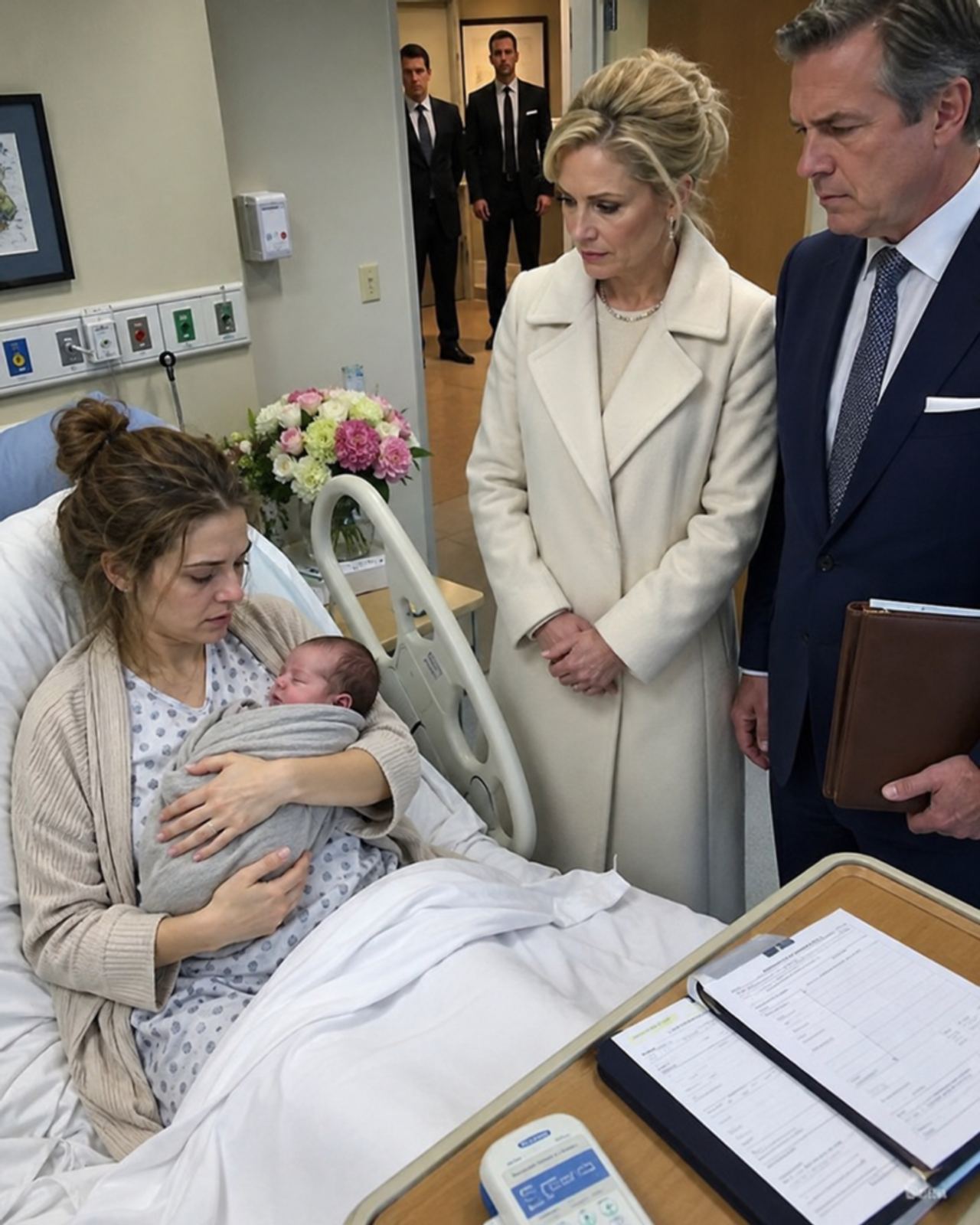
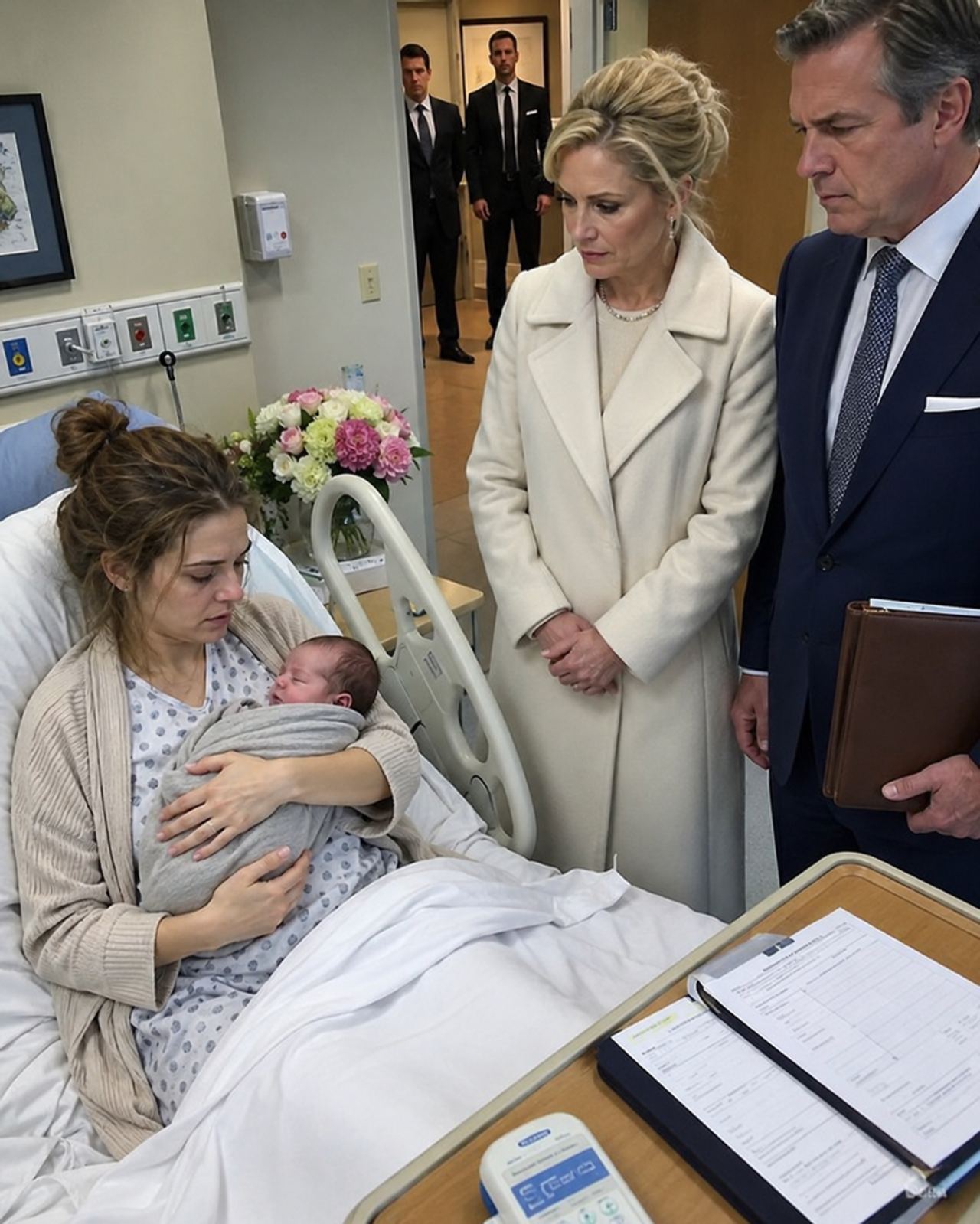
The nurse had only just placed my newborn son back into my arms when my parents entered the recovery room.
They did not knock.
My mother walked in first, wearing a cream wool coat over a navy dress, her hair arranged as neatly as if she were attending a board meeting instead of visiting her daughter in the hospital.
My father followed with a leather folder tucked beneath one arm.
Neither of them carried flowers.
There was no gift bag, no stuffed animal, no blanket, and no card with the baby’s name written inside.
They had not come to celebrate.
I understood that before either of them spoke.
The room had been peaceful only seconds earlier.
Late-afternoon light filtered through the blinds. A small television played silently on the wall. Beside my bed stood a plastic cup of water, a tray containing half-finished soup, and a vase of yellow flowers sent by my closest friend.
My son slept against my chest, wrapped in a pale gray hospital blanket.
His name was Elliot James Mercer.
He was nine hours old.
I had spent most of those hours staring at him, trying to understand how a person could feel so familiar when I had only just met him.
He had dark hair that lay flat against his small head. His nose turned up slightly at the end. His left hand escaped from the blanket every few minutes, as if he already objected to being contained.
The nurse smiled when she noticed.
“He’s determined,” she said.
“He gets that from both sides.”
At the time, I did not know how soon that determination would be tested.
My mother stopped near the foot of the bed.
She looked at me briefly.
Then she looked at Elliot.
There was no warmth in her expression.
No curiosity.
No surprise.
She examined him the way she might inspect an item delivered to the wrong address.
“So,” she said. “This is him.”
I adjusted the blanket around Elliot’s shoulder.
“This is your grandson.”
My mother’s mouth tightened.
My father remained near the door, his arms folded over the folder.
Neither came closer.
“We will never acknowledge a fatherless child,” my mother said.
Her voice was calm.
That was what made the words so cruel.
She did not sound angry enough to regret them later.
She sounded prepared.
My father nodded.
“And don’t expect us to ever hold that baby.”
The room seemed to become colder.
I looked down at Elliot.
His tiny fingers opened against my chest. I offered him one finger, and his hand closed around it.
I kissed his forehead.
“Then don’t,” I said.
My response surprised them.
My mother had expected tears.
She had probably imagined me exhausted, frightened, and desperate for support.
My father had expected shame.
They both believed the man who had fathered my child had disappeared.
They believed I had given birth alone because I had been abandoned.
They believed I would soon understand the cost of defying them.
Most importantly, they believed they had arrived at the moment when I would finally surrender my twelve-percent ownership in Mercer & Hale Industries.
My father walked toward the bed and placed the folder on top of the blanket covering my legs.
The weight made Elliot stir.
I moved the folder aside immediately.
“Be careful.”
My father looked offended.
“It’s paper.”
“He’s sleeping.”
My mother opened the folder and removed several documents marked with yellow tabs.
“Sign these.”
“What are they?”
“You know what they are.”
“I wouldn’t ask if I knew.”
She gave an impatient sigh.
“They transfer your company shares to your brother.”
I stared at her.
My younger brother, Marcus, already owned eight percent of Mercer & Hale. My father controlled thirty-one percent. My mother held six. Several relatives and institutional investors owned the rest.
My twelve percent mattered.
It did not make me powerful enough to control the company alone, but it gave me voting rights, board influence, and the ability to block certain family transactions when combined with outside directors.
For years, my parents had treated those shares as a mistake.
They had come from my grandmother.
My father’s mother, Evelyn Mercer, founded the company with her brother more than forty years earlier. Before she died, she divided part of her personal ownership between Marcus and me.
My father expected her to leave the full amount to Marcus.
Instead, she gave me the larger share.
She said I asked better questions.
My father never forgave her.
After the funeral, he told me the shares would eventually return to the appropriate branch of the family.
He meant my brother.
I was twenty-two then.
At thirty-one, I still owned them.
“You came to a hospital nine hours after I gave birth to make me sign away my company stake?” I asked.
My mother looked toward Elliot.
“You are no longer fit to represent this family.”
“Because I had a child?”
“Because you embarrassed us.”
“How?”
“You refused to identify the father.”
“I refused to identify him to you.”
“You allowed rumors to spread.”
“I did not start them.”
“You attended board meetings while visibly pregnant and gave no explanation.”
“I didn’t owe the board an explanation about my private life.”
“You are a Mercer.”
The sentence was meant to explain everything.
Mercers did not have private lives.
They had reputations.
Every marriage, friendship, mistake, and achievement became part of the company’s public image.
At least, that was how my parents justified controlling us.
My mother pushed the documents closer.
“Transfer the shares to Marcus. Once you do, we will arrange a reasonable allowance.”
I almost laughed.
“An allowance?”
“You will need help.”
“I have income.”
“You left your position.”
“I took maternity leave.”
“You will not be returning.”
“That is not your decision.”
My father finally spoke.
“It may become the board’s decision.”
I looked at him.
He was sixty-two and still carried himself like the executive who had spent decades entering rooms that became quieter when he arrived.
His gray hair was cut close. His suit fit perfectly. The gold watch on his wrist had belonged to my grandfather.
When I was a child, I believed my father knew everything.
As an adult, I learned that he often confused authority with knowledge.
“You cannot remove me from my director role because I had a baby,” I said.
“No,” he replied. “But questions of judgment and disclosure may become relevant.”
“What did I fail to disclose?”
“A relationship that may expose the company.”
“You don’t know anything about the relationship.”
“Exactly.”
My mother pointed toward the signature line.
“Sign, and we can avoid something ugly.”
I looked at Elliot again.
His breathing remained soft and even.
They had no idea who his father was.
That ignorance had made them reckless.
For eight months, they assumed I was protecting a man who did not want to be known.
They never considered that I might be protecting myself and my child from them.
“You should leave,” I said.
My mother laughed.
“You are hardly in a position to tell us what to do.”
“This is my room.”
“You are in a family-funded hospital suite.”
“No. My insurance is paying for it.”
“Your insurance exists because of the company.”
“I worked for that company.”
“You were given opportunities because of your name.”
My father tapped the folder.
“This offer will not remain available.”
“What offer?”
“Financial support in exchange for the shares.”
“You mean you’ll help your daughter and grandson only if I give you twelve percent of a company worth billions.”
My mother’s face hardened.
“Do not make this sound transactional.”
“It is written in a contract.”
Elliot moved against my chest and made a small sound.
I placed my hand over his back.
My mother stepped closer.
“Do you understand how people are talking?”
“I don’t care.”
“You will.”
“No.”
“Your child has no recognized father.”
“He has a father.”
“Then where is he?”
I looked toward the door.
“On his way.”
Both of my parents became still.
My father recovered first.
“Who?”
Before I could answer, the door opened.
A tall man in a dark overcoat entered the room.
Behind him came the hospital administrator and two attorneys.
My father recognized him immediately.
Every trace of confidence disappeared from his face.
My mother gripped the back of the visitor’s chair.
“Alexander,” she whispered.
Alexander Vale.
Founder and chief executive of Vale Global Holdings.
Investor.
Billionaire.
And the man my parents had spent three years trying unsuccessfully to persuade into rescuing Mercer & Hale from its growing debt.
He closed the door behind him.
Then he walked directly toward my bed.
The attorneys remained near the entrance.
The hospital administrator quietly stepped outside.
Alexander removed his coat and handed it to one of the attorneys.
He leaned down and kissed my forehead.
“You look exhausted,” he said softly.
“I am.”
“How is he?”
“Perfect.”
He looked at Elliot.
The tension in his face disappeared.
Alexander had held our son only briefly after the birth before leaving to attend an emergency legal meeting connected to the company.
The separation had lasted six hours.
From the way he looked at the baby, it might have been six months.
He touched one fingertip to Elliot’s cheek.
Our son turned slightly toward his hand.
Alexander smiled.
Only then did he look at my parents.
His voice remained calm.
That made it more frightening.
“I couldn’t help overhearing part of your conversation in the hallway.”
My mother opened her mouth.
Alexander continued.
“Did I understand correctly?”
He rested one hand gently on the edge of my bed.
“Did you just call my son fatherless?”
Nine Months Earlier
I had known Alexander Vale professionally for five years before our relationship became personal.
Our companies moved in overlapping circles.
Mercer & Hale manufactured industrial control systems, specialized medical equipment, and components used in renewable-energy projects.
Vale Global invested in infrastructure, logistics, technology, and advanced manufacturing.
Mercer & Hale wanted access to Vale’s international distribution network.
Vale wanted several patents our research division controlled.
The companies had negotiated three potential partnerships.
All failed.
My father blamed Alexander.
Alexander blamed our financial records.
The truth was closer to Alexander’s version.
Mercer & Hale had expanded too quickly.
My father approved the purchase of two overseas factories without fully understanding their liabilities. My brother pushed for a luxury consumer division that lost money for four consecutive years. Executives moved costs between departments to make weak divisions appear stronger.
By the time I joined the board, the company still looked impressive from the outside.
Inside, it had serious problems.
I had studied finance and industrial design. After graduate school, I worked for an independent engineering consultancy rather than joining the family company immediately.
My father considered that betrayal.
My grandmother considered it education.
When I returned to Mercer & Hale at twenty-seven, I expected to work in product development.
Instead, my father placed me in corporate communications.
He said I had “a natural eye for presentation.”
What he meant was that he did not want me near financial decisions.
I spent eighteen months rewriting reports that concealed more than they explained.
Then my grandmother transferred her shares.
With ownership came access.
I requested production records.
Debt schedules.
Safety reports.
Factory audits.
The more I read, the less comfortable I became.
At my first board meeting as a shareholder-director, I asked why one subsidiary’s losses had been classified as temporary expansion costs for three years.
My father looked at me as if I had spoken out of turn at dinner.
My brother smiled and said I was still learning how complex businesses operated.
Alexander attended that meeting as a potential strategic investor.
He did not speak until the end.
Then he said, “Ms. Mercer asked the only question that has not received a clear answer.”
My father disliked him from that moment.
I did not.
Our relationship began slowly.
Professional emails became longer than necessary.
Meetings ended, but we remained in conference rooms discussing books, architecture, and the strange loneliness of family businesses.
Alexander was forty-three, twelve years older than me.
He had built Vale Global from a transportation software company he founded in his twenties.
Business magazines described him as ruthless.
In person, he was careful.
He listened completely before answering.
He disliked public displays of emotion but remembered small details.
The first time we had dinner alone, he ordered tea for me before I arrived because he remembered I did not drink coffee after three.
I noticed.
He noticed that I noticed.
Neither of us discussed it.
For several months, we kept the relationship private.
Not secret.
Private.
There was a difference.
I knew my parents would treat it as a transaction.
My father would immediately assume Alexander’s interest could be converted into company financing.
My mother would begin discussing marriage before we had decided what we were.
Marcus would accuse me of using the relationship to strengthen my board position.
Alexander had his own reasons for caution.
He had been married once before.
His former wife had sold details of their divorce to a magazine after settlement negotiations.
Since then, he protected his personal life aggressively.
We were happy in quiet places.
A small restaurant near his apartment.
Sunday walks when neither of us carried assistants or security.
Evenings at my townhouse where he cooked badly and refused to admit it.
He met my closest friends.
I met his sister.
We did not attend public events together.
Then I became pregnant.
I found out on a Wednesday morning in my office bathroom.
The test sat on the edge of the sink while I stared at two lines.
My first emotion was joy.
The second was fear.
Not fear of Alexander.
Fear of everything around us.
The company was entering a dangerous period.
Mercer & Hale needed refinancing within a year.
Vale Global was one of the few possible investors with enough capital and industry knowledge to help.
If our relationship became public, every business decision would be questioned.
If the pregnancy became public before terms were settled, my parents would treat the child as leverage.
I called Alexander.
He left a meeting within fifteen minutes.
When he arrived, I was sitting on the floor of my office with the test inside a paper bag.
“Are you ill?” he asked.
“No.”
“Did someone threaten you?”
“No.”
I handed him the bag.
He opened it.
For several seconds, he did not understand.
Then he looked at me.
“Is this—”
“Yes.”
His expression changed completely.
“Are you sure?”
“I took three.”
“Three?”
“I wanted consensus.”
He laughed.
Then he crouched in front of me.
“How do you feel?”
“Terrified.”
“About the pregnancy?”
“About everything.”
He took my hands.
“We will handle everything.”
“You say that as if everything is manageable.”
“Most things are manageable when identified clearly.”
“That is the most Alexander response possible.”
He smiled.
Then his eyes filled.
“I’m happy,” he said.
“So am I.”
We decided to keep the pregnancy private until after the first trimester.
Then the company situation worsened.
My father quietly opened negotiations with another lender.
Marcus proposed using company pension assets as collateral for a short-term facility.
I opposed the plan.
That created a family conflict that had nothing to do with the pregnancy but soon became connected to it.
At sixteen weeks, my mother noticed I was avoiding wine at dinner.
She asked directly whether I was pregnant.
I said yes.
The question that followed was not whether I was healthy.
It was not whether I was happy.
“Who is the father?”
“I’m not discussing that yet.”
Her face changed.
“Does he know?”
“Yes.”
“Is he married?”
“No.”
“Then why the secrecy?”
“Because it is my decision.”
She immediately called my father.
By the next morning, both parents had arrived at my townhouse.
My father asked whether the man had signed a confidentiality agreement.
My mother asked whether he came from “an acceptable background.”
Neither asked his name with kindness.
I refused to answer.
Within a week, rumors spread through the company.
Someone told a board member that I was pregnant by a married executive.
Someone else claimed the father had abandoned me.
Marcus asked whether I planned to take extended leave from board duties.
I began documenting everything.
Alexander wanted to reveal the truth.
“Let them know,” he said.
“They’ll use you.”
“They already try.”
“They’ll assume Vale Global must rescue the company because of the baby.”
“I can say no.”
“You underestimate their ability to turn relationships into obligations.”
He looked at me.
“You have spent your whole life underestimating your own ability to say no.”
The sentence bothered me because it was partly true.
Still, we agreed to wait until the financing review was complete.
Vale Global’s investment committee was evaluating Mercer & Hale independently.
Alexander recused himself from the final recommendation.
The process had to remain clean.
My parents interpreted my silence as weakness.
They began pressuring me to transfer my shares before the birth.
At first, they framed it as temporary estate planning.
Then as protection.
Then as family duty.
My father said shareholders might lose confidence if I became a single mother.
My mother said no respectable board wanted “personal scandal” near a leadership role.
I reminded them that male executives had children outside marriage without losing board seats.
My mother replied, “You know the world is different for women.”
She treated inequality as a rule I should obey rather than a problem she should challenge.
I refused every proposal.
Then I stopped answering calls.
The Birth
Labor began two weeks before my due date.
Alexander was in London for a regulatory meeting.
I called him at four in the morning.
He answered before the first ring finished.
“What happened?”
“My water broke.”
“I’m coming.”
“You’re six hours away by plane.”
“Five and a half.”
“That isn’t reassuring.”
He arranged a flight while his sister, Camille, drove me to the hospital.
Labor lasted fourteen hours.
Alexander arrived during the ninth.
He entered the delivery room still wearing travel clothes, his hair disordered and his face pale.
“You made it,” I said.
“I said I would.”
He remained beside me through everything.
He held my hand.
He counted breaths when I forgot how.
He let me insult him during contractions without taking it personally.
When Elliot was born, Alexander cried before I did.
The nurse placed our son against my chest.
Alexander touched his back and whispered something I could not hear.
Later, I asked what he said.
“I told him we had been waiting.”
The morning after the birth, Alexander left briefly because Adrian Cole, his attorney, had discovered my parents were preparing an emergency board resolution.
The resolution claimed my “undisclosed personal circumstances” created reputational risk.
It proposed suspending my board voting rights until I transferred the shares or submitted to an internal review.
Alexander did not want to leave.
I told him to go.

“They’ll try something while I’m here,” I said.
“That is exactly why I should stay.”
“Your attorneys can stop the resolution. I need you to make sure everything is documented.”
He kissed me.
“I’ll be back before noon.”
My parents arrived at eleven thirty.
They believed I was alone.
The Hospital Confrontation
Alexander stood beside my bed, looking at my parents.
My father found his voice first.
“This is a private family matter.”
Alexander glanced at the folder.
“You brought corporate transfer documents to a maternity recovery room.”
“That is not your concern.”
“My child is in this room.”
My mother looked at Elliot.
Then at Alexander.
“You are the father?”
“Yes.”
“Why were we not told?”
I laughed softly.
The question was extraordinary.
“You called him fatherless thirty seconds ago.”
My mother ignored me.
She looked at Alexander.
“This changes matters.”
“No,” he said. “It reveals them.”
My father straightened.
“You and I should speak privately.”
Alexander’s expression remained calm.
“No.”
“Mercer & Hale has active negotiations with your company.”
“Those negotiations are being handled by independent committees.”
“You understand the significance of this child.”
Alexander looked toward Elliot.
“Yes. He is my son.”
“I mean financially.”
The room became completely silent.
Even my father seemed to realize too late what he had said.
Alexander stepped closer.
“That is precisely why you will not be involved in decisions concerning him.”
My mother sat in the visitor chair as though her legs had weakened.
“We did not know.”
“You did not ask,” I said.
“We asked repeatedly.”
“You demanded a name. You never asked whether I was loved or safe.”
My father pointed toward the documents.
“This issue is separate.”
“No,” Alexander replied. “It is the reason you came.”
One of the attorneys near the door stepped forward.
Her name was Naomi Price. She represented Alexander personally.
The other attorney, Julian Cross, represented Vale Global.
Naomi placed a document envelope on the table.
“Mr. and Mrs. Mercer, you are formally notified that any attempt to pressure Ms. Mercer into transferring assets during hospitalization may be presented as evidence of coercion in future civil or corporate proceedings.”
My mother stared.
“Coercion?”
“You conditioned family support on surrendering valuable shares,” Naomi said.
“That was a private offer.”
“It was a threat,” I replied.
My father looked at Alexander.
“You planned this.”
Alexander shook his head.
“I planned to return to the hospital and hold my son.”
“You brought attorneys.”
“Because your emergency board resolution arrived while I was driving here.”
My father’s face changed.
He had not expected us to know.
Julian opened his folder.
“The resolution has been circulated to outside directors. Several have requested an independent investigation into management conduct.”
Marcus had probably assumed the vote would happen quietly.
It would not.
My father looked at me.
“You gave company documents to Vale.”
“No.”
“Then how did he know?”
“A director forwarded the resolution to my counsel because it referenced an active Vale transaction,” Alexander said.
My father began pacing.
“This can be corrected.”
“It will be reviewed,” Julian replied.
My mother turned toward me.
“Charlotte, think carefully.”
My name is Charlotte Mercer.
My mother used the full version only when she wanted to remind me I belonged to her.
“You have just had a child,” she continued. “You are emotional.”
“I am tired. I am not confused.”
“You do not understand what Alexander wants.”
Alexander looked almost amused.
I said, “He wants to hold his son.”
“Men like him do not act without considering assets.”
“Men like Dad?”
My mother flinched.
My father stepped toward the bed.
“This family company has existed for forty years.”
“And you tried to take my ownership while I was recovering from childbirth.”
“To protect it.”
“From me?”
“From instability.”
Alexander moved between him and the bed.
“You will not come closer.”
My father looked at him.
For decades, people moved when my father gave orders.
Alexander did not.
The difference unsettled him.
“We should all calm down,” my mother said.
The person who had called my son shameful now wanted calm.
I picked up the folder and handed it to Naomi.
“Please keep this.”
My father reached for it.
Naomi moved it behind her.
“These are family documents.”
“They were delivered to my client,” she replied.
My father’s voice rose.
“She cannot give them to you.”
“She can.”
A nurse appeared in the doorway.
“Is everything all right?”
I looked at my parents.
“No.”
The nurse stepped inside.
“I need the room cleared unless the patient requests otherwise.”
My mother stared at me.
“You would have us removed?”
“Yes.”
“After everything we’ve done for you?”
“You came to take something.”
“We came to protect the family.”
“You refused to acknowledge my child.”
My mother’s face crumbled slightly.
Not from guilt.
From losing control of the conversation.
“You will regret humiliating us.”
“I’m not the one who should be embarrassed.”
The nurse opened the door wider.
My parents left.
My father stopped beside Alexander.
“This is not over.”
Alexander replied, “I agree.”
After the door closed, the room became quie…
Read more stories
- HE HAD ALREADY WRITTEN HER SONG BEFORE HE KNEW SHE WAS A SHE.
- The 24-year-old woman had been forced by her stepmother into a bedroom with one of her business partners. Terrified, she escaped and climbed into a stranger’s car… never knowing that one desperate choice would change her life forever.
- My Brother Tried To Kick Me Out At Christmas :“You Weren’t Invited”. Then The Governor Stood Up…
- My Husband Claimed I Destroyed His Business in Court – Until My Little Son Suddenly Whispered, ‘The Person Who Framed You Is Here’