
Stories
PART 2 Damian Volkov had fired every nurse who dared enter his room
A maid’s deaf daughter discovers an irregular vibration in Damian Volkov’s chest, leading to the revelation that he may have a hidden mechanical implant and that his supposedly dead son may have been taken, not lost. As Anna and her daughter are drawn deeper into Volkov’s dangerous world, the story shifts into a tense alliance against betrayal, poison, and buried family secrets.

The room remained so still I could hear the rain tapping against the tall windows.
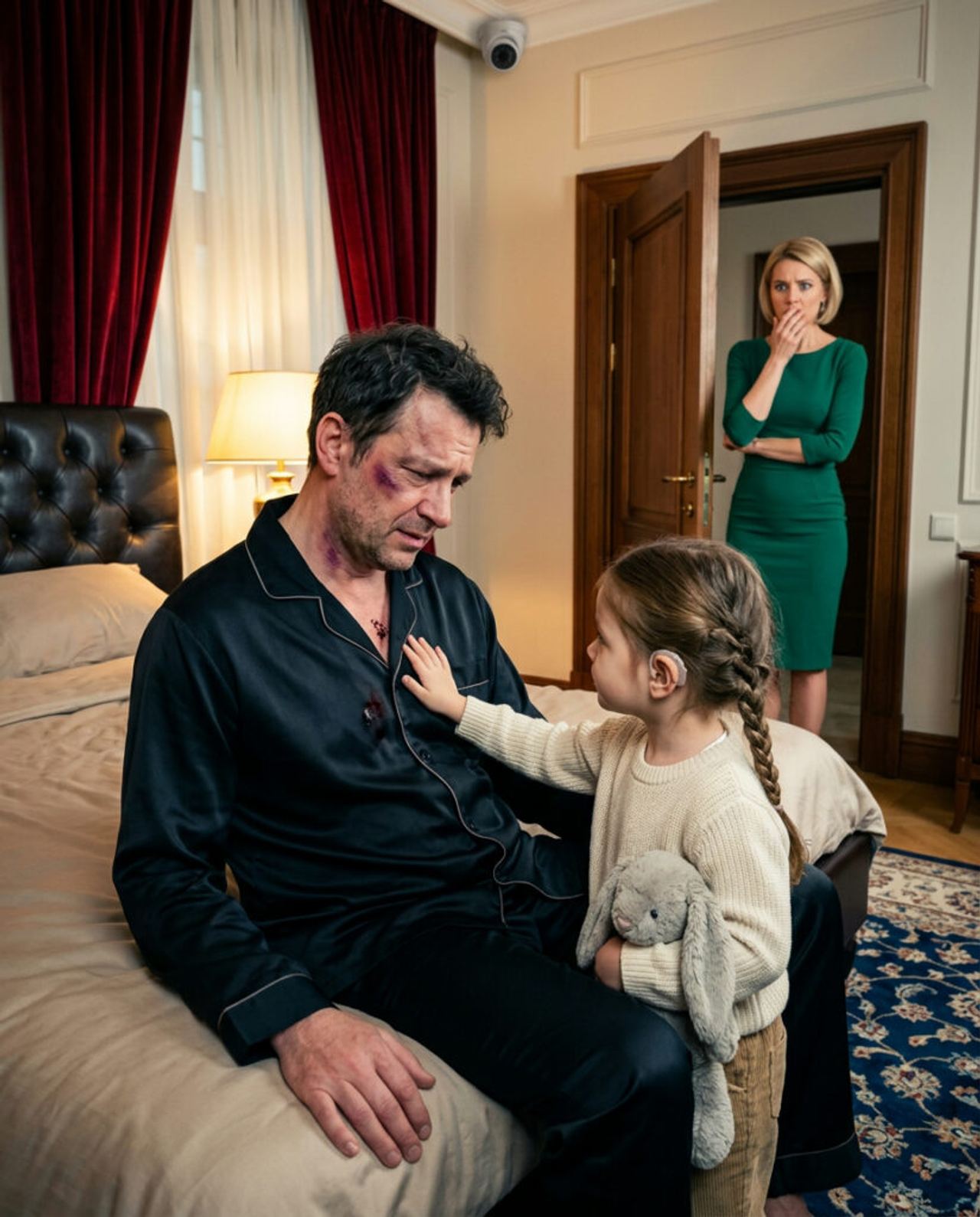
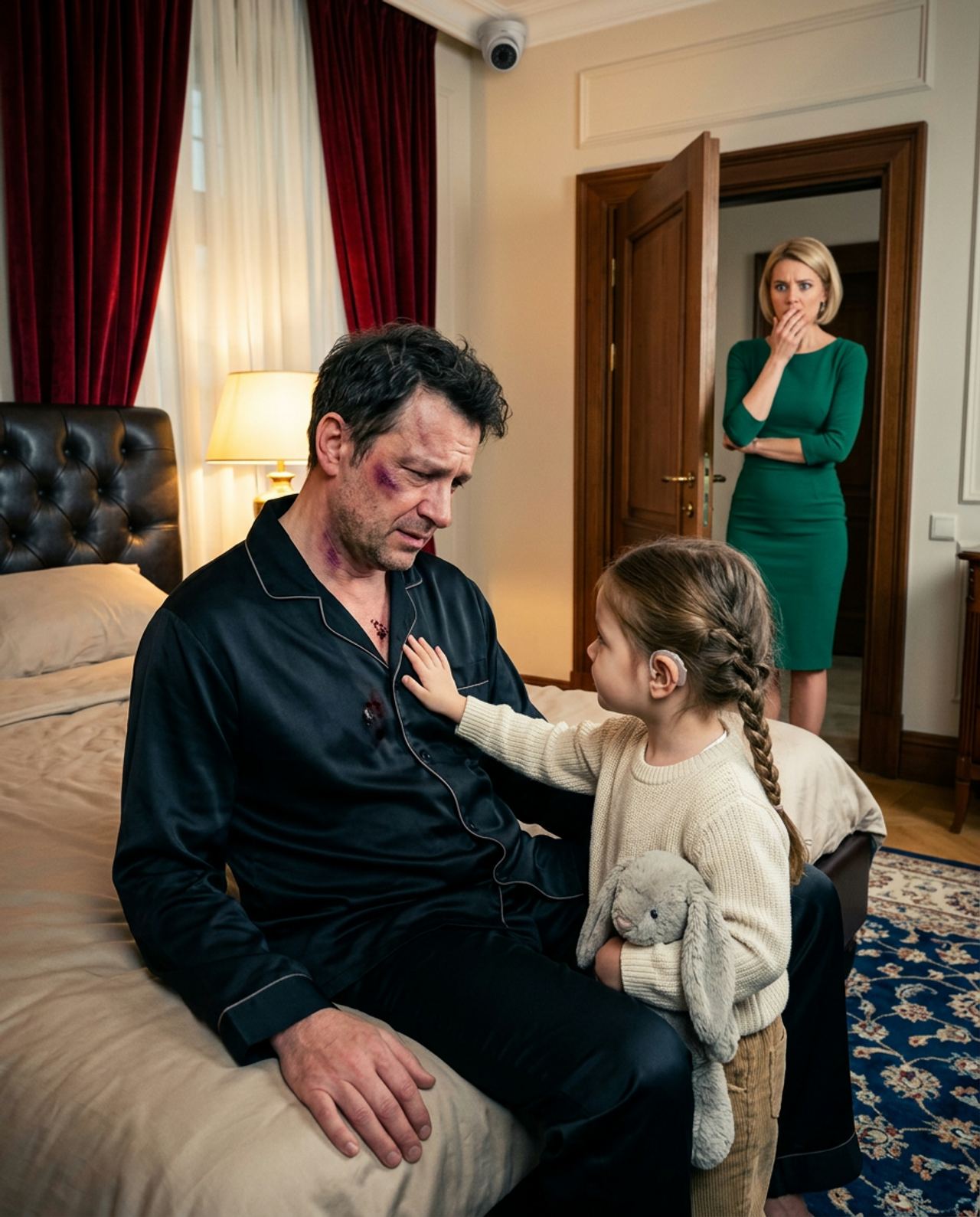
Damian Volkov held my daughter’s hand against his chest as if she had become the only thing keeping him in the world. His face, usually carved into stone even by pain, had changed.
The hardness had not disappeared, but something had cracked through it.
Fear.
Not the kind of fear that made a man beg for his life. Damian Volkov did not look like a man afraid to die.
He looked like a man afraid of being understood.
“She can hear what none of you can,” he whispered again.
One of the guards at the door shifted uneasily. His name was Viktor, a broad-shouldered man with a shaved head and a scar running through one eyebrow. He had once frightened me so badly by simply standing behind me in the laundry corridor that I nearly dropped a basket of sheets.
Now even he looked uncertain.
“Boss?” Viktor said.
Damian’s eyes cut toward him.
“Get everyone out.”
Viktor hesitated. “Sir, the doctor said—”
“Out.”
The word was quiet, but it carried more power than a shout.
The guards stepped back immediately. I reached for Lila, still trembling from the thought of what might have happened. She was so small beside him, her yellow boots dangling above the floor, her rabbit pressed between her knees. She looked from Damian’s face to mine, sensing the tension but not understanding all of it.
“I’ll take her,” I said softly. “We’ll leave now.”
“No.” Damian’s hand tightened over Lila’s, though not enough to hurt her. “You stay.”
I swallowed.
“Mr. Volkov, she’s only four.”
“I can see that.”
“She didn’t mean to disturb you.”
“She didn’t disturb me.” His gaze returned to Lila, and his voice changed, lower and rougher. “She found something.”
The words made the air in the room feel colder.
Lila’s pink hearing device caught the gray light from the windows. She was watching Damian’s mouth carefully, as she always did when adults spoke too quickly. Her deafness was not complete, but sounds came to her like things underwater—blurred, broken, unpredictable. Some days she reacted to thunder. Other days she did not hear me calling from across the room.
But she felt things.
Music through the floorboards. Trains through the soles of her feet. My heartbeat when she pressed her cheek against my chest after a nightmare.
And now, apparently, Damian Volkov’s failing heart.
I signed to her with unsteady fingers.
Are you okay?
Lila nodded. Then she pointed to Damian’s chest and frowned.
“What is she saying?” Damian asked.
“She says…” I hesitated, trying to read the shape of Lila’s small hand moving in the air. “She says your heart is knocking wrong.”
Damian stared at me.
I wished, suddenly, that I had softened it. Made it sound more childish. Less precise.
But Lila signed again, tapping two fingers against her palm in an uneven rhythm.
“Not just fast,” I translated. “Wrong.”
Damian closed his eyes.
For a moment, he looked exhausted beyond anger. Beyond pride. Beyond all the legends whispered about him in the servants’ hall.
I had worked at Grayhaven House for six months, long enough to learn that everyone carried stories about Damian Volkov. Some were probably true. Some were probably born from fear. He was the kind of man people described in lowered voices, as though speaking too clearly might summon him from another room.
I knew he owned half the shipping warehouses near the harbor. I knew powerful men visited at night and left looking paler than when they arrived. I knew he had no wife, no children anyone spoke of, and no friends who stayed long enough to call themselves friends.
But I also knew what the house tried to hide.
The untouched piano in the music room.
The library full of worn books with notes written in the margins.
The old photograph in the east wing corridor of a younger Damian standing beside a woman with kind eyes and a little boy holding a wooden horse.
No one ever mentioned the woman or the child.
And no one explained why the photograph had been turned toward the wall two weeks after I started working there.
Damian opened his eyes and looked at my daughter.
“What else does she hear?”
“She doesn’t hear like that,” I said quickly. “Not the way you mean. She feels vibrations. Patterns. Sometimes she notices things other people miss.”
His mouth tightened. “People have been missing things in this house for years.”
The statement was not loud, but it landed heavily.
I looked toward the door. The guards had left it half open, though I knew they would be waiting close enough to hear if Damian called. The hallway beyond was empty except for the dim glow of wall lamps and the moving shadows of rain.
“I should take her back,” I said. “I never should have brought her here.”
Damian’s gaze moved to me for the first time with real attention.
Until that moment, I had been part of the furniture to him. A maid in a gray dress. Another pair of hands keeping his mansion polished while he fought death behind a locked door.
“What’s your name?” he asked.
“Anna Reed.”
“And hers?”
“Lila.”
He repeated it softly. “Lila.”
My daughter smiled at the shape of her name on his lips.
Something passed over his face so quickly I almost missed it. Pain, but not the physical kind. It vanished before I could understand it.
“How old?” he asked.
“Four.”
He nodded, almost to himself. “My son was four when he learned to whistle.”
The words slipped out so quietly that I wondered if he had meant to say them at all.
I did not move.
I did not breathe.
Damian looked toward the rain-streaked window. “He couldn’t carry a tune. He whistled the same three notes for a month and drove the entire house mad.”
His voice had lost its edge. For the first time, I heard not the mafia boss, not the feared man behind the forbidden door, but a father remembering a sound no one else could return to him.
Then his expression hardened again.
“Leave us.”
My heart stopped.
“No.”
The word came out before I could stop it.
Viktor appeared instantly in the doorway, one hand near his jacket. Damian lifted two fingers, stopping him.
“No?” Damian repeated.
I lowered my voice, but not my gaze. “She doesn’t stay anywhere without me.”
The room tightened around us.
I knew what people said happened to those who refused Damian Volkov.
But he only studied me, breathing shallowly.
At last, he said, “Then you stay too.”
I should have picked Lila up and run from that room. I should have apologized, accepted whatever punishment came, and left Grayhaven House forever.
Instead, I remained where I was, because my daughter was still looking at his chest with that same troubled frown.
And because the man everyone feared had just spoken of a son nobody in the mansion admitted existed.
Damian shifted against the pillows with a wince. His hand fell away from Lila’s, and immediately the color drained from his face. His fingers curled in the sheet.
“Mr. Volkov?”
He sucked in a breath through his teeth. “There’s a bell on the table.”
I grabbed it before he could reach, but he shook his head.
“Not for the doctor. The black box beneath it.”
I lifted the bell and found a small wooden box hidden under a folded cloth. It was old and polished, with a silver latch.
“Open it,” he said.
Inside lay several small brown bottles, a folded envelope, and a gold pocket watch.
Medicine, I assumed at first. But the bottles had no labels.
Damian saw my expression. “Not poison, Mrs. Reed.”
“It’s Miss Reed.”
His eyes flickered to my left hand, bare of any ring.
“Miss Reed,” he corrected.
I picked up the envelope. My name was not on it, of course. No name was. Only a symbol pressed into dark red wax: a bird with wings spread wide, a mark I had seen before on crates carried into the cellar at night.
“Give me the watch,” Damian said.
I placed it in his palm.
His thumb moved over the gold lid. For several seconds, he did not open it.
When he finally did, I glimpsed the photograph inside.
The same woman from the corridor.
The same little boy.
Only in this picture, Damian was holding the boy against his chest, and all three of them were laughing.
Lila leaned forward, curious.
Damian angled the watch toward her.
“My son,” he said. “Misha.”
Lila looked at the photo, then at Damian. Her small face softened with the instinctive tenderness children sometimes have before adults teach them to hide it.
She signed something.
I hesitated.
Damian noticed. “What did she say?”
I cleared my throat. “She said he has happy eyes.”
Damian looked back at the photograph.
“Yes,” he murmured. “He did.”
The rain thickened, rattling gently against the glass.
I knew I should not ask. Maids at Grayhaven survived by not asking questions. We learned which doors to avoid, which conversations to forget, which stains to scrub without wondering how they got there.
But Lila’s hand had found something no doctor had, and Damian Volkov had spoken to us as if we were no longer invisible.
“What happened to him?” I asked.
Viktor shifted in the doorway again. This time, Damian did not silence him immediately.
The question hung between us.
Finally, Damian closed the watch.
“An accident,” he said. “That is what everyone was told.”
“And the truth?”
His eyes sharpened, but he did not lash out.
“The truth is why I was poisoned.”
A chill moved through me.
Lila, unaware of the words she could not fully hear, traced a finger over the rabbit’s stitched ear.
Damian turned the watch over in his hand. “Three weeks ago, I received a letter. No signature. No demand. Only one sentence.”
He looked at me.
“Your son did not die in the river.”
The words settled into the room like dust after a collapse.
My mind went to the photograph in the hallway, the wooden horse, the woman’s sad eyes.
“But if he didn’t…” I began.
Damian’s jaw worked. “Then someone took him. Someone let me bury an empty coffin. Someone inside my life made sure I grieved a child who may have been alive.”
My stomach twisted.
There are griefs so terrible the mind turns away from them. But to discover years later that the grief itself may have been built on a lie—that was another kind of cruelty entirely.
“I confronted the only man who knew every detail of that night,” Damian continued. “My adviser. My oldest friend. Sergei Orlov.”
“The man who poisoned you?”
“I believe so.” His voice was flat, but his hand trembled around the watch. “That evening, he poured my wine himself. By dawn, my body was failing.”
“Why not tell the police?”
A faint, humorless smile touched Damian’s mouth. “Because half the police in this city answer to men like Sergei. The other half are afraid of men like me.”
I could not argue.
He looked at Lila again. “Since then, doctors have come and gone. Every one of them examined my pulse, my lungs, my blood, my stomach. They gave me medicine, took it away, argued in corners.” His eyes narrowed. “But your daughter heard something else.”
“She felt something,” I corrected softly.
“Then ask her what she felt.”
I knelt beside the bed. Lila looked relieved to have my full attention again.
Sweetheart, I signed, what is wrong with his heart?
She frowned and pressed her palm lightly to Damian’s chest again. This time he held still, though pain tightened the corners of his mouth.
Lila waited.
The room waited with her.
Then she tapped a rhythm on the blanket.
Fast-fast… stop… knock… knock… buzz.
I repeated it slowly, trying to make sense of it.
“Buzz?” Damian asked.
“That’s the sign she uses for machines,” I said. “Or wires. Things that hum.”
“There are no machines in my chest.”
His tone was dry, but beneath it I heard unease.
Lila tapped again, then pointed not exactly to his heart, but slightly lower, near his ribs.
Damian’s face changed.
“What?” I asked.
He looked toward Viktor. “Bring Dr. Havel. Now. And no one else.”
Viktor disappeared without a word.
I stood, unsettled. “Mr. Volkov, what is it?”
Damian did not answer at first. His gaze had turned inward, searching memory.
“When they treated me after the poisoning,” he said slowly, “I was unconscious for almost two days.”
“Yes?”
“When I woke, there was a bandage here.” His fingers hovered near the spot Lila had indicated. “Sergei said I had fallen against the fireplace during the convulsions. Said the doctor had stitched the cut.”
My mouth went dry.
“You think someone put something inside you?”
“I think your daughter just noticed what a room full of adults were too arrogant to consider.”
I stared at the place beneath his ribs.
It sounded impossible. Too strange. Too much like one of the whispered stories the kitchen girls shared when storms knocked branches against the windows.
But Damian’s fear was real.
And so was Lila’s certainty.
Dr. Havel arrived seven minutes later, out of breath and deeply annoyed until he saw Damian’s face. He was a thin man with silver spectacles and a careful manner. Unlike the other doctors, he never spoke down to the staff. Once, when Lila had visited me at the back gate, he had crouched to admire her rabbit and signed clumsily, Hello.
Now he entered with a leather medical bag and shut the door behind him.
“What has happened?” he asked.
Damian pointed to Lila. “The child felt an irregular vibration below my ribs.”
Dr. Havel blinked.
For one second, I expected him to dismiss it. To smile politely and explain that children imagined things.
But he did not.
He looked at Lila, then at Damian, then at the spot on Damian’s side.
“May I examine you?” he asked.
Damian gave a curt nod.
The examination was quiet and tense. Dr. Havel listened with his stethoscope, first to Damian’s heart, then lower, moving inch by inch. He frowned. Then he listened again.
“Anna,” he said, surprising me by using my name, “would you take Lila to the window for a moment?”
Damian’s hand shot out and caught my wrist.
“She stays where I can see her.”
The doctor’s eyes lifted.
Something unspoken passed between the two men.
Finally, Dr. Havel lowered his voice. “There is a faint mechanical pulse. Not constant. Intermittent.”
I felt the blood leave my face.
“What does that mean?” I asked.
“It means,” the doctor said carefully, “that we need imaging equipment this house does not have.”
Damian’s expression darkened. “No hospital.”
“Damian—”
“No hospital,” he repeated. “If Sergei has people watching, I won’t make myself easier to finish.”
Dr. Havel removed his spectacles and pinched the bridge of his nose. “Then I will arrange for portable equipment. Quietly. But it will take time.”
“How much time?”
The doctor did not answer quickly enough.
Damian understood.
A shadow crossed his features—not fear this time, but calculation. He was building walls again, brick by brick.
“Viktor,” he called.
The guard stepped inside.
“Lock down the east wing. No staff beyond Anna. No visitors. No deliveries without your eyes on them. Find out where Sergei is.”
Viktor nodded.
Then Damian looked at me.
“And you,” he said. “You will remain at Grayhaven.”
My spine stiffened. “I work here, Mr. Volkov. I don’t live here.”
“You do now.”
The old fear flashed through me. Not because he raised his voice. He did not. But because men like him were used to the world reshaping itself around their decisions.
“No,” I said again.
Dr. Havel glanced at me, startled.
Damian’s eyes narrowed. “You say that word often for someone employed in my house.”
“I say it when my daughter is involved.”
Lila looked between us, sensing the change. Her small hand slipped into mine.
I took courage from that touch.
“She is not a tool,” I said. “She is not part of your security. She is not staying here because you order it.”
For a moment, no one spoke.
Then Damian did something I had not expected.
He looked away first.
The silence that followed was different. Not defeated. Not gentle. But changed.
“You’re right,” he said.
I almost wondered if pain had made me mishear.
He took a slow breath, each word costing him. “Your daughter is not a tool. But she may be in danger now. If Sergei learns she noticed something, he will want to know what else she knows.”
“She knows nothing.”
“She knows enough.”
I hated that he was right.
Dr. Havel stepped in softly. “Anna, Grayhaven is not a peaceful house, but at this moment it may be safer than your apartment. At least until we understand what this is.”
My apartment.
A narrow third-floor place above a closed bakery, where the lock stuck when it rained and the radiator clanged all night. I thought of the stairwell light that had been out for two weeks. The alley behind the building. The way Lila sometimes waved at strangers because she believed kindness was the natural language of the world.
Damian watched the decision moving across my face.
“I will not command you,” he said. “But I am asking you to stay.”
Asking.
From him, the word sounded unfamiliar.
I looked down at Lila. She squeezed my fingers and lifted her rabbit toward Damian as if offering comfort.
His face went still again.
The gesture had struck somewhere deep.
“We stay tonight,” I said. “Only tonight. And we need a room away from this hallway.”
“You’ll have one,” Damian said. “Anything else?”
“Yes.” My voice steadied. “No one questions her without me. No one touches her hearing device. No one uses her to test anything.”
“Agreed.”
“And you stop frightening every nurse who tries to help you.”
Dr. Havel coughed into his hand, badly hiding a smile.
Damian stared at me.
For a moment I thought I had gone too far.
Then he said, “I frightened them before I knew they were useless.”
“They may have been useless because you frightened them.”
His mouth twitched.
It was not a smile exactly. More like the memory of one.
Lila tugged my sleeve and signed, Hungry.
The ordinary word broke through the heavy room like sunlight through a crack.
Dr. Havel exhaled. Viktor looked at the floor. Damian stared at her tiny moving hands with a faint bewilderment, as if hunger had become a remarkable miracle simply because a child had announced it beside his deathbed.
“I’ll take her to the kitchen,” I said.
“No,” Damian said.
I stiffened.
He glanced at the door. “Food comes here. Sealed. From the pantry stores. Viktor watches it prepared.”
“That seems extreme.”
“I was poisoned in my own dining room.”
It was hard to argue with that too.
Within twenty minutes, a small table had been brought into Damian’s room. Soup, bread, sliced apples, and milk for Lila. Black coffee for me, though I had not asked for it. Nothing for Damian except a glass of water Dr. Havel personally poured.
Lila sat on the rug near the fireplace, eating apple slices and arranging her rabbit beside her like a dinner guest. The storm softened outside. The room, which had seemed forbidden and cold only an hour ago, began to reveal itself in details.
A stack of books beside the bed.
A chessboard on a side table, mid-game and dusty.
A child’s wooden horse hidden behind a row of medical bottles.
I noticed Damian watching me notice it.
“Misha’s,” he said.
I nodded, unsure what else to do with such a fragile offering.
“He left it everywhere,” Damian continued. “On staircases. Under chairs. Once in my briefcase before a meeting with three very serious men.”
Lila looked up, saw him holding the little horse, and crawled closer. She reached for it, then stopped and looked to him for permission.
The simple courtesy seemed to undo him.
Damian placed the horse in her hand.
She examined it with great seriousness, then set it beside her rabbit. Two companions at the edge of a dangerous man’s bed.
“You said the letter came three weeks ago,” I said carefully. “Do you still have it?”
Damian’s eyes sharpened, returning from memory. “Yes.”
“May I see it?”
Viktor looked at me as though I had asked to wear the crown jewels.
Damian studied me. “Why?”
“I cleaned Mr. Orlov’s study twice when he visited last month. He left papers everywhere. I noticed his handwriting.”
“You read my guests’ papers?”
“No. I picked them up from the floor.” I hesitated. “But my mother used to clean offices. She taught me that people reveal themselves in how they leave a room.”
This time, Damian’s almost-smile was clearer.
“And what do I reveal?”
I glanced around his room: the locked drawers, the turned-down photograph, the medicine untouched unless watched, the child’s toy hidden but never thrown away.
“You keep everything you can’t bear to look at close enough to reach.”
The words escaped before I could soften them.
Dr. Havel became very interested in repacking his bag.
Damian’s gaze held mine. Something unreadable moved behind his eyes.
Then he opened the wooden box and handed me the folded letter.
The paper was thick and cream-colored. Expensive. The sentence had been typed, not written.
Your son did not die in the river.
No signature.
No mark.
No scent except old paper and something faintly smoky.
“I’m sorry,” I said. “I thought it might be handwriting.”
“Disappointed?”
“Relieved,” I said honestly. “Handwriting would have made this too easy.”
Damian leaned back, breathing carefully. “You think like someone who has had to survive by noticing small things.”
I folded the letter again. “Most maids do.”
He accepted that without argument.
Dr. Havel rose. “I will make the arrangements. Damian, you must rest. Real rest. Not lying awake plotting six different ways to catch Sergei.”
“Only four,” Damian said.
The doctor ignored him. “Anna, keep Lila away from his bedside if he worsens. Press the bell twice if his breathing changes. Three times if he loses consciousness.”
My stomach tightened, but I nodded.
When Dr. Havel left, the room felt larger and quieter.
Viktor remained outside. I could see his shadow through the crack beneath the door.
Lila grew sleepy after eating. She climbed into my lap in the armchair near the fire, her rabbit tucked under her chin. Her hearing device hummed faintly when I adjusted it. I kissed the top of her head.
I should have taken her home.
I told myself that over and over.
But her body was warm and heavy against me, and beyond the windows the city looked washed in silver and secrets. Somewhere in Baltimore, a man named Sergei Orlov might already know that Damian had discovered something. Somewhere, the truth about a lost child waited beneath years of lies.
And in this room, the most feared man in the city watched my daughter sleep with an expression so raw it made me look away.
“She trusts easily,” he said.
“She’s four.”
“Not all children trust.”
There it was again: the shadow of a boy with happy eyes.
“What was he like?” I asked.
Damian was silent for so long I thought he would not answer.
Then, quietly, he said, “Loud. Stubborn. Afraid of geese. Loved pears but hated apples, unless they were sliced by his mother. He thought moonlight was snow that forgot to fall.”
I smiled despite myself.
“His mother sounds gentle.”
“She was stronger than I was.” Damian looked toward the window. “Elena believed there was a way to leave my world without being swallowed by it. I promised her I would find that way.”
“What happened?”
“Elena died first.”
The answer was simple and devastating.
I did not ask how. Not yet.
Damian’s fingers moved over the pocket watch. “After that, Misha was all that remained of the life I had almost chosen.”
Almost.
A word that could haunt a person forever.
Lila stirred in my lap. I rubbed small circles on her back until she settled.
“My mother used to say children are anchors,” I said. “They keep you from drifting too far into yourself.”
“Did yours?”
I looked down at Lila. “She still does.”
For the first time, Damian seemed to see me not as a maid or a mother who had wandered into his crisis, but as a person with a history of my own.
“Her father?” he asked.
“Gone.”
His eyes stayed on my face, waiting.
I surprised myself by answering.
“He left when we learned about her hearing loss. Said he wasn’t made for hospitals and appointments and sign language classes. I used to think that meant Lila and I were abandoned.” I brushed a braid from her cheek. “Now I think we were spared.”
Damian’s face hardened, but not at me.
“A man who leaves a child because the child needs him is not a man.”
There was no grand threat in his voice. No dramatic anger. Only certainty.
I found comfort in it, though I did not want to.
The afternoon faded. Grayhaven House settled into a watchful quiet. Twice, Viktor entered with updates too low for me to fully hear. Sergei had not been found at his townhouse. His driver had disappeared. Two accounts tied to his name had been emptied.
Each detail tightened the invisible net around us.
At six o’clock, Dr. Havel returned with a portable scanner brought in by a technician he trusted, a nervous young woman named Mara who looked as though she wished s
Read more stories
- He Left His Pregnant Wife Alone. The Hospital Wristband Said Everything-thuyhien
- MEL TILLIS WAITED FIFTY-TWO YEARS TO JOIN THE GRAND OLE OPRY. HIS DAUGHTER GOT THERE FIRST.
- The Grandmother Who Refused the Door Came to Claim the Babies
- My mom was sentenced to d!e for ᴋɪʟʟɪɴɢ my dad, and for six years, no one believed she was innocent. 5 minutes before the execution, my little brother hugged her and whispered something that shattered everything.