Human Stories
A Boy Crawled Seven Blocks To Save His Sister From Their Stepmother
A grieving uncle discovers his six-year-old nephew crawling seven blocks with his little sister to escape their stepmother, leading to a devastating investigation into abuse and neglect. The story follows the rescue, the evidence gathered, and the children’s slow path toward safety and healing.
The screwdriver slipped from Peter Calder’s hand and clattered across the porch boards.
It was a small sound, barely anything, metal against old wood in the morning heat.
But later, Peter would remember it as the sound before everything changed.
He had been trying to fix the loose hinge on his front door since 8:12 that Saturday morning.
The job should have taken ten minutes.
The screws were right there in a coffee can beside his knee.
The drill battery was charged.
The hinge was not even badly bent.
Still, he kept stopping, staring at the door, then staring past the porch railing toward the mailbox and the quiet street beyond it.
The air smelled like warm lumber, cut grass, and coffee gone cold in a paper cup near his boot.
A small American flag was stuck beside the mailbox, drooping slightly in the thick July heat.
Somewhere down the block, a mower started, sputtered, and died.
Everything looked like the kind of morning that had no right to become a memory.
Peter wiped sweat from his forehead with the back of his wrist and thought, again, of Aaron.
His little brother had loved this porch.
Aaron used to sit there in the evenings with a bottle of root beer, one ankle crossed over the other, laughing like trouble always belonged to somebody else.
He had been that kind of man.
Too trusting sometimes.
Too quick to believe that people meant what they said.
Too proud to admit when he needed help.
Peter had been the older brother by four years, which meant he had spent most of his life pretending he knew more than Aaron did.
But Aaron had a way of making people feel forgiven before they even apologized.
Three years earlier, on an ordinary weekday morning, Aaron’s heart stopped at thirty-five.
No warning.
No long illness.
One call from Reena, his wife, and Peter found himself standing in a funeral home staring at his little brother in a dark suit he would have hated.
Aaron left behind Drew, who was three then, and Lily, who was barely a baby.
Drew had stood beside the casket holding a toy truck in each hand, not understanding why everyone kept touching his head.
Lily had slept through half the service in Reena’s arms.
Reena cried loudly, accepted casseroles, and told every person who came near her that she only wanted stability for the children.
Peter believed her.
He wanted to believe her.
Grief makes decent people mistake distance for healing.
It also makes them forgive excuses they would question in any other season.
At first, Peter stayed close.
He called every week.
He dropped off groceries.
He offered to mow the yard, fix the sink, take Drew for ice cream, babysit Lily, drive them to appointments, sit through paperwork, anything.
Reena always sounded tired.
“They’re sleeping.”
“They’re sick.”
“They get upset when you visit.”
“You remind them too much of their father.”
Peter hated that last one.
He hated it because it worked.
He hated it because it made him imagine Drew crying after he left, Lily reaching for a man who sounded like somebody she had lost before she could remember him.
So he backed off.
Not all the way.
Never all the way.
But enough.
Enough to become the uncle who mailed birthday cards instead of bringing them in person.
Enough to text before stopping by.
Enough to let Reena decide when the children were “ready.”
And for years, he told himself that patience was kindness.
That morning, kneeling on his porch with a screwdriver in his hand, he was just beginning to understand that sometimes patience is only fear wearing a better shirt.
Then came the scraping sound.
Slow.
Dragging.
Wrong.
Peter looked toward the sidewalk.
For one second, his eyes saw the shape before his mind accepted it.
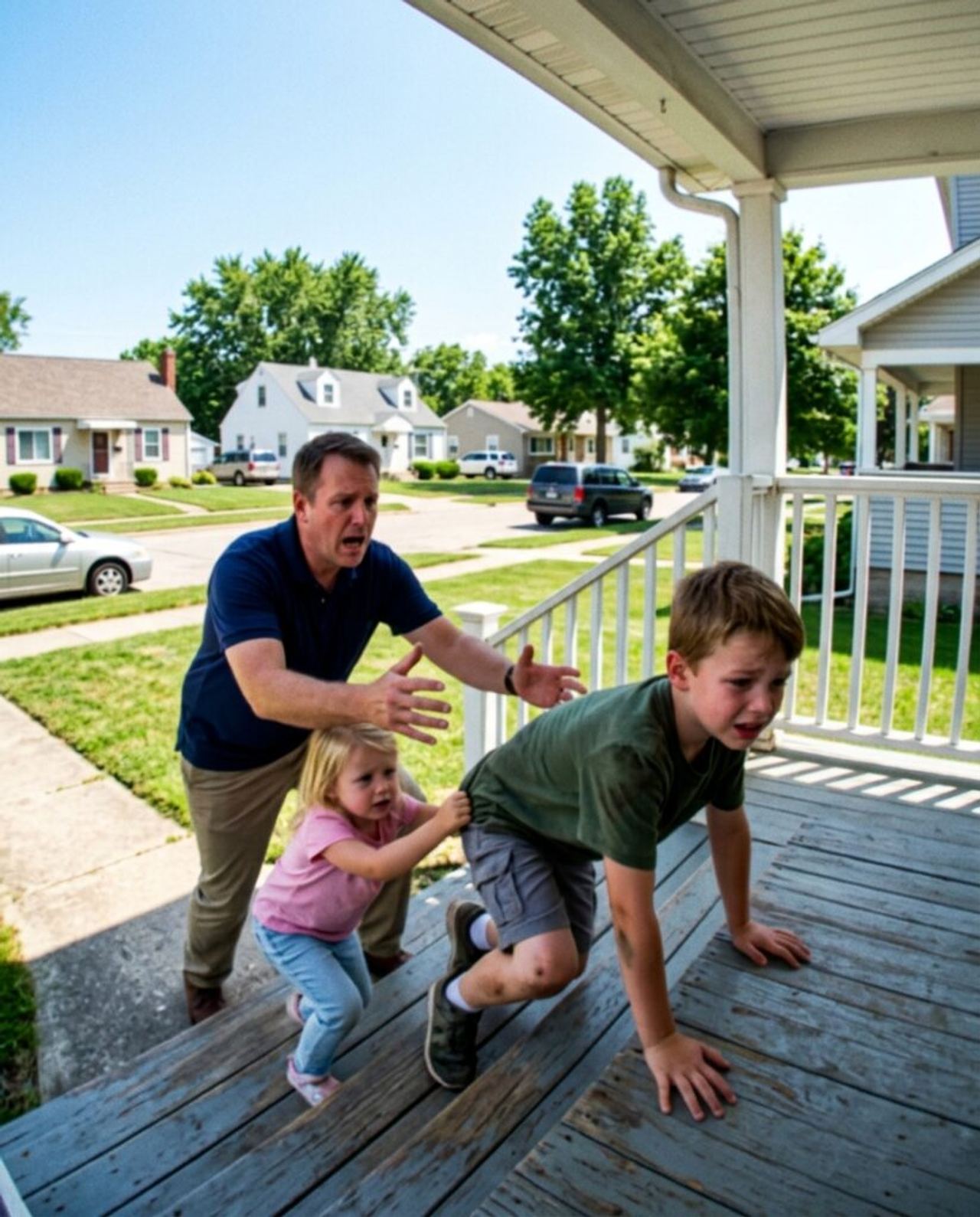
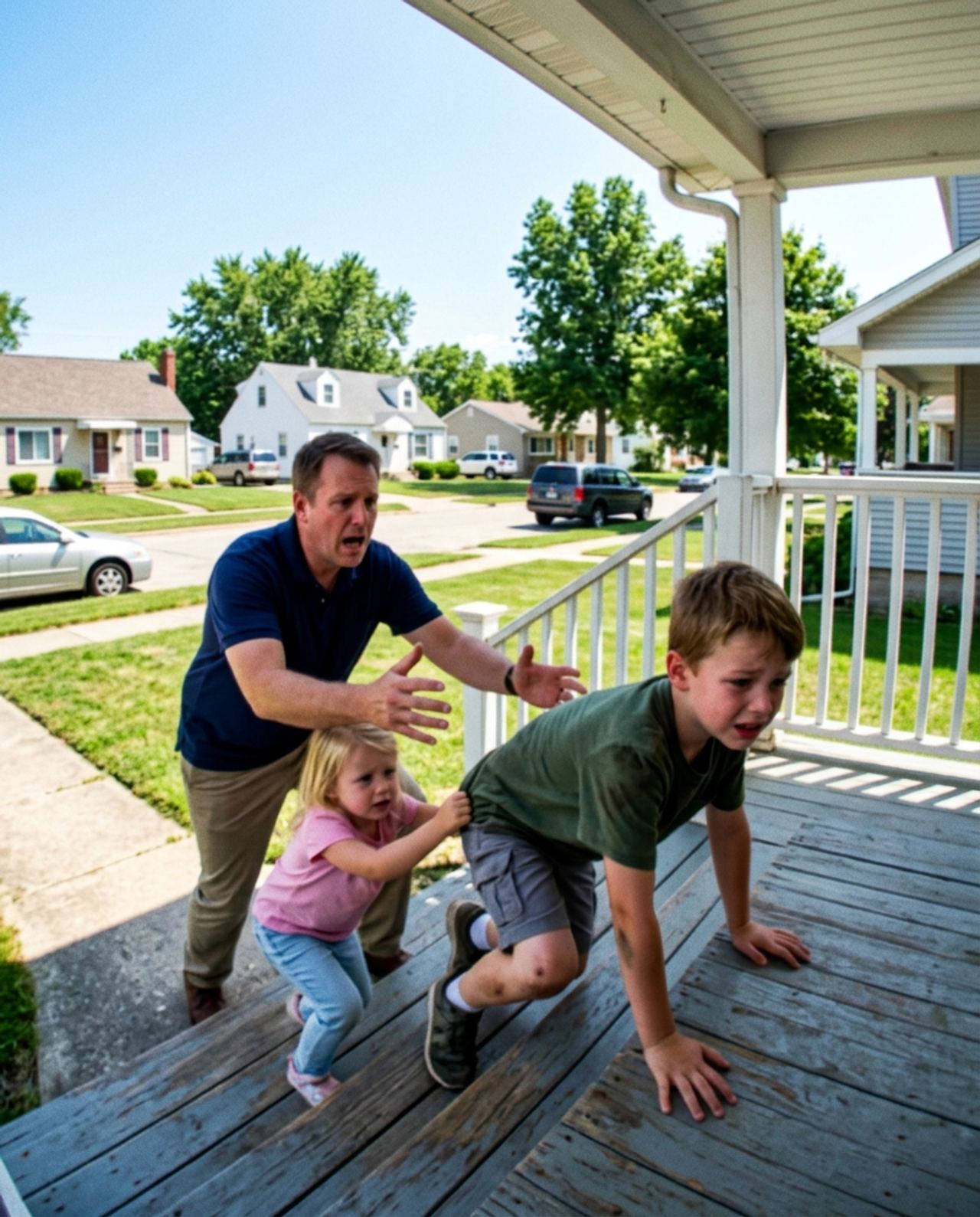
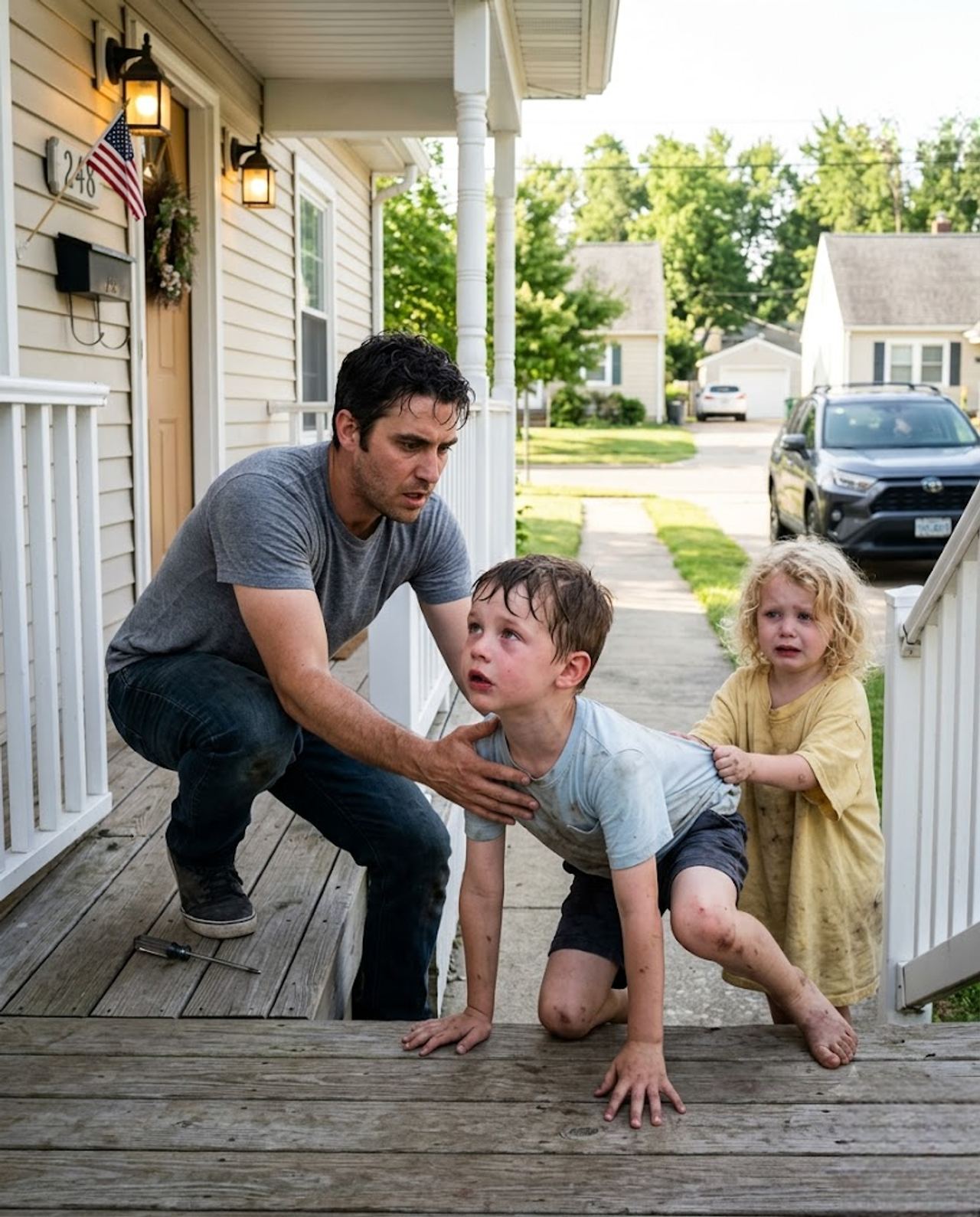
A child was crawling toward his porch.
Small hands on hot concrete.
One knee pushing forward.
One leg dragging behind.
A second, smaller child clinging to the back of his shirt.
Peter stood so fast the coffee can tipped and screws scattered across the porch.
“Drew?”
The boy lifted his head.
He was six now, but he looked smaller than that.
His dark hair was stuck to his forehead with sweat.
His face was pale under streaks of dirt and dried tears.
One leg dragged at an angle that made Peter’s stomach lurch.
Behind him, Lily clung to the stretched fabric of Drew’s shirt with both hands.
She was three, with blonde curls tangled around her face and cheeks hollow in a way no child’s cheeks should ever be hollow.
Her eyes were enormous.
Not curious.
Not shy.
Terrified.
Peter moved before his body waited for permission.
He reached the bottom step just as Drew’s arm began to shake.
“Drew. God. What happened?”
Drew’s lips moved once before sound came out.
“She locked us downstairs again.”
The word again hit Peter harder than the rest of the sentence.
Again meant history.
Again meant practice.
Again meant the first time had not been the worst time.
“I had to get Lily out,” Drew whispered. “She was really hungry.”
Peter lifted Lily first because she was slipping sideways.
She weighed almost nothing.
Not toddler-light.
Not sleepy-child-light.
Empty.
He set her carefully against his chest, felt her fingers clutch his shirt, then bent for Drew.
“I’m going to pick you up,” he said. “I’ve got your leg. Try not to move.”
Drew nodded once.
When Peter slid an arm under him, the boy bit his own lip so hard a bead of blood appeared.
He did not scream.
That silence was worse than any scream Peter could have imagined.
Inside the house, Peter laid Drew on the couch and tucked pillows around his leg as best he could.
He set Lily beside him and wrapped both children in blankets even though the living room was warm.
Lily saw the crackers on the coffee table and reached for them with both hands.
She ate too fast, crumbs sticking to her lips, her tiny body leaning forward as if food might vanish if she slowed down.
Drew lifted one trembling hand and patted her back.
“Slow, Lily,” he murmured. “Slow.”
Peter stood there with his phone in his hand, watching a six-year-old comfort a starving toddler.
A child should learn songs before survival.
A child should know bedtime stories before he knows how to ration crackers.
Peter unlocked his phone.
“I’m calling for help.”
Drew’s eyes widened.
“She’ll be mad.”
Peter knelt in front of him.
The words came out low and firm, because if they came out any other way, they would break.
“She is not touching you again.”
At 8:46 a.m., Peter dialed 911.
“My nephew and niece just showed up at my house,” he told the operator. “The boy’s leg looks broken. The little girl looks severely underfed. They said their stepmother locked them in the basement.”
The operator asked for the address.
Peter gave it.
She asked for ages.
“Six and three.”
She asked whether the children were conscious.
“Yes.”
She asked whether the suspected person was nearby.
“No. They came from her house. They crawled here. He crawled here.”
Even saying it felt impossible.
While he spoke, Drew kept one arm around Lily.
He watched the front door.
Then the hallway.
Then Peter.
Not like a child waiting for help.
Like a child measuring whether help could turn dangerous.
Sirens arrived three minutes later.
It felt like three hours.
Paramedics came through the front door first.
One was a woman with gray-streaked hair and kind, tired eyes.
She knelt beside Drew and spoke to him the way people speak when they know a child has had too many adults lie.
“My name is Karen. I’m going to look at your leg, okay? Your uncle is right here.”
Drew looked at Peter before nodding.
Another paramedic checked Lily’s pulse, temperature, and breathing.
Lily flinched at the touch, then looked ashamed for flinching.
That made Peter want to put his fist through a wall.
He did not.
He stood where the children could see him.
“I’m right here,” he kept saying. “I’m not leaving.”
Two police officers arrived behind the paramedics.
One took Peter into the kitchen just far enough that Drew could still see him.
The officer asked questions for the police report.
Time of arrival.
What Drew said.
What Lily looked like.
Whether Peter had touched or moved the injured leg.
Whether Reena had a history of refusing contact.
Peter answered everything.
He gave dates as best he could.
Birthday visits refused.
Texts unanswered.
The Christmas gifts left on Reena’s porch the year before.
The time she told him Drew had the flu, but he later saw a photo online of Reena at a cookout without either child.
Each fact had once seemed too small to accuse anyone with.
Together, they became a shape Peter could not unsee.
The older officer asked for Reena’s address.
Peter gave it.
The same house he had visited again and again.
The same porch where Reena had smiled and blocked the doorway with her body.
The same house where Aaron’s children had been hidden in plain sight.
The officer stepped aside and spoke into his radio.
“Possible child confinement. Possible medical neglect. We need units at the residence.”
Drew heard enough to understand.
His small face went tight.
Peter went to him immediately.
“They’re going to check the house,” Peter said.
Drew looked toward Lily.
“She said nobody would believe me.”
Peter swallowed.
“I believe you.”
At the hospital, the automatic doors opened into cold air and fluorescent light.
The place smelled like sanitizer, plastic tubing, and old coffee.
Drew was taken for X-rays.
Lily was taken for bloodwork, fluids, and an intake evaluation.
Peter signed where staff told him to sign as temporary family contact.
He gave Aaron’s full name.
He gave Reena’s full name.
He gave every number in his phone that might matter.
The hospital intake form was clipped to a chart by 9:34 a.m.
A nurse wrote “possible neglect” in a box Peter wished did not exist.
Child Protective Services was called.
A detective was notified.
A doctor came out after the X-rays with the kind of controlled anger that professionals use when the evidence is worse than the story.
“Drew has a spiral fracture of the tibia,” he said.
Peter stared at him.
“Broken?”
“Yes.”
“How long?”
The doctor’s mouth tightened.
“It appears to be at least two weeks old.”
The hallway seemed to tilt.
“Two weeks?”
“Yes. And untreated.”
Peter put one hand against the wall.
For a moment, he thought he might be sick.
The doctor continued because someone had to.
“Lily is significantly underweight and dehydrated. We’re documenting everything. Photographs, lab work, the X-ray report, intake notes. CPS is already on the way.”
Documenting.
That word became the thin line between horror and action.
Not gossip.
Not suspicion.
Not one uncle’s grief turning into accusation.
Documentation.
A record.
Proof with dates, names, signatures, and time stamps.
Through the glass, Peter saw Drew lying in a hospital bed while a cast began to harden around his leg.
Lily slept curled against his side, one hand tucked into his blanket.
Even unconscious, Drew’s arm rested around her.
Peter stood there and felt something in him settle.
Not peace.
Not calm.
A decision.
The first officer returned to the hospital around 11:20 a.m.
His expression told Peter before his words did.
“They found the basement door,” he said quietly.
Peter did not sit down.
The officer looked toward the children’s room, then back at Peter.
“There was a deadbolt on the outside.”
Peter closed his eyes.
The officer continued.
“There was a small room downstairs. Blanket. Bucket. Scratches near the door frame. We’re processing it.”
Peter could hear the hospital around him.
A cart rolling.
A monitor beeping.
Someone laughing too loudly near the vending machines because the world is cruel enough to continue while yours is splitting open.
Then the officer showed him one photo.
Not the children.
Not anything graphic.
Just the door.
Just the deadbolt.
Just the place where a six-year-old had learned that crying did not open locks.
The second officer arrived later with a sealed evidence bag.
Inside was Reena’s old phone.
“She left it charging in the kitchen,” he said. “We’re waiting on full authorization, but the lock screen still showed messages.”
Peter looked at the phone through plastic.
It was ordinary.
That almost made it worse.
A cracked corner.
A faded case.
A device someone carried to the grocery store, to the couch, to bed.
The officer said there were messages with dates.
Instructions.
References to keeping the children downstairs when they “acted up.”
There was also a small camera set up near the stairs.
Peter’s throat tightened.
“Camera?”
The officer nodded once.
“We believe there may be footage. We’ll know more after the warrant.”
Across the hall, the gray-streaked paramedic who had brought Drew in covered her mouth and turned away.
She had stayed long enough to check on the kids after her shift ended.
She was trying not to cry.
Peter understood.
Professionals see terrible things.
That does not mean they stop being human.
When Drew woke, his eyes found Peter first.
“Uncle Peter?”
“I’m here.”
“Are you mad at me?”
The question nearly broke him.
“No. Why would I be mad?”
Drew looked down at the cast.
“For leaving.”
Peter moved carefully to the edge of the bed.
“Drew.”
His nephew’s voice dropped.
“Reena said if we ever told, they’d take Lily away. She said Dad would be ashamed.”
Peter took the boy’s hand.
It was too small and too warm and too careful in his own.
“Your dad would be proud of you.”
Drew’s face crumpled.
“He would?”
“Yes.”
Peter had never been more certain of anything.
“You saved your sister. You were brave. You were smart. And I should have come sooner.”
Drew began to cry then.
Not the quiet, controlled crying of a child trying not to get punished.
Real sobs.
Deep, exhausted sobs that shook his small body while Peter leaned over him and held him as gently as he could.
“I’ve got you now,” Peter whispered. “Both of you.”
Lily woke at the sound and reached for Drew.
Peter lifted her carefully onto the bed beside him.
She curled into her brother as if that was the only safe place she knew.
For the next several hours, the hospital room became a place of forms, questions, and quiet promises.
CPS arrived with badges on lanyards and clipboards full of pages.
They asked Peter about family history.
They asked about Aaron.
They asked about Reena’s pattern of refusing visits.
Peter answered everything.
He gave them texts.
Voicemails.
Photos of unopened birthday gifts on Reena’s porch.
Screenshots of messages where she told him the children were too fragile to see him.
One worker wrote steadily while the other watched Drew and Lily sleep.
By evening, an emergency placement decision was being discussed.
Peter did not wait to be asked twice.
“They come home with me,” he said.
The worker explained that there were processes.
Background checks.
Emergency kinship placement paperwork.
A home inspection.
Follow-up hearings.
Peter nodded through all of it.
“Tell me what to sign.”
The words were simple, but they changed the shape of his life.
By 7:05 p.m., Peter was back at his house with a social worker walking through each room.
The loose hinge still hung crooked on the front door.
Screws were scattered on the porch where he had dropped them.
The coffee cup was still on the railing.
The house looked exactly as it had that morning, except now Peter understood it differently.
The spare bedroom was not a spare bedroom anymore.
The couch was not just a couch.
The porch was not just a porch.
It was the place Drew had been crawling toward.
It was the place Lily had trusted because Drew trusted it.
It was the place Aaron would have wanted them to reach.
That night, after temporary approval was granted and the children were settled under hospital instructions, Peter sat in the hallway between their rooms.
Drew had a cast propped on pillows.
Lily had eaten soup slowly from a plastic bowl and fallen asleep with a cracker still in her hand.
Peter left the hallway light on.
He left both doors open.
He slept in a chair because Drew had asked, without asking, whether he would be close.
Near midnight, Peter’s phone buzzed.
It was a message from an unknown number.
Only one line.
You had no right.
Peter stared at it for a long time.
Then he took a screenshot and forwarded it to the detective.
No reply.
No anger typed back.
No threat.
Only evidence.
That was the first lesson Peter learned after Drew and Lily came home.
Love had to be warm.
But protection had to be organized.
Over the next weeks, every promise became practical.
Doctor appointments.
Follow-up X-rays.
Counseling intake.
School enrollment meetings.
A family court hallway where Drew held Peter’s hand so tightly his knuckles turned white.
A police report with pages Peter could barely read without standing up and walking around the room.
A file folder on Peter’s kitchen counter labeled with both children’s names.
The hidden camera footage confirmed what Drew had said.
The messages confirmed a pattern.
The hospital reports confirmed the injuries and neglect.
Reena’s excuses did not survive contact with paper.
That was what Peter kept thinking.
People can perform grief in a black dress.
They can smile at neighbors.
They can say “stability” in a funeral home and sound almost holy.
But paper remembers what people try to bury.
In the first hearing, Peter sat behind the children’s advocate while Reena avoided looking at him.
She looked smaller than he expected.
Not sorry.
Smaller.
Like someone whose power had depended entirely on closed doors.
When the judge reviewed the emergency placement, Drew sat beside Peter in a hoodie that swallowed his shoulders.
Lily leaned against Peter’s other side with a stuffed rabbit from the hospital gift cart tucked under her chin.
The judge did not ask Drew to speak that day.
No one needed to make a six-year-old prove pain that adults had already documented.
The emergency order stayed in place.
Reena was not allowed contact.
Criminal proceedings moved separately.
Peter did not celebrate.
There are victories that still smell like hospital soap.
There are wins that come with nightmares.
There are days when safety arrives, and it still has to sit quietly beside trauma until the children believe it.
Drew healed slowly.
His leg took time.
His trust took longer.
At first he hid food in pillowcases and under the bed.
Lily cried when doors closed too firmly.
Both children woke at small noises.
Peter learned to announce everything.
“I’m closing the laundry room door.”
“I’m going to the mailbox.”
“I’ll be right back.”
He learned which night-light Lily liked.
He learned that Drew preferred the bedroom door open exactly halfway.
He learned that macaroni and cheese felt safe to both of them, but tomato soup did not.
He learned that healing did not look like a movie ending.
It looked like Lily asking for seconds.
It looked like Drew laughing once at a cartoon, then looking embarrassed because he had forgotten to be scared.
It looked like two small backpacks by the front door and a calendar full of appointments.
Months later, Peter finally fixed the loose hinge.
Drew watched from the porch swing with his cast gone and a brace still on his leg.
Lily sat beside him eating crackers slowly, the way Drew had taught her.
Peter tightened the last screw and tested the door.
It opened smoothly.
It closed without sticking.
Drew looked at it for a while.
Then he said, “This door locks from the inside, right?”
Peter set the screwdriver down carefully.
“Yes.”
“And we can open it?”
“Always.”
Drew nodded.
Lily leaned against his shoulder.
The little flag by the mailbox moved in the warm air.
For the first time in years, Peter could almost hear Aaron laughing on the porch again.
Not because anything was fixed completely.
Some things never become what they were supposed to be.
But because his children were there.
Safe.
Fed.
Believed.
And Peter finally understood the truth that had been waiting underneath all his regret.
Drew had not just crawled seven blocks to escape a basement.
He had crawled toward the last piece of family his father had left behind.
Peter had spent years thinking he was the uncle who had failed to get inside the house.
But from that morning on, he became the home they had been crawling toward all along.
Read more stories
- MILLIONS KNEW ROY CLARK’S SMILE. BUT THE WOMAN WHO KNEW THE MAN BEHIND IT HAD BEEN BESIDE HIM FOR 61 YEARS.
- Her Sister’s Newborn Went Quiet, Then One Whisper Changed Everything
- Her Parents Brought a Moving Truck, But the Porch Lawyer Had Proof
- They Thought My Silence Meant Weakness—Until the Truth They Buried Began to Surface