
Human Stories
Her Sister’s Newborn Went Quiet, Then One Whisper Changed Everything
A newborn’s sudden silence exposes hidden danger, leading to a terrifying family crisis and a police intervention. In the aftermath, the narrator pieces together warning signs, while the family begins the painful process of healing and rebuilding.

The dispatcher was still asking questions when my newborn niece went quiet in my arms.
Not the kind of quiet that means a baby has finally worn herself out.
Not the soft little silence that settles over a nursery when a newborn drifts back into sleep.
This was different.
This was the kind of quiet that makes every ordinary sound in a house turn sharp.
The white noise machine on the dresser seemed too loud.
The hum of the refrigerator down the hallway seemed too loud.
Even the small American flag outside our front porch sounded too loud as it tapped softly against the post in the afternoon breeze.
The nursery smelled like baby lotion, warm formula, and the clean cotton sheets I had changed that morning.
Thin strips of yellow light came through the blinds and landed across Mia’s face while I held her against my chest in her little yellow duck onesie.
She was three weeks old.
Three weeks.
That is barely enough time for a baby to learn the shape of this world.
My sister Maddie had dropped her off at 4:18 p.m.
I remember the exact time because Mark repeated it to the dispatcher later, and once a number becomes part of a 911 call, it stops being ordinary.
It becomes evidence.
Maddie had stood in my entryway with her keys still in her hand, her hair pulled into a messy bun that looked like it had survived three sleepless nights, and Mia tucked carefully in the crook of her arm.
“She just ate,” she told me.
Her eyes kept moving toward the driveway.
“Can you watch her for an hour?”
I had said yes before she finished the sentence.
That is what family does.
At least, that is what I thought family did.
Maddie was my little sister by six years, the kind of little sister who had slept in my room after thunderstorms, stolen my sweaters in high school, and called me from the hospital bathroom the night Mia was born because she did not want anyone to hear her cry.
When Mia came home, I brought casseroles, diapers, and grocery bags.
I washed bottles in her sink while Maddie stood beside me with one hand on the counter and the other on her phone.
I folded onesies while she stared out the window.
I told myself she was exhausted.
Postpartum exhaustion can turn a person inside out.
It can make the gentlest woman forget where she set her keys, snap over nothing, cry over spilled formula, and stand in a room looking like she does not remember why she entered it.
So when she said, “Don’t change the outfit, okay?” I did not hear warning.
I heard tired.
“It’s a pain to snap back up,” she said, already backing toward the front door.
I looked down at Mia’s yellow duck onesie and smiled.
“Okay,” I said.
That was the last normal thing I said before the house split into before and after.
Mark was in the kitchen packing Ava’s lunch for school the next day.
Our six-year-old had left her purple crayon under the high chair, her school folder open on the counter, and one of her sneakers in the hallway because she was a child and children have a gift for leaving proof of themselves everywhere.
I remember that now because the ordinary details hurt afterward.
The peanut butter jar on the counter.
The paper coffee cup Mark had forgotten by the sink.
The small pair of pink socks on the laundry room floor.
All of it sitting there like our house had no idea what was coming.
Mia started crying twenty minutes after Maddie left.
At first, it was normal newborn crying.
Thin.
Angry.
Full of air.
I rocked her in the glider.
I checked the bottle.
I checked the diaper through the fabric because Maddie’s voice was still in my head.
Don’t change the outfit.
Then Mia stiffened.
Her little hands curled tight against her body.
Her cry snagged in her throat, broke once, and turned into a sound that made my skin go cold.
I told myself not to panic.
I laid her on the changing pad and unsnapped one button.
Then another.
The cotton was soft under my fingers.
The duck print was bright and sweet and ridiculous in the way baby clothes always are.
Then I saw what was beneath it.
There are some moments your mind refuses at first because accepting them would mean accepting that the world has rules darker than you thought.
I stared.
I could not breathe.
I did not scream.
My body went still in a way that felt almost outside of me.
Under that yellow fabric were marks no newborn should have.
No baby.
No person.
Especially not someone who had been in this world for only three weeks.
My knees weakened.
My mouth opened, but nothing came out.
I remember Mia’s breath catching.
I remember the white noise machine hissing.
I remember seeing Maddie’s hospital bracelet still looped onto the diaper bag on the changing table, the tiny printed band proof that Mia had only just come from the place where babies are supposed to be safest.
Mark appeared in the doorway.
He saw my face first.
Then he looked down.
His expression changed so fast that I knew I would remember it for the rest of my life.
He did not ask, “What is it?”
He did not ask me to explain.
He turned immediately toward the hallway because Ava was walking toward the nursery with one sock on and one sock in her hand.
“Go across the street to Mrs. Walker,” he told her.
His voice was calm in a way that frightened me.
“Right now, sweetheart.”
Ava frowned.
“Why?”
Mark bent, kissed her forehead, and put both hands gently on her shoulders.
“Because I said so. Shoes on. Go.”
She knew that tone.
Children know when the air changes, even when adults try to hide it.
She looked past him toward me, and for one terrible second I thought she would see Mia.
Mark moved his body into the doorway and blocked her view.
Then he guided her out.
I heard the front door open.
I heard Mark tell Mrs. Walker from across the lawn that we had an emergency.
Then he came back inside and called 911.
“It’s a newborn,” he said.
His voice shook on the word newborn.
“Three weeks old. Something is wrong. We need help. Please hurry.”
The dispatcher asked for the address.
Mark gave our street in Columbus.
She asked who was with the baby.
He looked at me.
I whispered, “Maddie dropped her off at 4:18.”
He repeated it exactly.
“4:18 p.m. The mother dropped her off. The aunt noticed marks. The baby suddenly went quiet.”
Those words sounded different once spoken to emergency services.
They sounded stripped of love.
Stripped of panic.
Cleaned into facts.
That is what procedures do.
They turn terror into lines people can follow later.
A 911 call.
An incident number.
A hospital intake form.
A police report.
None of it makes the room less terrifying while you are still standing in it.
It only gives the truth a place to stand when someone later tries to move it.
I kept one hand on Mia’s tiny chest.
“Mia, stay with me,” I whispered.
I did not know what I meant.
She was breathing.
Her eyes were open.
But there was something about the stillness in her body that made me feel like I was bargaining with a door I could not see.
“Mia, sweetheart, stay with me.”
Mark stayed beside me until the siren reached our street.
Then he went to the front door.
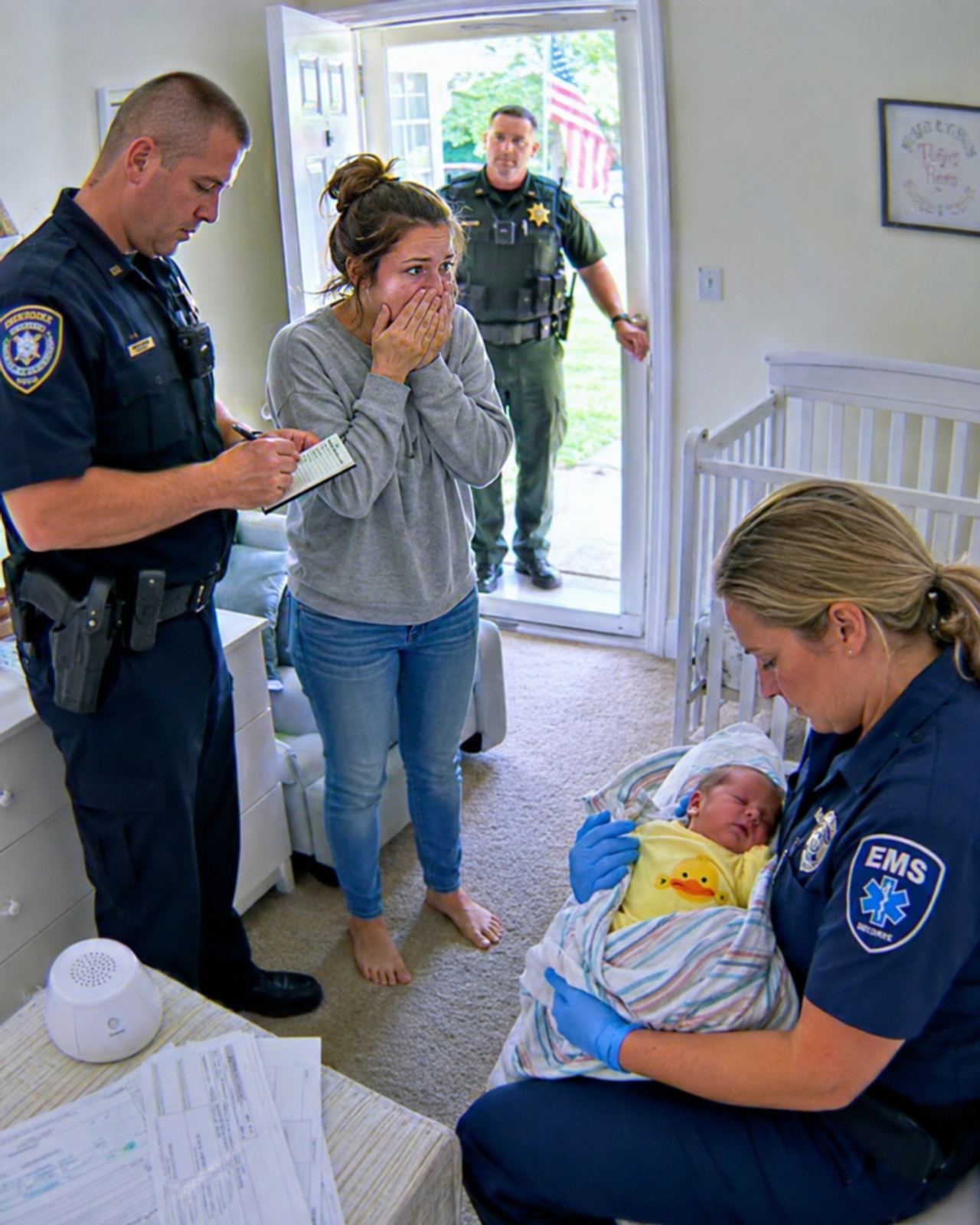
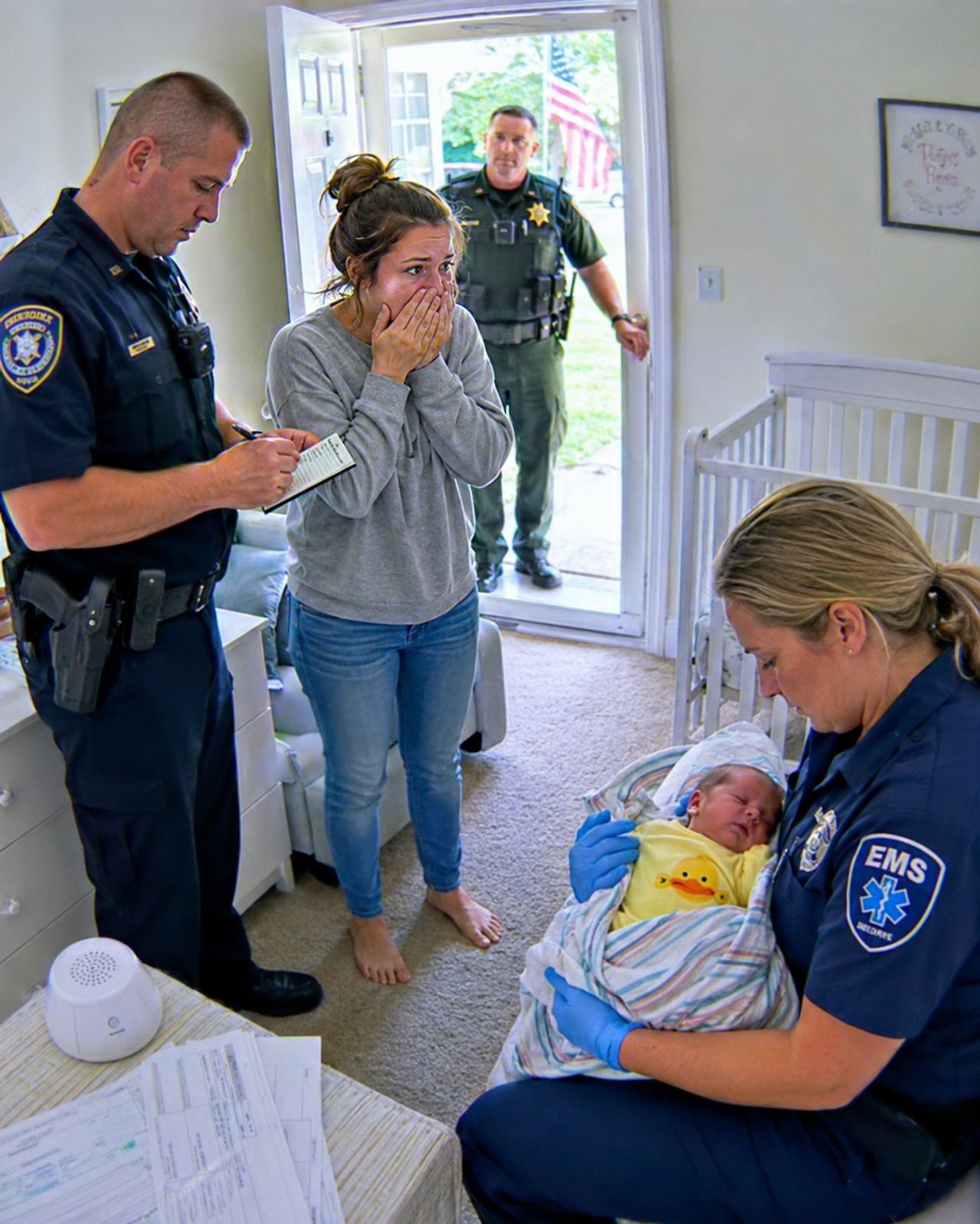
Seven minutes after the call, the ambulance pulled into our driveway behind our SUV.
Two paramedics came in fast.
A police officer followed them with a notepad already open in his hand.
The first paramedic took Mia from me with a gentleness that made my chest ache.
He did not snatch.
He did not rush in a messy way.
He moved like every inch of her mattered.
The second paramedic asked questions while opening equipment on the floor.
“Age?”
“Three weeks.”
“Feeding?”
“She ate before she came. Maddie said she ate.”
“Who had access to the baby today?”
“My sister,” I said.
I had to swallow before I could finish.
“Her mother. Maddie.”
“Anyone else?”
“I don’t know.”
The officer wrote that down.
His pen made a small scratching sound against the paper.
I hated that sound.
It felt too calm.
The paramedic opened the onesie wider, keeping Mia covered as much as he could.
His face changed.
Not much.
Not enough for a stranger to notice, maybe.
But I saw it.
A tightening around the eyes.
A pause at the mouth.
The tiny moment when a trained person recognizes something and decides not to show all of it in front of you.
“Ma’am,” he said quietly, “you did the right thing calling.”
That sentence should have comforted me.
It did not.
It made me understand that there had been a wrong thing available, too.
A wrong thing people sometimes choose.
Before I could answer, headlights swept across the nursery wall.
The officer turned his head.
Mark looked through the hallway toward the front window.
My stomach dropped before anyone said her name.
Maddie.
She came through the front door without knocking.
Her hair was falling out of its bun.
Her sweatshirt was inside out.
One shoe was untied.
She looked like she had run from the car without shutting it all the way.
For half a second, I thought she would rush to the paramedic.
I thought she would scream.
I thought she would ask me what happened, demand answers, fall apart, anything.
She did none of those things.
She stopped in the doorway of the nursery.
Her eyes moved across the scene.
The paramedic holding Mia.
The open yellow onesie.
The officer’s notepad.
Mark against the wall with his fists clenched.
Me standing beside the changing table, both hands shaking.
Maddie covered her mouth with both hands.
“Oh God,” she whispered.
Her voice was flat with horror, but not surprise.
“It happened again.”
The room froze.
The white noise machine hissed.
The paramedic looked up.
The officer stopped writing.
Mark’s face went blank in a way that scared me more than if he had shouted.
I stared at my sister.
Again.
One word can change the whole shape of a room.
Again meant history.
Again meant knowledge.
Again meant my sister had carried something into my house that she had not named.
“Maddie,” I said.
My voice barely worked.
“What do you mean again?”
She shook her head fast.
Her eyes darted toward the front window.
“You shouldn’t have called them.”
“Them?” Mark said.
His voice was low.
“We called 911.”
Maddie’s face folded inward, but no tears came.
“Not the hospital,” she said.
She looked at the officer.
“Not the police.”
The officer lowered his pen.
“Ma’am,” he said, “who are you afraid of?”
Maddie did not answer.
She looked at me instead.
For years, she had been the impulsive sister.
The one who borrowed my boots and returned them with mud on the heels.
The one who called me when her car battery died.
The one who made fun of me for labeling pantry shelves and then asked me to organize her diaper cart.
But in that moment, she looked older than me.
Not tired.
Cornered.
“He’ll know,” she whispered.
Outside, another siren cut through the neighborhood.
A second patrol car turned into our driveway.
The officer near the door glanced outside.
Then he straightened.
It was subtle, but everyone in the room felt it.
Maddie stepped backward until her shoulders hit the nursery wall.
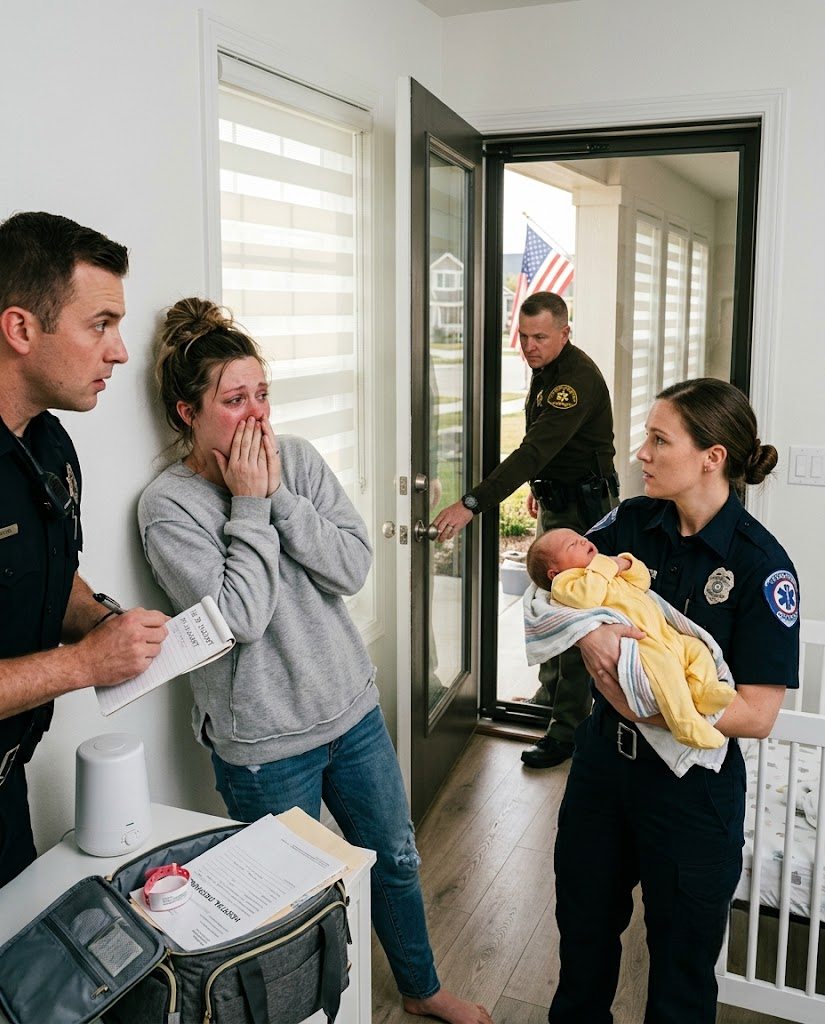
A man in a deputy’s uniform walked up onto our porch.
He reached for my front door.
Through the glass, Maddie saw him.
All the color drained from her face.
For one breath, nobody moved.
Then the deputy knocked.
Not hard.
Not urgently.
Once.
The kind of knock a person makes when he expects a door to open for him.
Maddie grabbed my wrist.
Her nails dug into my skin.
“Please,” she whispered.
The officer looked from her hand to her face.
“Do you know that deputy?”
Maddie shook her head.
It was the worst lie I had ever seen her tell.
Mark took one step forward, but the officer lifted a hand, telling him without words to stay back.
The paramedic adjusted Mia in his arms and spoke into his radio, quiet and controlled.
The second paramedic moved closer to the changing table.
That was when I saw the folded paper.
It had been tucked half under a stack of burp cloths inside the open diaper bag.
The same bag I had seen on the changing table all afternoon.
The same bag with Maddie’s hospital bracelet looped to the handle.
A corner of paper had slipped free.
Across the top was a handwritten phone number.
Under it, in Maddie’s shaky handwriting, was one word.
DON’T.
I looked at Maddie.
She looked at the paper.
Her face crumpled.
The officer followed my eyes and picked it up carefully.
“What is this?” he asked.
Maddie did not answer.
The deputy knocked again.
This time, Mark spoke.
“Officer,” he said to the man inside our house, “why is there a deputy at my door if this is a medical call?”
The officer did not answer right away.
He unfolded the hospital discharge paper.
His eyes moved over the first line.
Then his face went cold.
The kind of cold that does not come from anger.
The kind that comes from realizing the situation in front of you is larger than the room you are standing in.
“Maddie,” he said, very carefully, “I need you to tell me who wrote this number.”
She slid down the wall.
Not all the way to the floor.
Just enough that her knees bent and her hands went out for balance.
“My sister is scared,” I said.
It came out sharper than I meant.
“She is scared of him.”
The officer looked toward the front door.
The deputy outside leaned closer to the glass.
He could see us now.
He could see the paramedics.
He could see Maddie.
For the first time, his expression changed.
He stopped looking like a man arriving at a call.
He looked like a man who had walked into a room too early.
The officer inside stepped into the hallway.
He did not open the door all the way.
He cracked it just enough to speak.
“Deputy,” he said, “wait outside.”
The man on the porch smiled once.
It was small.
Almost polite.
“I heard the address over the radio,” he said.
Maddie made that small broken sound again.
The officer’s hand tightened on the door.
“This scene is secured,” he said.
The deputy’s eyes moved past him to Maddie.
“Is my daughter in there?” he asked.
The room stopped breathing.
My head turned toward Maddie so fast my neck hurt.
My sister did not look at me.
She kept staring at the floor.
Mark whispered, “Maddie.”
The paramedic holding Mia looked from the baby to the officer.
The officer in the hallway went very still.
“Your daughter?” he asked.
The deputy did not blink.
“My daughter,” he said.
Maddie pressed both hands over her ears like a child trying to block thunder.
“No,” she whispered.
The officer shut the door.
He shut it in the deputy’s face.
Then he turned the lock.
That was the first moment I understood we were not just calling for help anymore.
We were standing inside a story Maddie had been trying to survive without telling anyone the title.
The next hour moved in pieces.
A supervisor arrived.
Mia was taken to the hospital with one paramedic in the back and another officer following behind.
Mark drove me there after Mrs. Walker agreed to keep Ava at her house.
Maddie rode separately with an officer because the supervisor did not want the deputy near her.
At the hospital intake desk, a nurse asked Maddie questions she answered in a voice so small I barely recognized it.
Names.
Times.
Who lived in the home.
Who had visited.
Who had been alone with Mia.
The forms kept coming.
Hospital intake.
Medical notes.
Police report supplement.
A request for a statement.
Maddie sat in a plastic chair under fluorescent lights with her sweatshirt still inside out and her hands wrapped around a paper cup of water she never drank.
At 7:43 p.m., she finally looked at me.
“I thought I could keep him calm,” she said.
I did not know what to say.
There are sentences so terrible they make comfort sound insulting.
Mark stood by the vending machines with his arms folded, watching the hallway as if he could protect us from every person who turned the corner.
The officer came back twice.
The second time, he had a different expression.
Not softer.
More certain.
The deputy had been relieved of duty pending review.
His radio access had been cut.
A supervisor had taken his statement.
Maddie heard those words and started to shake.
Not with relief.
With delayed terror.
Because fear does not leave just because a door locks.
Sometimes it waits to see whether the lock will hold.
Mia stayed under observation.
The medical team was careful with their words in front of us.
They did not dramatize anything.
They did not need to.
Every quiet exchange between the nurse and the doctor felt like a weight being added to a table already cracking.
At 9:12 p.m., Maddie gave a formal statement.
I sat beside her because she asked me to.
She told them the deputy had been in her life longer than she wanted to admit.
She told them she had tried to leave.
She told them she had called me that day because something in her had finally broken, but even then she had been too ashamed to say the truth out loud.
“I thought if I left Mia with you, she’d be safe for an hour,” she said.
Her voice collapsed on the word safe.
I looked at my sister and felt two things at once.
I was furious.
I loved her.
Both were true.
Love does not erase rage.
Rage does not erase love.
Sometimes the hardest part of family is holding both without letting either one lie.
“What happened again?” the officer asked gently.
Maddie closed her eyes.
Then she answered.
The details are not mine to make uglier than they already were.
What mattered was this: Mia had not been the first warning sign.
There had been phone calls Maddie did not answer in front of me.
There had been excuses for why she could not come over.
There had been a cracked phone screen she said she dropped at the grocery store.
There had been a hospital visit she called “a postpartum thing” and changed the subject whenever I asked about it.
I had seen pieces.
I had not understood the picture.
That is a guilt I still live with.
But guilt can be useful if it does not turn into performance.
The next morning, Mark and I brought Ava to my mother’s house and went back to the hospital.
Maddie had not slept.
Her hair was still falling out of its bun.
Someone had given her a clean sweatshirt.
She looked smaller in it.
Mia was stable.
That word became the only word any of us could bear to hold.
Stable.
It did not fix anything.
It did not answer everything.
But it gave us one square inch of floor to stand on.
The investigation moved through channels I had never wanted to know.
Statements were taken.
Reports were filed.
The hospital records were preserved.
The 911 call was logged.
The folded discharge paper with DON’T written across it became part of the file.
Maddie’s fear, which had lived in whispers and flinches, finally had documents around it.
That mattered.
Not because paperwork heals anyone.
It does not.
But because people who survive behind closed doors are often forced to prove the door was ever closed.
In the weeks that followed, Maddie stayed with us.
Ava learned that Aunt Maddie and baby Mia needed quiet.
Mrs. Walker brought soup and did not ask questions she did not need answered.
Mark installed another lock on the front door, then stood there afterward with the screwdriver still in his hand because he did not know what else to fix.
Maddie cried in the laundry room once while folding Mia’s blankets.
I found her sitting on the floor beside the dryer, one yellow duck onesie in her lap.
She held it like it might accuse her.
“I told you not to change it,” she said.
Her voice broke.
“I know,” I said.
“I was scared you’d see.”
“I know.”
“I was scared if you saw, everything would happen.”
I sat beside her on the laundry room floor.
The dryer hummed against my back.
“That’s why it had to happen,” I said.
She cried then.
Not pretty crying.
Not movie crying.
The kind where your body finally stops helping you hide.
I did not tell her it was okay.
It was not okay.
I told her she was not alone in it anymore.
There is a difference.
Months later, when people asked how we knew something was wrong, I always thought about the yellow onesie.
I thought about the snap buttons.
I thought about Maddie’s warning.
I thought about the way fear can disguise itself as a small instruction.
Don’t change her.
Don’t call them.
Don’t make him angry.
Don’t tell.
That is how terror shrinks a life.
Not all at once.
One don’t at a time.
Mia grew.
Slowly.
Beautifully.
With checkups and appointments and people who learned to speak gently around her mother.
Maddie grew too, though healing did not look like anyone expects.
It looked like answering the phone without flinching.
It looked like filling out paperwork with her own hand.
It looked like letting Mark drive her to appointments without apologizing six times.
It looked like standing on our porch one morning, holding Mia against her shoulder while the small American flag moved in the breeze, and saying, “I want to go home someday. But not back there.”
I said, “Then we’ll help you build a home that means something else.”
She nodded.
For a long time, neither of us spoke.
Mia slept against her chest, one tiny fist resting near Maddie’s collarbone.
The world looked ordinary again from the outside.
A driveway.
A mailbox.
A school bus sighing to a stop at the corner.
A paper coffee cup on the porch rail.
But I knew better now.
Ordinary houses can hold extraordinary secrets.
And sometimes the moment that saves a life does not look heroic while it is happening.
Sometimes it looks like an aunt ignoring one small instruction.
One snap.
Then another.
And then refusing to stay quiet.
Read more stories
- Her Parents Brought a Moving Truck, But the Porch Lawyer Had Proof
- They Thought My Silence Meant Weakness—Until the Truth They Buried Began to Surface
- Right after I gave birth, my mother-in-law stormed in—demanding I give up the VIP room.
- At my daughter’s wedding, her fiancé leaned in with a smug smile: “Pay fifty thousand dollars or disappear from our lives forever”. My daughter didn’t even flinch—she coolly suggested I start preparing for a lonely room in an old-age home. I felt the anger burn, but I didn’t raise my voice. I calmly sipped my champagne and smiled. “You forgot one thing.” Minutes later, the music faltered, whispers spread, and the perfect wedding collapsed into chaos.