
Human Stories
8-Year-Old Girl’s Whisper Stopped Her Father’s Execution—Then a Hidden Truth Began to Surface
After an 8-year-old girl whispers a crucial secret to her father moments before his execution, a hidden truth begins to unravel a murder case built on shaky evidence. The story follows the urgent legal fight, a newly discovered recording, and the emerging possibility that the wrong man may have been condemned.

8-Year-Old Girl’s Whisper Stopped Her Father’s Execution—Then a Hidden Truth Began to Surface
PART 2
For several seconds, no one moved.
The room remained still except for the faint buzz of fluorescent lights above them and the small, uneven sound of Chloe’s breathing against her father’s shoulder.
Gavin Cole kept his eyes closed.
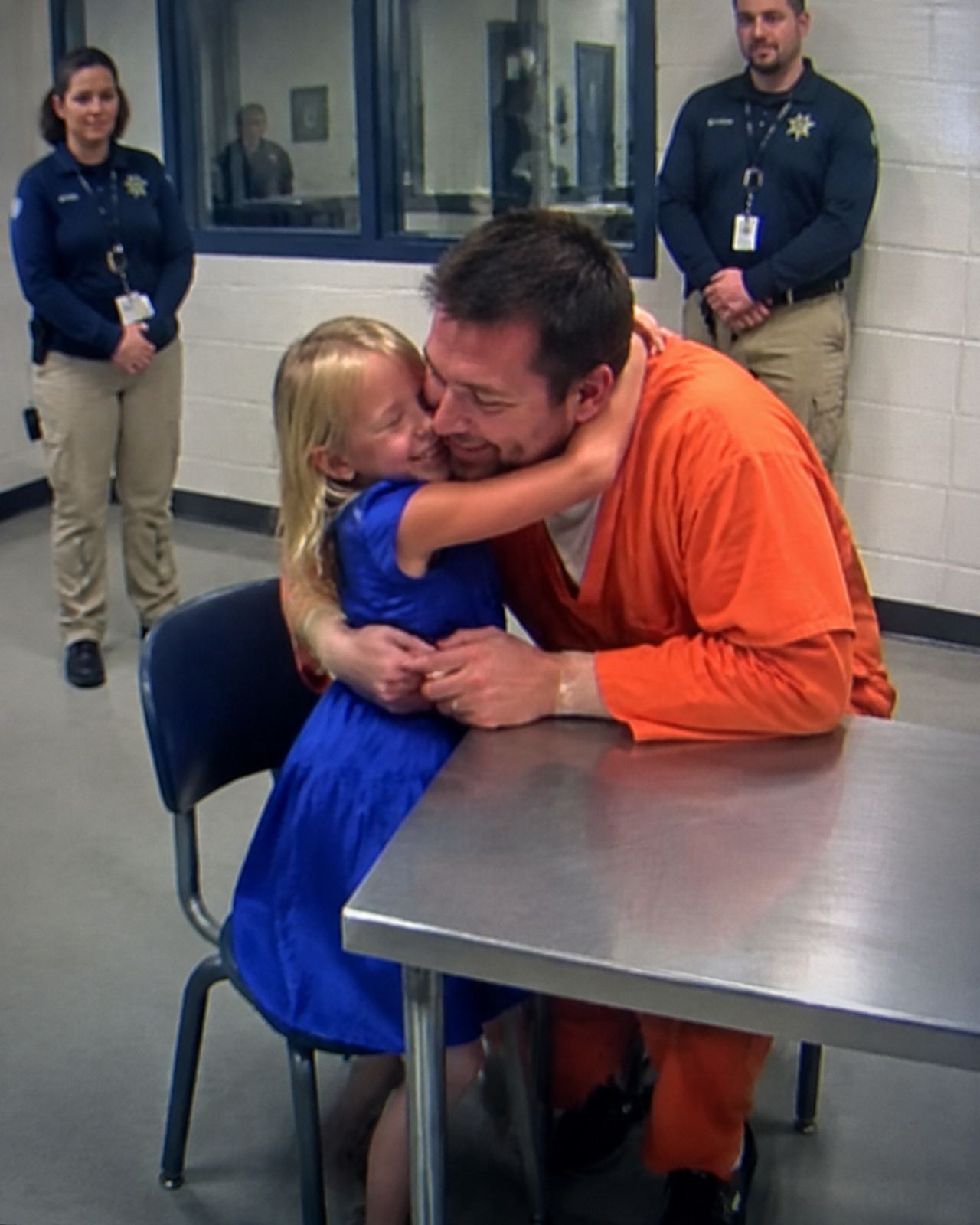
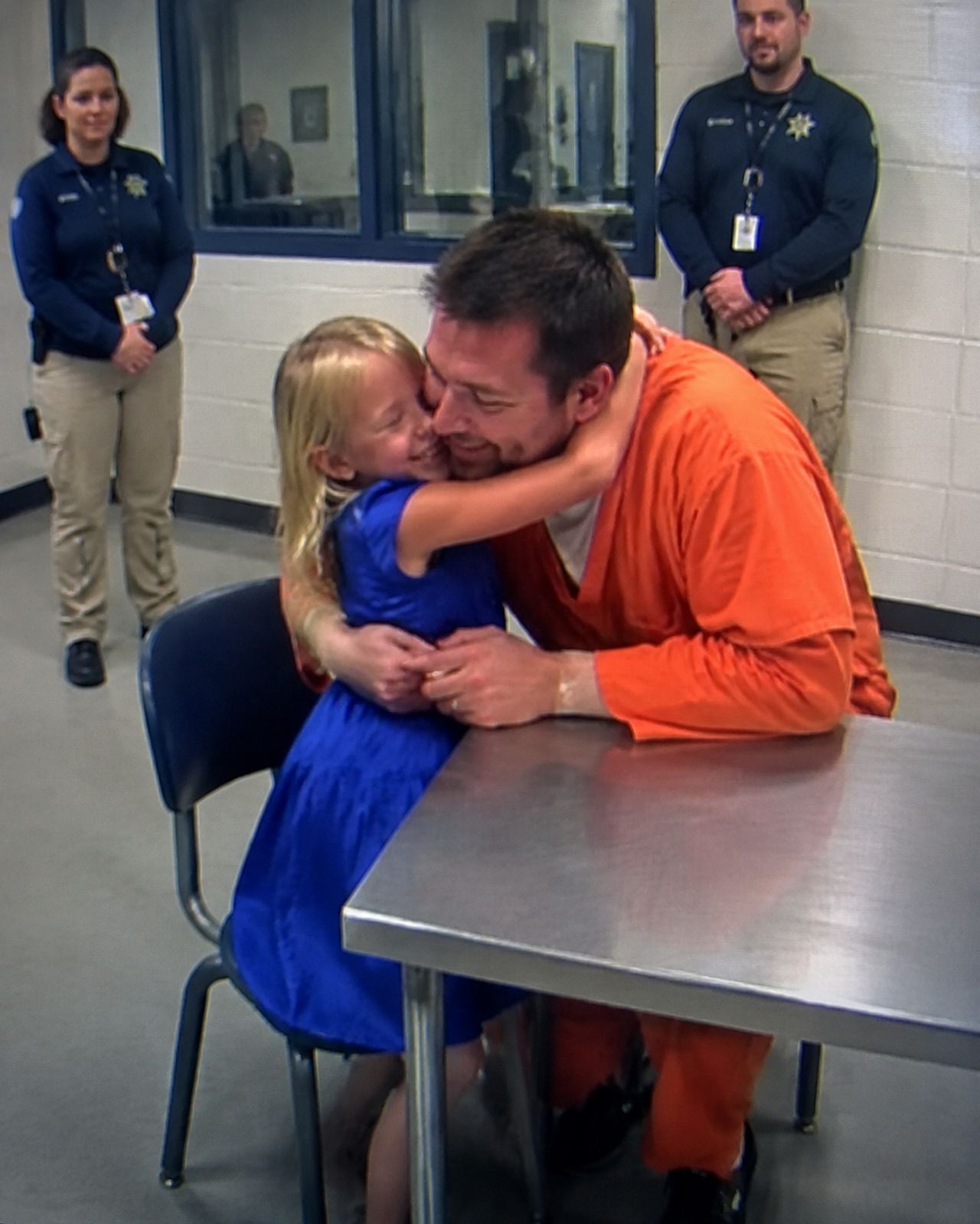
His shackled hands rested awkwardly on the metal table, unable to fully hold his daughter, yet somehow he looked less like a condemned man than he had only moments before. The tension in his jaw had softened. The hollow fear that had clung to the room seemed to loosen its grip.
Warden Robert Mitchell had seen men fall apart in that chair.
He had seen men pray, bargain, weep, rage, confess, and go silent. But he had never seen what he was seeing now.
A father, hours from death, smiling because of a secret whispered by a child.
The warden stepped forward.
“Chloe,” he said gently.
The little girl did not turn around.
Gavin opened his eyes first. His gaze lifted to Mitchell’s, steady and clear.
“Warden,” Gavin said, his voice quiet. “I need to speak to my lawyer.”
Mitchell’s brow tightened. “Your attorney has already filed every appeal available.”
“Not every one.”
The social worker, Denise Harper, placed a protective hand near Chloe’s back. “Gavin, this visit is only supposed to be—”
“I know what it’s supposed to be.” Gavin looked down at his daughter. “But she just told me something no one ever asked her about.”
At that, the two guards exchanged looks again.
Mitchell glanced at Chloe. “What did she tell you?”
Gavin lowered his head, then swallowed hard. “That night… she saw someone.”
The air changed.
Not dramatically. Not loudly.
But every adult in the room felt it.
Mitchell took one slow step closer. “What do you mean, she saw someone?”
Chloe finally turned. Her face remained calm, almost too calm, as though she had spent years learning how to keep every feeling folded neatly inside her chest.
“I wasn’t supposed to tell,” she said.
Her voice was small, but it did not tremble.
Denise knelt beside her. “Honey, who told you that?”
Chloe’s blue eyes moved from the social worker to the warden, then back to her father.
Gavin whispered, “It’s okay, peanut. You can say it now.”
Chloe looked at the officers standing by the door.
“Can they leave?”
One of the guards stiffened. “Warden—”
Mitchell raised a hand.
He was not a sentimental man. Sentiment was dangerous in his line of work. But something in the child’s face carried more weight than fear. It carried memory.
“Step outside,” Mitchell ordered.
The guards hesitated for only a moment before leaving the room. The door closed with a heavy click.
Mitchell remained standing near the table. Denise stayed beside Chloe.
“All right,” the warden said. “Tell me what you remember.”
Chloe twisted her fingers together. “I remember the rain.”
Gavin’s eyes flickered.
“It was raining that night,” he said. “The reports said so.”
Chloe nodded. “Mommy was sick, so Daddy took me to Mrs. Avery’s house.”
Mitchell knew the name. Mrs. Avery had been the neighbor who testified against Gavin Cole—the woman who claimed she saw him leaving the victim’s home shortly after the murder.
“She gave me warm milk,” Chloe continued. “Then she told me to go upstairs and sleep in the little room with the blue curtains. But I didn’t sleep.”
Denise’s expression shifted. “Why not?”
“Because people were arguing downstairs.”
Gavin’s face tightened.
“Who?” Mitchell asked.
Chloe looked at him. “Mrs. Avery and a man.”
“What man?”
“I don’t know his name.”
Mitchell’s disappointment appeared and vanished in an instant.
Then Chloe added, “But he had a bird on his hand.”
No one spoke.
“A bird?” Denise repeated.
Chloe nodded. “A black bird. Here.”
She tapped the inside of her wrist.
Gavin went pale.
Mitchell noticed it immediately. “You know something.”
Gavin stared at the tabletop. “During the trial, the prosecution said I’d been seen near Martin Keller’s house around nine-thirty. Mrs. Avery was the one who said it. She told the jury she saw me through her kitchen window.”
“And?”
Gavin lifted his eyes. “Martin owed money to a man with a raven tattoo.”
Mitchell’s mouth tightened. “Why was that never brought up?”
“My first lawyer said there was no proof. Said it made me look desperate.” Gavin’s voice hardened, not with anger, but with five years of swallowed frustration. “I told him Martin had been scared of someone. I told him Martin came to me two days before he died and asked to borrow money. He said he had to ‘pay the bird man.’ Nobody listened.”
Chloe leaned closer to him.
“And Mrs. Avery told the man that Daddy would take the blame,” she said.
Mitchell’s eyes sharpened. “Those exact words?”
Chloe nodded. “She said, ‘He touched the knife, and he already argued with Martin. They’ll believe it.’”
Denise covered her mouth with one hand.
Gavin closed his eyes again. A tear slipped down his cheek.
“Baby,” he whispered. “Why didn’t you tell anyone?”
Chloe’s lips pressed together.
“Because Mrs. Avery came to the foster house.”
Denise turned quickly. “What?”
“She brought cookies,” Chloe said. “She said grown-ups wouldn’t believe me because I was too little. She said if I told lies, Daddy would be sad before he went away.”
Mitchell’s shoulders sank beneath the invisible weight of the room.
This was no longer a last visit.
This was evidence.
Fragile evidence, yes. Delayed evidence. A child’s memory shaped by trauma and years of silence. But it was something. A thread. And after thirty years in corrections, Mitchell knew sometimes one thread was all it took to unravel a rope.
He looked at the clock on the wall.
11:42 a.m.
Gavin Cole was scheduled to die at 6:00 p.m.
Mitchell turned toward the door and called for the guards.
When they entered, he spoke with a firmness that made everyone stand straighter.
“Get the attorney general’s office on the phone. Now. And contact Gavin Cole’s counsel.”
One guard blinked. “Sir?”
“Now.”
Within twenty minutes, the visitation room had been cleared. Chloe was taken to a quiet office with Denise, where she was given juice, crackers, and a blanket that smelled faintly of prison laundry detergent.
Gavin was returned to a holding cell, though Mitchell personally ordered that he remain off the final transfer schedule until further notice.
That decision alone was enough to ripple through the unit.
By 12:30 p.m., phones were ringing in offices across Texas.
By 1:15 p.m., Gavin’s attorney, Amelia Grant, arrived at the prison with her hair pulled into an untidy knot and a stack of folders pressed to her chest.
She had represented Gavin for only eighteen months, long after the trial mistakes had hardened into legal stone. She was young enough that some judges still mistook her for an assistant, and stubborn enough that most stopped making the mistake twice.
She stepped into Mitchell’s office, breathless.
“Where is she?”
Mitchell stood behind his desk. “The child?”
“Yes.”
“She’s with her social worker. I’m not letting anyone pressure her.”
“I don’t want to pressure her.” Amelia dropped her folders onto a chair. “I want to protect whatever she remembers before the state dismisses it as coached.”
Mitchell studied her. “Do you think it’s enough?”
“I think enough is a word people use when they don’t want to look closer.” She opened one folder and pulled out a photograph. “This is Martin Keller.”
Mitchell glanced down.
The victim was a middle-aged accountant with tired eyes and a neat gray beard. The photo had been taken at a charity picnic two years before his death. He looked ordinary. The kind of man whose murder would never have become famous if the accused killer had not been sentenced to die.
Amelia placed another photo beside it.
“This is Lyle Danton.”
Mitchell leaned closer.
The man in the photo was broad-shouldered, with a shaved head and a faint smile that did not reach his eyes. On the inside of his wrist was a dark tattoo in the shape of a bird.
A raven.
Mitchell felt the hair rise on the back of his neck.
“Where did you get this?”
“Buried in a supplemental police file I received six months ago after filing three motions and threatening a records complaint,” Amelia said. “Danton was interviewed once. One time. He admitted knowing Keller, denied seeing him that week, and somehow disappeared from the investigation.”
“Why?”
“Because Mrs. Avery gave police their witness.”
Mitchell slowly sat down.
Amelia’s voice dropped. “Warden, I’ve been trying to prove for months that the investigation narrowed too early. But we didn’t have anything strong enough. No new forensic results, no recantation, no alternate suspect tied clearly to the scene.”
“Until Chloe.”
“Until Chloe.”
Mitchell looked toward the window, though there was nothing to see except a courtyard, razor wire, and a strip of white afternoon sky.
“What exactly do you need?”
Amelia did not hesitate. “A sworn statement from the social worker about what Chloe said before any lawyer spoke to her. A request for emergency stay based on newly discovered evidence. And I need the state not to fight me for six hours just to save face.”
Mitchell gave a humorless laugh. “You’re asking the wrong man about saving face.”
“No,” Amelia said. “I’m asking the one man in this building who can say he witnessed the beginning of this.”
Silence settled between them.
Mitchell had spent most of his life believing procedure was the only thing standing between order and chaos. There were forms for meals, forms for medication, forms for movement, forms for death.
But no form existed for a child’s whisper.
He picked up the phone.
“This is Warden Mitchell,” he said when the line connected. “I need to speak directly with Deputy Director Haines. Tell him it concerns the Cole execution.”
By late afternoon, the prison seemed to hold its breath.
The usual sounds carried on—doors closing, keys turning, boots on concrete—but beneath them lay a strange quiet. News had not been released publicly, but institutions had their own nervous systems. Officers knew. Clerks knew. The chaplain knew. And behind the walls of death row, the men who had heard nothing somehow sensed everything.
Gavin sat alone in a small holding cell, his hands clasped between his knees.
Amelia was allowed to meet with him briefly at 3:05 p.m.
She entered with a legal pad in hand and no attempt at comfort in her expression. That was one reason Gavin trusted her. She never offered him false hope wrapped in soft words.
“Chloe told them?” he asked.
“She told the warden and Denise. Denise is writing a statement now. I’m filing an emergency motion.”
His throat worked. “Is it enough?”
Amelia sat across from him. “It should be enough to stop tonight.”
“But not enough to clear me.”
“No.”
He nodded slowly. “I figured.”
“Gavin, listen to me.” She leaned forward. “A stopped execution is not a small thing. Once time starts moving again, we can investigate properly. We can find Danton. We can challenge Avery. We can test what should’ve been tested years ago.”
“My fingerprints were still on the knife.”
“You picked it up earlier that day when you helped Martin unpack kitchen supplies after his move.”
“I told them that.”
“I know.”
“They said it was convenient.”
“I know.”
He looked away, toward the gray wall. “Blood on my clothes.”
“You said Martin hugged you when he was crying two days before the murder. He had a cut on his hand.”
“No one believed that either.”
Amelia’s face softened. “Someone might now.”
Gavin let out a shaky breath.
“My daughter remembered all this alone,” he said. “All these years.”
Amelia said nothing.
Sometimes silence was the only respectful answer.
A few doors down, Chloe sat in Warden Mitchell’s outer office, swinging her feet lightly above the floor. Denise sat beside her, writing carefully on a yellow legal pad.
“Can I see Daddy again?” Chloe asked.
Denise paused. “I don’t know, honey.”
“Before tonight?”
The question struck Denise harder than she expected.
She had worked with children for sixteen years. She had seen fear in many forms—loud fear, angry fear, silent fear. Chloe’s fear was different. It had grown roots. It had learned patience.
Denise set down her pen. “Chloe, what made you decide to tell him today?”
The girl looked at the cup of juice in her hands.
“Because of the postcard.”
“What postcard?”
Chloe reached into the pocket of her yellow cardigan and pulled out a worn piece of paper.
Denise took it carefully.
It was not truly a postcard. It was a photograph cut from a larger picture, folded many times until the edges had softened. In the photo, Gavin was crouched beside a tiny blonde girl on a porch, helping her hold a fishing pole. Both of them were laughing.
On the back, in Gavin’s handwriting, were the words:
When you’re scared, tell the truth out loud. It gets smaller that way.
Denise felt her eyes sting.
“He wrote it before?” she asked.
Chloe nodded. “Before jail. I kept it in my shoe at first. Then in my pillow. Today I put it in my pocket.”
“Why today?”
“Because if I didn’t tell, the truth would stay big forever.”
Denise turned away for a moment, pretending to read over her notes.
At 4:17 p.m., Amelia’s motion was filed.
At 4:42 p.m., the attorney general’s office opposed it.
At 5:06 p.m., a judge called for an emergency review.
And at 5:38 p.m., twenty-two minutes before Gavin Cole was scheduled to be strapped to the execution gurney, the call came through.
Warden Mitchell answered it in his office.
He listened.
His face revealed nothing.
Then he closed his eyes.
“Understood,” he said.
He hung up and stood there for a moment with his hand still resting on the receiver.
Denise rose from her chair. “Warden?”
Mitchell looked through the doorway to where Chloe sat with the folded photograph in her lap.
“The execution is stayed,” he said.
Chloe did not seem to understand at first.
Denise knelt in front of her. “That means your daddy won’t die tonight.”
The girl stared at her.
Then, for the first time since entering the prison, Chloe cried.
Not loudly. Not dramatically. She simply folded forward into Denise’s arms and wept as though some invisible string inside her had finally snapped.
When Gavin was told, he did not cheer.
He sat down on the edge of the bunk in his holding cell and covered his face with both hands. For five years, he had imagined death arriving in a thousand ways. He had prepared himself for the last meal he would not eat, the final words he might not be strong enough to say, the faces that might watch from behind glass.
But he had not prepared himself for tomorrow.
The next morning, the story broke.
At first, it was only a brief segment on a local news station.
Execution halted after condemned inmate’s daughter raises new questions.
By noon, it was everywhere.
Reporters gathered outside the prison gates. Legal analysts debated whether a child’s memory could change a capital case. Former investigators defended their work. Commentators argued. Strangers posted opinions about Gavin Cole without ever having met him, some calling him innocent, others insisting nothing had changed.
Inside the noise, the people closest to the case moved quietly.
Amelia Grant returned to the county courthouse and requested access to every sealed file, every evidence log, every recorded interview, every photograph that had been withheld, misplaced, or ignored.
Warden Mitchell did something he had not done in years.
He opened his own copy of Gavin’s case file.
Not the summary.
The full file.
He read through trial transcripts until the words blurred.
The prosecution had built its case around three pillars.
Fingerprints on the knife.
Blood on Gavin’s shirt.
Mrs. Avery’s eyewitness testimony.
Each had seemed strong enough alone. Together, they had been devastating.
But now, under the pale light of Mitchell’s desk lamp, they looked different.
The fingerprints proved only that Gavin had touched the knife.
The blood proved contact, not murder.
And Mrs. Avery’s testimony…
Mitchell stopped at that section.
She had testified with perfect certainty.
Yes, she had seen Gavin leave Martin Keller’s back door.
Yes, his shirt appeared stained.
Yes, he looked “agitated.”
No, she had not seen anyone else near the house.
No, she had not spoken with anyone that night.
Mitchell reread the last answer twice.
No, she had not spoken with anyone that night.
Chloe’s voice returned to him.
Mrs. Avery and a man.
He had a bird on his hand.
Mitchell closed the file.
Across town, Amelia sat in a coffee shop with a retired detective named Samuel Ortiz.
Ortiz had been part of the original investigation, though not the lead. He was in his sixties now, with silver hair and careful eyes. He had agreed to meet only because Amelia had mentioned Lyle Danton’s name.
“I don’t like being dragged into old cases,” Ortiz said.
“I don’t like innocent people being nearly executed,” Amelia replied.
He gave her a dry look. “You always talk like that?”
“Usually I’m more polite before coffee.”
Despite himself, Ortiz almost smiled.
Amelia slid the photo of Danton across the table.
Ortiz looked at it and went still.
“You remember him,” she said.
“I remember that tattoo.”
“Why wasn’t he investigated further?”
Ortiz leaned back. “Because he had an alibi.”
“What alibi?”
“Said he was at a bar in Livingston until after midnight. Bartender confirmed it.”
“Which bartender?”
Ortiz’s jaw tightened. “A woman named Karen Vale.”
Amelia wrote it down. “Was she reliable?”
“She was dating Danton.”
Amelia’s pen stopped.
Ortiz looked toward the window. “I told them that mattered.”
“Who is ‘them’?”
“The lead detective. The prosecutor. Everyone above my pay grade.”
“And?”
“And they had Gavin Cole. Local man. Argument with the victim. Prints. Blood. Witness.” Ortiz tapped the photo. “Danton was messy. He brought in other names, other crimes, things the department didn’t want tied to a murder trial unless they had to be.”
Amelia kept her voice steady. “Are you willing to say that in an affidavit?”
Ortiz laughed once, quietly and without humor. “Counselor, I have grandchildren. I like quiet mornings. I like fishing. I don’t like reporters in my driveway.”
“Gavin Cole was twenty-two minutes from death.”
The old detective looked down at his hands.
The coffee shop hissed and murmured around them.
Finally, Ortiz said, “I’ll tell you what I can prove. Not what I suspect.”
“That’s all I’m asking.”
“No.” His eyes met hers. “It isn’t. But it’s all I can give.”
By the end of the day, Amelia had three new leads.
Lyle Danton’s questionable alibi.
A retired detective willing to admit concerns.
And Chloe’s memory of Mrs. Avery speaking to a man with a raven tattoo.
But the strongest lead came unexpectedly from Gavin himself.
During their afternoon call, he remembered something small.
So small he had never thought to mention it.
“Martin had a tape recorder,” Gavin said.
Amelia sat up in her chair. “What kind?”
“One of those little handheld ones. He used it for reminders. Grocery lists. Client notes. Stuff like that.”
“Was it found at the scene?”
“I don’t remember it being mentioned.”
“Where did he keep it?”
“In the kitchen drawer beside the stove.”
Amelia searched the evidence inventory.
Knife. Shirt. Shoes. Broken glass. Wallet. Receipts. Telephone. Kitchen towels.
No tape recorder.
Her pulse quickened.
“Gavin,” she said carefully, “did Martin ever record conversations?”
There was a pause on the line.
Then Gavin said, “He recorded me once by accident. We joked about it.”
Amelia stood, already reaching for her coat.
“Where was the kitchen drawer in relation to where he died?”
“About six feet away.”
“And if people argued in that kitchen…”
“They might have been recorded.”
Amelia closed her eyes.
A missing tape recorder would not prove innocence by itself. It might have been lost, thrown away, never turned on. But if Martin Keller had recorded something that night, and if someone removed it before police arrived, then the original crime scene had been incomplete from the beginning.
That evening, Amelia drove to the old Keller house.
It had been sold twice since the murder. The current owner, a school librarian named Mr. Bell, answered the door wearing reading glasses and an expression of deep concern.
“I saw the news,” he said before Amelia could explain. “You’re here about the man they almost executed.”
“Yes.”
He opened the door wider. “Come in.”
The house smelled of lemon polish and old wood. Amelia walked through it carefully, imagining the layout from photographs she had studied for months. The kitchen had been repainted, the cabinets replaced, the floor redone.
Everything looked clean and ordinary.
That somehow made it worse.
Mr. Bell watched her from the doorway. “What are you looking for?”
“I don’t know yet.”
“That sounds difficult.”
“It usually is.”
He led her to the garage, where old items left by previous owners had been stacked on metal shelves. Most were useless—paint cans, curtain rods, a cracked lampshade, a box of mismatched tiles.
Then Amelia saw a carton labeled KITCHEN JUNK.
Her heart began to pound.
Inside were drawer handles, a rusted bottle opener, faded appliance manuals, and a small plastic tray that looked as though it had once fit inside a drawer.
No recorder.
She tried not to show her disappointment.
Then Mr. Bell said, “There’s also the attic.”
The attic was narrow and hot, filled with insulation dust and forgotten objects. Amelia used the flashlight on her phone, sweeping it across beams and boxes until something reflected faintly near a vent.
A small metal case.
She crawled toward it, careful not to put her foot through the ceiling.
The case was no larger than a lunchbox. Its latch was stiff.
Inside, wrapped in an old dish towel, was a miniature cassette.
Amelia stopped breathing.
There was no recorder. Only the tape.
On its white label, written in hurried blue ink, were three words:
Danton—Avery—money.
Mr. Bell whispered from behind her, “Is that important?”
Amelia stared at the cassette in her hand.
“It might be everything.”
The tape could not be played immediately.
It had to be documented, photographed, and submitted properly or the state would challenge it before anyone heard a single word. Amelia called Ortiz first. Then she called the court clerk. Then she called Warden Mitchell, though she was not entirely sure why.
Maybe because he had been there when Chloe whispered.
Maybe because someone needed to know the thread had become a rope.
By morning, the cassette was in the hands of an audio specialist approved by the court.
Gavin was not told right away. Amelia did not want to give him hope until there was something real behind it.
But Chloe knew something had changed.
When Denise took her to visit Gavin two days later, the child seemed lighter. She brought a drawing this time: a small house, a bright sun, and three stick figures holding hands.
One was labeled Daddy.
One was labeled Me.
The third was labeled Truth.
Gavin looked at it for a long time.
“Truth has very long arms,” he said.
Chloe smiled. “So it can reach us.”
His laugh broke halfway through and became something close to a sob.
“I’m proud of you,” he said.
She climbed into the chair across from him. The prison had allowed a contact visit this time, but Gavin’s hands were still cuffed in front. Chloe didn’t seem to mind. She placed her small palms over his fingers.
“Are you coming home?” she asked.
The question entered him gently and painfully.
“I’m trying.”
“That’s not yes.”
“No,” Gavin admitted. “It’s not yes.”
She looked down. “But it’s not no.”
He nodded. “That’s right.”
For the first time in five years, father and daughter sat together inside a sentence that was not finished.
Outside the prison, Amelia received the first cleaned audio file.
She sat alone in her office after sunset, headphones over her ears, a transcript page open before her.
The recording began with static.
Then came Martin Keller’s voice, low and strained.
“I told you I need more time.”
A chair scraped.
A woman spoke next.
“You had time.”
Amelia froze.
She had watched Mrs. Avery’s testimony countless times. The voice was older now in memory, but unmistakable.
Then a man’s voice entered.
“Time’s over, Marty.”
Lyle Danton.
Amelia pressed one hand over her mouth.
The tape crackled. Some words vanished beneath background noise. But enough remained.
Money.
Accounts.
A missing ledger.
A threat to go to the police.
Then Martin said something that made Amelia rewind three times to be certain.
“Gavin doesn’t know anything. L…
Read more stories
- He Claimed Her Dream House—Then His Family Entered an Empty Home
- My family never helped me buy a single thing, but the moment they saw my
- “My daughter? No, just my guest,” my mother told the armed guard at the military gala. I stayed still. Then his flashlight hit the gold seal on my card—and my mother finally stopped smiling.
- HE WROTE A SONG ABOUT REFUSING TO LET AGE DEFEAT HIM. FIVE YEARS LATER, TOBY KEITH SANG IT WHILE CANCER WAS TRYING TO TAKE HIS STRENGTH AWAY.