
Human Stories
I Left My Daughters at My Parents’ Door and They Denied It
A mother recounts leaving her young daughters at her parents’ house during her husband’s medical emergency, only to learn they had been left outside in freezing weather. The story follows the ensuing investigation, the parents’ denials, and the long aftermath for the family.

On Christmas Day, I left my eight-year-old daughter at my parents’ front door holding her three-year-old sister’s hand so I could rush back to the hospital after my husband’s emergency surgery, and hours later another hospital called to say both girls had been found out in the freezing dark.
That sentence still doesn’t sound real when I say it out loud.
What replays in my head isn’t a scream or the ambulance lights or even my father’s lie.
It’s my own voice through the cracked car window, calm and automatic, saying, “Go on inside.
Grandma and Grandpa are waiting.”
I said it the way mothers say ordinary things every day.
I said it like the world was still operating by its usual rules.
I said it because my husband was bleeding internally, my phone wouldn’t stop vibrating, and my mother had just told me, with the same brisk confidence she used for recipes and church committees and funerals, “Don’t drag those babies back to the hospital.
Leave them here.
We’ve got them.”
That morning had started like any Christmas morning with young kids.
Paper everywhere.
A half-built toy kitchen in the living room.
Ruby in red tights with one sock already gone.
Maisie pretending she was too old to be excited while hovering over every present like a small, serious supervisor.
My husband, Nate, was on the floor helping Ruby pry tape off a box when he stood up too fast, winced, and put a hand to his side.
He’d taken a bad fall in the garage about an hour earlier while dragging down storage bins.
He’d slipped off the short ladder and hit the edge of the workbench hard.
At the time he insisted he was fine.
He even laughed when I told him to let me drive him to urgent care.
Then his face went gray.
By the time we got to the emergency room, he was bent over and sweating through his shirt.
A scan, a rush of voices, two forms shoved into my hand, and suddenly a surgeon in blue scrubs was speaking to me in a flat, careful tone about internal bleeding, a damaged spleen, and good timing.
Good timing.
I remember staring at the poinsettia on the desk behind him because it was easier than staring at his mouth.
I had both girls with me in the hospital hallway then, still wearing their Christmas dresses under puffy little winter coats.
Ruby was sticky with candy cane sugar and half asleep on my shoulder.
Maisie was holding my handbag because she’d decided that was one useful thing she could do.
I called my mother because I didn’t know who else to call.
My parents lived fifteen minutes away in the same house I grew up in.
Trimmed hedges.
Porch light always on.
Same chipped flowerpot near the steps.
The kind of house people describe as solid.
Reliable.
Respectable.
They had never been warm people, but they were organized people, polished people.
My mother could chair a fundraiser, arrange flowers for church, and host twenty people for dinner without raising her voice.
My father liked order, quiet, and being obeyed.
They were the kind of parents who treated kindness like a favor and silence like a weapon.
But they were still my parents.
They were still my daughters’ grandparents.
And my mother said, without hesitation, “Bring them here.
We’ve got them.”
So I drove.
I remember every second of that driveway.
The sky had already started going that dim winter gray.
The front door had been freshly painted a bright, glossy white.
The smell was faint even from the porch.
I parked, unbuckled Ruby, fixed Maisie’s scarf, and kissed both girls too quickly because my mind was back in pre-op with Nate.
“Go on inside,” I told them.
“Grandma and Grandpa are waiting.”
Maisie took Ruby’s hand.
She always did that automatically, like she had been born with some extra thread in her that tied her to her sister.
I watched them climb the steps.
I saw the curtain move.
That is the part that matters most to me now.
I did not imagine that.
I saw it.
Someone inside that house was watching them reach the door.
Then I drove away.
The waiting room at the hospital had that overlit, stale look hospitals get in the late afternoon.
A half-dead poinsettia near reception.
Burnt coffee from the machine by the elevators.
A church service playing silently on the television with captions sliding along the bottom.
I sat in a molded plastic chair with my coat still on and texted my mother.
Did the girls get in okay?
No answer.
Ten minutes later I texted again.
Everything alright?
Still nothing.
I told myself she was busy.
Getting them changed.
Heating something up.
Taking boots off.
My mother had always acted as though answering people was optional when she believed she was the most competent person in the room.
Then my phone rang from a number I didn’t know.
A woman said, “Ma’am, we have your daughters here.”
For one stupid second I thought she had the wrong person.
Then she said pediatric intake, exposure to cold, and I was already standing.
I don’t remember the walk to the parking garage.
I remember fumbling my keys.
I remember praying without forming words.
I remember red lights and not caring.
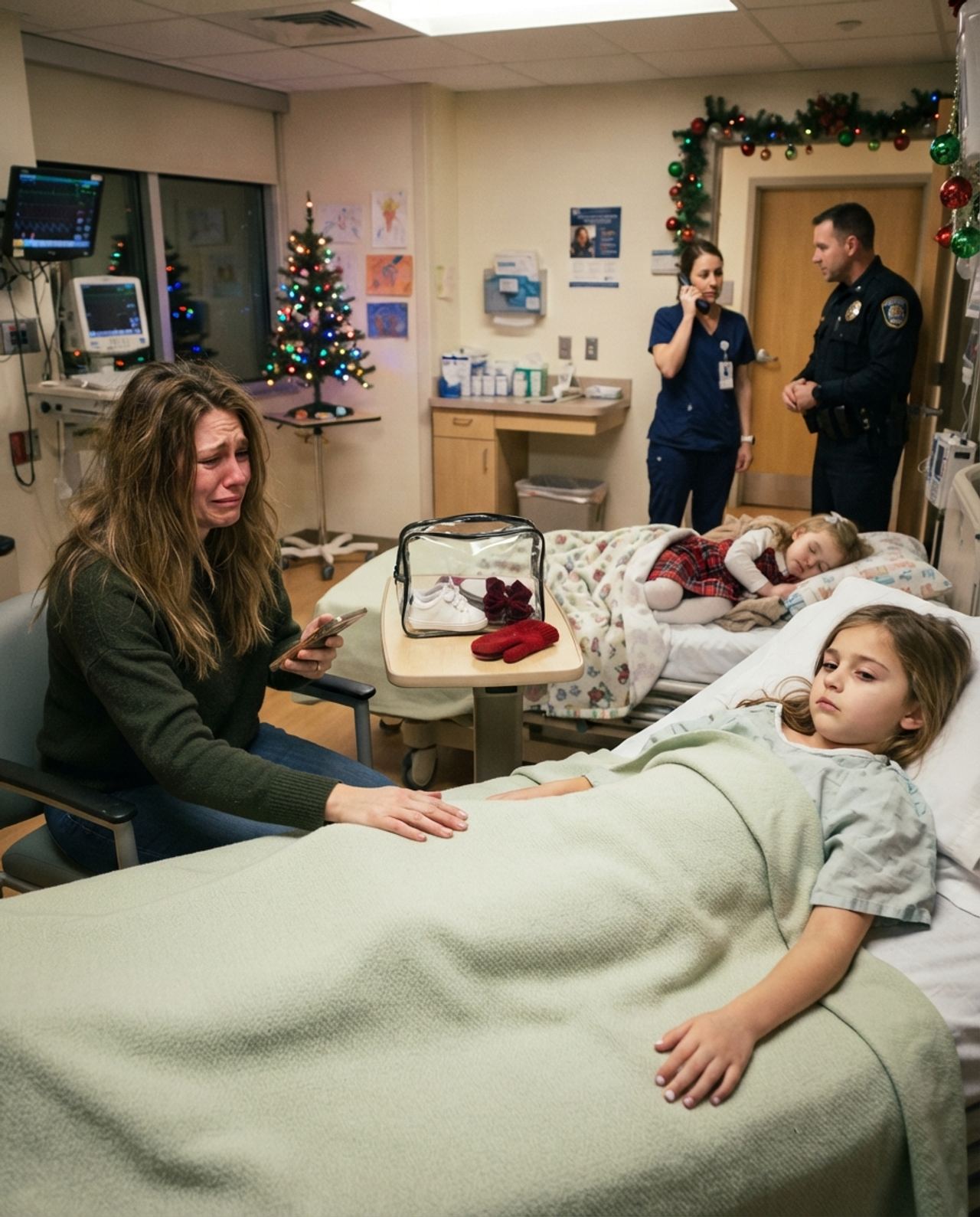
By the time I reached the children’s hospital, both girls were under warming blankets.
Ruby’s lips had lost their color.
Her cheeks were blotchy and pale.
Maisie looked exhausted in a way no eight-year-old ever should.
There was dried salt along the hem of her tights.
Her hair was damp from melted snow.
One of the nurses told me Maisie had kept herself wrapped around Ruby the entire time, even after the paramedics arrived, like letting go wasn’t an option she trusted.
I kissed both of them and kept apologizing, though neither of them was awake enough to hear me.
A nurse came in with a clear plastic bag holding the girls’ things.
Ruby’s mitten.
A velvet bow.
One of Maisie’s shoes with road grit stuck to the bottom.
When she handed me the bag, I looked down and saw Maisie’s hand lying outside the blanket.
Small, red, trembling in her sleep.
That was when I noticed what was caught under her thumbnail.
A thin curl of glossy white paint.
The exact shade of my parents’ front door.
I called my father right there.
He answered on the third ring, irritated, as though I had interrupted dinner.
I said, “Where are you?”
He said, “At home.
Why?”
My voice came out so flat it didn’t sound like mine.
“The girls were found outside.
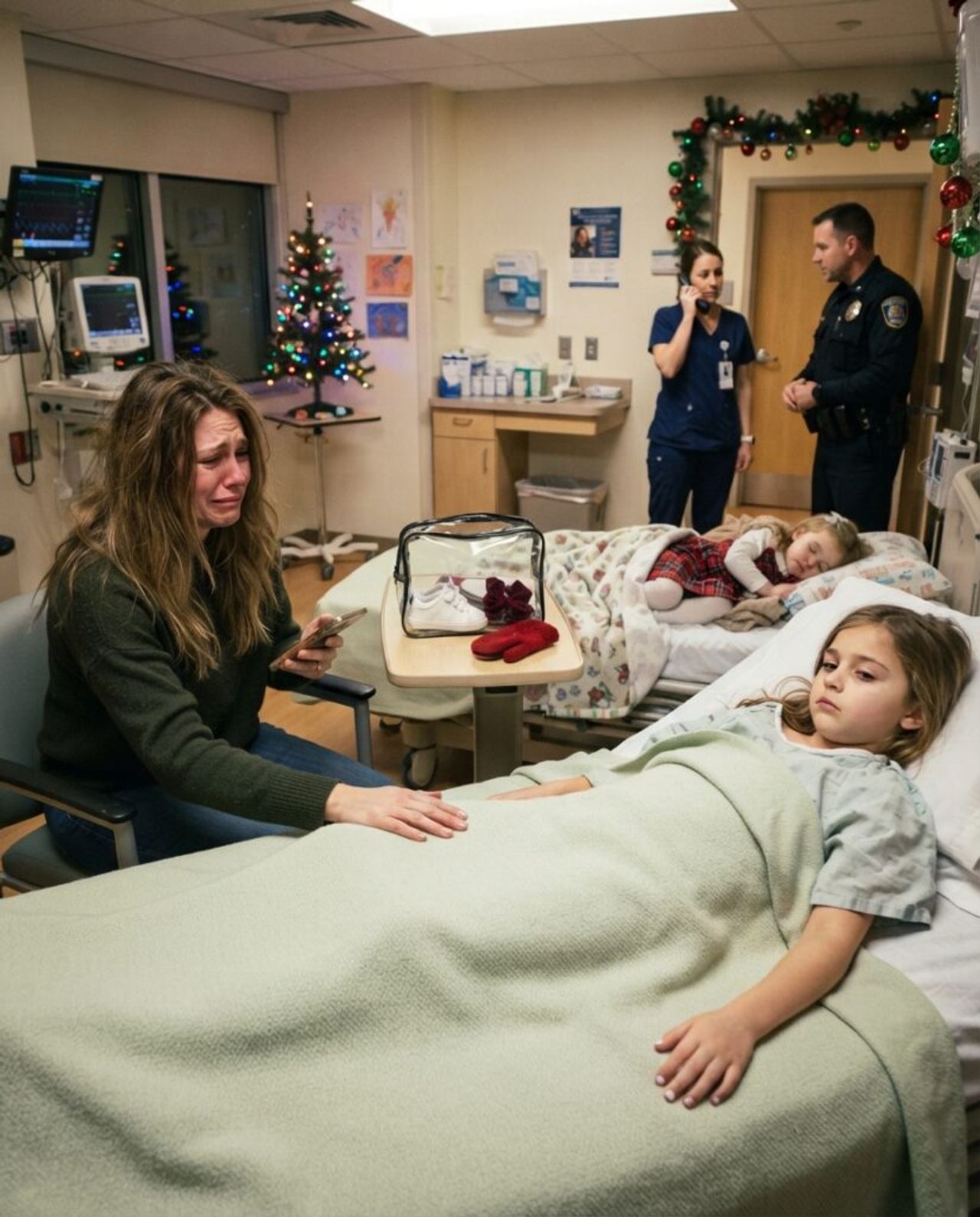
They are in pediatric intake with cold exposure.”
There was half a second of silence.
Then he said, “What girls?”
I actually thought I had misheard him.
“Maisie and Ruby.
I brought them to your house.”
His tone turned colder.
“You never brought them here.
Don’t start this on Christmas.”
I put him on speaker without even deciding to.
The nurse was standing beside me.
A hospital social worker had just stepped into the room because two young children had been brought in without an adult.
An officer had followed her in to take the intake statement.
My father repeated it for all of them.
“Those girls were never at our house.”
At the sound of his voice, Maisie’s eyes fluttered open.
She looked straight toward my phone, then buried her face in the blanket.
I sat on the bed and bent down until my forehead almost touched hers.
“Baby, can you tell me what happened?”
Her voice was rough and tiny.
“Grandpa opened the door.
Just a little.”
The room went still.
She swallowed and kept going because Maisie had always been the kind of child who would tell the truth even when it hurt her.
“He said Grandma had company.
He said Ruby was sticky.
He said not to come stomping through the house.
He said wait quiet on the porch.”
My father cut in sharply over speaker.
“She’s confused.
She’s dramatic.”
Then another call came through.
My mother’s number.
I answered.
She did not ask where the girls were.
She did not ask if they were hurt.
She said, furious and clipped, “Maybe teach that child not to scratch our freshly painted door like some little animal.”
The officer turned his head so fast his chair legs scraped the floor.
My mother went silent.
No one said anything for a second.
Then the officer asked quietly, “Freshly painted?”
My mother disconnected.
That was the moment something inside me changed.
Until then I had been pleading with reality to be less awful than it looked.
Maybe there had been a misunderstanding.
Maybe my father had stepped away.
Maybe my mother had thought my father let them in.
Maybe somebody had panicked and lied.
After that sentence, I stopped begging for excuses.
I started paying attention.
The officer stepped out to make calls.
Five minutes later he came back and said the neighbor across the street had responded to his knock and wanted to share doorbell footage.
Her name was Mrs.
Kenney.
She was in her sixties, widowed, and famous on our block for knowing which garbage can belonged to which house.
She told the officer she had seen my car pull up earlier but assumed the girls went inside.
When ambulance lights later flashed near the road, she’d checked her camera because she thought maybe it had caught the vehicle.
It had caught much more than that.
The officer asked if I wanted to view the footage that night or wait until morning to make a formal statement.
I said, “Now.”
He took me to a small consultation room off the ward.
The social worker stayed with the girls.
My hands were shaking so badly I had to sit on them.
The first clip showed my car pulling into the driveway at 3:14 p.m.
The timestamp sat bright in the corner.
There I was getting Ruby out, fixing Maisie’s scarf, leaning through the open window.
There were my daughters climbing the steps.
Then the camera angle from across the street caught the front door opening just six inches.
My father stood there.
He did not look surprised.
He did not look confused.
He looked annoyed.
He said something to Maisie.
She answered.
He looked past them toward the street, probably checking whether my car was gone.
Then he shut the door.
A minute later the curtain moved.
Three minutes later Ruby sat down on the top step.
Maisie knocked.
No one answered.
She knocked again.
Then she banged harder, first with the flat of her hand and then with the side of her fist.
When that didn’t work, she scraped at the door.
Even on the grainy footage, I could see her trying the knob with one hand while holding on to Ruby with the other.
That was where the paint under her thumbnail came from.
I watched my eight-year-old daughter do everything she could think of to get her little sister warm while two adults stood inside a brightly lit house and ignored them.
At one point my mother’s shape appeared behind the curtain.
She stood there for several seconds.
Then the porch light went off.
I made a sound in that room I had never made before.
Not a sob exactly.
Something lower and rawer.
The second clip showed the girls nearly forty minutes later.
Ruby was crying hard enough to stumble.
Maisie took off one of her own mittens and tried to put it on Ruby’s hand.
Then she guided her down the driveway and out toward the road.
Later, Maisie told me Ruby had started saying she needed the bathroom and that her feet hurt and that she wanted me.
Maisie had been trying to be good, trying not to get in trouble, trying to wait the way she’d been told.
But once it got dark and the porch light went out, she decided waiting was worse than moving.
She thought if they got to the main road, someone would help them.
A couple driving to an early evening church service saw them near the edge of the road, called 911, and stayed until the ambulance came.
The officer didn’t need anything else after the footage, but more kept coming anyway.
One of my mother’s dinner guests later gave a statement saying she’d heard knocking and asked whether someone should answer the door.
My father had apparently laughed and said, “If she wants to dump her chaos here, she can come back and do it properly.”
By the time I returned to the girls’ room, I wasn’t crying anymore.
I was cold.
Nate was out of surgery by then, groggy and hooked to monitors.
I had to tell him in pieces because he was still drifting in and out from anesthesia.
I told him the girls were alive.
I told him they were being warmed.
I did not tell him everything until the next morning, because I knew if I did, he would try to tear out his IV and go find my father himself.
Nate had never fit into my parents’ picture of what my life should look like.
He grew up in a rented duplex, worked with his hands, laughed too loudly, and never once treated my mother like she was the center of a room.
My parents called him impulsive.
Common.
Not our kind of people.
What they really meant was that he made it easier for me to notice how little love there had been in their house.
The next day I gave my formal statement at the police station while my girls slept at the hospital and Nate insisted on signing himself out early so he could come sit in the waiting area with a pillow pressed to his side.
My parents arrived separately with a lawyer.
My mother was in a camel coat, lipstick perfect, eyes dry.
My father looked angry that this had become public at all.
My mother opened with, “This is a family misunderstanding that has gotten out of hand.”
No one in the room answered her.
My father tried first.
He said he opened the door and told the girls to wait because he thought my mother was coming.
Then he said he assumed I must have circled back and picked them up.
Then he said he had been distracted by guests.
Then he said children exaggerate.
The detective let him talk.
Then she turned a monitor toward all of us and played the footage from Mrs.
Kenney’s camera.
No one spoke while it ran.
You could hear only the hum of the station heater and, faintly, one of the officers at the front desk answering a phone.
My father’s face changed first.
He stopped looking annoyed and started looking old.
My mother held on longer.
She kept her chin up through the first clip, through the porch light going off, through Maisie scratching at the door.
She broke at the second clip, the one where Ruby sat down on the freezing step and Maisie pulled her back up because she understood something my parents did not: little bodies lose heat fast.
My mother whispered, “I didn’t think they would still be out there.”
The detective said, “You saw them.”
My mother didn’t answer.
The detective said, “You told their mother to bring them.
You watched them arrive.
You heard them knocking.
And you left them outside in below-freezing weather.”
My father tried one last thing.
He said, “She uses those children to manipulate people.”
He meant me.
I looked at him across that table and understood that he had always believed cruelty became reasonable if he could give it a tidy explanation.
The charges were filed within days.
I won’t dress them up with legal language I didn’t grow up knowing.
What mattered was simple: two adults agreed to take charge of two children, watched those children arrive, refused them entry, and left them outside in dangerous cold.
The state had words for that.
So did the judge.
My parents were ordered to have no contact with my daughters while the case moved forward.
Later, faced with video, witness statements, and my mother’s own recorded admission about the freshly painted door, they stopped pretending nothing had happened.
Their lawyer worked out a plea.
They did not go to prison, which at first felt like another injury.
But they were convicted, supervised, publicly named in court records, and barred from unsupervised contact with any minor family members.
Their church removed my mother from every committee she cared about.
My father resigned from the board he liked to mention at dinner parties.
People stopped using the word respectable around them.
None of that made my daughters warmer that night.
None of it gave Maisie back the part of childhood that ended on that porch.
But it did something important.
It ended the lie.
For months after, Ruby cried whenever we pulled into any driveway after dark.
Maisie apologized constantly for things that were not her fault.
For scratching the door.
For walking to the road.
For not keeping Ruby warmer.
Once she even apologized for being heavy when the paramedic lifted her.
We put her in therapy.
We put both girls in therapy, though Ruby mostly colored and played with dolls while the therapist quietly helped her body learn that waiting by a door did not have to feel like danger forever.
One night, months later, I found Maisie standing in our hallway in her socks, not moving.
I asked what was wrong.
She said, very carefully, “If someone tells you to wait outside and they don’t come back, how long are you supposed to stay good before you can leave?”
I sat down on the floor with her right there in the hallway and told her the truth.
“You were good the first time you knocked,” I said.
“You were good the second time.
You were good every second after that.
None of this happened because you did anything wrong.”
She cried so hard she hiccuped.
I cried with her.
Nate healed slowly.
He has a scar now that runs along his side, pale and flat.
Sometimes I catch him looking at the girls with an expression that is half relief and half rage.
He still cannot talk about my father without his jaw locking.
We changed every emergency contact form at the school, both pediatricians’ offices, every camp, every after-school activity.
We blocked numbers.
We returned cards unopened.
When my mother sent a letter saying she had made one mistake in an impossible moment, I mailed it straight to my attorney.
The next Christmas, we stayed home.
Not because we were hiding.
Because home meant something different after that year.
We made cinnamon rolls from a tube because nobody had the energy for elegance.
Nate sat at the table wearing one of Ruby’s plastic crowns because she said the king had to supervise breakfast.
Maisie put the ornaments on the tree in perfect color order, then rearranged them because she decided perfect wasn’t the point.
A week before Christmas, she had asked me something unexpected.
“Can we paint our front door?”
I said yes.
She chose red.
Not burgundy or wine or anything tasteful my mother would have called classic.
Bright, certain, impossible-to-miss red.
The day we painted it, Ruby got more paint on herself than on the brush.
Nate had to sit down twice because his side still bothered him.
Maisie was serious about the edges and proud of the clean lines.
When we were done, she stepped back on the lawn with paint on her cheek and nodded like a contractor finishing a job.
“Good,” she said.
“Now it doesn’t look like theirs.”
Last Christmas Eve, after the girls were asleep, I checked the locks, turned out the downstairs lights, and stood for a moment in the hallway looking at that red door.
It is just a door.
Wood.
Hinges.
Paint.
But it opens the first time.
And every time one of my daughters comes home cold, scared, loud, muddy, crying, sticky, tired, or just wanting in, it opens before she even has to knock.
Read more stories
- I Gave a Speeding Ticket to a Woman Who Wrote the Law I Was Citing
- My Daughter Called Me Crying, “Dad, Please Come Get Me.” When I Reached Her In-Laws’ House, Her Mother-In-Law Blocked The Door And Said, “She’s Not Leaving.” I Stepped Past Her—And The Moment I Saw My Daughter On The Floor, I Knew This Wasn’t Family Drama. It Was a Secret They Had Buried For Months. They Expected Me To Walk Away Quietly. Instead, One Father’s Next Move Made Their Entire House Of Lies Collapse.
- Mom Took Her Injured Son to the ER After Family Tried to Stop 911
- SVU The Night I Told My Husband I’d Been Promoted to Lieutenant Colonel, He Smirked, Said My Rank Meant Nothing, and Announced His Mother Was Moving Into My Home to Turn Me Into Their Unpaid Maid… By the Time He Came Back With Her Suitcases, His Belongings Were Packed, My Father’s Hidden Evidence Had Exposed the Crime Family He Married Me to Protect, and the Secret They’d Buried for Thirty Years Finally Came Home