
Human Stories
“Walk it off. You’re fine,” my dad growled as I curled up in pain. My brother said, “She does this for sympathy.” Even my mom said, “She’ll do anything to ruin a peaceful weekend.” But when I lost consciousness and the paramedic ran a scan, she turned to them and said, “You better call a lawyer.” Because the MRI revealed
A young woman endures years of family abuse and dismissal until a violent fall leads to hospital imaging that exposes longstanding injuries. The MRI results trigger police intervention, legal consequences, and her eventual escape to a safer home.

I spent most of my life learning how to disappear.
At family dinners, I took the chair closest to the wall. At holidays, I kept my hands folded in my lap and answered questions with as few words as possible. At our family’s Colorado lake house, I knew which bedrooms to avoid, which jokes not to challenge, and exactly how much space to leave between me and my older brother, Tyler.
To everyone else, Tyler was the golden son—nineteen, loud, funny, headed back to college with fraternity stories and a future my parents talked about as if it were already framed above the fireplace.
To me, he was the person who could hurt me in a room full of adults and still make everyone look at me like I had caused the problem.
That Saturday, sunlight flashed off the lake and poured through the tall living-room windows. The house smelled like grilled burgers, sunscreen, and the sweet bourbon the adults had been drinking since lunch. Laughter bounced off the polished wood beams while I sat in the corner of the couch, rubbing my thumb over the rough seam of my jeans.
“Olivia, stop sulking,” my mother, Jennifer, called without looking up from her phone. “Come help set the table.”
I stood.
Quiet.
Helpful.
Out of Tyler’s way.
Those were the rules that kept the peace—or at least kept everyone else comfortable.
Tyler leaned against the stone fireplace, entertaining two uncles with a story from college. When I walked past carrying a platter, his expression changed just enough to tighten my stomach.
“There she goes,” he announced. “Everybody secure your valuables.”
A few relatives laughed.
“Remember last Christmas?” he continued. “Grandma’s china cabinet? Cost Dad what, three thousand dollars?”
“It was an accident,” I said.
“Everything’s an accident with you.”
My father, Robert, chuckled from his chair. “Leave your sister alone. You know how sensitive she gets.”
Sensitive. Dramatic. Difficult.
Those words had followed me longer than any bruise. If I cried, I was dramatic. If I flinched, I was sensitive. If I said Tyler had hurt me, I was trying to ruin the mood.
So I carried the platter into the dining room and said nothing.
All afternoon, Tyler found small ways to reach me without ever looking cruel enough for anyone else to object.
When I answered a board-game question correctly, he said I cheated.
When I got up for the bathroom, he called it another escape.
When I stayed quiet, he explained my silence for me.
“She doesn’t really do people,” he told one of our uncles. “She’s more of a library ghost.”
Mom finally glanced up. “Be nice to your sister.”
There was no warning in her voice. There never was.
By evening, the younger cousins were tired, the adults were louder, and Monopoly had turned mean. The living room felt overheated from too many bodies, and every burst of laughter made my shoulders rise.
I saw my chance to leave and headed toward the stairs.
“Where are you going?” Tyler called.
“Upstairs for a minute.”
“Running away again.”
His sneakers scraped across the hardwood behind me.
At the landing, I turned and found him directly in my path. He was taller now, broad through the shoulders, still smiling for the room below.
“Tyler, please move.”
“Or what?” He spread his arms. “I’m protecting the kingdom from the dragon.”
It sounded childish. His eyes didn’t.
I tried to slip around him, but he moved with me and blocked the rail. Behind us, someone rolled the dice. A cousin complained about rent. My father laughed at something near the dining table.
Tyler lowered his voice. “You always have to make everything weird.”
“I’m just going upstairs.”
“No. You want everyone to ask what’s wrong so you can act like a victim.”
For one hot second, I pictured grabbing the framed lake photo from the wall and smashing it on the floor just to make a sound no one could laugh away.
I kept my hands at my sides instead. “I said move.”
Below us, the room kept going—until Tyler stepped closer.
Then something in my face must have changed, because Aunt Susan stopped talking and looked up. The table froze a beat later. A fork hovered over a paper plate. My uncle held his glass halfway to his mouth. Meltwater slid down the side of a pitcher and pooled beneath it while one cousin stared at the Monopoly board as if the answer might be printed between Boardwalk and Park Place.
Nobody moved.
Tyler glanced down at the witnesses, then back at me. His smile tightened.
“Don’t start,” he whispered.
“I’m not starting anything.”
That was the truth about families like mine: they call the wound a performance because admitting it is real would require them to remember who kept causing it.
I stepped toward the rail.
Tyler’s palms slammed into my shoulders.
Not a nudge. Not a joke. A shove.
His smile vanished as my heel missed the top step. The room below went silent, and the staircase dropped out from under me—
My hip hit the first step, then my shoulder, then the base of my spine. The crack inside me was quieter than the thud of my body at the bottom, but I felt it everywhere.
“What happened?” Mom snapped.
“She fell,” Tyler said too quickly. “She just fell.”
I tried to sit up. Pain tore through my back in a hot electric sheet, and my legs did not answer.
“Walk it off. You’re fine,” Dad growled.
Tyler said, “She does this for sympathy.”
Even Mom looked at the relatives and muttered, “She’ll do anything to ruin a peaceful weekend.”
Aunt Caroline pulled out her phone anyway. Dad warned her she would not be welcome back if she called 911.
She made the call.
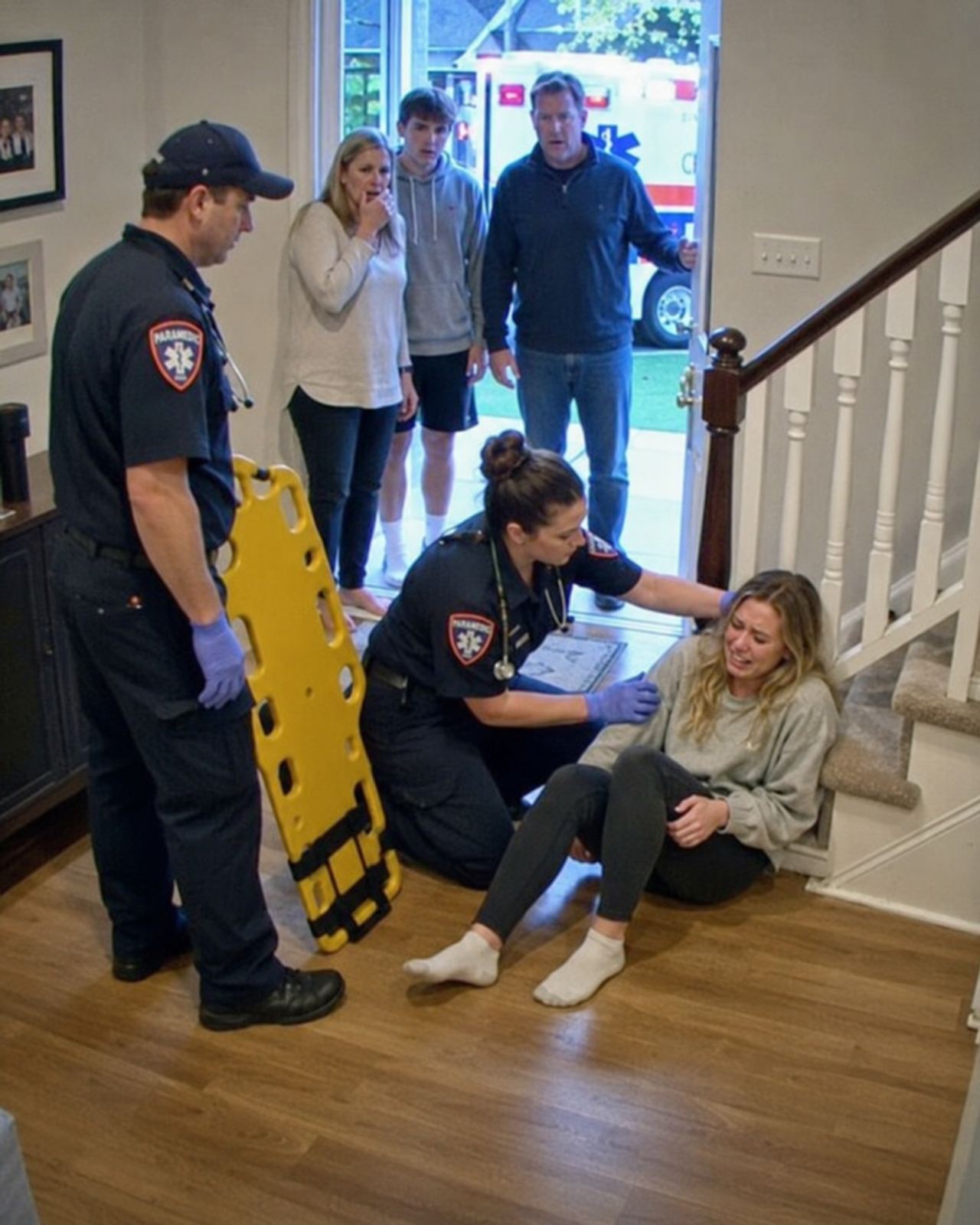
Fifteen minutes later, two paramedics came through the front door with a stretcher and rigid collar. One asked me what happened.
“I was pushed,” I whispered.
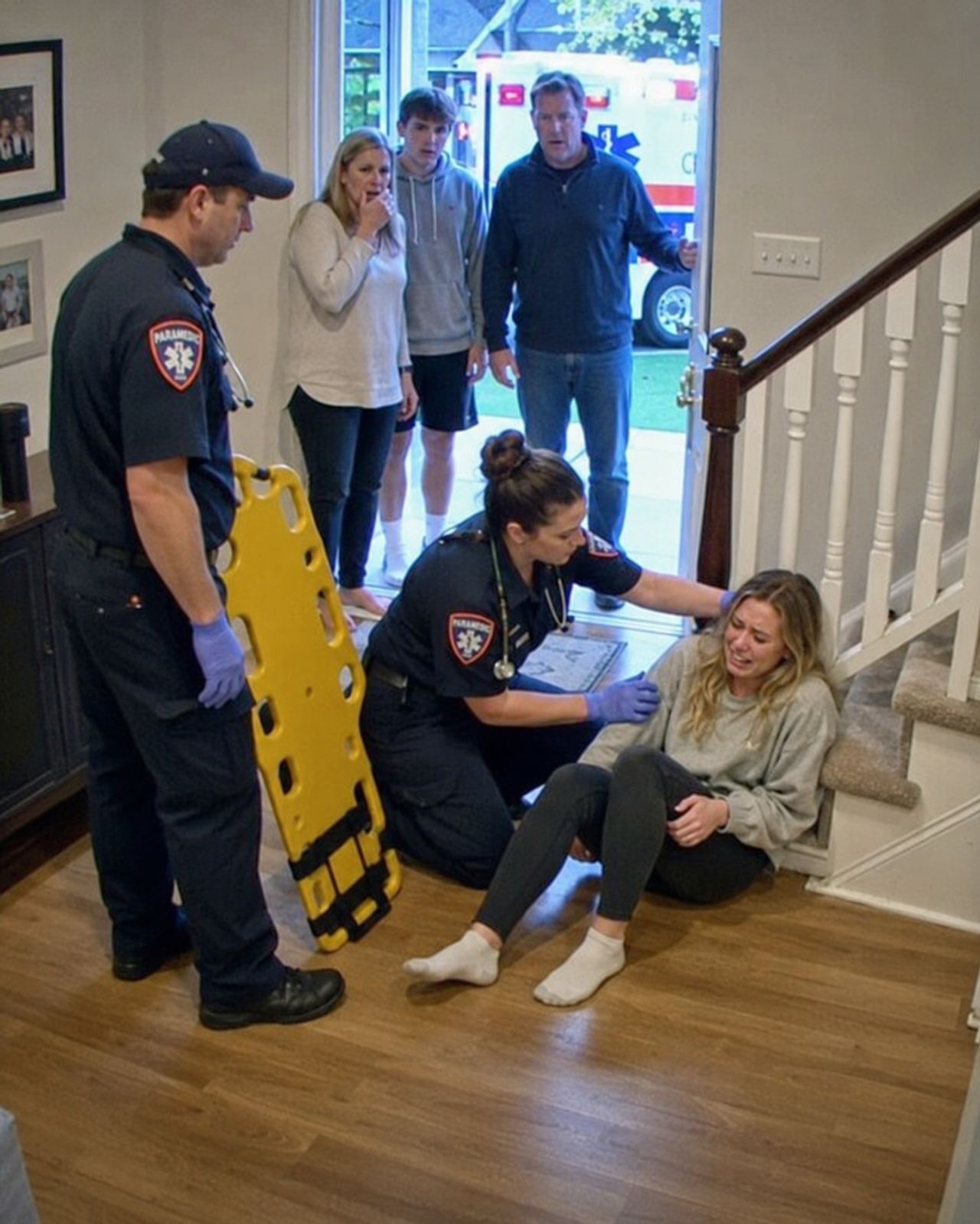
Dad stepped in. “She’s confused. The kids were playing.”
Then the second paramedic lifted the back of my shirt to check my spine—and went completely still.
That was the new thing no one in my family had prepared an explanation for: bruises in different colors, hidden under hoodies, spread across my back like dates on a calendar.
Tyler’s face collapsed. He leaned over the stretcher before the doors closed and whispered, “Liv, don’t say anything stupid. It was just a joke.”
At the hospital, the MRI confirmed my spinal cord was intact and that I could recover movement. Mom finally started crying.
But the doctor did not comfort her.
She turned the tablet toward my parents, pointed to a second finding that had nothing to do with that night’s fall, and said, very quietly:
“Before either of you speaks again, you need to understand what this scan proves…”
Part 2: The Fracture
“…this scan proves her injuries aren’t from a single bad fall,” Dr. Vance said, her voice eerily calm against the hum of the heart monitor. She zoomed in on a cross-section of my ribcage and spinal column, pointing a pen at pale, shadowed lines across the bone.
“These are micro-fractures in varying stages of healing,” the doctor continued, turning her sharp gaze directly on my father. “Two healed hairline fractures in the ribs from roughly six months ago. A partially calcified crack in the left collarbone from last year. And deep tissue scarring that matches chronic, repetitive blunt trauma. A fall down wooden stairs causes acute trauma. It doesn’t cause a map of systematic abuse spanning three years.”
The room went so quiet you could hear the faint drip of my IV line.
My father’s face hardened into that familiar, terrifying mask of controlled anger. “Now wait just a minute. She’s an athletic kid. She rides bikes, she mess around—you can’t throw around accusations like that in my direction.”
“I’m not throwing anything,” Dr. Vance said, leaning forward. “I’m informing you that as a mandatory reporter, I’ve already notified Child Protective Services and the local sheriff’s department. Officers are outside right now taking statements from the paramedic who examined her back.”
Mom gasped, her hand flying to her mouth, but her eyes didn’t dart to me. They darted to Tyler, who was standing near the door, his face drained of all color.
“Robert, do something,” Mom whimpered.
“Shut up, Jennifer,” Dad snapped quietly. He looked at me, lying motionless on the thin hospital mattress. The usual threat wasn’t in his eyes anymore; it was replaced by something desperate. “Olivia. Tell the doctor. Tell her how clumsy you’ve always been. Tell her about the time you tripped over the cooler at the lake.”
I looked at him. Really looked at him. For seventeen years, I had believed that if I just made myself small enough, if I shrank into the wallpaper and bore Tyler’s cruelty in silence, my family would love me. But sitting in that stark white room, surrounded by the cold evidence of my own broken body, I realized something terrifying and liberating: they didn’t want a daughter. They wanted a scapegoat.
“The cooler didn’t crack my collarbone, Dad,” I said. My voice was raspy, barely a whisper, but it cut through the room like shattered glass. “Tyler twisted my arm behind my back because I wouldn’t give him my allowance money. And the rib fracture was from when he kicked me for ‘looking at him wrong’ while you two were at dinner.”
“You little liar—” Dad took a step toward my bed.
Before he could take another, two uniformed sheriff’s deputies stepped through the curtain.
“Robert Davis?” the taller deputy asked, his hand resting casually on his belt. “We need you, your wife, and your son to step out into the hallway. Now.”
Tyler looked like he was going to vomit. He tried to catch my eye as the police led them out, but I turned my head toward the window, watching the moonlight pool on the dark hospital parking lot below.
For the first time in my life, the quiet didn’t feel dangerous.
Part 3: The Reconstruction
The legal storm that followed shattered what was left of the Davis family’s pristine reputation.
Aunt Caroline—the only adult who had dared to make the call—came to the hospital the next morning and stayed by my side. She brought me real clothes, a warm blanket, and a lawyer who specialized in advocacy for minors. When my parents tried to post Tyler’s bail after he was booked for felony assault and child endangerment, Aunt Caroline filed for emergency guardianship.
The lake house was sold six months later to cover my parents’ legal fees. The fraternity brothers Tyler bragged about ceased all contact when his mugshot leaked onto social media. The framed picture above the fireplace was gone, replaced by a wall of official court documents, protective orders, and depositions.
It took four months of physical therapy to walk without a limp. It took much longer to stop flinching when someone walked up behind me.
Today, I live with Aunt Caroline in a small house three hours away from the lake. There are no polished wood beams, no booming voices demanding silence, and no golden sons whose secrets are bought with my pain.
Sometimes, late at night, I sit by the window in my new room—a room far away from the wall, right in the center of the house where the sunlight hits first. I still keep my answers short, and I still prefer quiet corners. But I no longer hide.
My parents thought I would do anything to ruin a peaceful weekend. They were wrong.
I just did what was necessary to survive it.
Read more stories
- At my father’s graveside, the gravedigger grabbed my arm and whispered, ‘Sir, your father paid me to bury an empty coffin.’ Before I could even breathe, he pressed a brass key into my palm and said, ‘Don’t go home. No matter who calls, don’t go home. Go to Unit 17 on Route 9 — right now.’ Then my phone buzzed with a text from my mother: Come home alone.
- Mexican Street Corn
- After refusing to help pay for my college when they watched me struggle alone, my
- My Daughter Died Seven Years Ago. Every Year, I Sent Her Husband $40,000 To Take Care Of My Grandchild. One Day, She Grabbed My Sleeve And Whispered, “Grandpa, Don’t Send Dad Any More Money. Just Follow Him. You’ll See.” What I Discovered Next Terrified Me…