
Stories
My son’s wife pointed at the door of my own lake cottage and said, ‘You have 48 hours to leave.’ She thought the old man in flannel couldn’t afford a fight — so I nodded, called my lawyer, and by sunset her key stopped working. The next document she opened showed five properties, $4.2 million… and one mistake she could never undo…
Walter Hale, a modest-looking but wealthy contractor, recounts how his daughter-in-law tried to force him out of his own lake cottage in order to turn it into a rental property. Instead of yielding, he consulted his lawyer, changed the locks, and prepared legal action as the family conflict escalated.

I didn’t raise my voice when my daughter-in-law pointed at the front door of my own lake cottage and told me I had forty-eight hours to leave.
I just looked at her, set my coffee mug down on the kitchen counter, and nodded once.
That counter was not marble. It was not imported stone with a designer name attached to it. It was maple butcher block I had installed myself thirty-one years earlier, back when my knees didn’t complain every time I crouched and my wife Patricia still danced barefoot through that kitchen while I worked.
Renata saw the flannel shirt, the dented Ford pickup in the gravel drive, the old coffee mug from a hardware store, and she thought she understood me.
She thought a man like me could be pushed.
She thought wrong.
My name is Walter Hale. I’m sixty-three years old, and for most of my life I made my living with a tool belt around my waist and sawdust in my hair. I started in construction at nineteen, framing houses in January with my hands so cold I could barely close them around a hammer. By thirty-four, I had my own small contracting company. By forty-five, I had crews working under me. By fifty-five, I had learned that a man could do very well for himself if he showed up early, kept his word, paid his people on time, and never spent money just because other people expected him to.
That last part mattered more than people think.
I still wore the same kind of flannel shirts I wore when I was making twelve dollars an hour. I still drove a 2019 Ford F-150 with a dent in the rear bumper from backing into a fence post one icy morning. I still bought my coffee at Dunkin’ when I drove through town, not because I couldn’t afford better, but because I liked it and because at my age, you stop apologizing for simple habits that make sense.
My son Marcus knew I had money.
He knew I owned the lake cottage outright.
He knew I had done well.
What he didn’t know was the full picture.
And his wife, Renata, definitely didn’t.
The cottage sits on a quiet stretch of lake in upstate New York, tucked behind tall pines and a narrow gravel road where the mailboxes lean a little and everyone knows who plows whose driveway in February. It has four bedrooms, a stone fireplace, a screened porch, and a dock Patricia and I rebuilt together one summer when Marcus was fourteen and too embarrassed to be seen helping his parents unless we paid him in cheeseburgers.
It was never meant to be impressive.
It was meant to be ours.
Patricia used to say the place had good silence. Not lonely silence. The other kind. The kind where the water moves softly against the shore and the old refrigerator hums in the kitchen and you can hear someone you love turning a page in the next room.
After she died, that silence changed.
Patricia passed from cancer eleven years ago. She was fifty-one. Some days, I still can’t believe a person can be in a house so completely and then be gone from it so thoroughly. For months after her funeral, I would catch myself buying the tea she liked or turning to say something to her when a cardinal landed on the porch rail.
Marcus was twenty-two then, just finishing college in Albany. He was grieving, though I didn’t understand the shape of his grief at the time. Mine looked like work. His looked like distance. Neither of us knew how to reach across it.
I did what men in my family had always done when pain walked into the room.
I got busy.
I worked longer hours. I took on bigger jobs. I answered emails at midnight. I paid bills early. I made sure Marcus had what he needed. Tuition. Rent help. A reliable used car. Money for interviews. Money for the things young men need when they’re trying to become adults while pretending they’re fine.
I gave him checks when I should have given him conversations.
I can admit that now.
Marcus met Renata about four years after Patricia died. She was beautiful in a polished, city way that made waiters remember her and other women check their posture when she walked into a room. She worked in finance down in New York City, then later remotely from their condo outside Albany. She was sharp, organized, ambitious, and careful with words in a way that made you feel like every sentence had already passed through a legal department before it reached her mouth.
At first, I admired that.
Marcus seemed happy. He laughed more. He stood a little straighter around her. Patricia would have wanted me to welcome anyone who made our son feel proud of his life, so I tried.
When they got married six years ago, I paid for the wedding.
They didn’t ask. I offered.
It was at a vineyard in the Hudson Valley, with string lights in the trees and little linen menus that had their names printed in gold. The final cost was just under ninety thousand dollars. I wrote the checks without making speeches about sacrifice. I didn’t tell Marcus to remember it. I didn’t hold it over Renata. I paid because he was my son, because Patricia was not there to help me choose the suit, and because grief sometimes makes you generous in ways that look noble from the outside but are really just loneliness wearing a nicer coat.
After the wedding, Marcus and Renata bought a condo closer to the city. I helped with the down payment. Two hundred thousand dollars, wired directly.
Marcus cried when he thanked me. Renata smiled and said they would pay me back someday.
I told her that wasn’t necessary.
She looked relieved.
A couple of years later, my granddaughter Claire was born.
Claire is four now. She has Patricia’s eyes and a stubborn little chin that I recognize from both sides of the family. She calls me Grandpa Walt and believes I can fix anything, which is both the sweetest compliment in the world and a burden I accept with full seriousness. When she was born, I opened a 529 college plan for her and put fifty thousand dollars in to start, then set up automatic monthly contributions.
I told Marcus I had opened an account for her education.
I didn’t mention the amount.
Renata said, “That’s very thoughtful,” while checking something on her phone.
That was the first thing about her I started to notice.
She was thankful when something came easy. Not deeply thankful. Not the kind of thankful that remembers the hand behind the gift. More like a person acknowledging a credit applied to an account.
Still, I tried not to judge. Everybody has their own way of moving through the world. Patricia had taught me that. “Walter,” she used to say, “not every quiet person is kind and not every difficult person is bad.”
So I kept trying.
But over time, Renata’s eyes changed when she looked at me.
Not openly. She was too smart for that. It was small things.
A pause when I pulled up in my truck at Christmas instead of some shiny luxury SUV.
A little smile when I said I still did some repairs around my own properties.
A comment at Thanksgiving about how “some people get attached to houses instead of making them work financially.”
She would look around the cottage as if she were not visiting a home but inspecting an underperforming asset.
I let too many of those moments pass.
That is the truth.
The bigger truth is that I let them pass because part of me expected Marcus to notice. I kept waiting for my son to step in, to say, “Renata, that’s Dad’s place,” or “We’re not talking about his home like that.”
He never did.
He would look down into his coffee or bounce Claire on his knee or change the subject to football.
That hurt more than Renata’s comments.
Renata was not my child.
Marcus was.
The first real push came in August, during a long weekend at the lake. They drove up late Friday afternoon with Claire asleep in the backseat and a trunk full of bags, toys, organic snacks, and the kind of collapsible baby equipment that makes young parents look like they are moving into a hotel for six months.
That first night was almost perfect.
I grilled trout on the old Weber. Marcus and I drank beer on the dock. Renata took a few pictures of Claire with the sunset behind her. For a while, I could almost imagine that we were becoming the kind of family Patricia had hoped we would be.
Then Saturday morning came.
We were sitting at the kitchen table. Claire was coloring at the counter. I had made pancakes, and Renata was scrolling through her phone with that bright, efficient expression she wore when she was about to present something.
“Walter,” she said, “I’ve been thinking about this property.”
I already didn’t like the way she said property.
Not cottage. Not home. Property.
She told me the short-term rental market on the lake was incredible. Summer weeks were booking for numbers I had never cared to know. Families from Manhattan, Boston, Philadelphia. People willing to pay anything for water access, four bedrooms, a fire pit, a dock, and “authentic rustic charm.”
That phrase came out of her mouth like she had read it from a brochure.
She had done research.
She had spoken to a property management company.
She had looked at comparable listings.
She believed the cottage could bring in twelve to fifteen thousand dollars a month during peak season.
“We could split the income,” she said. “However you think is fair.”
I looked at Marcus.
He was spreading butter on a pancake for Claire.
I asked, “You’ve already spoken to a management company?”
Renata’s smile didn’t move, but her eyes sharpened.
“Just informally.”
“About my house?”
“About the opportunity,” she corrected.
I took a sip of coffee and said, “I’ll think about it.”
She took that as progress.
It wasn’t.
Over the next few months, she sent emails. Interior design links. Rental income projections. A PDF about “maximizing legacy properties.” A sample listing description that referred to my home as a “luxury lake retreat with old-world charm.”
I hated that phrase so much I closed the laptop and went outside for half an hour.
In October, they came back for a weekend, and I found Renata walking through the bedrooms with her phone held high, taking video.
“What are you doing?” I asked.
She smiled like I had caught her wrapping a present.
“Just getting a sense of the space.”
“For what?”
“For possibilities.”
I said, “I haven’t agreed to anything.”
“I know,” she said lightly. “We’re just exploring.”
That word did a lot of work for her.
Exploring meant pushing.
Exploring meant assuming.
Exploring meant if I objected, I was the difficult one.
I should have stopped it there. I should have said, “No. This is my home. I am not turning it into a rental. Do not bring it up again.”
But I didn’t.
Some men yell because they are weak.
Some men stay quiet for the same reason.
I told myself I was keeping the peace.
Really, I was avoiding the fight.
By March, the fight came anyway.
They came up for Claire’s spring break. There was still dirty snow under the pines and that damp cold in the air that makes lake country feel half-asleep. Claire arrived wearing purple rain boots and carrying a stuffed rabbit by one ear. She ran straight into my arms, and for the first day, I let myself believe the weekend might be normal.
On the second morning, Renata slid a document across my kitchen table.
It was an agreement.
Not a request. Not a proposal. An agreement.
She said she had a friend draft it. The friend, apparently, worked in real estate administration and “knew how these things were structured.”
I read the first page.
Then the second.
Then I read the first page again, slower.
The document said I would grant Marcus and Renata management rights over the lake property for an initial period of three years. They would handle all bookings, expenses, vendors, pricing, renovations, guest communication, and income. In return, I would receive a flat monthly payment of two thousand dollars.
Two thousand dollars a month for a lakefront house that Renata herself believed could earn seven times that in July.
I set the papers down.
“I’m not signing this.”
Renata leaned forward like I was a nervous client.
“I understand that it feels like a big step.”
“It doesn’t feel like a big step,” I said. “It feels like a bad agreement.”
Her mouth tightened.
“It’s actually very generous when you consider the work involved.”
“This is my house, Renata.”
“No one is disputing that.”
“You are asking me to hand over control of it.”
“We’re asking you to let us help you manage an asset you’re not using properly.”
There it was.
Not using properly.
I looked at Marcus.
He was sitting at the far end of the table, staring into his coffee.
“Marcus,” I said. “Do you agree with this?”
He rubbed the back of his neck.
“I think Renata has done a lot of research.”
That answer told me more than yes would have.
Renata took a breath, softened her voice, and said, “Walter, have you thought about what the next ten or fifteen years look like for you? There are some really beautiful active retirement communities near Saratoga. Not nursing homes. Nothing like that. Nice places. Safe. Social. Less maintenance.”
I was sixty-three years old.
I still split my own firewood.
I still climbed ladders carefully when a gutter needed clearing.
I still knew every board in that dock because my hands had put half of them there.
And my daughter-in-law was sitting in my kitchen, discussing me as if I were a box that needed to be moved out of the way before summer bookings opened.
That night, I did not sleep.
I lay in the bedroom Patricia and I had shared, looking at the ceiling fan turn slow circles in the dark. I thought about the version of myself who signed the paper to avoid tension. The version who told himself it was only three years. The version who moved into some beige apartment with a community newsletter and spent the rest of his life pretending he had chosen it.
Then I thought about Patricia.
Patricia, who had once stood in the county clerk’s office with me after we bought that cottage, holding the deed like it was a newborn baby.
Patricia, who had planted lavender by the porch steps because she said every home needed something fragrant near the door.
Patricia, who had told me, during one of her last good weeks, “Don’t let this place become a monument to me. Live in it.”
At eight the next morning, I called my attorney.
His name is Raymond Ellis, and he has handled my contracts, property transfers, estate planning, and occasional headaches for more than twenty years. His office is in Albany, in an old brick building near a courthouse where the elevators smell like paper, coffee, and other people’s bad decisions.
I told him what happened.
He was quiet for a moment.
Then he said, “Send me the document.”
I took pictures of every page and emailed them.
He called back within the hour.
“Walter,” he said carefully, “this document is amateurish enough to be almost funny, but the intent behind it is not funny at all.”
“I figured.”
“You need to put boundaries in writing. Today.”
“I know.”
“And you need to stop treating this like a misunderstanding.”
That landed harder than I expected.
Because I had been treating it that way.
A misunderstanding was easier to forgive. A misunderstanding let me keep seeing Marcus as passive instead of complicit. A misunderstanding let me imagine Renata simply got carried away with numbers and spreadsheets.
But this was not a misunderstanding.
This was a plan.
That week, while Marcus, Renata, and Claire were still under my roof, I began doing what I should have done years earlier.
Quietly.
I called my financial advisor. I called my accountant. I reviewed every account, every property, every beneficiary designation, every old assumption I had allowed to sit untouched since Patricia died.
By then, I owned the lake cottage free and clear. I also owned four other properties: two rental houses near Albany, a duplex outside Saratoga Springs, and a small commercial building in Glens Falls leased to a physical therapy clinic. I had investment accounts, retirement accounts, dividend stocks, index funds, and cash reserves I had built slowly over three decades.
My net worth, according to the most recent statement, was just over $4.2 million.
Not flashy money.
Not private jet money.
But real money.
Life-changing money, if handled badly.
Relationship-destroying money, if people started treating it like it already belonged to them.
Patricia and I had talked about that often. She grew up with relatives who fought over inheritance before the body was cold. We had watched good people become suspicious over furniture, jewelry, land, and accounts they had done nothing to build.
So we made a choice.
We would live comfortably but modestly. We would help Marcus when it mattered, but we would not raise him to believe our money was the foundation of his life. We would not make wealth the loudest thing in the room.
It sounded wise when we were young.
Looking back, I think we mistook secrecy for wisdom.
When Marcus and Renata left that March weekend, I kissed Claire on the top of her head and helped buckle her into the car seat. Renata told me she hoped I would reconsider.
I said, “I’ll be in touch.”
Three weeks later, Renata came back alone.
She let herself in with the spare key Marcus had.
I was in the kitchen sanding a drawer front when I heard the door open. I looked up, and there she was in a cream coat that probably cost more than my table saw, carrying a leather folder against her chest.
No knock.
No call from the driveway.
Just inside my home.
“Walter,” she said, startled but not sorry. “Good, you’re here.”
That was the first moment my patience began to truly leave me.
She had a revised agreement. This one, she said, had been reviewed by “someone with legal experience.” She placed it on the table like a teacher giving a student a second chance.
I washed my hands. I made coffee. I read it.
The language was cleaner. The meaning was worse.
It gave them broader control over renovations, pricing, calendar access, furnishings, and vendor decisions. It included a clause about “reasonable relocation support” for me during peak rental periods.
Reasonable relocation support.
For the owner.
In his own house.
I closed the folder.
“Renata, I’m not signing this.”
Her face hardened.
“Walter, you’re being emotional.”
“No. I’m being clear.”
“This could benefit everyone.”
“It benefits you.”
“That is unfair.”
“So is walking into my house without knocking.”
She blinked.
I held out my hand.
“I need the key back.”
Her laugh was short and sharp.
“It’s Marcus’s key.”
“It opens my door.”
“He’s your son.”
“He is not the owner.”
Her eyes went cold.
“I really think you should consider what kind of relationship you want with your son.”
I looked at her for a long moment.
“I would like a relationship where people knock before entering my home.”
For the first time since I’d known her, Renata had no immediate answer.
She placed the key on the table.
I changed the locks that evening.
Not later. Not after another talk. That evening.
The locksmith was a man named Pete who had worked on a few of my rental properties over the years. He arrived in a blue van with a cracked windshield and a Red Sox cap he wore even though we were in Yankees country. He didn’t ask many questions. Men like Pete know when a job is just a job and when a house has had enough.
By sunset, every exterior lock was changed.
At 8:17 that night, Marcus called.
“Dad,” he said, “Renata is really upset.”
“I imagine she is.”

“You changed the locks?”
“Yes.”
“That seems extreme.”
“Walking into someone else’s house without permission is extreme.”
“She was trying to help.”
“She was trying to take control.”
He sighed, the way a tired parent sighs at a child who won’t understand reason. That sound, coming from my own son, almost made me hang up.
“The agreement is actually a good deal,” he said. “You’re not seeing the big picture.”
“I asked you before. Did you read it?”
“I looked it over.”
“That’s not what I asked.”
Silence.
Then he said, “This isn’t just about money. This is about family working together.”
“No,” I said. “This is about my home.”
Another silence.
Then Marcus said the sentence that changed something permanent in me.
“Dad, you need to start thinking about what happens to all of this when you’re gone.”
I sat very still.
There are moments in a family when a person says something and everyone involved knows the relationship has stepped onto different ground.
That was one of them.
“I am sixty-three,” I said. “Not ninety-three. I have been thinking about my life, my property, and my affairs for thirty years.”
“I didn’t mean—”
“Yes, you did.”
He didn’t argue.
I told him I loved him. I told him I would talk when he was ready to speak to me as his father, not as an obstacle.
Then I ended the call.
For six weeks, I heard nothing.
No calls. No texts. No pictures of Claire. No cheerful little FaceTime with her showing me a drawing from preschool. Just silence, the kind families use when they want you to feel punished but still pretend they are the injured party.
I mailed Claire’s birthday gift anyway.
A picture book, a stuffed frog, and a check for her college account.
I don’t know whether she was told it came from me.
In May, on a Tuesday morning, I heard unfamiliar tires on the gravel driveway.
I looked out and saw a dark SUV I didn’t recognize. Renata stepped out first. Behind her came a man in khakis with a measuring tape clipped to his belt and the weary face of someone who had already realized he was standing in the middle of somebody else’s family problem.
Renata knocked.
I gave her that much credit.
When I opened the door, she smiled like we had an appointment.
“Walter,” she said. “This is Daniel. He’s a contractor. We’re just going to take some measurements.”
“No, you’re not.”
Her smile flickered.
“The renovation timeline is tight, and we really need to get moving if we’re going to be ready for summer.”
“What renovation?”
“The rental updates.”
“There are no rental updates.”
She looked past me into the kitchen as if the house might overrule me.
“I sent an email.”
“I did not receive an email approving renovations to my home.”
Her voice lowered.
“Walter, I think it would be easier for everyone if you found somewhere else to stay while this gets sorted out.”
Daniel suddenly became very interested in the gravel.
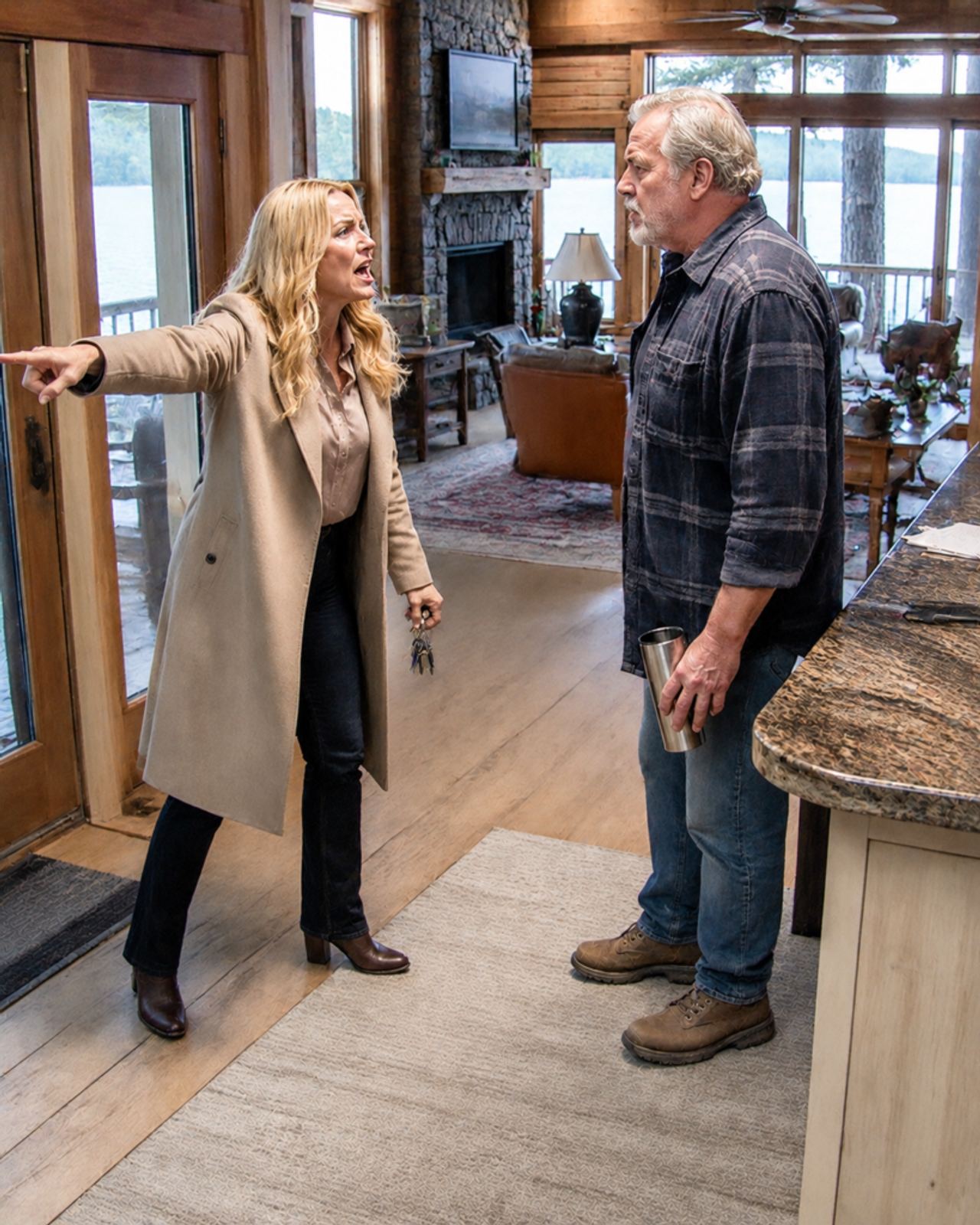
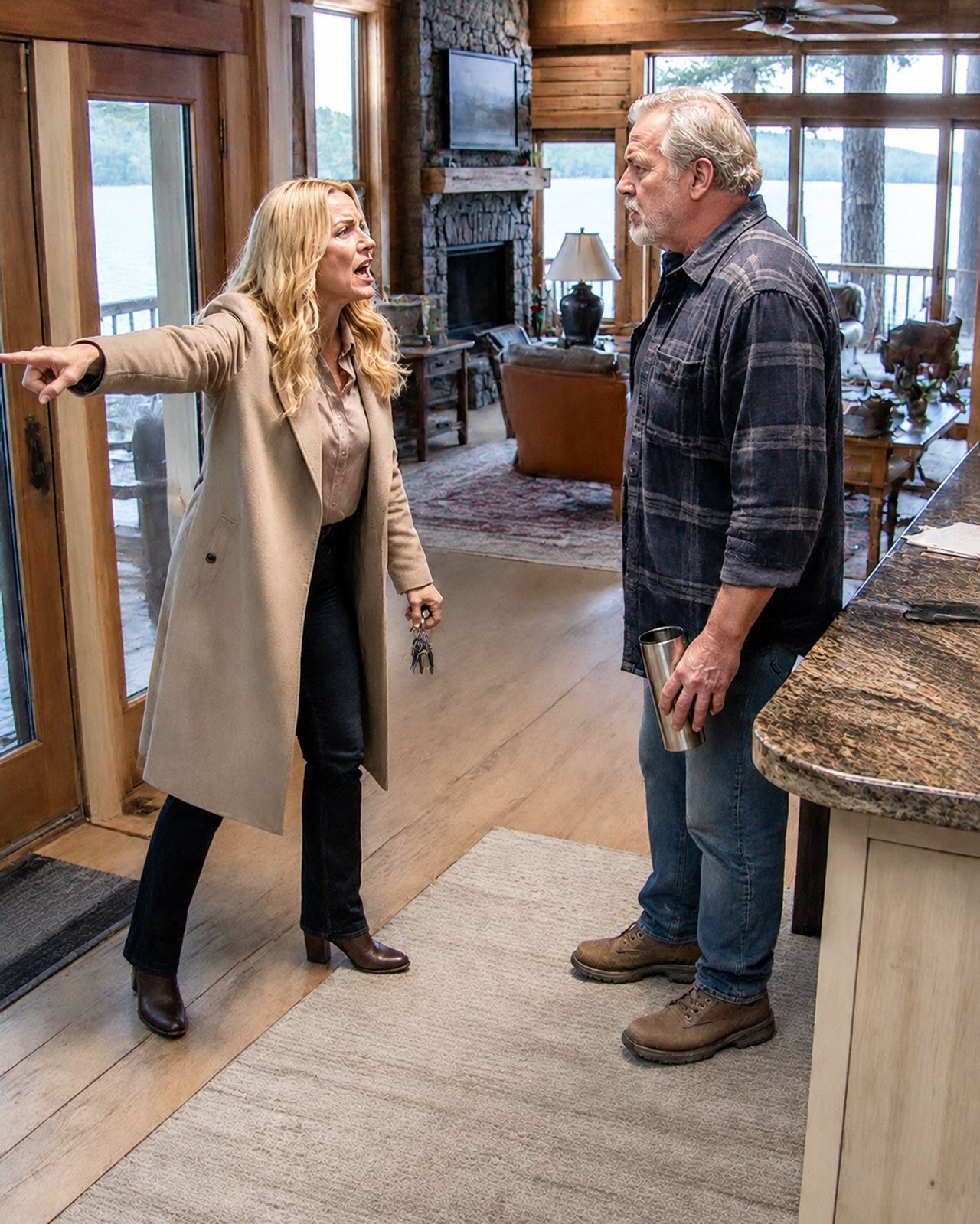
Renata continued, “You have forty-eight hours to leave. After that, we’ll need access to begin work.”
There it was.
Plain.
Ugly.
Uncovered.
Not wrapped in planning language. Not hidden behind family concern. Not softened by “legacy” or “opportunity.”
You have forty-eight hours to leave.
I looked at the woman my son had married. I thought about the wedding I had paid for. The down payment. The college account. The Christmas gifts. The weekends on the dock. The way I had tried to make space for her in a family that grief had already made too quiet.
Then I looked at the contractor.
“Daniel,” I said, “you seem like a decent man, so I’m going to save you some trouble. This is my house. I am the sole legal owner. No one has permission to measure, alter, enter, list, photograph, stage, or renovate it. You need to leave.”
He nodded immediately.
Renata’s face went pale with anger.
“Walter.”
“Both of you,” I said.
She stared at me like I had embarrassed her.
Maybe I had.
But she had mistaken my home for a conference room, and I was done attending the meeting.
They left.
I watched the SUV disappear down the gravel road. Then I went back inside, sat at the kitchen table, and looked out at the lake.
The ice had gone out a few weeks before. The water was dark blue and restless. A loon moved near the far shore, dipping its head under and coming back up somewhere else, as if even the birds knew when to disappear from foolishness.
I picked up the phone.
“Raymond,” I said when my attorney answered. “It’s time.”
He didn’t ask what I meant.
“I’ll prepare the letters.”
That afternoon, I did not shout. I did not send Marcus a long emotional message. I did not call Renata names. I did not post anything online. At my age, you learn that the loudest move is not always the strongest one.
Sometimes the strongest move is a certified letter.
Raymond drafted a formal notice of trespass covering the lake cottage and eve…
Read more stories
- A Virginia Ski Resort Singer Stepped Into the Cinematic Glare of a Nationally Loved Stage — To Carry a Voice Everyone Thought Was Gone Forever.
- Her Daughter Woke In ICU And Named The Man Behind The Hit-And-Run
- Ground Beef and Gravy Over Mashed Potatoes
- They called me a liar in a courtroom packed with spectators, and my own mother made sure everyone believed them. With one hand on the Bible, she looked the judge in the eye and declared, “She was never a soldier. The scars, the medals… every part of her story is a lie.” The room grew quiet as every suspicious gaze turned toward me. Then the courtroom doors swung open, and the man who walked in wiped the smile from my mother’s face.