
Stories
Her Daughter Woke In ICU And Named The Man Behind The Hit-And-Run
A mother sits vigil beside her daughter in the ICU after a hit-and-run, only to learn the child has identified her own father as the person behind the attack. The story unfolds into a family conspiracy involving forgery, insurance, and a plot to silence the girl before she can tell the truth.

The call came while the hospital lights were still humming above me.
I had been standing outside my daughter’s ICU room for so long that the soles of my shoes felt glued to the floor.
Katie was ten.
She had a bright ponytail, a stubborn chin, and a hallway closet full of gymnastics medals she treated like buried treasure.
That Tuesday, she had left for practice with her backpack slung over one shoulder and a granola bar in her hand.
She used the same sidewalk, the same crosswalk, and the same green light she had used all season.
A car came through, hit her, and kept going.
By the time I reached the hospital, my hands were shaking so hard the admitting clerk had to point twice at the line where my signature belonged.
The doctors said stable.
Then they said intensive care.
Both words were true, and neither one made me feel less afraid.
Katie looked impossibly small under the white blanket.
There was a bruise near her temple, tape over the IV in her arm, and a monitor counting out a rhythm that became the only sound I trusted.
Andrew had not reached the hospital yet.
My husband was always good at sounding close even when he was somewhere else.
So when my phone lit up with his name, I answered before the first ring finished.
It was not Andrew.
It was his mother.
Barbara Carter did not ask if Katie was alive.
She asked where I was.
“The hospital,” I said.
There was a pause on her end, short and offended.
“Andrew said she was stable,” Barbara replied.
“She is in ICU.”
“But stable,” Barbara said, as if she had found a loophole in motherhood.
Behind her, I heard the thin clink of dishes.
Then she reminded me that her sixtieth birthday dinner was the next night.
People were coming.
She had already told them I was cooking.
The chicken needed to be seasoned properly.
The sides needed to be hot.
She could not rely on other people to make a family event look right.
I looked through the glass at my daughter.
“Barbara, Katie was hit by a car.”
She sighed.
“You are so dramatic.”
That sentence did not land like an insult.
It landed like proof.
For years, Barbara had treated my patience like a servant’s uniform.
If I cooked, she took credit.
If I paid, Andrew called it peacekeeping.
If I pushed back, the whole family spoke about me in careful voices, as if I had broken some rule by wanting to matter.
Then Barbara said the word she always used when she wanted me small.
Home.
“Come back tonight and help,” she said, “or do not expect to come back at all.”
I almost laughed because the house was not hers.
Her name was not on the mortgage.
Her money had not bought the curtains, the furniture, or Katie’s little chalkboard wall in the breakfast nook.
But Andrew had let his mother act like every door in our life belonged to her.
I heard him in the background, saying, “Mom, stop.”
He sounded tired.
He did not sound horrified.
Then he took the phone.
“Amanda,” he said softly, “Katie is stable.”
I stared at the monitor beside our daughter’s bed.
“She is in intensive care.”
“I know,” he said, “but Mom is upset, and she has people coming.”
For a second, I could not speak.
The nurses were moving quietly around Katie, checking lines, adjusting numbers, whispering in that steady hospital way that tells you everyone understands the situation is serious.
My husband was asking me to manage his mother’s birthday mood.
“No,” I said.
That was the whole answer.
Andrew went silent.
Barbara made a sharp sound on the other end, like I had slapped a glass out of her hand.
Then the call ended.
I did not sleep that night.
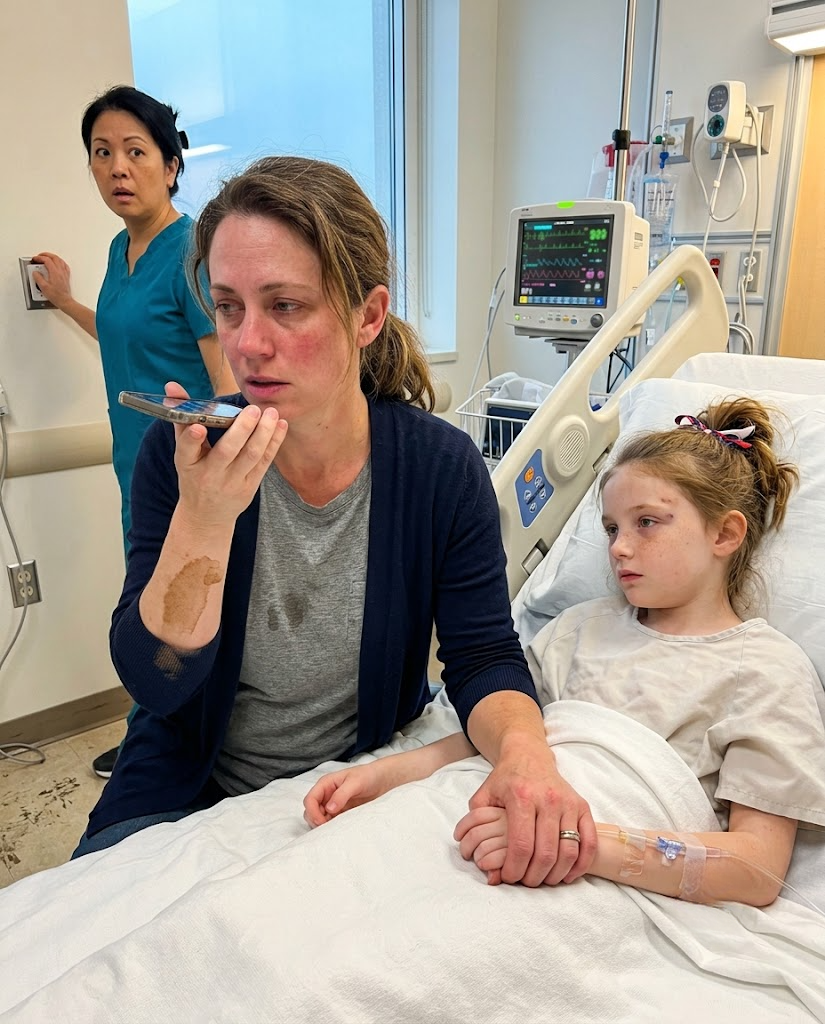
I sat beside Katie and held her hand while the room blinked around us.
Every so often, a nurse came in and asked if I needed anything.
I always said no.
I needed my child to open her eyes.
Morning came pale through the blinds.
My coffee had gone cold on the side table, and my back ached from the visitor chair.
Katie’s fingers moved inside mine.
At first I thought I imagined it.
Then her eyelids fluttered.
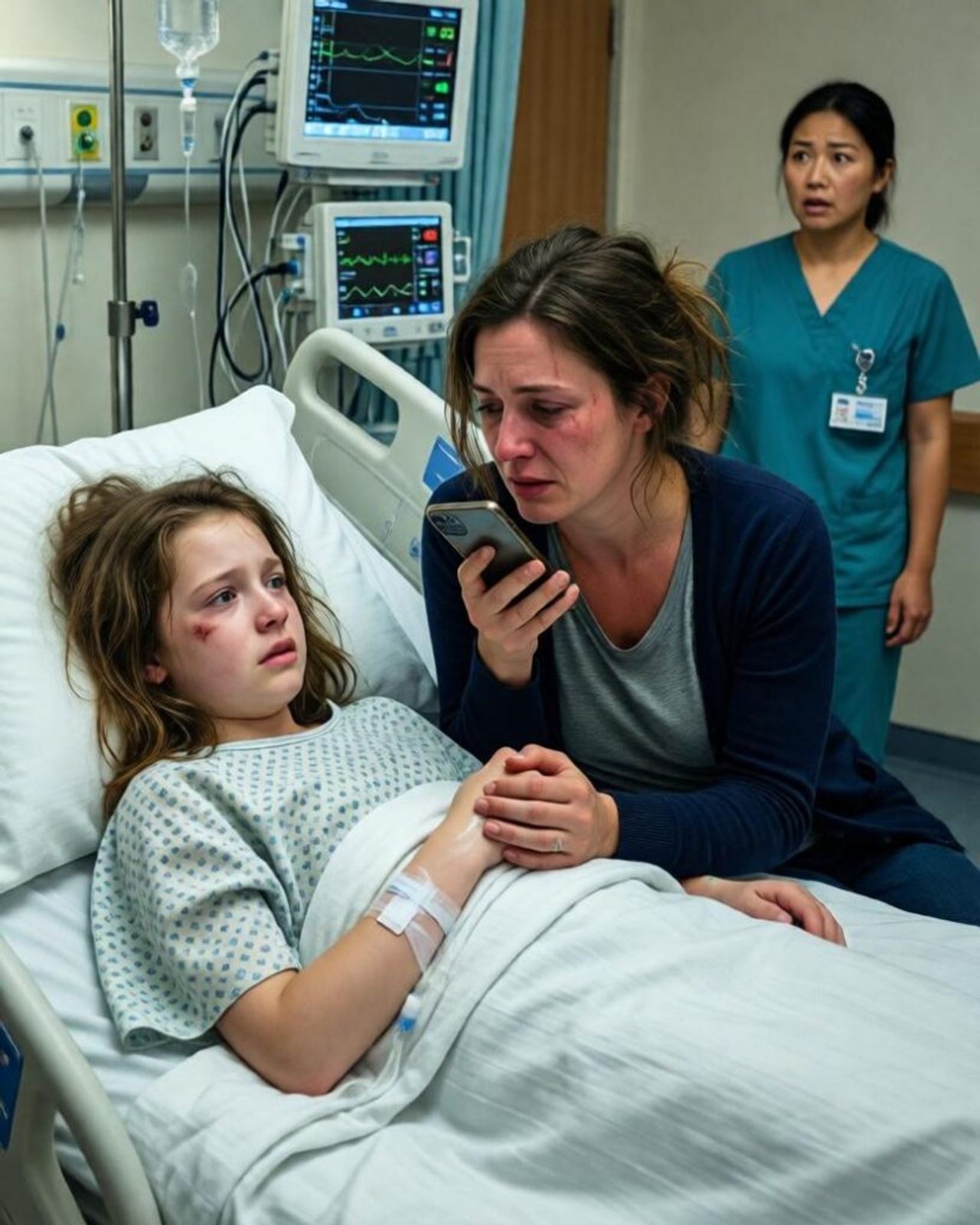
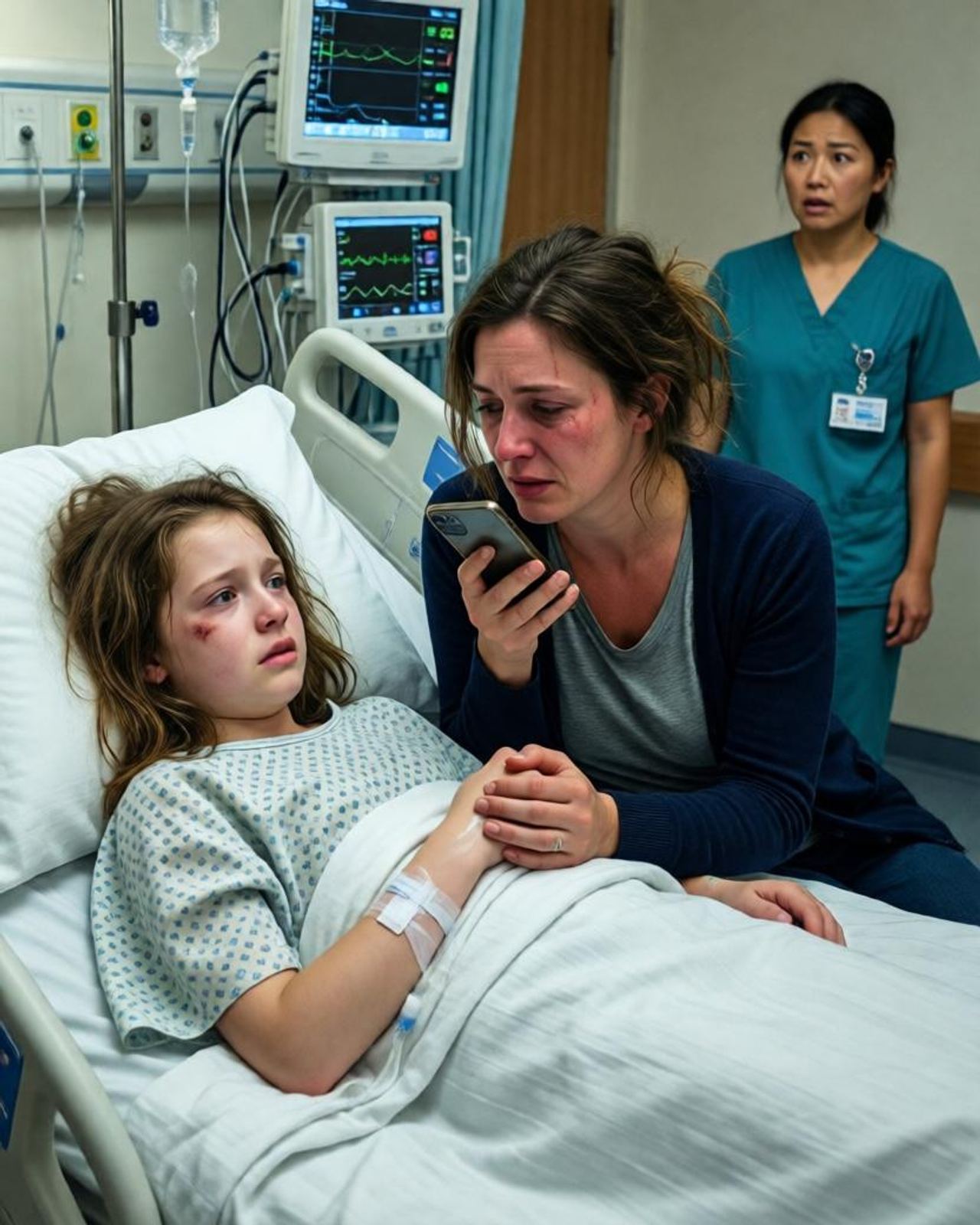
I leaned over so quickly the nurse put a hand on my shoulder.
“Katie,” I whispered.
Her eyes opened partway.
They were cloudy with pain, but they found me.
“Mama?”
I kissed her fingers.
“I’m here.”
Her grip tightened.
She looked past me once, toward the door, and fear moved across her face so clearly that my stomach turned.
“Andrew did it,” she whispered.
The room seemed to narrow around those words.
“Baby, what do you mean?”
“He pushed me.”
Her lips trembled, but her eyes did not drift.
“At the crosswalk,” she whispered.
I wanted to give her confusion.
I wanted to give her pain medicine.
I wanted to give her any explanation that did not have my husband standing behind my child with his hands out.
Katie kept going.
“I felt two hands. Hard. I fell forward.”
She swallowed.
“I turned my head. He had his black jacket. The hood. White shoes.”
The nurse’s hand tightened on my shoulder.
I pressed the call button and heard my own voice ask for the police.
Detective Mark Reynolds arrived before noon.
He was not dramatic.
That made it worse.
He asked Katie gentle questions, then asked her to tell him again.
She gave the same details in the same order.
Crosswalk.
Hands.
Black jacket.
White shoes.
Andrew.
When she finished, Detective Reynolds closed his notebook.
He did not look at me like a mother who was overreacting.
He looked at me like a witness.
“Do not call your husband,” he said.
Two officers drove me back to the house.
The birthday decorations were the first thing I saw.
Gold plates sat on the kitchen island.
Napkins were folded in a neat fan beside a grocery list in Andrew’s handwriting.
Katie’s sneakers were by the mudroom bench.
One lace was tucked under the other, waiting for a child who had expected to come home.
Detective Reynolds moved slowly through the entryway.
Andrew’s black jacket hung on the hook by the door.
On the sleeve, caught near the cuff, was a pale blue thread.
It matched Katie’s school uniform shirt.
An officer photographed it before anyone touched it.
I stood there looking at that thread and realized my brain could understand cloth before it could understand evil.
In the bedroom, Reynolds found a printed movie ticket on Andrew’s nightstand.
It looked like an alibi made by someone who thought paper could act innocent.
In the kitchen, there was half a bottle of whiskey beside a clean glass.
In the desk drawer, there was a folder I had never seen before.
Detective Reynolds opened it with gloved hands.
The first page was a life insurance policy on Katie.
Andrew’s name was listed where no father’s name should have been listed.
Under that was a power of attorney.
My signature sat at the bottom, crooked and wrong.
The document claimed I had authorized Andrew to sell our house if I became unavailable or incapacitated.
Beneath it were condo listings in Miami.
One page had red pen across the top.
After the problem is handled.
I read those words once.
Then I stopped reading because the kitchen had started to tilt.
Detective Reynolds put the folder into an evidence sleeve.
“This is why he needed you away from the hospital,” he said.
I could not answer him before the front door opened.
Barbara stepped in wearing pearls and a pale pink jacket, dressed for a party that had not begun.
She saw the officers first.
Then she saw me.
Her face hardened, not with fear, but with irritation.
“Where is my son?” she asked.
Detective Reynolds turned toward her.
“Mrs. Carter, we need to ask you a few questions.”
Barbara looked at the evidence sleeve in his hand.
For the first time since I had known her, she did not immediately speak.
Andrew arrived ten minutes later.
He came in too fast, then slowed when he saw the uniforms.
He looked at me, then at the jacket, then at his mother.
“Amanda,” he said, using the soft voice.
I stepped behind Detective Reynolds.
Andrew noticed that.
His mouth twitched.
“Katie is confused,” he said.
No one had told him what Katie said.
That was the first crack.
Detective Reynolds tilted his head.
“Why would you say that?”
Andrew blinked.
Barbara answered for him.
“Children wake up frightened in hospitals,” she said.
The detective did not look away from Andrew.
“I asked your son.”
Andrew rubbed his jaw.
He had shaved in a hurry.
There was a tiny strip of foam still dry near his ear.
“Mom told me,” he said.
Barbara’s eyes flicked toward him.
It was quick, but I saw it.
So did Reynolds.
He placed the evidence sleeve on the kitchen table.
“Then maybe both of you can explain this.”
Barbara stared at the power of attorney through the plastic.
Her lips parted.
The paper that had looked so powerful in a drawer looked ugly and cheap under the kitchen lights.
“That is a private family matter,” she said.
“It is a forged legal document tied to an injured child,” Reynolds replied.
Andrew reached for the back of a chair.
His knuckles went white.
The room went quiet enough for me to hear the refrigerator hum.
Then Detective Reynolds asked Andrew for his phone.
Andrew said he had left it in the car.
An officer said they had already secured the car.
Andrew looked at his mother again.
That was the second crack.
At the station, the cracks became a line.
The movie theater confirmed Andrew’s ticket had been bought online after Katie was already in the ambulance.
A neighbor’s door camera showed his SUV turning onto the road near the gym ten minutes before the call to 911.
The jacket thread went to the lab.
The forged signature went to a document examiner.
None of it brought Katie out of ICU, but each piece made the world less slippery under my feet.
That evening, Detective Reynolds asked me if I knew a number that had been texting Andrew.
I did not.
The messages were short.
Everything is ready.
The girl needs to disappear.
Tomorrow?
It is done.
I read them once and put my hand over my mouth.
I read the line again and felt my stomach turn.
“We are tracing the number,” Reynolds said.
I thought I already knew the worst part.
I was wrong.
The number belonged to a prepaid phone bought two towns over.
Security footage showed Barbara at the register.
She had paid cash.
She had worn the same pearl earrings she wore to church.
When Reynolds told me, I did not feel surprise.
I felt the last foolish hope leave my body.
Barbara had not called the hospital because she was selfish.
She had called because she needed me away from Katie.
She needed me cooking, apologizing, and answering doors while my child lay alone with a secret that could ruin her son.
The birthday party had been cover.
The guests were supposed to remember Barbara in her kitchen and Andrew at a movie.
I was supposed to be the frantic mother who abandoned the hospital to keep peace.
Katie was supposed to be too hurt to speak.
But Katie woke up.
That was the part neither of them had planned for.
Three days later, Andrew was brought into a small interview room.
I watched from behind the glass because Detective Reynolds said I did not have to, but I needed to see the soft voice run out of road.
Andrew sat with his hands folded.
He looked smaller without Barbara beside him.
Reynolds placed a photo of Katie’s uniform thread on the table.
Then the door-camera still.
Then the insurance policy.
Then the forged power of attorney.
Andrew kept saying the same thing.
“I want my mother.”
When Barbara was brought in, she did not look at him first.
She looked at the detective.
“This family has been under strain,” she said.
Reynolds set the prepaid phone records in front of her.
Barbara’s face changed by degrees.
First the mouth.
Then the chin.
Then the eyes.
She reached for the edge of the table, and her pearls shifted against her throat.
Andrew whispered, “Mom.”
She did not answer him.
Reynolds read one message aloud.
“The girl needs to disappear.”
The words sounded worse in his voice.
Barbara closed her eyes.
When she opened them, they were not soft.
They were angry.
“He was drowning,” she said.
That was how she described a grown man who had tried to sacrifice a child for money and a condo.
Not cruel.
Not guilty.
Drowning.
Andrew turned toward her.
“You said she would only fall,” he whispered.
The room froze.
Even Reynolds stopped moving for half a second.
Barbara’s hand flew toward Andrew, not to comfort him, but to stop him.
Too late.
The soft voice was gone.
The mother who had always spoken for him could not swallow the sentence back.
Reynolds leaned forward.
“Say that again.”
Andrew stared at the table.
He did not.
He did not have to.
Katie recovered slowly.
There were headaches, nightmares, and weeks when the sound of tires at a wet intersection made her grip my sleeve until her fingers hurt.
She had to relearn trust in pieces.
So did I.
The house stayed mine.
The forged power of attorney never became anything except evidence.
Barbara’s birthday decorations sat in a box in the garage until I threw them out on a Saturday morning while Katie watched from the porch wrapped in a blanket.
“Were those for her party?” Katie asked.
“Yes.”
“Good,” she said.
It was the first time I heard a little steel come back into her voice.
Andrew tried to write letters.
I did not read them.
Barbara sent one message through a relative, saying a mother would do anything for her child.
I sent back one sentence through my lawyer.
“You mistook my silence for permission.”
After that, the messages stopped.
Months later, Katie returned to the gymnastics gym.
She did not compete that day.
She just walked inside, touched the balance beam with one hand, and breathed.
Her coach cried quietly near the mats.
Katie pretended not to see and kept her eyes on the beam.
When we left, she asked if we could take the long way home.
We drove past the crosswalk.
The light turned green.
Katie watched it through the windshield.
Then she reached over and put her hand on mine.
“Keep going,” she said.
So I did.
Not because the fear was gone.
Because my daughter was still here.
Because the house key in my pocket belonged to us.
Because the people who tried to turn love into a transaction had finally learned that a mother sitting quietly beside a hospital bed is not weak.
Sometimes she is the only witness who refuses to leave.
Read more stories
- Ground Beef and Gravy Over Mashed Potatoes
- They called me a liar in a courtroom packed with spectators, and my own mother made sure everyone believed them. With one hand on the Bible, she looked the judge in the eye and declared, “She was never a soldier. The scars, the medals… every part of her story is a lie.” The room grew quiet as every suspicious gaze turned toward me. Then the courtroom doors swung open, and the man who walked in wiped the smile from my mother’s face.
- Released in 1973, this song once made the whole world slow down, and even today it still brings old memories rushing back like they never left. – Page 2 of 2 – StoryPulse
- 3-Ingredient Peach Dump Cake