
Celebrities & Music
26 YEARS AFTER “MURDER ON MUSIC ROW,” GEORGE STRAIT WALKED ONSTAGE FOR ALAN JACKSON’S LAST SHOW — AND THE TWO MEN SANG IT ONE MORE TIME.
The article discusses George Strait’s appearance at Alan Jackson’s final concert, where they performed ‘Murder on Music Row’ together, highlighting the significance of traditional country music in their careers.

Before George Strait appeared at Nissan Stadium, Alan Jackson had already waited through a storm. Lightning had delayed the night for about an hour. More than two hours of country stars had sung Alan’s songs before Alan himself walked out after 9:35 p.m. The stadium had heard Carrie Underwood, Miranda Lambert, Luke Combs, Eric Church, Lainey Wilson, and a long line of younger artists explain what Alan Jackson had meant to them. He was 67. Charcot-Marie-Tooth disease had changed the way he walked and made the physical work of performing harder than it had once been. But when he opened with “Gone Country,” the voice was still there. The baritone. The timing. The sound of a man who had spent more than three decades refusing to let steel guitar, fiddle, small-town stories, and real country phrasing disappear from the radio.
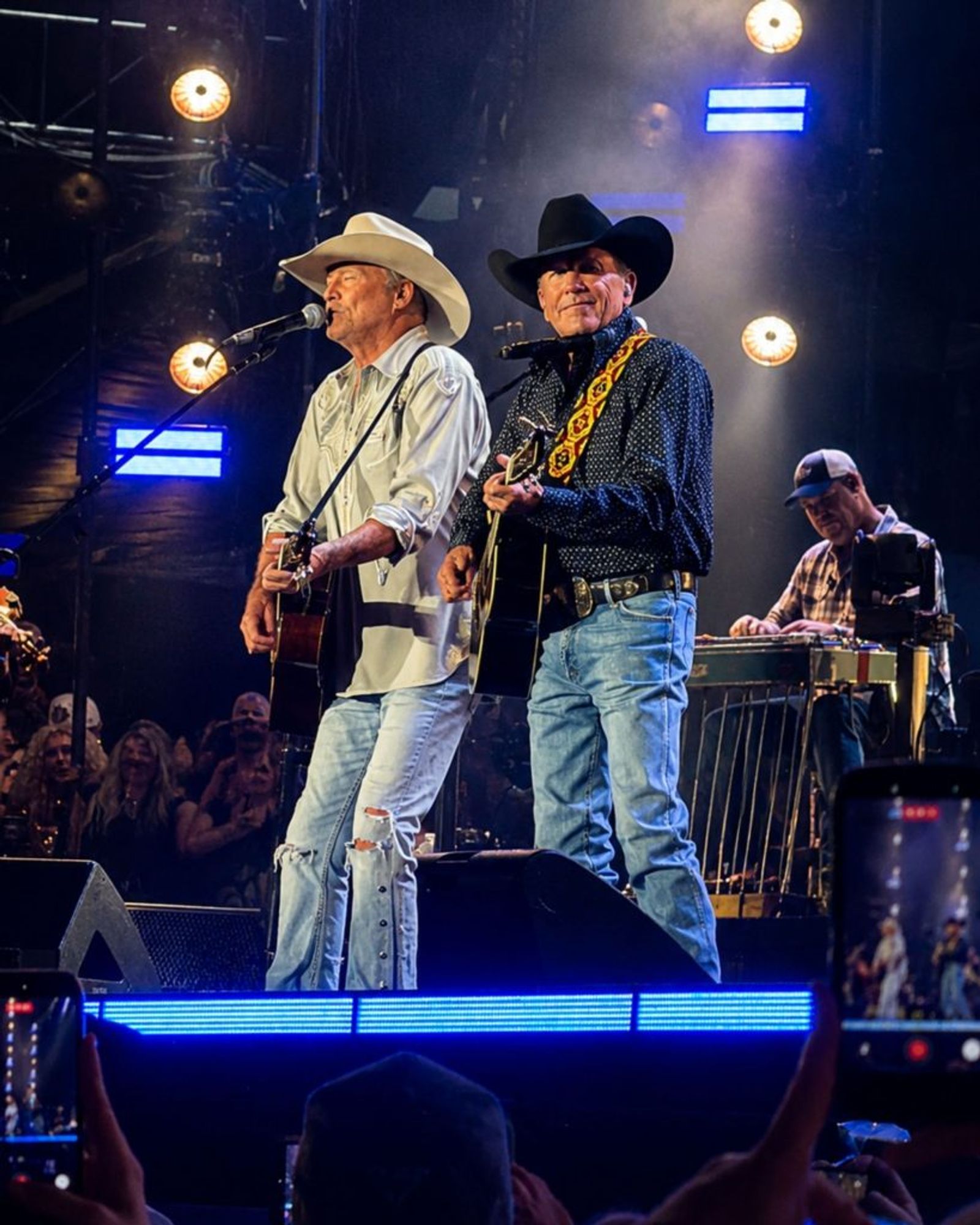
About an hour into his set, Alan told the crowd he needed some help. George Strait came out. The two men had recorded “Designated Drinker” together in 2000. But the song that carried the heavier meaning that night was the next one: “Murder on Music Row.” When Alan and George first released it, the song was a warning. It was about country music losing its fiddles, its steel guitars, its working-class stories, and the sound that had built the whole town. Some people treated it like an argument. Others treated it like a line in the sand. They were two Hall of Famers standing together at the end of one man’s touring life, singing the same warning back into a stadium full of people who had come because those old sounds still mattered to them. George Strait did not come out to say goodbye for Alan. He came out to stand beside him one more time. And for a few minutes at Nissan Stadium, “Murder on Music Row” did not sound like a complaint from the past. It sounded like two men reminding Nashville what they had spent their lives protecting.
Then Alan Walked Out
After 9:35 that night, Alan Jackson finally stepped onto the stage. He was 67. Charcot-Marie-Tooth disease had changed the way he walked and made the physical work of performing harder than it had once been. But when he opened with “Gone Country,” the voice was still there. The baritone. The timing. The calm, steady phrasing. The sound of a man who had spent his career refusing to let steel guitar, fiddle, small-town stories, family cars, fishing boats, and real country hurt disappear from the radio. The storm had interrupted the night. It had not taken the singer away.
Then He Said He Needed Help
About an hour into his set, Alan told the crowd he needed some help. George Strait came out. For years, the two men had stood near the same center of country music without needing to explain what that meant. They had recorded “Designated Drinker” together. But the next song carried the heavier history. “Murder on Music Row.”
It Had Never Been Just A Song
When Alan and George released “Murder on Music Row,” it sounded like a warning. A warning about country music losing its fiddles. Its steel guitars. Its working-class stories. Its rough edges. Its memory. Some people treated it like an argument. Others heard it as a line in the sand. But for George Strait and Alan Jackson, it was never only about complaining that the old days were gone. It was about protecting the things that made country music feel like country music in the first place.
Twenty-Six Years Later, The Warning Came Back
Now they were standing together again. Two Hall of Famers. One man at the end of his touring life. The other stepping out to share the stage one more time. And “Murder on Music Row” no longer sounded like a song from the past. It sounded like proof. Proof that the old sounds had survived. Proof that the people in Nissan Stadium still cared. Proof that no matter how many new directions country music takes, there will always be listeners waiting for a steel guitar to cut through the noise.
George Did Not Come Out To Say Goodbye
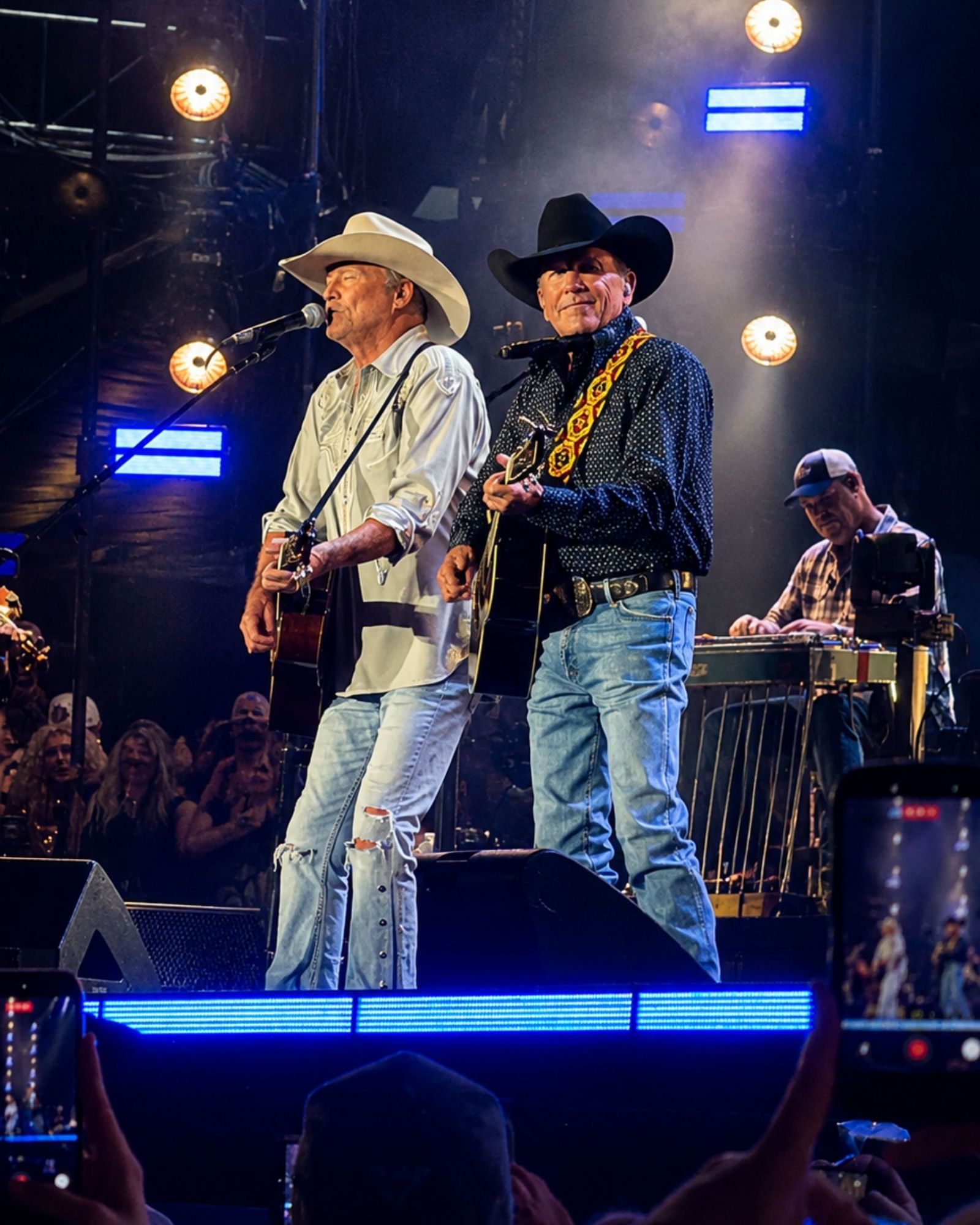
That was the part that made the moment land. George Strait did not walk out to give Alan Jackson a farewell speech. He came out to stand beside him. To sing the same song they had sung when both men were still fighting for traditional country in a business that kept trying to move on. There were no speeches needed. The song said enough. Two voices. One warning. A stadium full of people who had waited through lightning to hear it.
What That Night Really Left Behind
The deepest part of this story is not only that George Strait joined Alan Jackson at his final concert. It is what they chose to sing together. A storm over Nashville. A delayed farewell. A singer fighting a disease that had made the road harder. A crowd that refused to leave. Two Hall of Famers standing under the lights. And a song about the kind of country music they had spent their lives protecting. For a few minutes at Nissan Stadium, “Murder on Music Row” did not sound like a complaint from another era. It sounded like two men reminding Nashville what they had been trying to save all along.
Video
Lee Ann Womack Did Not Come To Alan Jackson’s Final Show To Sing The Easy Hit. She Chose “Between The Devil And Me.” By the time Lee Ann Womack walked onto the Nissan Stadium stage, Alan Jackson’s last full-length concert had already become a night of giants. George Strait had come. Carrie Underwood had come. Luke Combs, Miranda Lambert, Eric Church, Lainey Wilson, and a stadium full of fans had gathered to honor the man who spent more than three decades keeping fiddle, steel guitar, small-town stories, and old-country heartbreak alive on the radio. Lee Ann did not choose “Chattahoochee.” She did not choose “Gone Country.” She chose “Between the Devil and Me.” It was one of Alan’s darker records — a song about a man trapped between the life he knows is right and the trouble he cannot stop reaching for. When Alan released it in 1997, it went to No. 2 on the country chart. It did not need fireworks. It did not need a big chorus built for a stadium. It needed a voice that knew how to let a hard song sit in the room. When country music was getting brighter and smoother in the late 1990s, Lee Ann came in carrying the older sound. Fiddle. Steel guitar. Women who were angry, ashamed, lonely, stubborn, and not interested in making heartbreak look pretty. Then “I Hope You Dance” made her a crossover star. But she never let that song become the whole story. In 2005, she made There’s More Where That Came From — an album full of the kind of hurt Nashville had started treating like old furniture. The record brought back cheating songs, crying steel guitar, and women who did not solve their lives before the final chorus. It won CMA Album of the Year. So when Alan Jackson was saying goodbye to the road, Lee Ann Womack did not simply sing one of his hits. She sang one of the songs that proved why he mattered. A song about temptation, damage, and the truth waiting after the music stops. Exactly the kind of country music Alan Jackson had spent his life keeping alive.
Alan Jackson’s Final Concert Was Stopped By Lightning. Then Nashville Waited Until The Storm Moved On. By the time Alan Jackson walked toward Nissan Stadium on June 27, 2026, the night had already become bigger than a normal concert. This was called Last Call: One More for the Road — The Finale. Nashville had filled the stadium to say goodbye to the man who had spent more than three decades refusing to let country music forget steel guitar, small towns, fishing boats, family cars, and songs that did not need to shout to hurt. He had already ended his last road tour in 2025. The reason was no secret. Since revealing his Charcot-Marie-Tooth disease in 2021, he had spoken openly about the nerve condition changing his balance, his movement, and the physical cost of standing through a show. The voice was still Alan Jackson’s. But the road had become harder to carry. Then the weather came in. Lightning forced Nissan Stadium to pause the farewell. Fans were moved into concourses and covered areas while the storm passed over Nashville. For a while, the final night of Alan Jackson’s touring life was not music at all. It was thousands of people waiting. Waiting under a stadium roof. Waiting through the weather. Waiting to see whether the man who had sung “Chattahoochee,” “Remember When,” “Drive,” and “Where Were You” would get the ending Nashville had come to give him. The storm cleared. The show resumed. Country stars came to honor him. The crowd stayed. And Alan Jackson walked back into the night that had been interrupted, not cancelled. That may be the right final image for him. Not a singer slipping quietly away after the last note. A stadium full of people standing by while the lightning passed — because Alan Jackson still had one more song to sing.
The Crowd Still Wanted “Hell Yeah.” But After 2017, Eddie Montgomery Had To Walk Onstage Under A Name That Used To Require Two Men. When Troy Gentry died in September 2017, Eddie Montgomery did not only lose a friend. They had played Kentucky clubs together before Nashville cared. They had built Montgomery Gentry out of working-class songs, Southern rock guitars, and the feeling that ordinary people deserved to hear themselves on country radio. Troy brought the grin, the rhythm guitar, the easy connection with the crowd. Eddie brought the rougher voice. The name worked because both halves were there. After Troy died, the ninth Montgomery Gentry album was almost finished. The vocal tracks had been completed only days before the helicopter crash. Eddie could have put the songs away. Nobody would have blamed him. Instead, Here’s to You came out in February 2018, carrying Troy’s final recordings into the world. Then came the harder question. What do you do with a duo name after one half is gone? Eddie kept the name. He went back on the road with the band. He sang the songs that had been built for two men. “My Town.” “Lucky Man.” “Something to Be Proud Of.” “Hell Yeah.” The crowd still knew every word, but the stage picture had changed forever. One microphone was gone. One laugh between songs was gone. One voice that had helped make the name sound complete was now only inside the records. Every show after that became part concert, part memorial, part proof that a band can keep moving without pretending the loss never happened. The name stayed on the marquee. But Eddie was the only one left to answer when it was called.
Read more stories
- He Was Rejected By His Own Mom And Raised To Think ‘Women Are Evil’ But He Became A Legendary Rockstar
- TOBY KEITH RECORDED SOME OF THE BIGGEST PATRIOTIC ANTHEMS IN COUNTRY MUSIC HISTORY—BUT HIS REAL LEGACY WAS BUILT ON MILITARY BASES WHERE NO CAMERAS WERE ROLLING.
- [Video]: The One-Take Hit That Took Over Rock Radio
- The Box Tops’ “The Letter” Captures Lightning in a Bottle and Redefines Blue-Eyed Soul in 1967-2